
E-Waste EPR Floor Price Rules: What Producers and Recyclers Must Know in 2027
Under India's Extended Producer Responsibility (EPR) framework, obtaining an e-waste registration certificate is the starting point. Covered producers must also meet their prescribed e-waste EPR targets, procure eligible recycling certificates and maintain records of certificate transactions.
Schedule a Call Back
2,000+ e-waste EPR assignments since 2018
Clients include Intangles Lab, Emerson Automation Solutions Intelligent Platforms, Deki Electronics, Amzetta Technologies, Alogic Electronics India, KWW Electricals & Electronics, Emerson Process Management (India), Lianchuang Electronic India, Q-Line Biotech, Genes 2ME, Sanrad Medical Systems, Agfa Healthcare India (12 of 850+ served since 2018).
A few more clients we've served in this industryHide the list
- Electronics and technology
- Intangles Lab · Emerson Automation Solutions Intelligent Platforms · Deki Electronics · Amzetta Technologies · Alogic Electronics India · KWW Electricals & Electronics · Emerson Process Management (India) · Lianchuang Electronic India
- Pharma and healthcare
- Q-Line Biotech · Genes 2ME · Sanrad Medical Systems · Agfa Healthcare India · Dental Tree Supply Company · Vital Sign Medidevices · Trivitron Healthcare · Radimage Healthcare India
- Engineering and manufacturing
- Juki India · Hilti India · Migatronic India · Bauer Equipment India · Aptiv Components India · Wacker Neuson Equipment · Franklin EV India
- Logistics and trade
- Siddhartha Logistics · Zenexpress Logistics · MOL Logistics (India) · Fibs Logistics India
- Food and consumer goods
- Milano Ice Cream · Milano22 Foods · Milano21 Foods
- Energy and power
- Eirmon Solar System · Spear Solar System · Bitek Solar · Nash Energy (I)
- More clients
- Cambro Nilkamal · M.C. Dean Systems India · Haesi GHL · Meditronix Corporation · Nash Industries (I) · Nilkamal · Franke Faber India · Alten India · Parswa Exports · Indicate Exim · Truetech Services · BitVoice Solutions · Heidelco Medicore · Trans Health Care India
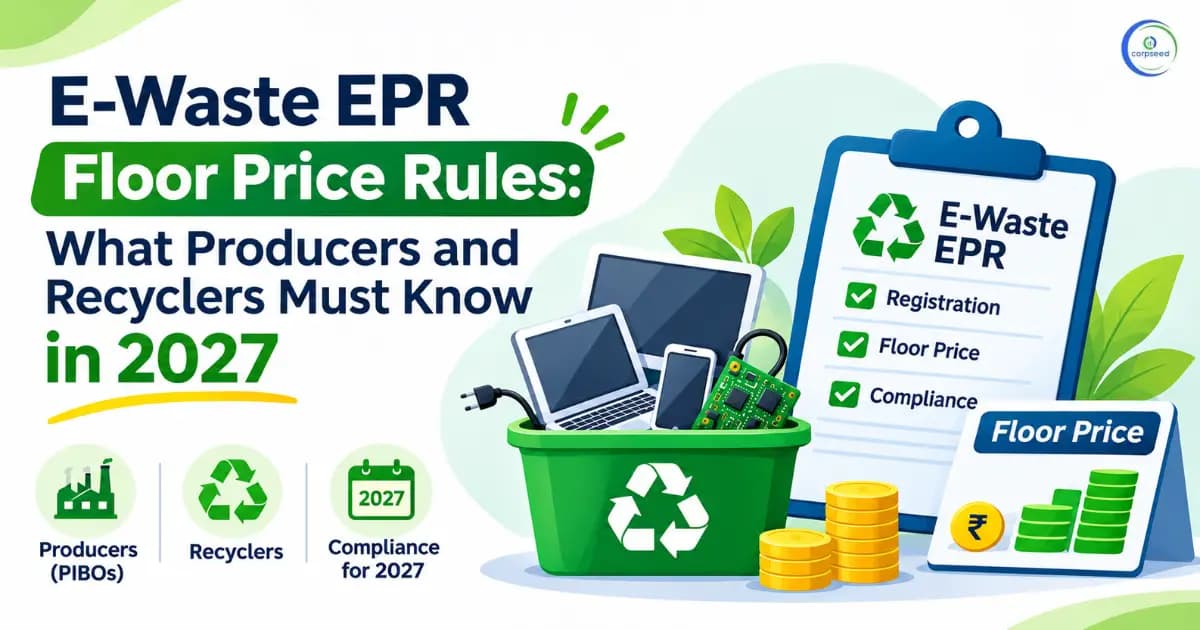
The e-waste EPR floor price rules govern the exchange of those recycling certificates. For businesses preparing for 2027, the key is understanding how this requirement connects with product coverage, recycling targets and portal reporting. This guide explains what producers and recyclers should check before completing a certificate transaction.
What are the E-Waste EPR Floor Price Rules?
The floor price is the prescribed minimum exchange price for an EPR recycling certificate. The framework also sets an upper limit, called the ceiling.
The E-Waste (Management) Amendment Rules, 2024, notified through G.S.R. 164(E) on 8 March 2024, introduced these provisions. They require the Central Pollution Control Board (CPCB) to prescribe exchange limits linked to environmental compensation for an unmet EPR obligation. Transactions must follow the applicable requirements and court directions.
Certificate transactions must also involve registered recyclers, eligible certificates and completion of the prescribed process through the CPCB e-waste EPR portal. Check these requirements together when reviewing a proposed transaction.
EPR Floor Price and Ceiling Price at a Glance
Under Rule 15(9) of the E-Waste (Management) Rules, 2022, as amended in 2024, CPCB determines the minimum and maximum exchange prices for EPR certificates based on the applicable environmental compensation.
| Particulars | Regulatory Requirements |
|---|---|
| Floor Price (Minimum) | 30% of the applicable environmental compensation |
| Ceiling Price (Maximum) | 100% of the applicable environmental compensation |
| Regulatory Authority | Central Pollution Control Board (CPCB) |
| Legal Framework | E-Waste (Management) Amendment Rules, 2024 |
| Certificate Exchange Platform | CPCB e-waste EPR portal |
| Eligible Participants | Registered entities eligible to exchange EPR certificates |
| Applicability | Subject to applicable CPCB directions and court orders |
Why Was the E-Waste EPR Floor Price Introduced?
The e-waste EPR floor price framework was introduced to regulate certificate exchanges and support environmentally responsible recycling practices in India. It aims to address concerns about excessively low certificate prices and encourage investment in formal e-waste recycling operations.
The framework also seeks to support a more structured certificate market. However, compliance with prescribed exchange limits does not replace the requirement for genuine recycling activities, accurate documentation and valid EPR certificate transactions.
Who Needs E-Waste EPR Registration?
The E-Waste (Management) Rules, 2022 apply to specified electrical and electronic equipment listed in Schedule I. Covered businesses can include own-brand equipment sellers and importers.
Manufacturers, producers, refurbishers and recyclers have separate registration roles. A business may fall under more than one role. Check the business activity, product coverage and applicable exclusions, including the micro-enterprise exclusion, before deciding the registration requirement.
An EPR Registration Certificate indicates the registered company. An EPR Recycling Certificate serves as a means to meet the requirements for an eligible recycling obligation. It is important to understand the difference for business needs.
Which E-Waste Recycling Targets Apply in 2027?
The calendar year 2027 overlaps two financial years. For producers covered by Schedule III, the general targets are:
| Financial year | General recycling target |
|---|---|
| 2026-27 | 70% |
| 2027-28 onwards | 80% |
January to March 2027 falls in FY 2026-27. The next financial year begins on 1 April 2027.
Calculate the applicable obligation using estimated e-waste generation based on relevant historical sales and the product's prescribed average life.
Newer producers may follow Schedule IV. If the sales history is shorter than the product's average life, the EPR target from FY 2025-26 onwards is generally set at 20% of the sales made two financial years earlier. This applies until the producer becomes subject to the targets under Schedule III.
Used-equipment imports and solar photovoltaic waste have special provisions. Confirm the requirements for the relevant product group before applying a general target.
E-Waste EPR Floor Price Rules for Producers and Recyclers
The e-waste EPR floor price framework affects both producers purchasing recycling certificates and recyclers generating and selling them. Although their responsibilities differ, both must follow applicable CPCB certificate exchange requirements, maintain accurate records and complete prescribed portal transactions.
Impact of E-Waste EPR Floor Price Rules on Producers
For producers, the floor price framework changes how EPR certificates are negotiated and procured. With the general recycling target increasing from FY 2027-28 under Schedule III, businesses should assess their certificate requirements well before the compliance deadline.
Producers should focus on the following requirements:
- Review Applicable Directions: Check CPCB certificate exchange requirements and relevant court orders before procuring certificates.
- Confirm Product Coverage: Ensure that electrical and electronic equipment sold or imported is covered under the existing EPR registration.
- Assess E-Waste EPR Targets: Calculate recycling obligations based on the applicable target schedule, historical sales and prescribed product life.
- Verify Certificate Eligibility: Ensure that certificates match the applicable metal-wise recycling obligations assigned on the CPCB portal.
- Verify Recycler Registration: Procure eligible EPR certificates from registered e-waste recyclers and complete the prescribed portal transactions.
- Maintain Records and File Returns: Maintain sales and certificate transaction records and submit quarterly and annual EPR returns within applicable deadlines.
Impact of E-Waste EPR Floor Price Rules on Recyclers
For recyclers, the floor price framework establishes prescribed exchange limits that may support better business planning and investment in formal recycling operations. However, certificate generation continues to depend on actual eligible recycling activities and supporting records.
Recyclers should focus on the following requirements:
- Maintain Valid Approvals: Keep e-waste recycler registration and applicable environmental consents valid.
- Generate Eligible EPR Certificates: Generate certificates based on eligible recycling activities and recovered materials.
- Maintain Recycling Records: Keep accurate records of waste received, processing activities, material recovery and sales.
- Follow Certificate Exchange Rules: Review applicable floor price requirements and court directions before transferring certificates.
- Complete Reporting Requirements: Submit prescribed returns and maintain supporting documents for regulatory inspections and audits.
Schedule a Call Back
What Do the Court Orders Mean for EPR Floor Price Compliance?
The EPR Floor Price Framework has been challenged in the Delhi High Court. In Blue Star's case, an order issued on 24 December 2025 gave provisional relief regarding the declaration of the price band on the portal up to the time of next hearing.
In the connected proceedings, an order dated 9 October 2026 scheduled the matters for a further hearing on 13 January 2027.
These orders did not finally determine the validity of the floor price framework. Producers and recyclers should monitor subsequent court orders and CPCB directions before completing EPR certificate transactions.
What Happens If E-Waste Recycling Obligations Are Not Met?
CPCB may impose environmental compensation on producers who fail to meet their prescribed e-waste recycling targets. Payment of environmental compensation does not eliminate the outstanding EPR obligation. The shortfall can be carried forward for up to three years under the applicable rules.
Submitting false information or generating EPR certificates without supporting recycling records may also attract regulatory action. Businesses should regularly review their declared data, certificate transactions and supporting documents to avoid non-compliance.
Common Mistakes to Avoid in E-Waste EPR Compliance
Even after obtaining e-waste EPR registration, businesses may face compliance issues due to incorrect target calculations, incomplete documentation or improper certificate transactions. Producers and recyclers should avoid the following mistakes while fulfilling their EPR obligations in 2027:
- Incorrect Recycling Target Calculation: Applying the 80% recycling target without checking the applicability of Schedule III or Schedule IV.
- Incorrect Product Classification: Failing to register electrical and electronic equipment under the appropriate product categories.
- Procuring Ineligible EPR Certificates: Obtaining certificates that do not match the applicable recycling obligations, or prescribed portal requirements.
- Ignoring Floor Price Rules: Completing certificate transactions without reviewing applicable CPCB directions and court orders.
- Delayed Return Filing: Missing quarterly and annual EPR return filing deadlines.
- Incomplete Documentation: Failing to maintain sales records, recycling data and certificate transaction records.
- Ignoring Registration Amendments: Not updating EPR registration details when business activities, product categories or registered information change.
How Can Corpseed Help with E-Waste EPR Compliance?
Corpseed provides e-waste EPR registration services and compliance support to manufacturers, producers, importers, brand owners and recyclers. Our EPR compliance consultants assist businesses with registration, recycling target assessment, certificate procurement and ongoing CPCB compliance.
- E-Waste EPR Registration and Amendment: Reviewing product categories, business activities and existing registration details, along with assistance in new registration applications and e-waste EPR registration amendment requirements.
- EPR Target Assessment: Reviewing historical sales records, prescribed product life, applicable e-waste EPR targets and CPCB portal obligations.
- EPR Certificate Procurement: Assisting with CPCB EPR credit procurement, transaction documentation and reconciliation of certificates against applicable recycling obligations.
- E-Waste EPR Return Filing: Assisting with quarterly and annual return filing, supporting documentation and responses to CPCB compliance notices.
Preparing for your 2027 e-waste EPR obligations? Share your product list, registration details and available sales records with our EPR consultants to identify your applicable recycling targets, certificate requirements and pending compliance obligations.
Connect with an EPR compliance expert at Corpseed.
Conclusion
The e-waste EPR floor price rules are an important consideration for producers and recyclers preparing for compliance in 2027. With the general recycling target increasing to 80% from FY 2027-28 under Schedule III, eligible businesses must carefully assess their obligations, maintain accurate records and procure valid EPR certificates.
Businesses should keep track of CPCB guidelines, court orders and return filing deadlines to avoid missing any compliance requirements. Keeping records accurate and completing the required filings on time can also help prevent environmental compensation and regulatory action.
About the Author

Parul Bohral
Legal Content WriterParul Bohral, a BALLB graduate and experienced legal researcher and content writer with expertise in various legal areas, including corporate law and intellectual property. I have gained valuable experience in esteemed legal environments, where I have strengthened my research skills, allowing me to approach legal writing with precision and depth.
As a legal content writer, I am committed to delivering work that not only informs but also engages readers. By staying informed about the latest trends in content marketing and regulatory developments, I ensure that my writing remains sophisticated and meets industry standards. My dedication to thorough research enables me to craft content that is both insightful and impactful.
Related articles
EPR for Plastic Packaging in 2027: Annual Return Filing, Targets and Penalties Explained
2026-11-25
CPCB SOP 2026 for CTE and CTO Approvals - Timelines, Inspections and Key Directions
2026-10-30
E-Waste EPR for Electronics Brands: Registration, Targets & Annual Compliance
2026-10-26
Battery EPR Registration: Who Needs It Under the Battery Waste Management Rules?
2026-10-26
Detailed Project Report for CTE and CTO: Requirements, Format, Documents and Approval Process
2026-10-22
EPR Registration in India: Who Needs It and Which EPR Category Applies to Your Business?
2026-10-21