
Detailed Project Report for CTE and CTO: Requirements, Format, Documents and Approval Process
A Detailed Project Report (DPR) explains your industrial project to the State Pollution Control Board. This guide shows what to include in a DPR for CTE and CTO, how to prepare the process flow diagram and water balance, which documents to arrange, and the mistakes that cause delays.
Schedule a Call Back
1,800+ CTE/CTO and plant setup assignments since 2018
Clients include Magnum Aluminium, Enershell Alloys and Steel, Ganesh Foundry & Cast, Inland Speciality Metals, JK Cement, Sskbp India Alloy, Denso India, Neometrix Defence, PMS Waste Management, Daebak India Recycler, Ganix Rubber Recycling, Pashidaa E Waste Copper Battery Recycling PLT Company (12 of 1,100+ served since 2018).
A few more clients we've served in this industryHide the list
- Engineering and manufacturing
- Magnum Aluminium · Enershell Alloys and Steel · Ganesh Foundry & Cast · Inland Speciality Metals · JK Cement · Sskbp India Alloy · Denso India · Neometrix Defence
- Recycling and waste management
- PMS Waste Management · Daebak India Recycler · Ganix Rubber Recycling · Pashidaa E Waste Copper Battery Recycling PLT Company · Upcycle Debris Management · Ficusa Ewaste Recyclers · Shuchaye Recyclers · Quantara Battery Recycling
- Logistics and trade
- 20Cube Logistics Solutions · Airsurge Logistics · Green Space Logistics · Saap Logistics
- Food and consumer goods
- Bake Wish · Kokora Spices · Babi Beverages · Indraj Beverages and Distilleries · Adheshwar Agro Dairy Products · Venco Research and Breeding Farm · Explore Food · IFF India Frozen Foods
- Energy and power
- Servotech Renewable Power System · Saurya Urja Company of Rajasthan · Sun Mobility · Sun Max Solar · Maxvolt Energy Industries · Rays Power Infra
- Chemicals and materials
- Venkateshwara Roto Pack · Lami Tube · M C Bauchemie I · Pro Flexi Packaging · Rustchem Corrosols · SVN Polymers · Kairaa Polypack · Sanctum Chemicals
- More clients
- Intangles Lab · Alten India · Adit Buildwell · Ecowise Trading · GS E-Commerce · Beaucience India
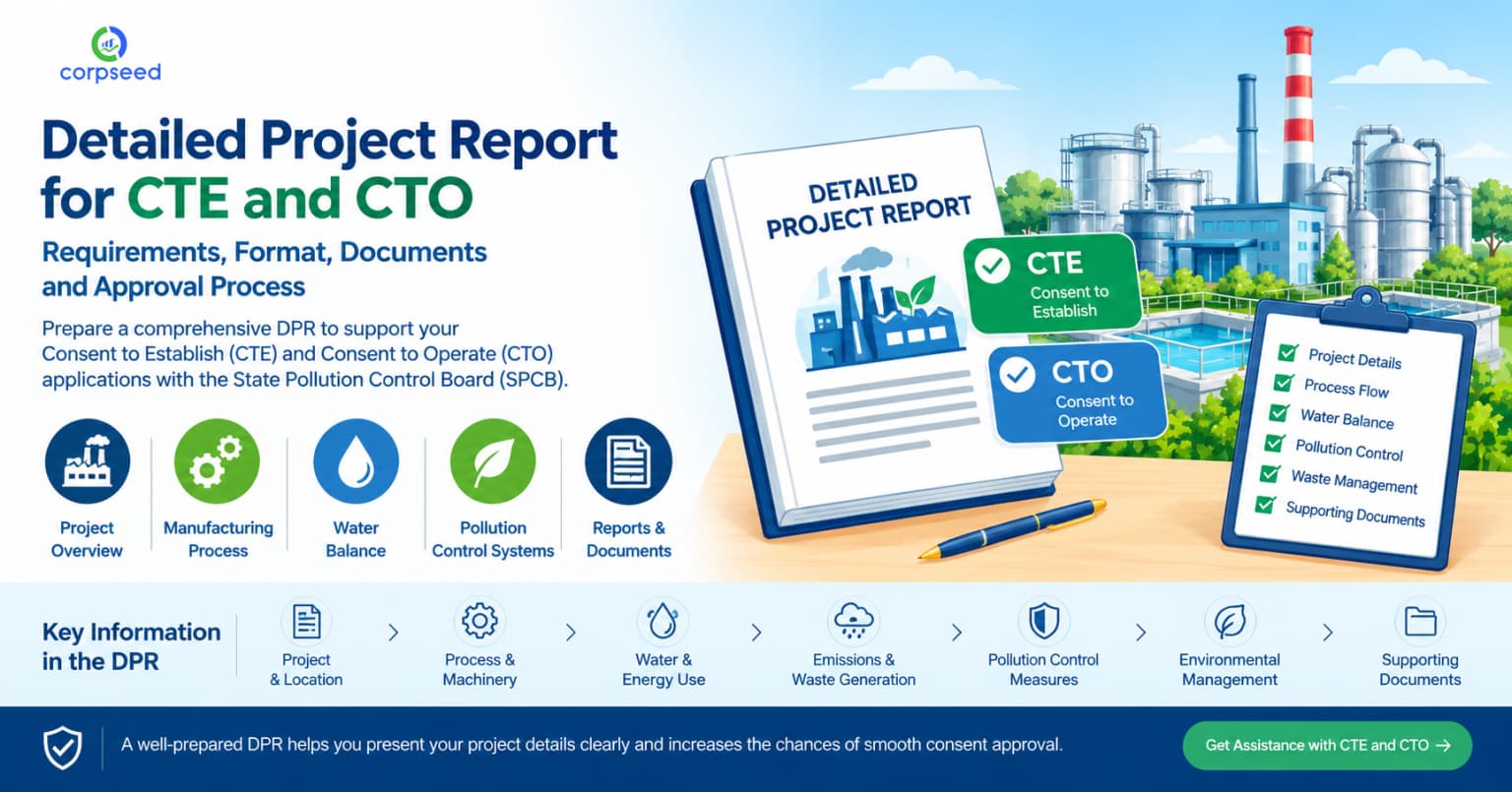
DPR for CTE and CTO: How to Prepare a Detailed Project Report
A Detailed Project Report (DPR) is the document that tells the pollution control board what your plant does, what it uses, what waste it creates and how you plan to control it. You attach it to your CTE and CTO application so the board can understand your project before it decides.
Quick Takeaways
- The DPR supports your application. It does not replace the form, the fee or any other approval.
- For CTE, you describe the plant you plan to build. For CTO, you describe the plant you actually built.
- Your numbers must match everywhere: DPR, application form, layout plan and machinery list.
- Every state board has its own checklist. Always follow yours.
- A good DPR helps your case, but it never guarantees approval.
Why Does a DPR Matter?
Say you are planning a factory, a processing unit or any activity that can pollute air or water. Before you build or start running it, you may need approval from your State Pollution Control Board (SPCB) or Pollution Control Committee (PCC).
Two approvals come up again and again:
- Consent to Establish (CTE): your permission to set up the project.
- Consent to Operate (CTO): your permission to start running it.
Both come under pollution-control laws and state-level procedures. Assam PCB, for example, treats CTE as the prior consent for setting up an industry, and CTO as the consent you need once the unit is ready with its pollution-control systems.
Here is the catch: each board asks for slightly different papers. Maharashtra PCB lists the manufacturing process and a pollution-control proposal among its supporting documents. Assam PCB looks for project reports, process flow diagrams, water budgets and waste-management details. So before you start writing, get your own board’s latest checklist.
Need a state-specific guide? Start here:
CTE: Delhi | Punjab | Uttar Pradesh | Gujarat | Madhya Pradesh | Telangana | Andhra Pradesh | Uttarakhand
CTO: Punjab | Haryana | Gujarat renewal | West Bengal renewal
What Exactly Is a DPR?
Think of a DPR as your project’s introduction to the board. It is a technical report that explains your industrial project and how it affects the environment. It usually covers:
- Who owns the project, where it is and how much is being invested
- What you make, how much, and from which raw materials
- How the manufacturing process works
- Machinery and utilities
- Water use and wastewater
- Air emissions, fuel and DG sets (if you have them)
- Solid and hazardous waste
- Your pollution-control systems
- How you will dispose of waste and monitor the plant
With this, the board can see what your unit does and judge whether your pollution-control plan makes sense.
One thing to remember: a DPR does not replace the application form, the consent fee, environmental clearance, waste authorisation or any other permission you may need separately.
CTE vs CTO: How the DPR Changes
| # | DPR for CTE | DPR for CTO |
| When you need it | Before you set up the project | Before you start operations |
| What it covers | Planned project, expected capacity, likely pollution and proposed control measures | Real machinery, actual process, installed pollution-control systems and waste handling |
| Where the data comes from | Design estimates and calculations | Real, installed and measured details |
A common slip is to copy the CTE report and reuse it for CTO. If anything changed on site, your CTO report must show the change.
What a Good DPR Does for You
A clear DPR helps in six practical ways:
- It explains your project. Location, owner, industry type, capacity, land area and investment are all in one place.
- It shows your process. The board sees how raw material becomes a finished product, and where wastewater, emissions or waste may appear.
- It points out pollution sources. Think boilers, furnaces, process vents, DG sets, washing areas and chemical handling.
- It describes your controls. This includes ETPs, air-pollution-control equipment, dust collectors and waste-storage areas.
- It makes the review smoother. When the DPR, form and layout all match, the board has fewer doubts to raise.
- It helps during inspection. For CTO, the report explains your real layout, equipment, discharge points and control systems.
What to Include in a DPR for CTE
Use this structure as a starting point and adjust it to your board’s checklist.
| # | Section | What to write |
| 1 | Executive summary | Purpose, location, capacity, investment and a short environmental overview |
| 2 | Applicant details | Legal name, ownership, registered address, authorised person |
| 3 | Project location | Site address, plot details, land use, surrounding area |
| 4 | Project description | Type of activity, proposed capacity, working hours, staff |
| 5 | Products and capacity | Product names and quantity per day or year |
| 6 | Raw materials | Names, quantities, storage and handling |
| 7 | Manufacturing process | Step-by-step description with a flow diagram |
| 8 | Machinery and utilities | Machine list, installed capacity, fuel, power |
| 9 | Water balance | Sources, use, reuse, wastewater and discharge |
| 10 | Air emissions | Emission sources, fuel, stacks, proposed control equipment |
| 11 | Waste management | Solid, process and hazardous waste, where applicable |
| 12 | Pollution-control systems | ETP, air-control equipment, noise control and others |
| 13 | Environmental management | Monitoring, housekeeping, spill prevention, emergency response |
| 14 | Project cost | Land, building, machinery, pollution-control systems, total |
| 15 | Implementation schedule | Construction, installation and commissioning timeline |
| 16 | Supporting documents | Site plan, land papers, registrations, other approvals |
What to Include in a DPR for CTO
Your CTO report should show the plant exactly as it stands today, not as you first planned it. Cover these points:
- Details of the unit and the CTE you already received
- Actual products, capacity and working schedule
- Installed machinery and the current process
- Real raw-material and fuel consumption
- Water use and wastewater generation
- Working status of your ETP, STP or air-pollution-control equipment
- Discharge points and emission sources
- Solid and hazardous waste quantities and how you dispose of them
- Monitoring reports or lab results, where required
- How well you are following your existing consent conditions (see CTO annual compliance)
- Any changes made since the CTE was approved
- Certificates, records and other papers the board asks for
West Bengal PCB gives a good example. Its CTO procedure lists a DPR covering emissions, effluent, solid-waste management, raw materials, finished products, manufacturing processes and machinery. It also refers to your CTE papers and compliance status.
How to Prepare the Process Flow Diagram
A process flow diagram shows your production steps in order. It also helps the board spot where pollution can arise.
A simple flow looks like this:
Raw material receipt and storage → Processing / manufacturing → Finishing and quality control → Finished product storage and dispatch
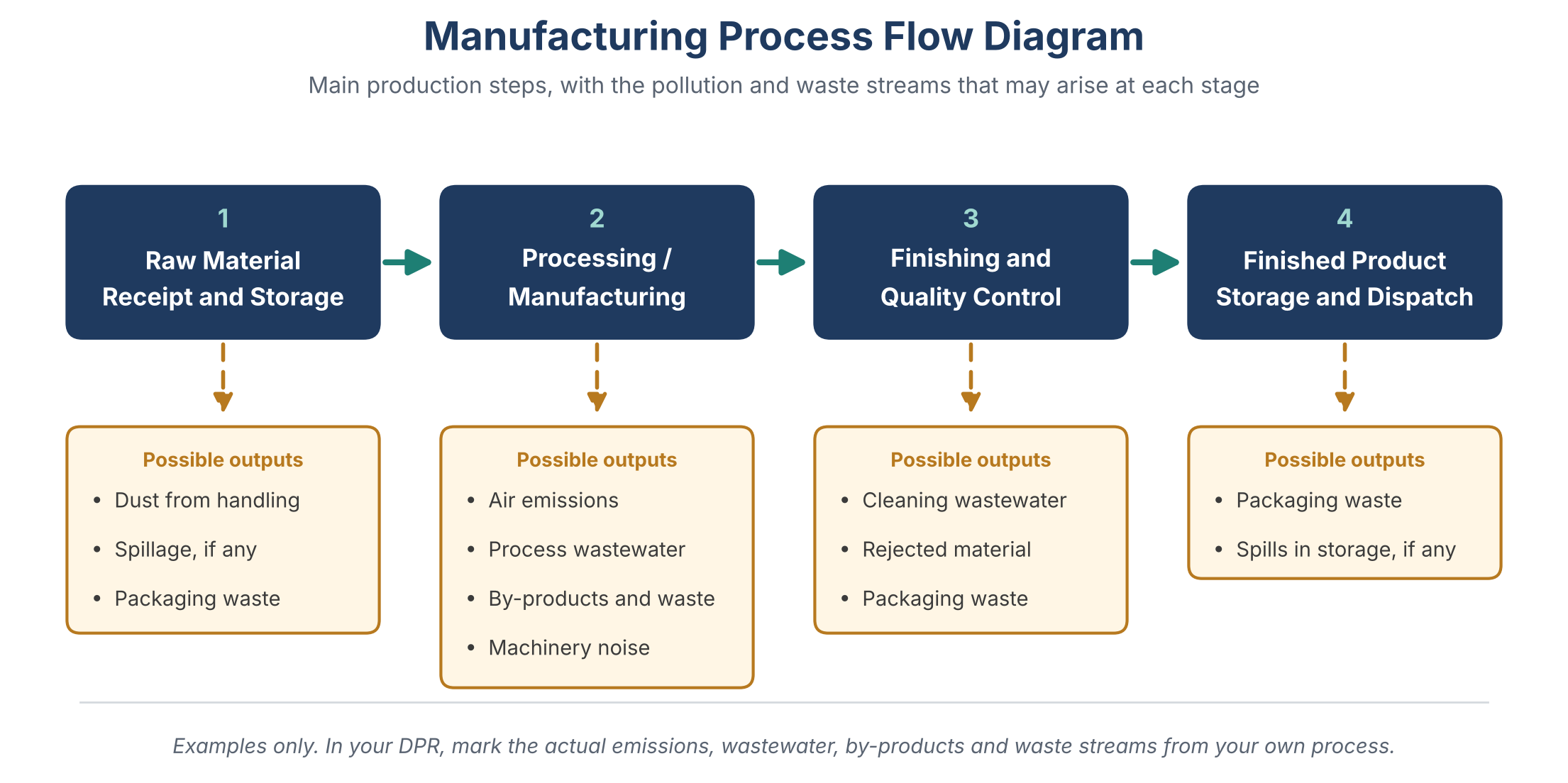
Next, mark what comes out at each step: emissions, wastewater, by-products and waste. Keep the diagram true to your real process. A generic diagram copied from somewhere else will not help your case.
How to Prepare the Water Balance
A water balance answers three questions: where does your water come from, how much do you use, and where does the wastewater go? Make sure it covers:
- Water source (municipal supply, borewell or an authorised supplier)
- Water used in manufacturing
- Water used for cooling, washing and cleaning
- Domestic water use
- Water that is reused or recycled
- Wastewater from each activity
- Treatment and final disposal or reuse
- Any planned discharge to a sewer, common treatment facility or other authorised place
A simple table can look like this:
| Water-use activity | Water required per day | Wastewater generated per day |
| Manufacturing process | Project-specific | Project-specific |
| Equipment cleaning | Project-specific | Project-specific |
| Cooling system | Project-specific | Project-specific |
| Domestic use | Project-specific | Project-specific |
| Total | Calculated total | Calculated total |
Take your figures from design calculations, supplier specifications or measured data. Never guess numbers just to make the application look compliant. Also check that intake, use, recycling and wastewater all add up.
Pollution-Control Systems to Describe
What you need depends on your process, pollutants, capacity and the standards that apply to you. The table below shows examples, not fixed rules.
| Source | Possible control measures |
| Industrial wastewater | Effluent Treatment Plant (ETP), recycling or authorised disposal |
| Domestic wastewater | Sewage Treatment Plant (STP) or another permitted arrangement |
| Dust and particles | Dust collectors, bag filters or other suitable systems |
| Boiler or furnace emissions | Suitable emission-control equipment and compliant stacks |
| DG set emissions and noise | Proper exhaust, acoustic enclosure and regular maintenance |
| Solid waste | Segregation, storage, reuse, recycling, authorised disposal |
| Hazardous waste | Safe storage, records, authorised recovery or disposal (read about hazardous waste authorisation) |
| Machinery noise | Maintenance, acoustic treatment and other controls |
Documents You Will Usually Need
The exact list changes with the state, industry category and type of application. Use this table as a general guide, and confirm against your board’s checklist.
| Document | CTE | CTO |
| Prescribed application form | Generally required | Generally required |
| Project report / DPR | Commonly required | May be required or updated |
| Site or layout plan | Commonly required | Updated layout may be needed |
| Land ownership, lease or possession proof | Commonly required | May be required |
| Industry registration documents | As applicable | As applicable |
| Project cost or CA certificate | As prescribed | As prescribed |
| Process and flow diagram | Proposed process | Actual process |
| Machinery details | Proposed machinery | Installed machinery |
| Water balance and effluent details | Proposed estimates | Actual details and test results, as required |
| Pollution-control system details | Proposed systems | Installed systems and working status |
| Copy of previous CTE | Not applicable for a first CTE | Commonly relevant |
| Compliance report against CTE conditions | Not applicable for a first CTE | Relevant where required |
| Emission or effluent test reports | If prescribed | If prescribed |
| Consent fee and undertakings | As prescribed | As prescribed |
Maharashtra PCB, for instance, lists the manufacturing process, industry registration, land ownership certificate and a detailed pollution-control proposal among the documents for CTE and CTO applications.
Common Mistakes (and How to Avoid Them)
- Different capacity figures in different papers. Keep the DPR, application form and machinery list consistent.
- A half-written process. Missing steps make it hard to find pollution sources.
- A water balance that does not add up. Intake, use, recycling and wastewater must reconcile.
- Forgotten waste streams. Remember process waste, used oil, sludge and packaging waste, where applicable.
- A generic pollution-control plan. Choose equipment that suits your actual pollutants and capacity.
- Layout mismatch. The DPR, site plan and application should show the same premises and equipment locations.
- Not reporting changes. Changes from the approved CTE may need to be reported or approved first, depending on your consent conditions.
- Using another state’s checklist. Formats and technical needs differ between boards.
- Assuming the DPR is enough. Other permits, clearances, fees and documents may also be needed.
How Corpseed Can Help
Many businesses find it hard to match their technical project details with what the board expects. Depending on your project and the scope you agree on, Corpseed’s environmental compliance services can help you with:
- Reviewing your project and the consent requirements that apply
- Preparing the DPR structure and a document checklist
- Organising process and material-flow information
- Compiling water balance, wastewater and waste-management details
- Documenting proposed or installed pollution-control systems
- Checking that the DPR, site layout and application documents match
- Assisting with the online consent application and follow-up
- Helping you organise technical replies to queries from the board
- Support with CTO renewal and annual compliance
The scope of support and any technical certification should be agreed based on your project. The final approval always rests with the competent authority.
Final Thoughts
A clear and honest DPR makes your application easier to read and easier to trust. Describe your process, capacity, water balance, pollution sources, waste streams and control systems exactly as they are.
Before you submit, check the latest requirements of your SPCB or PCC, and make sure the DPR matches your application and site details. A little care at this stage can save you from avoidable document gaps later.
Need a hand with your DPR for CTE or CTO? Talk to the Corpseed team to understand the documents and the state pollution control consent process for your project.
Schedule a Call Back
About the Author

Shamshad Alam
Head - Digital MarketingExperienced Digital Marketer with a demonstrated history of working in the Internet industry. He likes to write about the latest technology trends, Skilled in Digital Marketing likes. Search Engine Optimization, SMO, SEM, PPC, Content Writing, and, Designing, etc.
Related articles
CPCB SOP 2026 for CTE and CTO Approvals - Timelines, Inspections and Key Directions
2026-10-30
E-Waste EPR for Electronics Brands: Registration, Targets & Annual Compliance
2026-10-26
Battery EPR Registration: Who Needs It Under the Battery Waste Management Rules?
2026-10-26
EPR Registration in India: Who Needs It and Which EPR Category Applies to Your Business?
2026-10-21
CPCB Guidelines on Levy of Fees Under the Solid Waste Management Rules, 2026
2026-10-07
Used Oil EPR in India: GST E-Invoicing & Hazardous Waste Rules Compliance Guide 2026
2026-10-06