
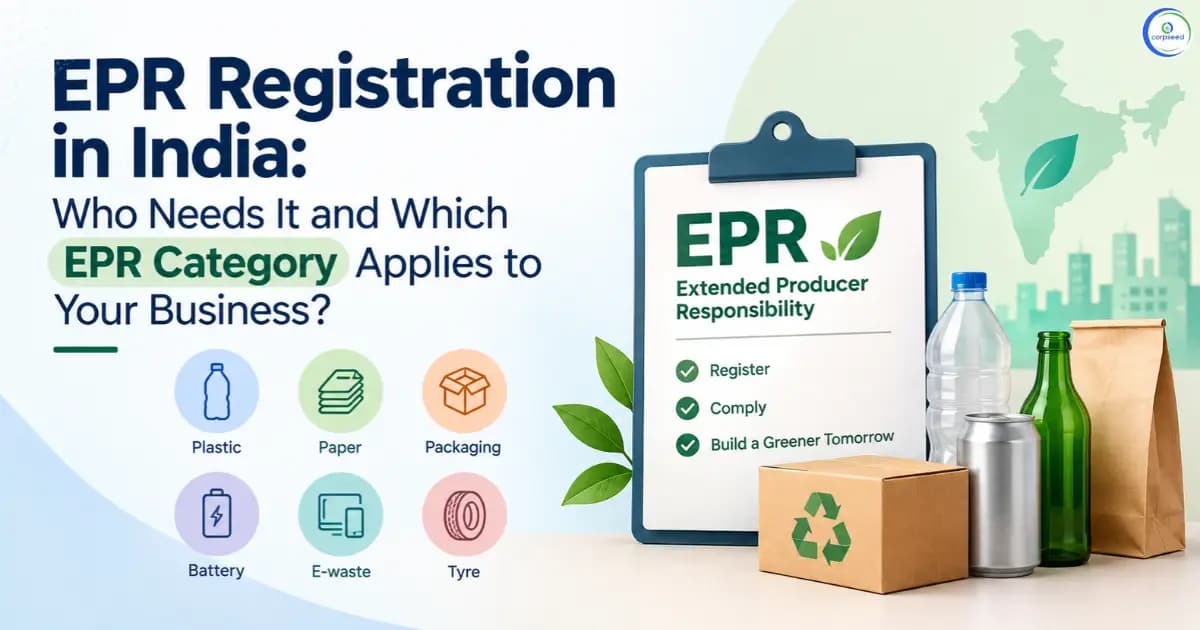
EPR Registration in India: Who Needs It and Which EPR Category Applies to Your Business?
EPR registration in India applies to businesses covered by specific waste-management rules, but the correct category depends on the products they manufacture or import, their role in the supply chain and the activities they carry out.
Schedule a Call Back
8,300+ EPR assignments since 2018
Clients include Emerson Automation Solutions Intelligent Platforms, Intangles Lab, Colt Technology Services India, Deki Electronics, Amzetta Technologies, Shindengen India, Emerson Process Management (India), Lianchuang Electronic India, Beryl Drugs, Q-Line Biotech, Ascent Meditech, Eli Lilly and Company (India) (12 of 2,300+ served since 2018).
A few more clients we've served in this industryHide the list
- Electronics and technology
- Emerson Automation Solutions Intelligent Platforms · Intangles Lab · Colt Technology Services India · Deki Electronics · Amzetta Technologies · Shindengen India · Emerson Process Management (India) · Lianchuang Electronic India
- Pharma and healthcare
- Beryl Drugs · Q-Line Biotech · Ascent Meditech · Eli Lilly and Company (India) · Endolite India · Rajasthan Antibiotics · G D Pharmaceuticals · Micro Labs
- Engineering and manufacturing
- Juki India · Hilti India · Essel Mining & Industries · Bundy India · Hilti Manufacturing India · KJS Cement (I) · Mangalam Cement · Birla Precision Technologies
- Chemicals and materials
- Brenntag Ingredients India · Reliant Packaging Films · Taurus Packaging · Axel Polymers · Lintec India · Kumar Organic Products · DDP Speciality Products India · HP Adhesives
- Food and consumer goods
- Onest · AVT McCormick Ingredients · Akay Natural Ingredients · AVT Natural Products · Ugraya Foods and Feeds · Jalpaiguri Food Industries · Milano Ice Cream · Milano22 Foods
- Logistics and trade
- Siddhartha Logistics · Siddhartha Logistics Ftwz · Honda Trading Corporation India · Zenexpress Logistics · MOL Logistics (India) · Dksh India · Fibs Logistics India
- More clients
- Nilkamal
Introduction
A company dealing with electronic equipment may have obligations under the e-waste rules, while its packaging, or batteries may require a separate assessment under other frameworks.
For manufacturers, importers, brand owners and recyclers, identifying the right category is the first step. Applying under the wrong framework or overlooking a separate waste stream can leave important compliance requirements unaddressed. This guide explains who may need EPR registration, how the major categories differ, where to apply and when professional EPR registration services can help.
What Is EPR Registration in India?
Extended Producer Responsibility (EPR) is a regulatory approach that places responsibility for managing certain products or materials at the end of their useful life on the businesses defined under the relevant rules.
In India, EPR requirements are set out through different waste-management frameworks. These include the Plastic Waste Management Rules, 2016, the E-Waste (Management) Rules, 2022, the Battery Waste Management Rules, 2022 and amendments to the Hazardous and Other Wastes (Management and Transboundary Movement) Rules, 2016. Separate frameworks also address end-of-life vehicles and construction and demolition waste.
EPR registration is not the same for every product or business. The requirements depend on the type of waste involved and the role a business plays, such as manufacturing, importing or selling products. Each EPR framework has its own eligibility criteria, registration process and compliance obligations.
Depending on the category, the process may involve:
- Registration with the Central Pollution Control Board (CPCB) or the authority specified under the applicable rules.
- Providing company, product, manufacturing, import or sales information.
- Meeting the required targets for recycling, collection, recovery or use of recycled materials.
- Obtaining or transferring EPR certificates, where required under the applicable rules.
- Submitting the required returns and keeping records of the work carried out.
The key point is that EPR registration and ongoing EPR compliance are not the same thing. Registration is one part of the process. A business must also meet the obligations that apply to its activities after registration.
Who Needs EPR Registration in India?
There is no single answer for every business. The applicable rules define which stakeholders must register and what responsibilities they must fulfil.
- Producers and manufacturers: Businesses manufacturing products or materials covered by an EPR framework should check whether the rules classify them as producers, or manufacturers. These terms have specific legal meanings, and are not interchangeable across every category.
For example, a manufacturer of electrical and electronic equipment listed in Schedule I of the E-Waste (Management) Rules, 2022, needs to assess the registration requirements under those rules. A manufacturer introducing plastic packaging into the market must separately assess its position under the plastic packaging framework.
- Importers: Importers should examine both the imported product, and any relevant packaging or embedded components.
An importer bringing electronic equipment into India may need to assess e-waste EPR obligations. Batteries supplied separately or incorporated into equipment may also require assessment under the Battery Waste Management Rules. Plastic packaging may create a separate obligation where the importer falls within the applicable definitions.
Importing a product does not automatically establish the same obligations under every category. The relevant rules and the nature of the business activity determine the result.
- Brand Owners: Businesses selling products under their own brand should check whether they fall within the definition of a brand owner or another regulated stakeholder.
Under the plastic packaging framework, eligible producers, importers and brand owners are commonly referred to as PIBOs. Their obligations depend on the packaging placed on the market and the applicable rules.
Brand ownership alone, however, should not be treated as a universal test for every EPR category.
- Recyclers, Refurbishers and Waste Processors: EPR frameworks may require registration or authorisation for businesses that process regulated waste.
For example, the E-Waste (Management) Rules, 2022, cover registration requirements for specified manufacturers, producers, refurbishers and recyclers. The plastic packaging, waste tyre and used-oil frameworks have their own requirements for relevant processors and other stakeholders.
A recycler should check whether its existing State Pollution Control Board or Pollution Control Committee authorisation is sufficient for its activities or whether separate registration on the applicable EPR portal is also required.
- Businesses handling more than one Regulated Category: A business can have responsibilities under multiple frameworks.
Consider an importer that brings electronic devices to India. The devices may fall within the e-waste framework, their batteries may need to be assessed under battery rules, and their packaging may fall under the plastic packaging framework.
In this situation, checking only one EPR category could leave other obligations unidentified. A product-wise, and activity-wise review is a better starting point than applying for a generic EPR certificate.
Which EPR Category Applies to Your Business?
The following table provides an initial guide to the main EPR frameworks and the businesses that should assess their applicability.
| EPR Category | Businesses or Activities to Assess | Governing Framework |
| Plastic packaging EPR | Eligible producers, importers and brand owners dealing with covered plastic packaging | Plastic Waste Management Rules, 2016, as amended |
| E-waste EPR | Covered manufacturers, producers, refurbishers and recyclers of electrical and electronic equipment | E-Waste (Management) Rules, 2022, as amended |
| Battery waste EPR | Producers and other regulated stakeholders dealing with covered batteries | Battery Waste Management Rules, 2022, as amended |
| Waste tyre EPR | Covered tyre producers, importers, recyclers and retreaders | Hazardous and Other Wastes Rules, as amended |
| Used-oil EPR | Covered producers, importers, recyclers and collection agents | Hazardous and Other Wastes Rules, as amended |
| End-of-life vehicles | Vehicle producers and other stakeholders covered by the rules | Environment Protection (End-of-Life Vehicles) Rules, 2025 |
| Construction and demolition waste | Producers, recyclers and other stakeholders covered by the applicable rules | Environment (Construction and Demolition) Waste Management Rules, 2025 |
| Non-ferrous metal scrap EPR | Businesses covered by the framework for regulated non-ferrous metal products and scrap | Hazardous and Other Wastes Rules, as amended |
This is a screening guide, not a final determination of legal applicability. The exact product, business role, exclusions and current registration provisions must be checked before an application is submitted.
Plastic packaging EPR registration
Plastic packaging EPR is relevant to eligible producers, importers and brand owners covered by the Plastic Waste Management Rules.
The applicable packaging categories and obligations must be assessed against the current rules and guidelines. Businesses should not assume that every type of packaging is treated identically.
For example, a brand owner selling goods in flexible plastic packaging needs to assess the packaging placed on the market and its role under the rules. A business dealing in multiple packaging formats may need to classify each format correctly before calculating its obligations.
The plastic packaging portal closed on 28 June 2026 and registered units’ data was shifted to the Common EPR Portal. If your business was already registered, check whether your details have been transferred correctly before editing them.
E-waste EPR registration
E-waste EPR applies to electrical and electronic equipment covered by Schedule I of the E-Waste (Management) Rules, 2022, and the relevant regulated stakeholders.
Businesses should verify the product against the current schedule rather than relying only on a broad description such as electronics, appliances or IT equipment.
For a covered producer, the process can involve registration, applicable recycling targets, purchase of eligible EPR certificates from registered recyclers, and prescribed returns. Manufacturers, refurbishers and recyclers must assess their own registration requirements.
Battery waste EPR registration
The Battery Waste Management Rules, 2022, apply to different types of batteries. The requirements vary depending on the battery, and whether the business manufactures, imports or sells it.
Businesses importing equipment with batteries should not limit their assessment to batteries sold separately. They should check whether batteries supplied as part of the product fall within the applicable framework.
A battery producer should review the relevant registration requirements, battery categories, quantities placed on the market and applicable collection, recycling or recovery obligations.
Waste Tyre EPR registration
Waste tyre EPR requirements apply to stakeholders covered by the relevant amendments to the Hazardous and Other Wastes Rules.
Tyre producers and importers should review their registration and EPR obligations. Recyclers and retreaders should separately check the requirements applicable to their operations and the generation or transfer of EPR certificates.
An existing state-level authorisation should not automatically be treated as a substitute for registration required under the centralised EPR framework.
Used-oil EPR registration
The used-oil EPR framework covers specified stakeholders and activities, including relevant producers, importers, recyclers and collection agents.
Businesses should first establish whether their activity falls within the definitions under the applicable rules. Registration, recordkeeping and return requirements can differ by stakeholder type.
The assessment should also consider any consent, authorisation or operational requirements that apply to the facility under the relevant pollution-control framework.
End-of-life vehicles, construction and demolition waste, and non-ferrous metals
EPR is not limited to plastic packaging, electronics and batteries.
The Environment Protection (End-of-Life Vehicles) Rules, 2025, established a separate framework for covered vehicles and related stakeholders. The Environment (Construction and Demolition) Waste Management Rules, 2025, also provide for registration and EPR-related obligations for covered stakeholders.
The non-ferrous metal scrap framework is another area that businesses dealing with regulated metal products should examine.
These categories should be assessed independently. A company should not assume that registration under a more familiar EPR category covers a separate regulatory framework.
How to Identify the Correct EPR Category for Your Business
Before starting an EPR registration application, work through the following checks.
Step 1: Identify the product or material
Prepare a list of the products you manufacture, import or sell under your brand. Record relevant details such as product type, packaging material, battery type and other components where applicable.
For electrical and electronic equipment, compare the product with Schedule I of the E-Waste (Management) Rules, 2022. For plastic packaging, assess the packaging format against the applicable provisions.
Step 2: Establish your role
Determine whether your business acts as a producer, importer, brand owner, manufacturer, recycler, refurbisher, retreader or another stakeholder defined by the relevant rules.
Do not select a category based only on the name your company uses internally. The legal definition under the relevant framework takes precedence.
Step 3: Check the applicable rules and exclusions
Read the relevant rules and amendments, including any exclusions, exemptions or special conditions that may apply to your business.
For example, the e-waste framework contains specific exclusions, including for waste batteries and plastic packaging covered by their respective rules. Such distinctions matter when determining the correct framework.
Step 4: Confirm the registration authority and portal
Verify the current CPCB or other stated official registration routes for the category. Some frameworks use centralized portals, while other regulatory permissions and/or facility level requirements may involve State Pollution Control Boards/Pollution Control Committees.
Details and operations of portals may change. Verify the route in question before filing an application.
Step 5: Check if more than one category is applicable
It may apply to the entire product and packaging chain, and not just the main product.
For example, an imported electronic device may require assessment under e-waste, battery waste and plastic packaging rules. Each obligation must be evaluated under its own framework.
Step 6: Prepare the application data
Establish the category and collect the required business data and documents according to the specified portal. Check the data for consistency and complete the application.
This early review can help identify missing records and reduce the risk of avoidable application queries.
What Documents Are Required for EPR Registration?
The document list varies by category, applicant type and current portal requirements. A business should use the relevant official checklist rather than rely on one generic list for every EPR registration.
Common records to prepare for an initial assessment may include:
- Certificate of incorporation, partnership deed or other applicable business constitution documents.
- PAN and GST registration details, where required.
- Details of authorised signatories and their authorisation.
- Product lists, packaging information or applicable product-category details.
- Manufacturing, import, procurement or sales data relevant to the category.
- Existing environmental permissions or facility authorisations, where applicable.
- Declarations, undertakings and supporting documents prescribed by the portal.
Additional technical records may be required for particular categories. For example, electronic equipment details, battery information, packaging quantities or waste-processing data may be relevant depending on the applicant's role.
Do not submit a checklist without confirming the category first. Documents required for an e-waste producer may differ from those required for a plastic packaging brand owner or a waste tyre recycler.
How to Apply for EPR Registration in India
The process for obtaining EPR Registration in India is outlined below, and it is important to understand that there may be differences in the overall process for various frameworks.
- Verify Eligibility: Recognize the applicable waste stream, stakeholder definition, and registration authority. Confirm if your activity is in scope of the relevant rules.
- Access the Official Portal: Use the official portal specific to the category of your interest. For systems which have migrated to the Common EPR Portal, check the latest instructions and the status of the registration data, if any, previously uploaded.
- Provide Required Information: Enter company and product information and activity details, based on your category interest. Use data consistent with the supporting records.
- Submit Supporting Documents: Upload the requested documents in the required format. Check the application for completeness and correctness and other inconsistencies, before final submission.
- Address Queries/clarifications: In case the authority has raised queries or requests for clarification, provide the relevant records along with your answers. The time taken for processing the application depends on the category, extent of the application and whether there are any issues which require correction or clarification.
- Review Registration Outcome: Review the registration certificate, registered details and/or conditions, if any. In case there is a correction required, follow the procedure indicated by the Authority.
- Manage Ongoing Compliance: Once registered, you have certain obligations to fulfil based on your category including required returns, recycling and collection targets, EPR certificate transactions and other reporting requirements.
Registration should not be treated as the end of the process.
EPR Registration Fees, Validity and Processing Time
There is no single fee or processing timeline that applies to every EPR category.
The amount payable, registration conditions, renewal provisions and processing requirements depend on the applicable rules and official portal. Some frameworks also distinguish between the registration requirements of producers and those of recyclers or other stakeholders.
Before budgeting for EPR registration, check:
- The official application or registration fee.
- Any applicable annual processing, renewal or amendment fee.
- Whether the registration has a prescribed validity period or renewal requirement.
- Whether additional permissions or authorisations are required for the activity.
- The professional fee charged by an EPR registration consultant, if you engage one.
Keep official regulatory fees separate from consultancy charges and other expenses.
A environment consultant can help prepare records and manage the application process, but no adviser should promise a guaranteed approval date when the decision rests with the competent authority.
What Happens If a Business Does Not Meet Its EPR Obligations?
Failure to comply with applicable EPR requirements can expose a business to regulatory action under the relevant rules and environmental legislation.
Depending on the framework and the nature of the contravention, the consequences may involve environmental compensation, directions from the authority or other action provided under the applicable law.
The precise consequences should be checked against the relevant category's current provisions. A single penalty figure should not be applied indiscriminately to plastic packaging, e-waste, batteries, used oil and other regulated waste streams.
Businesses should pay particular attention to the following areas:
- Failure to obtain registration when required.
- Incorrect product or stakeholder classification.
- Inaccurate information in registration applications or returns.
- Failure to meet applicable recycling, collection or recovery obligations.
- Missing returns, incomplete records or unaddressed regulatory queries.
- Failure to follow the requirements for EPR certificates, where applicable.
A periodic review of registrations, product data and reporting obligations can help identify gaps before they become larger compliance issues.
Common EPR Registration Mistakes Businesses Should Avoid
- Choosing a Category Based only on the Product Name: A product's commercial name may not settle whether it is covered by a particular rule. Check the relevant schedules, definitions and exclusions.
- Assuming one EPR Registration covers Everything: Separate waste streams may be governed by separate frameworks. Check the product, its packaging and relevant components before deciding that one registration is sufficient.
- Using an Outdated Registration Portal: Portal changes can affect where applications and updates must be submitted. Confirm the current official portal, and any migration instructions before making changes.
- Submitting Inconsistent Business Data: Differences between company records, GST details, product information and sales or import data can lead to queries. Review the records before submission.
- Ignoring Obligations after Registration: A registration certificate does not automatically discharge all EPR responsibilities. Businesses should track applicable targets, certificates, returns and other reporting duties.
- Treating General Online Advice as a Legal Determination: A guide can help narrow down the likely category, but the actual applicability decision must be based on the current rules and the facts of the business.
How Can Corpseed Help With EPR Registration?
Identifying the correct EPR category can be difficult when a business imports multiple products, uses different packaging materials or operates across several regulated waste streams.
Corpseed can position its EPR registration services around helping businesses review their activities, identify the relevant regulatory framework, prepare application documents and understand the compliance steps that follow registration.
Depending on the service scope and applicable category, professional assistance may include:
- Reviewing the products, packaging and business activities relevant to EPR applicability.
- Identifying the registration category and official portal to be checked.
- Preparing and reviewing supporting documents for the application.
- Assisting with application submission and responses to regulatory queries.
- Helping businesses understand applicable returns, EPR targets and recordkeeping requirements.
The exact scope should be confirmed for the category involved. Registration decisions and statutory approvals remain with the competent authority.
If your business needs an EPR registration consultant in India, consult Corpseed's experts to discuss your products, business activities and likely registration requirements before proceeding with an application.
Conclusion
EPR registration in India depends on the waste stream, the products or materials involved and the role a business performs under the applicable rules. Plastic packaging, e-waste, batteries, waste tyres, used oil, end-of-life vehicles and other covered streams have distinct requirements.
Before applying, identify the relevant category, verify the current official rules and portal and prepare the required business records. Where the position is unclear, or multiple categories may apply, professional EPR registration assistance can help you assess the requirements, and plan the next steps.
About the Author

Parul Bohral
Legal Content WriterParul Bohral, a BALLB graduate and experienced legal researcher and content writer with expertise in various legal areas, including corporate law and intellectual property. I have gained valuable experience in esteemed legal environments, where I have strengthened my research skills, allowing me to approach legal writing with precision and depth.
As a legal content writer, I am committed to delivering work that not only informs but also engages readers. By staying informed about the latest trends in content marketing and regulatory developments, I ensure that my writing remains sophisticated and meets industry standards. My dedication to thorough research enables me to craft content that is both insightful and impactful.
Related articles
CPCB SOP 2026 for CTE and CTO Approvals - Timelines, Inspections and Key Directions
2026-10-30
E-Waste EPR for Electronics Brands: Registration, Targets & Annual Compliance
2026-10-26
Battery EPR Registration: Who Needs It Under the Battery Waste Management Rules?
2026-10-26
Detailed Project Report for CTE and CTO: Requirements, Format, Documents and Approval Process
2026-10-22
CPCB Guidelines on Levy of Fees Under the Solid Waste Management Rules, 2026
2026-10-07
Used Oil EPR in India: GST E-Invoicing & Hazardous Waste Rules Compliance Guide 2026
2026-10-06