
CPCB SOP 2026 for CTE and CTO Approvals - Timelines, Inspections and Key Directions
Waiting for pollution control consent can delay a factory's construction or operations. To improve how these applications are handled, the Central Pollution Control Board (CPCB) issued a direction on 21 August 2026 asking State Pollution Control Boards (SPCBs) and Pollution Control Committees (PCCs) to implement its Standard Operating Procedure (SOP). The Punjab Pollution Control Board (PPCB) circulated the direction to its regional offices on 8 October 2026.
Schedule a Call Back
1,800+ CTE/CTO and plant setup assignments since 2018
Clients include Magnum Aluminium, Enershell Alloys and Steel, Ganesh Foundry & Cast, Inland Speciality Metals, JK Cement, Sskbp India Alloy, Denso India, Neometrix Defence, PMS Waste Management, Daebak India Recycler, Ganix Rubber Recycling, Pashidaa E Waste Copper Battery Recycling PLT Company (12 of 1,100+ served since 2018).
A few more clients we've served in this industryHide the list
- Engineering and manufacturing
- Magnum Aluminium · Enershell Alloys and Steel · Ganesh Foundry & Cast · Inland Speciality Metals · JK Cement · Sskbp India Alloy · Denso India · Neometrix Defence
- Recycling and waste management
- PMS Waste Management · Daebak India Recycler · Ganix Rubber Recycling · Pashidaa E Waste Copper Battery Recycling PLT Company · Upcycle Debris Management · Ficusa Ewaste Recyclers · Shuchaye Recyclers · Quantara Battery Recycling
- Logistics and trade
- 20Cube Logistics Solutions · Airsurge Logistics · Green Space Logistics · Saap Logistics
- Food and consumer goods
- Bake Wish · Kokora Spices · Babi Beverages · Indraj Beverages and Distilleries · Adheshwar Agro Dairy Products · Venco Research and Breeding Farm · Explore Food · IFF India Frozen Foods
- Energy and power
- Servotech Renewable Power System · Saurya Urja Company of Rajasthan · Sun Mobility · Sun Max Solar · Maxvolt Energy Industries · Rays Power Infra
- Chemicals and materials
- Venkateshwara Roto Pack · Lami Tube · M C Bauchemie I · Pro Flexi Packaging · Rustchem Corrosols · SVN Polymers · Kairaa Polypack · Sanctum Chemicals
- More clients
- Intangles Lab · Alten India · Adit Buildwell · Ecowise Trading · GS E-Commerce · Beaucience India
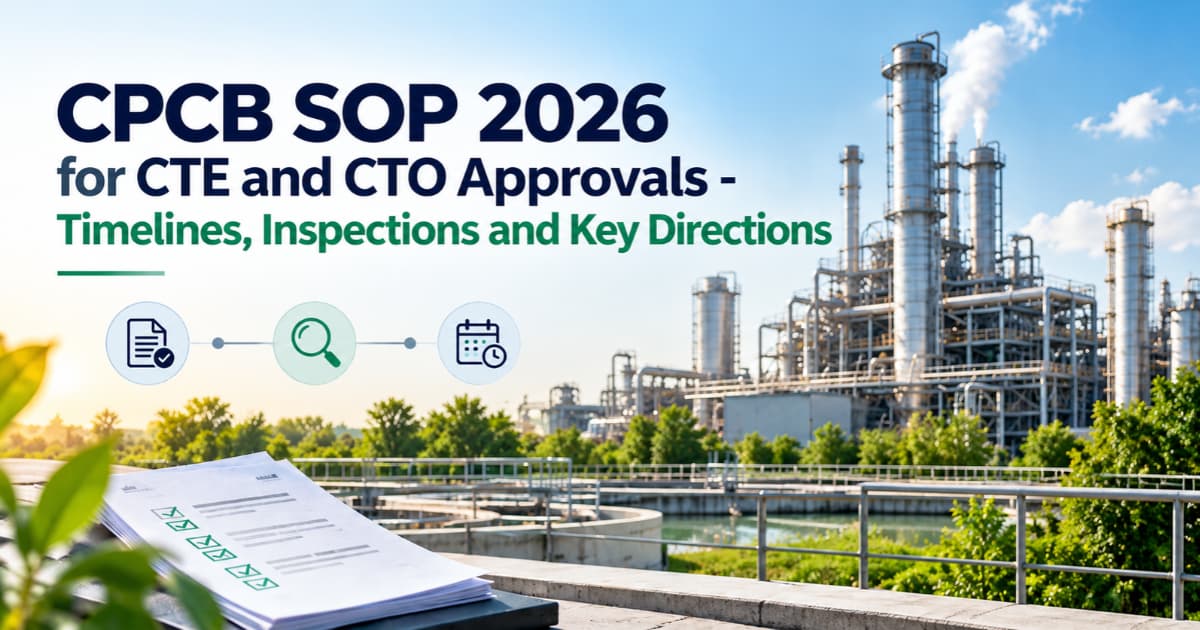
Waiting for pollution control consent can delay a factory's construction or operations. To improve how these applications are handled, the Central Pollution Control Board (CPCB) issued a direction on 21 August 2026 asking State Pollution Control Boards (SPCBs) and Pollution Control Committees (PCCs) to implement its Standard Operating Procedure (SOP). The Punjab Pollution Control Board (PPCB) circulated the direction to its regional offices on 8 October 2026.
The CPCB SOP 2026 covers decisions on CTE and CTO applications, environmental inspections and grievance redressal. For industries, key questions include how long consent decisions should take, what happens when an application is delayed, and which compliance obligations continue to apply.
The CTE and CTO approval timelines in this article follow the applicable MoEFCC consent guidelines, not a separate new licensing process.
Schedule a Call Back
What Is the CPCB SOP 2026?
The SOP guides pollution control authorities on disposing of consent and waste-authorisation applications within prescribed periods, responding to possible environmental violations and handling public complaints. It follows directions from the National Green Tribunal (NGT) and works alongside existing environmental laws; it is not a new standalone licence scheme.
Consent to Establish (CTE) generally concerns permission to establish activities covered by the Water Act, 1974 and the Air Act, 1981. Consent to Operate (CTO) concerns operating a covered industrial facility. Depending on the activity, separate waste-management authorisations may also be necessary.
The PPCB letter dated 8 October 2026 forwards a nationwide CPCB direction. It does not create a separate Punjab-only consent requirement.
Why Did CPCB Issue These Directions?
Concerns about delays in deciding consent and authorisation applications prompted these directions. Its 8 October 2025 order asked CPCB to develop procedures for timely decisions, proactive monitoring and grievance redressal.
CPCB circulated the SOP on 27 February 2026. After a further NGT order on 14 May 2026, CPCB issued its implementation direction on 21 August 2026.
The aim is to make regulatory decisions more accountable while helping authorities respond to pollution incidents without relying solely on complaints.
Key Provisions of the CPCB SOP
The SOP brings together three important responsibilities for SPCBs and PCCs:
- Application disposal: Decide CTE, CTO and relevant authorisation applications within the applicable legal periods.
- Proactive enforcement: Respond to monitoring alerts, inspections, complaints and incidents indicating potential non-compliance.
- Grievance handling: Provide appropriate systems for submitting complaints and communicating action taken.
The August direction also requires the concerned boards and committees to acknowledge it and send CPCB an action-taken report within 30 days of receiving the direction. This is an obligation on the authorities, not a fresh filing deadline for businesses.
CTE and CTO Approval Timelines for Different Industries
The guidelines for uniform consent set different decision periods for industries in the Red, Orange, and Green categories. The decision periods are applicable to the processing of complete applications, not approvals.
An industry's category depends on the applicable pollution classification. Businesses should confirm their classification with the relevant SPCB or PCC before using these timelines for planning.
CTE and CTO approval timelines (days)
| Application type | Red category | Orange category | Green category |
| Consent to Establish (CTE) | 60 | 45 | 30 |
| First Consent to Operate (CTO) | 90 | 60 | 30 |
| CTO for expansion or amendment | 90 | 60 | 30 |
CTO Validity Under the January 2026 Amendments
The Ministry of Environment, Forest and Climate Change has revised the Air and Water Consent Guidelines by means of G.S.R. 62(E) and 63(E), dated 23 January 2026 and published on 27 January 2026. With the revision, CTO will be valid till its cancellation according to the guidelines.
This does not affect operating conditions and consent charges. The states and Union Territories can stipulate a single CTO charge for periods of five to 25 years, followed by further charges beyond that period. Alteration or expansion of operations could still require amendment or approval. Business entities must also look into how existing consents have been treated.
What Happens if an SPCB Delays an Application?
If a consent application is not decided within the prescribed period, the guidelines allow referral to a State Level Monitoring Committee. The Member Secretary of the concerned board presents the matter to that committee, which is required to dispose of the referred application within 30 days of receipt.
The committee can examine why the application was delayed and recommend appropriate action where the delay was unjustified.
Applicants should retain submission acknowledgements, reply promptly to deficiency notices and check whether any requested information remains outstanding. A delayed decision does not itself allow a business to start regulated operations without the necessary consent.
This committee's 30-day period is separate from the 30-day CPCB action-taken report deadline for pollution control authorities.
Environmental Inspection Frequency Under CPCB Guidelines
The SOP refers to earlier CPCB directions setting out preferred environmental surveillance frequencies. These depend on the pollution category or facility type.
CPCB environmental inspection frequency
| Industry or facility | Inspection frequency |
| Identified 17 highly polluting industries | Every 3 months |
| Other Red category industries | Every 6 months |
| Orange category industries | Every year |
| Green category industries | Every 2 years |
| Specified common waste treatment facilities, CETPs and STPs | Every 3 months |
Under the SOP, firms may retain higher frequencies, and exceptions may be justified. Inspections may consider emission and effluent levels, pollution control devices, and other consent conditions.
Here, more frequent inspections may be continued by the concerned State or Union Territory authority, not individual firms.
Businesses should not confuse the general surveillance schedule with additional monitoring or reporting duties imposed under their individual approvals.
What Is the UCAMS Portal?
The Unified Consent and Authorization Management System (UCAMS) is CPCB's platform for online consent and authorisation administration. It is intended to improve consistency, application tracking and transparency across pollution control authorities.
Even though the February SOP had mentioned that the implementation process was ongoing, the Government of India has confirmed that the UCAMS was launched in September 2026. However, this doesn’t mean all SPCBs were on the portal at that time.
Before applying for CTE or CTO online, businesses should check the relevant SPCB or PCC's latest filing instructions instead of assuming one portal route applies everywhere.
How Does Environmental Grievance Redressal Work?
The SOP discusses existing complaint mechanisms and the need for accessible state-level systems.
CPGRAMS allows people to lodge public grievances and track them using a registration number. CPCB handles relevant environmental complaints received through that system.
The SAMEER App provides air-quality information and supports air-pollution complaints, with complaint features described in the SOP, particularly for Delhi-NCR.
SPCBs and PCCs may also operate or develop their own grievance portals. The intention is for complaints to be considered, action taken to be communicated and relevant information to be made available. The SOP does not require every state to launch a new portal.
How Will the CPCB Directions Affect Businesses?
The direction mainly tells regulators how to process applications and monitor environmental compliance. It does not require every existing factory to obtain a fresh consent.
For new manufacturing units, the timelines can help with planning, provided the business first checks whether CTE is required. Operating factories must continue to comply with their CTO conditions, pollution standards and applicable monitoring requirements.
Expanding businesses should check whether proposed capacity or process changes need a consent amendment. Waste processors and recycling units may also need authorisations under the relevant waste-management rules.
For Punjab-based businesses, the PPCB communication confirms that the state is circulating the nationwide direction. The industry's actual obligations still depend on its activities, permissions, pollution category and applicable exemptions.
What Should Industries Do Next?
A useful compliance review starts with the approvals already held and the operations actually carried out. Before filing or changing an application, businesses should:
1. Confirm their industrial pollution category and whether CTE, CTO or a waste authorisation applies.
2. Review current consent conditions, particularly emission, effluent and waste-management requirements.
3. Check whether an expansion or process change requires an amendment.
4. Track pending applications and reply to official queries with complete information.
5. Keep the monitoring and recordkeeping evidence required by the relevant rules and consent conditions.
The January 2026 amendments also provide a conditional deemed-CTE arrangement for qualifying micro and small units in notified industrial estates or areas upon submission of the prescribed self-certified application. It is not a blanket exemption for every MSME.
These checks provide practical guidance; an industry's binding duties must be determined under applicable law and its own approvals.
How Can Corpseed Help With CTE and CTO Approvals?
Businesses seeking pollution control board consent consultancy may need support understanding applicable approvals and organising documents before filing.
Corpseed's relevant Pollution NOC services and Punjab Pollution Control Board services can assist businesses with applicable consent requirements.
Businesses looking for CTE application assistance or PPCB consent consultancy should first confirm their industrial category and approval requirements.
- CTE and CTO application assistance: Identifying the applicable consent category and organising application information.
- Pollution NOC services: Supporting documentation and relevant state pollution control submissions.
- Consent amendment support: Preparing information for changes or expansion where an amendment is required.
- Environmental compliance consultancy: Helping identify related authorisations and respond to official documentation queries.
Professional assistance does not guarantee government approval or replace the pollution control authority's powers.
Need help with a CTE, CTO or pollution control consent application? Contact Corpseed to discuss the requirements for your business.
Conclusion
The CPCB SOP 2026 focuses on timely processing of environmental consent applications, proactive industrial inspections and grievance redressal.
The CPCB direction dated 21 August 2026 requires SPCBs and PCCs to implement the SOP, and the Punjab Pollution Control Board distributed it to its regional offices on 8 October 2026.
The industry should note the consent guideline amendments in January 2026, especially those on the validity period of CTO, processing period and qualification of micro and small units.
Industries should review relevant guidelines, approvals and directions from the pollution control board before filing for consent or any operational change.
About the Author

Mahek Sancheti
Content WriterMahek Sancheti, BAJMC graduate with a deep passion for writing. As a content writer, video content creator, creative content creator, and scriptwriter, I bring stories to life through words and visuals. I honed my skills by working with a prominent news agency, where I excelled in crafting compelling narratives and engaging content. Coming from a journalism and mass communication background I have skills to craft engaging narratives that captivate audiences. With a keen interest in writing and creativity, I aim to deliver impactful and meaningful content that resonates with diverse audiences.
https://www.linkedin.com/in/mahek-sancheti-837196212
Related articles
E-Waste EPR for Electronics Brands: Registration, Targets & Annual Compliance
2026-10-26
Battery EPR Registration: Who Needs It Under the Battery Waste Management Rules?
2026-10-26
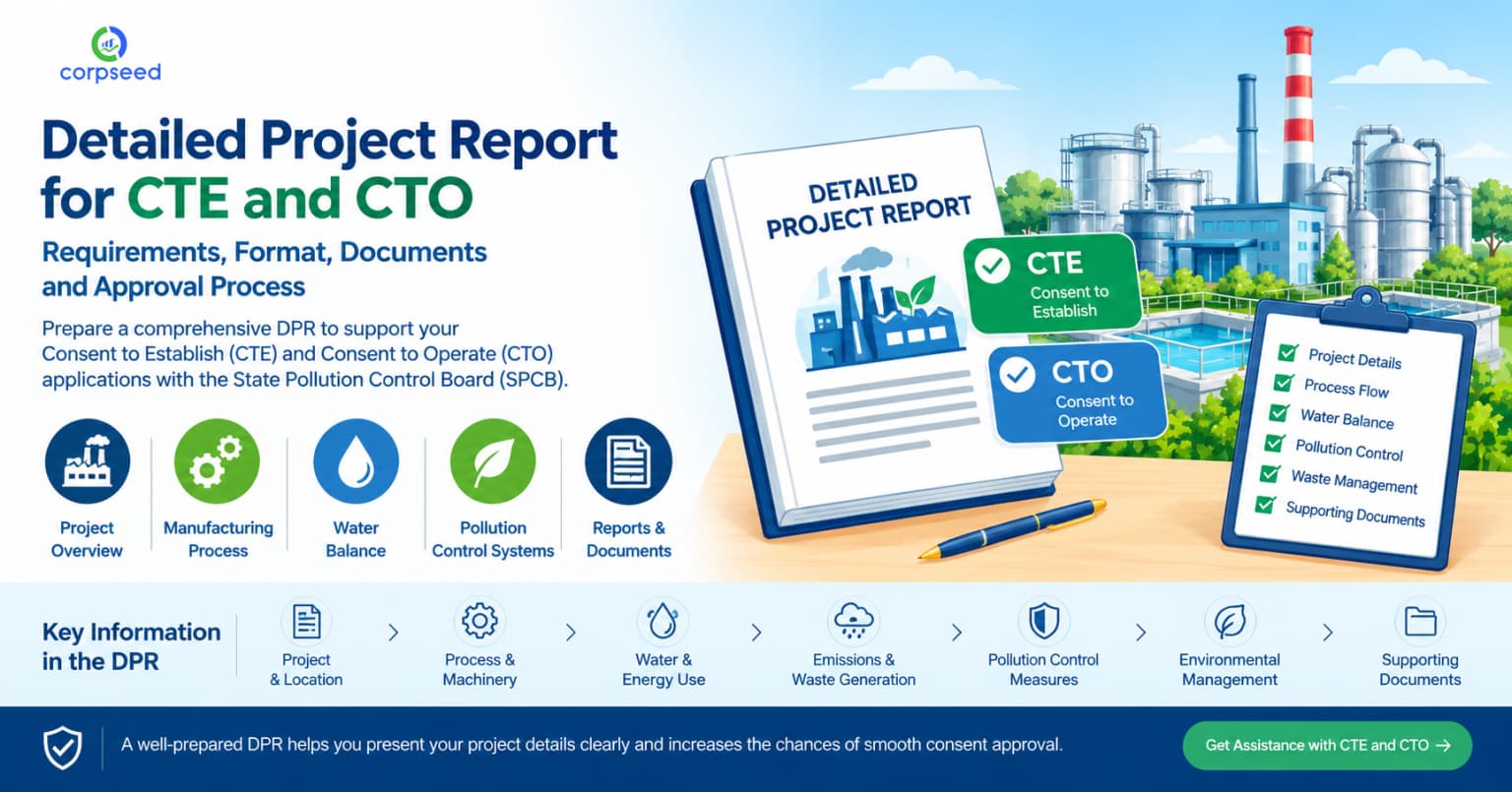
Detailed Project Report for CTE and CTO: Requirements, Format, Documents and Approval Process
2026-10-22
EPR Registration in India: Who Needs It and Which EPR Category Applies to Your Business?
2026-10-21
CPCB Guidelines on Levy of Fees Under the Solid Waste Management Rules, 2026
2026-10-07
Used Oil EPR in India: GST E-Invoicing & Hazardous Waste Rules Compliance Guide 2026
2026-10-06