
Cabinet Approves Rs. 11,000 Crore Scheme for Construction and Infrastructure Equipment Manufacturing in India
Cabinet approves Rs. 11,000 crore CIE Manufacturing Scheme with up to 13% sales-linked incentives. Check eligibility, timelines and compliance requirements.
Schedule a Call Back
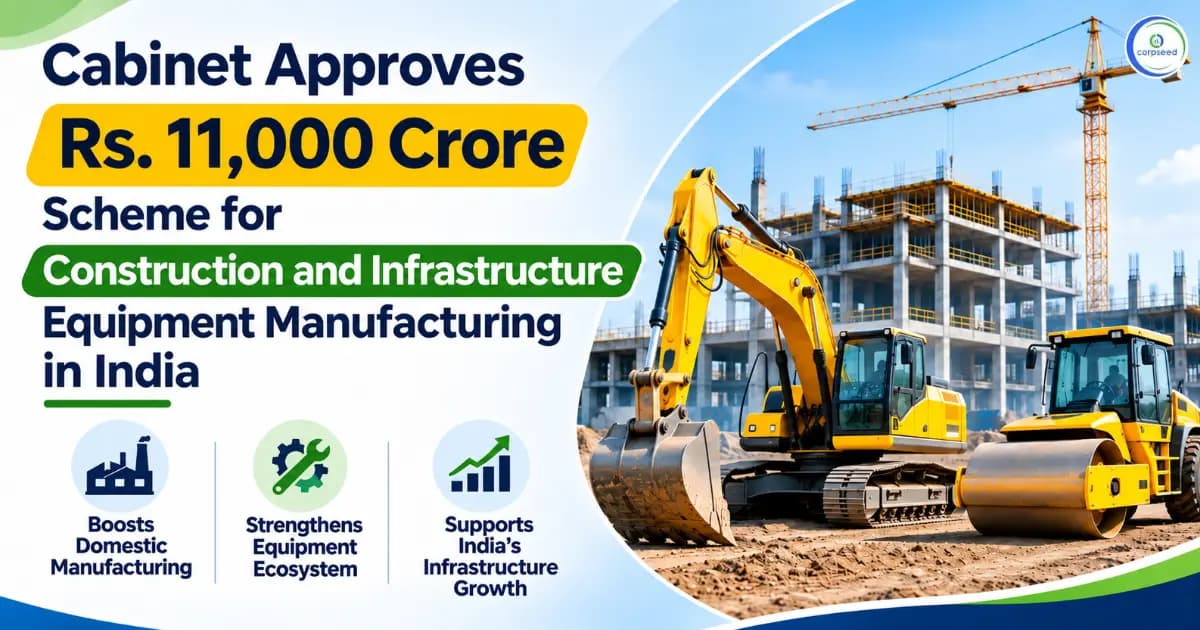
The scheme aims to encourage domestic manufacturing of advanced construction equipment and critical components, reduce import dependence and strengthen India's industrial manufacturing capabilities.
Under the scheme, approved Original Equipment Manufacturers (OEMs) and component manufacturers will receive graded sales-linked incentives ranging from 13% to 8% on the incremental sales value of eligible products over five years.
The government has also approved a grant of up to Rs. 375 crore in the form of Viability Gap Funding (VGF) for establishing a dedicated construction and infrastructure equipment testing facility in India.
The Ministry of Heavy Industries will implement the scheme over eight financial years, beginning in FY 2026-27 and concluding in FY 2033-34.
Construction and Infrastructure Equipment Manufacturing Scheme 2026 at a Glance
| Particulars | Details |
|---|---|
| Scheme Name | Scheme for Enhancement of Construction and Infrastructure Equipment (CIE) Manufacturing Ecosystem |
| Approving Authority | Union Cabinet |
| Implementing Ministry | Ministry of Heavy Industries (MHI) |
| Approval Date | 25 November 2026 |
| Total Financial Outlay | Rs. 11,000 crore |
| Scheme Duration | Eight years |
| Implementation Period | FY 2026-27 to FY 2033-34 |
| Incentive Type | Sales-linked incentive |
| Incentive Rate | 13% to 8% of eligible incremental sales value |
| Eligible Applicant Categories | OEMs and component manufacturers, subject to prescribed conditions |
| Manufacturing Facility Setup Period | FY 2026-27 to FY 2027-28 |
| Incentive Disbursement Period | FY 2028-29 to FY 2032-33 |
| Final Incentive Settlement | FY 2033-34 |
| Grant for Testing Facility | Up to Rs. 375 crore |
| Application Window | Not specified in the Cabinet announcement |
Background of the Construction Equipment Manufacturing Scheme
India is currently the world's third-largest construction and infrastructure equipment market, after China and the United States. According to the government, the domestic CIE industry recorded a market size of approximately Rs. 97,500 crore in FY 2024-25.
With increasing investment in roads, highways, ports, housing and other infrastructure projects, the industry is projected to reach approximately Rs. 2,28,100 crore by FY 2029-30.
Despite this growth, India continues to depend on imported equipment and specialised components for several large-scale construction and infrastructure projects.
The newly approved scheme seeks to address this gap by encouraging manufacturers to establish domestic production facilities, develop advanced technologies and strengthen local component supply chains.
Key Objectives of the Rs. 11,000 Crore CIE Manufacturing Scheme
The scheme has been introduced to achieve the following objectives:
- Promote domestic manufacturing of advanced construction and infrastructure equipment.
- Reduce dependence on imported machinery and critical components.
- Encourage investment in new manufacturing facilities and production capabilities.
- Strengthen domestic OEM and component manufacturing supply chains.
- Improve access to specialised product testing infrastructure.
- Enhance the global competitiveness of Indian construction equipment manufacturers.
- Generate direct and indirect employment opportunities.
- Support the objectives of Atmanirbhar Bharat and Viksit Bharat 2047.
Major Components of the Construction Equipment Manufacturing Scheme
The scheme consists of two principal components covering manufacturing incentives and testing infrastructure development.
1. Sales-Linked Incentives for Manufacturers
Under the first component, financial incentives will be provided to approved manufacturers based on the incremental sales value of eligible construction equipment and components.
The scheme covers two applicant categories:
- Original Equipment Manufacturers (OEMs).
- Component manufacturers.
Eligible beneficiaries will receive graded incentive rates ranging from 13% to 8% over a five-year period.
Unlike a conventional capital investment subsidy, the manufacturing incentive is linked to eligible incremental sales rather than solely to expenditure incurred on establishing a manufacturing facility.
The exact year-wise incentive rates, base-year sales calculation, minimum investment thresholds and claim verification procedures are not specified in the Cabinet announcement.
2. Financial Grant for Dedicated CIE Testing Facility
The second component provides a grant of up to Rs. 375 crore through Viability Gap Funding for establishing a dedicated construction and infrastructure equipment testing facility in India.
The proposed facility is expected to support manufacturers by improving access to domestic equipment testing infrastructure and facilitating the development of advanced construction machinery.
It may also help manufacturers reduce their reliance on overseas testing facilities, improve product development capabilities and meet applicable technical requirements.
However, the announcement does not prescribe individual testing reimbursements for manufacturers or introduce a new mandatory product certification requirement.
Construction and Infrastructure Equipment Covered Under the Scheme
The scheme focuses on technologically advanced equipment used in major construction and infrastructure development projects.
The Cabinet announcement specifically identifies the following equipment:
| Equipment | Major Industrial Applications |
|---|---|
| Ship-to-Shore Cranes | Port operations, container handling and maritime logistics |
| Tunnel Boring Machines (TBMs) | Metro rail, road tunnels and underground infrastructure |
| Hydraulic Excavators | Construction, mining and earthmoving operations |
| Off-Highway Trucks | Mining, quarrying and heavy material transportation |
Additional media reports following the Cabinet announcement identify loaders, piling rigs and drilling machines among the equipment categories proposed for coverage.
The detailed product list, technical specifications and applicable product classification codes should be confirmed from the official scheme guidelines before assessing eligibility.
Critical Components Proposed for Domestic Manufacturing
The scheme also aims to strengthen the manufacturing supply chain for specialised components used in construction and infrastructure equipment.
According to additional reports on the Cabinet decision, the proposed component categories include:
- Engines.
- Transmission systems.
- Hydraulic systems.
- Undercarriages.
- Drive systems.
Domestic manufacturing of these components could help equipment manufacturers reduce dependence on overseas suppliers and improve the availability of replacement parts and specialised machinery components.
The final eligibility of individual components will depend on the product coverage and technical criteria prescribed under the scheme guidelines.
Implementation Timeline of the CIE Manufacturing Scheme
The government has divided the eight-year implementation period into three phases covering manufacturing facility establishment, incentive disbursement and final settlement.
| Implementation Phase | Financial Year | Key Activity |
|---|---|---|
| Phase 1 | FY 2026-27 | Establishment of manufacturing facilities |
| Phase 1 | FY 2027-28 | Continuation of manufacturing facility setup |
| Phase 2 | FY 2028-29 | First year of the incentive period |
| Phase 2 | FY 2029-30 | Second year of the incentive period |
| Phase 2 | FY 2030-31 | Third year of the incentive period |
| Phase 2 | FY 2031-32 | Fourth year of the incentive period |
| Phase 2 | FY 2032-33 | Fifth year of the incentive period |
| Phase 3 | FY 2033-34 | Settlement of incentives relating to incremental sales in FY 2032-33 |
The initial two-year gestation period provides manufacturers with time to establish production infrastructure before the scheduled five-year incentive period begins.
Businesses considering participation should align their investment, machinery procurement, regulatory approvals and production schedules with the prescribed implementation framework.
Who Can Apply Under the Construction Equipment Manufacturing Scheme?
The Cabinet-approved framework identifies two categories of manufacturers eligible for consideration under the sales-linked incentive component.
Original Equipment Manufacturers (OEMs)
Businesses engaged in manufacturing eligible construction and infrastructure machinery in India may apply, subject to the technical, financial and operational conditions prescribed under the scheme.
Component Manufacturers
Companies manufacturing eligible components and sub-assemblies used in construction and infrastructure equipment may also qualify for financial incentives.
The scheme may create opportunities for established industrial manufacturers and businesses planning to invest in eligible manufacturing activities.
Important: The Cabinet announcement does not specify minimum turnover, net worth, investment requirements, domestic value addition thresholds or separate eligibility conditions for MSMEs. Manufacturing an identified product does not automatically qualify a business for incentives.
How Will the Sales-Linked Incentive Work?
The scheme provides financial assistance based on the incremental sales value of eligible equipment and components manufactured by approved applicants.
For example, if an approved manufacturer records eligible incremental sales of Rs. 100 crore during a particular incentive year, the financial assistance may be calculated as follows:
| Particulars | At 13% Incentive Rate | At 8% Incentive Rate |
|---|---|---|
| Eligible Incremental Sales | Rs. 100 crore | Rs. 100 crore |
| Applicable Incentive Rate | 13% | 8% |
| Illustrative Incentive Amount | Rs. 13 crore | Rs. 8 crore |
This calculation is only for illustration. Actual incentives will depend on the applicable annual rate, approved product categories, eligible sales calculation, financial limits and other conditions prescribed by the Ministry of Heavy Industries.
The incentive should not be interpreted as a direct reimbursement of the total investment made by a manufacturer.
Impact of the CIE Manufacturing Scheme on MSMEs
The development of domestic construction equipment manufacturing facilities is expected to create additional business opportunities for Micro, Small and Medium Enterprises (MSMEs) operating within industrial supply chains.
Potential opportunities include:
- Manufacturing machinery parts and sub-assemblies.
- Supplying precision-engineered components.
- Providing metal fabrication and machining services.
- Manufacturing hydraulic and mechanical components.
- Supporting equipment maintenance and repair activities.
- Providing industrial testing and quality assurance services.
- Entering domestic OEM supply chains.
MSMEs manufacturing eligible components may also be considered for direct incentives if they meet the prescribed scheme requirements.
However, no separate subsidy rate, reserved allocation or automatic eligibility relaxation for MSMEs has been announced in the Cabinet press release.
Regulatory Compliance Requirements for Construction Equipment Manufacturers
Manufacturers planning to establish or expand construction equipment production facilities must assess the applicable statutory requirements alongside the conditions of the government incentive scheme.
Depending on the equipment category, manufacturing process, project location and business operations, the following registrations and approvals may be applicable.
| Compliance Requirement | Applicability and Purpose |
|---|---|
| Business Registration | Establishing an appropriate legal entity for manufacturing operations |
| Udyam Registration | Recognition as an MSME, subject to applicable classification criteria |
| GST Registration | Compliance with applicable taxation and sales reporting requirements |
| Factory License | Factory registration, licensing and occupational safety compliance |
| Consent to Establish (CTE) | Applicable pollution control approval before establishing a manufacturing facility |
| Consent to Operate (CTO) | Applicable pollution control approval before commencing industrial operations |
| BIS Certification | Product conformity assessment wherever prescribed under applicable regulations |
| Hazardous Waste Management Authorization | Management of hazardous waste generated during manufacturing activities, wherever applicable |
| Environmental Clearance | Required for projects falling within the applicable environmental clearance framework |
| Fire NOC | Compliance with applicable industrial fire safety requirements |
| Equipment Type Approval | Where prescribed for the relevant equipment or vehicle category |
| Import Export Code (IEC) | Required for eligible businesses undertaking import or export activities |
Manufacturers should also assess applicable emission standards, machinery safety requirements, technical standards and product-specific Quality Control Orders (QCOs).
Approval under the CIE Manufacturing Scheme does not exempt businesses from existing statutory licensing, environmental, taxation or product certification obligations.
Compliance and Documentation Readiness for Manufacturers
Businesses intending to participate in the scheme should begin reviewing their financial, technical and manufacturing documentation.
The following records may assist businesses in preparing for the application and subsequent incentive claim process.
| Document Category | Suggested Records |
|---|---|
| Corporate Documents | Incorporation certificate, PAN and constitutional documents |
| Financial Records | Audited financial statements and investment records |
| Project Documents | Detailed Project Report (DPR) and manufacturing facility plans |
| Manufacturing Records | Production capacity, equipment details and manufacturing process information |
| Sales Documentation | GST invoices, sales registers and product-wise sales records |
| Investment Documentation | Machinery purchase invoices, fixed asset records and funding details |
| Product Compliance | Applicable test reports, certifications and technical specifications |
| Statutory Approvals | Factory licence, pollution control consents and other applicable permissions |
Important: This is a suggested documentation readiness checklist. The official application and incentive claim document requirements will need to be confirmed from the detailed scheme guidelines.
Details Yet to Be Announced Under the CIE Manufacturing Scheme
Although the Union Cabinet has approved the financial outlay and broad implementation framework, several operational conditions remain unspecified in the official announcement.
These include:
- Application commencement and closing dates.
- Official application portal and submission procedure.
- Detailed equipment and component eligibility list.
- Minimum investment and turnover requirements.
- Year-wise incentive rates.
- Base-year and incremental sales calculation methodology.
- Domestic value addition requirements, if prescribed.
- Applicant selection and verification procedures.
- Incentive claim submission requirements.
- Beneficiary-wise financial limits.
- Monitoring, recovery and non-compliance provisions.
Manufacturers should refer to subsequent notifications and operational guidelines issued by the Ministry of Heavy Industries before submitting applications or making investment decisions based on anticipated incentives.
Expected Impact on India's Construction and Infrastructure Sector
The Rs. 11,000 crore scheme is expected to support the expansion of domestic manufacturing capabilities and improve the availability of specialised machinery for infrastructure development.
| Sector | Expected Impact |
|---|---|
| Road and Highway Development | Improved availability of domestically manufactured construction machinery |
| Metro and Railway Infrastructure | Opportunities for domestic tunnel boring equipment manufacturing |
| Ports and Maritime Logistics | Development of domestic heavy-duty crane manufacturing capabilities |
| Mining and Quarrying | Increased domestic production of excavators and off-highway trucks |
| Industrial Manufacturing | Greater demand for specialised machinery components |
| MSMEs | Opportunities to enter OEM and component supply chains |
| Testing and Certification | Expansion of domestic equipment testing infrastructure |
| Employment | Potential creation of skilled manufacturing and engineering jobs |
| International Trade | Improved competitiveness and reduced dependence on imported equipment |
These benefits represent the anticipated outcomes of the scheme and will depend on successful implementation, industry participation and the development of domestic manufacturing capacity.
What Should Manufacturers Do Next?
Construction equipment and component manufacturers planning to benefit from the scheme should consider the following preparatory measures:
- Identify whether their existing or proposed products fall within the announced equipment categories.
- Assess the financial feasibility of establishing or expanding domestic manufacturing facilities.
- Prepare a Detailed Project Report covering investment, technology, infrastructure and production requirements.
- Review applicable industrial licences and environmental approvals.
- Maintain accurate product-wise manufacturing and sales records.
- Evaluate applicable product testing, safety and BIS certification requirements.
- Review component sourcing arrangements and domestic supply chain capabilities.
- Monitor official announcements from the Ministry of Heavy Industries regarding applications and operational guidelines.
Early preparation can help manufacturers identify regulatory gaps and align their proposed investments with the scheme's implementation timeline.
How Can Corpseed Help?
Planning to establish or expand a construction equipment manufacturing unit in India? Corpseed provides government subsidy consultancy, project documentation and industrial licensing services to OEMs, component manufacturers and MSMEs. From assessing eligibility under the Rs. 11,000 crore CIE Manufacturing Scheme to obtaining statutory approvals, our experts help businesses prepare for manufacturing operations and applicable incentive benefits.
Corpseed offers assistance with:
- Government Subsidy Consultancy: Scheme eligibility assessment, application documentation and incentive claim support, subject to official guidelines.
- Detailed Project Report (DPR) Preparation: Project feasibility, capital investment planning and financial documentation.
- Industrial Licensing and Registration: Factory License, Udyam registration and other applicable industrial approvals.
- Environmental Compliance: Consent to Establish (CTE), Consent to Operate (CTO) and environmental clearance assistance.
- Product Certification: BIS Certification, applicable product testing and machinery compliance support.
Connect with Corpseed experts to assess your manufacturing project, government subsidy eligibility and regulatory requirements.
Key Takeaways
- The Union Cabinet approved the Rs. 1,000 crore Construction and Infrastructure Equipment (CIE) Manufacturing Scheme on 25 November 2026.
- The scheme will be implemented over eight financial years, from FY 2026-27 to FY 2033-34.
- Eligible OEMs and component manufacturers will receive graded sales-linked incentives ranging from 13% to 8% on eligible incremental sales over five years.
- A grant of up to Rs. 375 crore has been approved for establishing a dedicated construction and infrastructure equipment testing facility in India.
- The scheme aims to reduce import dependence, strengthen domestic manufacturing and create business opportunities for MSMEs.
- Manufacturers must comply with applicable industrial licensing, environmental, product certification and other statutory requirements.
- Detailed eligibility criteria, application timelines, product coverage and incentive claim procedures are yet to be specified in the operational guidelines.
About the Author

Parul Bohral
Legal Content WriterParul Bohral, a BALLB graduate and experienced legal researcher and content writer with expertise in various legal areas, including corporate law and intellectual property. I have gained valuable experience in esteemed legal environments, where I have strengthened my research skills, allowing me to approach legal writing with precision and depth.
As a legal content writer, I am committed to delivering work that not only informs but also engages readers. By staying informed about the latest trends in content marketing and regulatory developments, I ensure that my writing remains sophisticated and meets industry standards. My dedication to thorough research enables me to craft content that is both insightful and impactful.