
Ministry of Power Proposes Mandatory Battery Storage for Rooftop Solar Systems Above 10 kW from April 2028
Power Ministry proposes 20% battery storage for larger rooftop solar systems from April 2028, alongside revised net metering charges and electricity tariff rules. Check the proposed changes and consult Corpseed experts for compliance guidance.
Schedule a Call Back
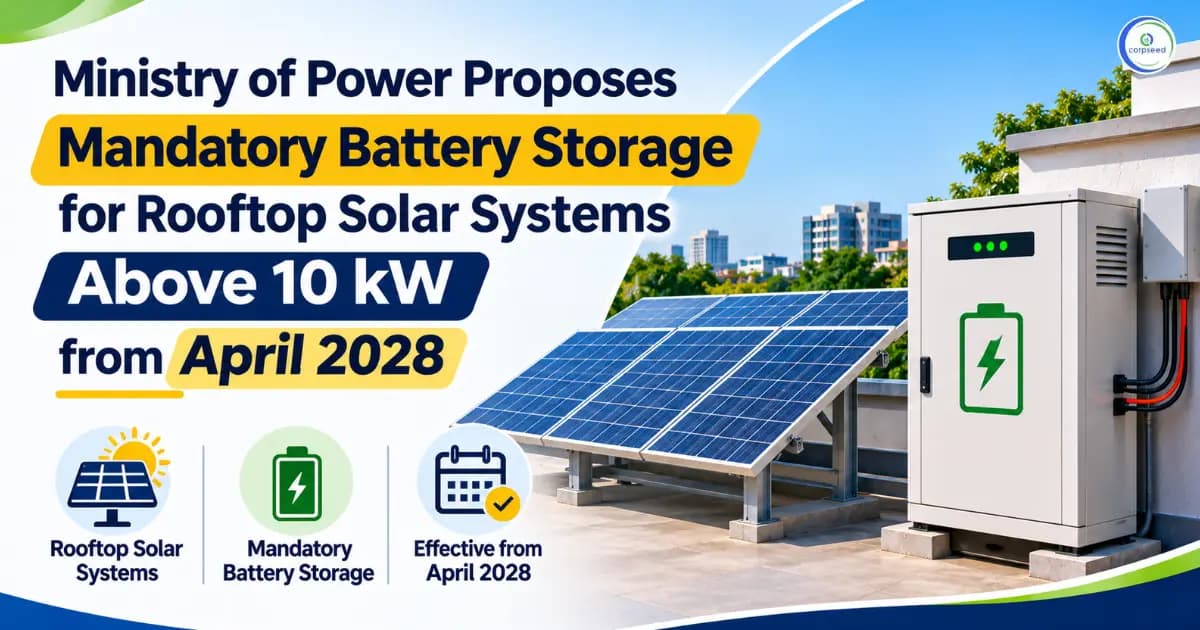
From 1 April 2028, eligible consumers may be required to install energy storage capacity equivalent to at least 20% of their daily electricity generation, subject to state-specific regulations.
The draft also proposes changes to net metering charges, renewable energy installation limits, Time-of-Day tariffs and electricity billing safeguards to improve grid stability and strengthen consumer protection.
Draft Electricity (Rights of Consumers) Amendment Rules, 2026 at a Glance
| Particulars | Details |
|---|---|
| Issuing Authority | Ministry of Power |
| Principal Rules | Electricity (Rights of Consumers) Rules, 2020 |
| Governing Act | Electricity Act, 2003 |
| Reference Number | 23/05/2020-R&R-I (Part-I) Vol. II |
| Revised Draft Date | 23 November 2026 |
| Proposed General Effective Date | 1 April 2027 |
| Proposed Energy Storage Threshold | As determined by SERCs; above 10 kW where no threshold is specified |
| Proposed Energy Storage Capacity | At least 20% of daily generation or a proportion specified by the SERC |
| Proposed Storage Implementation Date | 1 April 2028 |
| Net Metering Charges | Based on state-specific capacity thresholds |
| Abnormal Bill Resolution Period | 30 days |
| Stakeholder Consultation Deadline | 23 December 2026 |
Why Has the Ministry of Power Proposed These Amendments?
The rapid adoption of rooftop solar systems across residential, commercial and industrial establishments has introduced new challenges for electricity distribution companies. Solar installations generate electricity primarily during daylight hours, while electricity demand often remains high during evening hours when solar generation declines.
Consumers using net metering facilities can export surplus solar electricity during the day and draw electricity from the distribution network during non-solar hours. According to the Ministry, the existing arrangement may result in inadequate recovery of network-related fixed costs and increased cross-subsidisation by other electricity consumers.
The proposed amendments seek to address these challenges by encouraging energy storage, improving electricity demand management, allowing state-specific tariff arrangements and strengthening consumer rights.
The major objectives include:
- Improving electricity grid stability and renewable energy integration.
- Reducing peak-hour power procurement pressure on DISCOMs.
- Encouraging the adoption of Battery Energy Storage Systems (BESS).
- Improving the recovery of electricity distribution network costs.
- Strengthening electricity billing transparency and consumer grievance resolution.
Mandatory Energy Storage for Rooftop Solar Installations
Under the proposed Rule 11(4A), SERCs may prescribe the installed renewable energy capacity beyond which consumers generating their own electricity will be required to install an Energy Storage System.
Where the respective State Commission has not prescribed a capacity threshold, the requirement would apply to renewable energy installations exceeding 10 kW.
The proposed framework links storage capacity to daily electricity generation. Consumers may be required to install storage equivalent to at least 20% of their daily generation, unless the State Commission specifies another proportion.
| Parameter | Proposed Requirement |
|---|---|
| Applicable Installations | Renewable energy systems exceeding the prescribed threshold |
| Default Capacity Threshold | Above 10 kW |
| Proposed Storage Capacity | At least 20% of daily electricity generation or another state-prescribed proportion |
| Regulatory Authority | State Electricity Regulatory Commission |
| Intended Implementation Date | 1 April 2028 |
The proposed requirement could significantly influence the design, procurement and investment planning of commercial rooftop solar projects and industrial renewable energy installations.
How Will the 20% Energy Storage Requirement Be Calculated?
The proposed storage requirement is based on the amount of electricity generated during a day, rather than simply 20% of the installed solar panel capacity.
The following table illustrates the proposed calculation where the 20% proportion applies.
| Daily Electricity Generation | Illustrative Energy Storage Requirement |
|---|---|
| 50 kWh | 10 kWh |
| 100 kWh | 20 kWh |
| 250 kWh | 50 kWh |
| 500 kWh | 100 kWh |
| 1,000 kWh | 200 kWh |
| 2,000 kWh | 400 kWh |
Important: These figures are illustrative. Actual battery sizing will depend on the applicable state regulations, generation assessment methodology and technical requirements. The revised draft does not prescribe a uniform battery chemistry or detailed battery sizing methodology.
Who Will Be Affected by the Proposed Energy Storage Requirement?
The proposed amendments are particularly relevant to commercial and industrial electricity consumers operating larger renewable energy installations.
Potentially affected stakeholders include:
- Manufacturing units and factories with rooftop solar installations.
- Commercial buildings, shopping malls and office complexes.
- Warehouses, logistics parks and industrial estates.
- Hospitals, hotels and educational institutions.
- Residential consumers and housing societies with larger solar installations.
- Solar power developers and EPC contractors.
- Battery manufacturers, importers and energy storage system suppliers.
Residential installations of 10 kW or below would fall outside the proposed default storage threshold. However, SERCs may prescribe different capacity limits based on state-specific conditions.
Proposed Changes to Net Metering Charges
The Ministry of Power has proposed giving SERCs greater flexibility to regulate net metering arrangements and determine applicable charges for rooftop solar consumers.
Under the existing framework, net metering is permitted up to 500 kW where the State Commission has not prescribed a separate capacity limit.
The revised draft proposes allowing SERCs to introduce charges for solar photovoltaic installations exceeding specified thresholds. These charges may account for the estimated cost of energy storage and losses associated with using the electricity distribution network.
Proposed Net Metering Framework
| Particulars | Proposed Provision |
|---|---|
| Net Metering Capacity Limit | Determined by the respective SERC |
| Installations Within Prescribed Threshold | No proposed net metering charges under this provision |
| Installations Above Prescribed Threshold | Charges may be imposed |
| Basis for Determining Charges | Imputed energy storage costs and adjustments for network losses |
| Uniform Nationwide Charges | Not prescribed |
| Regulatory Implementation | State-specific regulations |
The draft does not establish a common nationwide net metering fee. Businesses should assess the applicable state-level regulations before calculating the expected financial returns from rooftop solar investments.
Renewable Energy Installations Permitted Beyond Rooftops and Sanctioned Load
The proposed amendment to Rule 11(2) seeks to provide consumers with greater flexibility in establishing renewable energy generation systems.
Consumers may be permitted to install solar and other renewable energy systems on suitable areas within their premises, rather than being restricted to rooftops.
The installed renewable energy capacity may also exceed the sanctioned electricity load, subject to the limits prescribed by the respective State Commission.
However, the proposal distinguishes between installed generation capacity and the amount of electricity that consumers can export to the distribution network.
| Activity | Proposed Regulatory Condition |
|---|---|
| Installation on rooftops | Permitted |
| Installation on other parts of the premises | Permitted, subject to applicable requirements |
| Installation beyond sanctioned load | Subject to SERC-prescribed limits |
| Electricity injection beyond sanctioned load | Requires specific authorization from the distribution licensee |
| Unauthorized excess electricity injection | No payment or compensation for excess electricity |
| Penalty for unauthorized injection | As prescribed by the State Commission |
This provision could create additional opportunities for businesses with sufficient space to expand their captive renewable energy generation capacity.
However, permission to install additional solar capacity should not be treated as automatic permission to export additional electricity to the grid.
Revised Implementation Timeline for Time-of-Day Tariffs
The Ministry has proposed revising the implementation deadlines for Time-of-Day (ToD) electricity tariffs under Rule 8A.
Time-of-Day tariffs allow electricity rates to vary according to the time of consumption. Consumers may benefit from shifting electricity-intensive operations to periods when renewable energy generation is higher and electricity procurement costs are lower.
Proposed Time-of-Day Tariff Deadlines
| Consumer Category | Proposed Implementation Deadline |
|---|---|
| Consumers with maximum demand exceeding 10 kW | No later than 1 April 2028 |
| Other non-agricultural consumers | No later than 1 April 2029 |
| Agricultural consumers | Excluded from this proposed ToD framework |
SERCs would determine applicable tariff periods after considering electricity demand patterns, renewable energy generation, power procurement costs and metering infrastructure.
The proposed Time-of-Day tariff would apply to the energy charge component of the normal electricity tariff.
Commercial and industrial consumers should evaluate their electricity consumption patterns, production schedules and energy storage requirements to manage potential peak-hour electricity costs.
Consumer Protection Against Abnormal Electricity Bills
The revised draft introduces additional safeguards against unusually high or low electricity consumption recorded in billing cycles.
Distribution licensees would be required to establish billing system arrangements that identify abnormal consumption patterns by comparing current billed consumption with the average consumption of the preceding six billing cycles.
Proposed Electricity Billing Safeguards
| Particulars | Proposed Provision |
|---|---|
| Unusually High Consumption | More than five times the previous six-cycle average |
| Unusually Low Consumption | Below one-fifth of the previous six-cycle average |
| Reference Period | Previous six billing cycles |
| Alternative Thresholds | May be determined by the SERC |
| Resolution Deadline | Within 30 days of bill generation |
| Protection Against Disconnection | Available if the consumer continues paying based on average consumption |
| Billing System Implementation | Within six months of commencement of the amended rules, or earlier |
For example, if a consumer's average electricity consumption over the previous six billing cycles is 500 units, consumption exceeding 2,500 units or falling below 100 units would trigger a review under the proposed default thresholds.
The consumer would be protected against electricity disconnection during the review period, provided payment continues on the prescribed average-consumption basis.
Revised Timelines for New Electricity Connections
The draft also proposes changes to the maximum timelines for providing new electricity connections or modifying existing connections after receipt of a complete application.
| Location or Connection Category | Proposed Maximum Timeline |
|---|---|
| Metropolitan and municipal corporation areas | 3 days |
| Other municipal areas | 7 days |
| Rural areas | 15 days |
| Rural areas in specified hilly states and Union Territories | 30 days |
| Connections requiring distribution network extension or new substations | 90 days |
The proposed changes seek to bring municipal corporation areas under the same connection timeline applicable to metropolitan areas.
These provisions could help businesses reduce delays associated with obtaining or modifying electricity connections for their commercial and industrial operations.
Strengthening Consumer Grievance Redressal Mechanisms
The revised draft proposes restructuring Consumer Grievance Redressal Forums (CGRFs) to improve the handling of electricity-related complaints.
The proposed framework includes:
- Grievance forums operating at a minimum of two levels, including the company level and district or municipal level.
- Normal grievance resolution within 30 days, subject to a maximum of 45 days.
- An opportunity to approach the company-level forum within 90 days of the lower-level forum's decision before appealing to the Ombudsman.
- Online complaint submission, virtual hearings and grievance tracking facilities.
- Online availability of complaint resolution status.
These changes are intended to improve accountability and accessibility in consumer grievance handling.
Introduction of a Demand Response Framework
The Ministry has proposed inserting Rule 17 to establish a regulatory framework for Demand Response programmes, allowing consumers to reduce or shift electricity consumption during peak demand periods through financial incentives or tariff signals.
The proposed state-level framework may cover provider eligibility, consumer incentives, software and communication systems, performance verification and financial settlement. Industrial consumers could benefit by optimising electricity use and better utilising stored renewable energy.
Impact of the Proposed Amendments on Solar and Battery Businesses
The revised draft could influence investment decisions across India's solar energy, battery manufacturing and electricity storage sectors.
| Business Category | Potential Impact |
|---|---|
| Rooftop Solar Developers | Greater integration of energy storage into project designs |
| Solar EPC Contractors | Additional battery installation and system integration opportunities |
| Battery Manufacturers | Potential increase in demand for stationary energy storage batteries |
| Battery Importers | Greater demand for compliant battery products |
| BESS Suppliers | Expansion of commercial and industrial energy storage opportunities |
| Manufacturing Units | Changes in renewable energy investment and electricity cost planning |
| Commercial Establishments | Assessment of battery storage costs and net metering charges |
| Electricity Distribution Companies | Improved demand management and potential network cost recovery |
| MSMEs | Additional investment considerations for larger solar installations |
| Battery Recyclers | Potential long-term increase in demand for end-of-life battery management |
While the proposed amendments could create new business opportunities, larger rooftop solar consumers may also face additional upfront investment requirements for battery storage infrastructure.
Regulatory Compliance Requirements for Solar and Battery Businesses
Apart from the proposed electricity rules, manufacturers, importers and developers operating in the renewable energy sector should continue to assess their existing regulatory obligations.
Depending on their business activities and product categories, applicable compliance requirements may include:
| Compliance Requirement | Applicability |
|---|---|
| BIS Certification | Solar modules, inverters, batteries and electrical equipment covered under applicable compulsory certification requirements |
| EPR Registration for Battery Waste Management | Applicable battery producers, including importers |
| Battery EPR Annual Compliance | Fulfilment of applicable waste battery management and reporting obligations |
| Electrical Safety Approvals | Renewable energy and battery installations requiring statutory electrical approvals |
| Pollution Control Board Approvals | Applicable battery manufacturing and recycling facilities |
| Grid Connectivity Approval | Grid-connected renewable energy installations |
| Fire Safety Approvals | Battery storage and industrial facilities, wherever prescribed |
These are separate regulatory requirements under applicable laws. The proposed electricity amendments do not independently introduce new BIS certification, EPR registration or pollution control licensing obligations for every rooftop solar consumer.
Important Implementation Dates
| Event | Date or Timeline |
|---|---|
| Revised Draft Issued | 23 November 2026 |
| Last Date for Stakeholder Comments | 23 December 2026 |
| Proposed General Commencement | 1 April 2027 |
| Abnormal Billing System Implementation | Within six months of commencement, or earlier |
| Intended Energy Storage Implementation | 1 April 2028 |
| ToD Tariff Deadline for Consumers Above 10 kW Maximum Demand | 1 April 2028 |
| ToD Tariff Deadline for Other Non-Agricultural Consumers | 1 April 2029 |
All proposed implementation dates remain subject to final notification and applicable regulatory arrangements.
Submission of Stakeholder Comments and Suggestions
The Ministry of Power has invited comments and suggestions from stakeholders on the revised draft Electricity (Rights of Consumers) Amendment Rules, 2026.
| Particulars | Details |
|---|---|
| Consultation Authority | Ministry of Power |
| Submission Deadline | 23 December 2026 |
| Document Format for Email Submission | MS Word |
| Official Email Address | rr1-mop@gov.in |
Solar developers, battery manufacturers, industry associations, commercial electricity consumers and other interested stakeholders may submit representations concerning the proposed energy storage capacity, net metering charges, implementation timelines and technical requirements.
What Should Businesses Do to Prepare for the Proposed Amendments?
Businesses operating existing rooftop solar installations or planning new renewable energy projects should assess the potential financial, technical and regulatory impact of the revised draft.
The recommended preparatory measures include:
- Review Existing Solar Capacity: Identify installed renewable energy capacity, sanctioned electricity load and daily electricity generation.
- Assess Battery Storage Requirements: Evaluate suitable energy storage capacity and associated capital expenditure.
- Review Net Metering Arrangements: Examine existing metering agreements and potential changes in state-specific electricity charges.
- Evaluate Product Compliance: Verify applicable BIS certification, battery EPR registration and electrical safety requirements before procuring equipment.
- Update Project Financial Planning: Consider battery procurement, installation, maintenance and potential changes in electricity tariff structures.
- Monitor Regulatory Developments: Track the final notification from the Ministry of Power and subsequent regulations issued by the respective SERC.
Businesses operating existing solar installations should not assume either automatic exemption or an immediate mandatory retrofit requirement. The treatment of existing installations requires further regulatory clarity.
How Can Corpseed Help Solar Energy and Battery Storage Businesses?
The proposed energy storage requirements could change how businesses plan rooftop solar installations, procure batteries and manage renewable energy compliance. Corpseed provides regulatory compliance consultancy, BIS certification assistance, battery EPR registration and industrial licensing support to solar developers, battery manufacturers, importers and energy storage businesses.
Corpseed helps with:
- Battery EPR Registration: CPCB registration and documentation support for eligible battery manufacturers and importers.
- Battery EPR Compliance: Annual return filing, EPR obligation assessment and waste battery management compliance.
- BIS Certification Consultancy: Product-specific certification assessment, testing documentation and application assistance for covered solar and battery equipment.
- Environmental and Industrial Licensing: Applicable pollution control approvals and statutory permissions for battery manufacturing and recycling facilities.
- Regulatory Compliance Advisory: Assessment of applicable renewable energy regulations, project-specific approvals and compliance readiness.
Connect with Corpseed experts to evaluate your solar energy or battery storage project's regulatory requirements and prepare for upcoming compliance changes.
Key Takeaways
- The Ministry of Power issued the revised draft Electricity (Rights of Consumers) Amendment Rules, 2026, on 23 November 2026.
- Energy storage requirements are proposed for renewable energy installations exceeding the threshold prescribed by SERCs, with a default threshold of above 10 kW.
- The proposed minimum energy storage capacity is 20% of daily electricity generation, subject to state-specific regulations.
- The energy storage provision is proposed to take effect from 1 April 2028.
- SERCs may introduce net metering charges for solar installations exceeding specified capacity thresholds.
- Consumers may install renewable energy systems beyond their sanctioned electricity load, subject to regulatory limits.
- Time-of-Day tariff implementation deadlines are proposed to be revised to April 2028 and April 2029.
- DISCOMs will be required to review and resolve abnormal electricity billing cases within 30 days under the proposed framework.
- Stakeholders can submit comments and suggestions until 23 December 2026.
About the Author

Parul Bohral
Legal Content WriterParul Bohral, a BALLB graduate and experienced legal researcher and content writer with expertise in various legal areas, including corporate law and intellectual property. I have gained valuable experience in esteemed legal environments, where I have strengthened my research skills, allowing me to approach legal writing with precision and depth.
As a legal content writer, I am committed to delivering work that not only informs but also engages readers. By staying informed about the latest trends in content marketing and regulatory developments, I ensure that my writing remains sophisticated and meets industry standards. My dedication to thorough research enables me to craft content that is both insightful and impactful.