
Used Oil EPR in India: GST E-Invoicing & Hazardous Waste Rules Compliance Guide 2026
Used Oil EPR has moved quickly from registration to enforcement. Targets double to 20% in 2026-27, and CPCB's June 2026 notice means a certificate is only valid when a GST e-invoice sits behind it. Recyclers that fix their invoicing now will be the suppliers producers trust; producers that check their recyclers now will avoid inheriting someone else's false certificate.
Schedule a Call Back
Businesses we've worked with on used-oil EPR
Clients include Brenntag Ingredients India, VAS Petrochemicals, Genpact India, Headstrong Services India, Jakson, Aisin ASK India, Escorts Kubota, Sealand Trading Exim, Sun Oil Company (9 of 10+ served since 2018).
See our used-oil EPR service →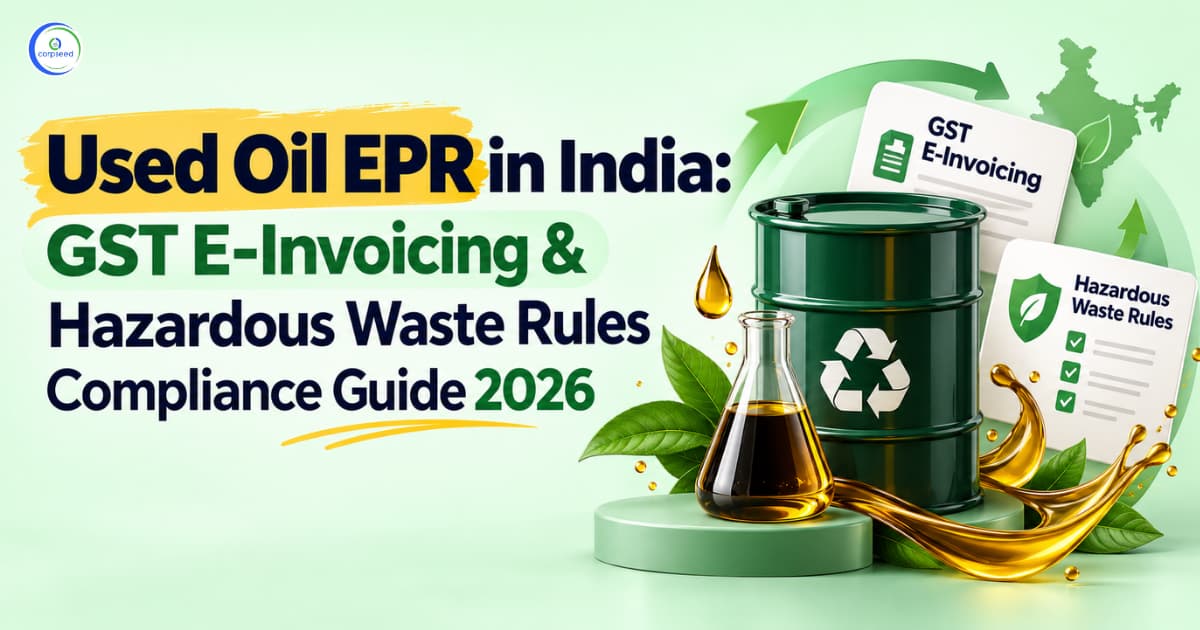
India's used oil sector has been under Extended Producer Responsibility (EPR) since 1 April 2024, when Chapter VII of the Hazardous and Other Wastes (Management and Transboundary Movement) Rules, 2016 came into force through the Second Amendment Rules, 2023 (MoEF&CC notification G.S.R. 677(E), dated 18 September 2023). Every producer of base oil or lubrication oil, and every importer of used oil, now has to meet a recycling target by buying EPR certificates from recyclers registered with the Central Pollution Control Board (CPCB).
In June 2026 the rules tightened further. A CPCB notice dated 2 June 2026 requires recyclers to record sales of recycled product through GST-linked invoices, and states that EPR certificates generated on sales invoices other than GST e-invoices will not be considered after 30 June 2026. Such certificates are to be treated as false certificates and non-compliance under the Rules. Producers, in turn, must accept GST-linked e-invoices from recyclers. With producer targets doubling to 20% in 2026-27, a certificate that fails this test is now a real compliance risk on both sides of the transaction.
This guide explains who must register for Used Oil EPR, the targets, fees and certificate rules, what CPCB's GST e-invoicing requirement means in practice for recyclers and producers, the end-to-end compliance process, and how Corpseed supports Used Oil EPR compliance.
What is Used Oil EPR?
Used Oil EPR is the legal obligation on producers of base oil and lubrication oil, and on importers of used oil, to ensure that a defined share of the oil they place on the Indian market is collected and recycled in an environmentally sound manner. The obligation is met by purchasing EPR certificates, generated on CPCB's EPR Portal for Used Oil Management by registered recyclers after they recycle used oil.
A recycler's certificates are calculated with a formula set out in CPCB's FAQs: QEPR = QP × CF × WP, where QP is the quantity of end product recovered, CF is a conversion factor determined by CPCB, and WP is a weightage of 1.0 for re-refined base oil and 0.25 for energy recovery. Re-refining therefore earns four times the certificate value of burning used oil for energy, which is a deliberate push towards circular use of oil.
Regulatory Framework for Used Oil EPR in India
Used Oil EPR sits inside India's hazardous waste law, and its certificate system now connects to GST:
- Environment (Protection) Act, 1986 - Sections 6, 8 and 25 empower the Central Government to make the hazardous waste rules.
- Hazardous and Other Wastes (Management and Transboundary Movement) Rules, 2016 - The parent rules governing hazardous and other wastes, including used oil.
- Second Amendment Rules, 2023 (G.S.R. 677(E), 18 September 2023) - Inserted Chapter VII, "Extended Producer Responsibility for Used Oil", in force from 1 April 2024.
- Amendment Rules, 2024 (G.S.R. 177(E), 12 March 2024) - A further amendment to the 2016 Rules, published with the Used Oil EPR rules on CPCB's portal.
- CPCB EPR Portal for Used Oil Management - The single portal for registration, certificate generation, transactions and returns (eprusedoil.cpcb.gov.in).
- CPCB Notice, F. No. CP-21/49/2023-WM-II-HO-CPCB-HO-Part(1), 2 June 2026 - GST e-invoice requirement for EPR certificate generation, effective after 30 June 2026.
- GST e-invoicing - Notification No. 10/2023-Central Tax, 10 May 2023 - E-invoicing mandatory for taxpayers with aggregate turnover above Rs.5 crore from 1 August 2023; e-invoices are registered on the Invoice Registration Portal, which issues an Invoice Reference Number (IRN) and QR code.
- CPCB guidelines on Environmental Compensation - Issued to State Pollution Control Boards and Pollution Control Committees for violations under the Second Amendment Rules, 2023.
Who Must Register for Used Oil EPR?
CPCB's FAQs identify four kinds of entity that must register on the EPR Portal for Used Oil Management:
- Producers - Any person or entity, whatever the selling channel (dealer, retailer or e-retailer), that manufactures and sells base oil or lubrication oil in India under its own brand, sells lubrication oil under its own brand using base oil from other manufacturers, or sells imported base oil or lubrication oil in India. CPCB groups producers into nine categories (P1 to P9). Producers of exempted oils must also register so that the exemption claim can be verified.
- Used oil importers - Entities importing used oil, whose obligation is 100% of the used oil imported in the previous year.
- Recyclers - Facilities that recycle used oil and generate EPR certificates.
- Collection agents - Entities that collect used oil from generators and channel it to registered recyclers.
Two practical points often trip businesses up. First, an entity carrying out more than one activity must register separately for each activity, unless the activities share the same GST number, in which case one login can hold separate profiles. Second, a new unit established after 1 April 2024 takes on its EPR obligation two years after the end of the financial year in which it was established.
Key Used Oil EPR Requirements: Targets, Fees and Certificates
Producer targets rise in steps, calculated on oil sold or imported two years earlier (Y-2):
| Financial year | EPR target for producers | Based on oil sold/imported in |
| 2024-25 | 5% | 2022-23 |
| 2025-26 | 10% | 2023-24 |
| 2026-27 | 20% | 2024-25 |
| 2027-28 | 20% | 2025-26 |
| 2028-29 | 40% | 2026-27 |
| 2029-30 | 40% | 2027-28 |
| 2030-31 onwards | 50% | Year Y-2 |
Registration fees depend on the entity type and annual quantity or capacity, as published in CPCB's FAQs:
| Entity | Slab | Registration fee |
| Producer (base/lubrication oil, MTPA) | Above 1,00,000 | Rs.10,00,000 |
| 50,001–1,00,000 | Rs.5,00,000 | |
| 10,001–50,000 | Rs.2,00,000 | |
| 5,000–10,000 | Rs.50,000 | |
| Below 5,000 | Rs.25,000 | |
| Used oil importer (MTPA imported) | Above 1,00,000 | Rs.10,00,000 |
| 50,001–1,00,000 | Rs.5,00,000 | |
| 10,001–50,000 | Rs.2,00,000 | |
| 1,001–10,000 | Rs.1,00,000 | |
| 500–1,000 | Rs.50,000 | |
| Below 500 | Rs.25,000 | |
| Recycler (facility capacity, MTPA) | Above 20,000 | Rs.75,000 |
| 10,001–20,000 | Rs.50,000 | |
| 5,000–10,000 | Rs.35,000 | |
| Below 5,000 | Rs.25,000 | |
| Collection agent (facility capacity, MTPA) | Above 10,000 | Rs.10,000 |
| 5,001–10,000 | Rs.5,000 | |
| 2,001–5,000 | Rs.2,000 | |
| 500–2,000 | Rs.1,000 | |
| Below 500 | Rs.500 |
An annual processing charge of 25% of the application fee applies in each category. These are government fees; professional fees are separate.
Certificate rules every producer should know:
- Validity: two years from the end of the financial year in which the certificate was generated.
- No trading between producers: certificates are not tradable between registered producers or used oil importers.
- Purchase cap: a producer may buy certificates up to its current-year liability, plus any leftover liability from earlier years, plus 10% of the current year's liability.
- Price band: CPCB fixes the highest and lowest certificate prices at 100% and 30% of the Environmental Compensation rate.
CPCB's GST E-Invoicing Requirement: What the June 2026 Notice Says
The CPCB notice of 2 June 2026, addressed to recyclers and producers under the Second Amendment Rules, 2023, sets out three requirements:
Recyclers must use GST-linked invoices: to generate EPR certificates on the portal, recyclers must maintain records of sales of recycled product through invoices linked to GST.
Non-e-invoice certificates are invalid after 30 June 2026: registered recyclers without GST-linked invoicing must register for GST e-invoicing immediately. Certificates based on recycled-product sales invoices other than GST e-invoices will not be considered after 30 June 2026, and are treated as false certificates and non-compliance under the Rules.
Producers must accept e-invoices: producers must henceforth accept sales e-invoices linked to GST for recycled products from used oil recyclers.
What this means in practice:
For recyclers: every sale of re-refined base oil or other recycled product that supports an EPR certificate must carry a GST e-invoice with an IRN and QR code. Recyclers below the Rs.5 crore e-invoicing threshold should confirm with their GST advisor how to set up e-invoicing, since CPCB's notice applies to all registered recyclers.
For producers and importers: certificates are only as good as the invoices behind them. Because the Rules provide for Environmental Compensation for the use of false EPR certificates, producers should check recyclers' e-invoicing readiness before buying, and reconcile certificates against GST purchase records.
Used Oil EPR Compliance Process: End to End
A defensible Used Oil EPR programme follows these steps:
- Applicability check: confirm whether you are a producer, importer, recycler or collection agent, whether any of your oils are exempt, and when your obligation starts (including the two-year rule for new units).
- Portal registration: register on the EPR Portal for Used Oil Management for each activity, with the correct GST and PAN details, and pay the applicable fee.
- Target calculation: calculate the current-year target from oil sold or imported in year Y-2, and add any leftover liability from earlier years.
- E-invoicing readiness (recyclers): set up GST e-invoicing for every sale of recycled product, and keep sales records linked to GST.
- Certificate generation (recyclers): generate certificates on the portal using the QEPR formula, based on e-invoiced sales after 30 June 2026.
- Certificate purchase (producers and importers): buy certificates from registered recyclers within the purchase cap and price band, backed by GST e-invoices.
- Returns: producers and importers file the annual return by 30 June following the financial year (CPCB has extended the FY 2025-26 annual return to 30 November 2026); recyclers and collection agents file quarterly and annual returns.
- Reconciliation and records: reconcile certificates with GST records every quarter and keep an audit trail for inspections.
Benefits of Getting Used Oil EPR Right
- No Environmental Compensation: meeting targets with valid certificates avoids compensation for non-fulfilment of obligations or use of false certificates.
- Certificates that hold up: e-invoice-backed certificates are traceable to real, tax-paid sales, so they stand up to scrutiny.
- Cleaner supply chains: e-invoicing pushes collection and recycling into the formal sector, reducing the risk that used oil is burnt or dumped illegally.
- Credible sustainability reporting: verified recycling data supports the environmental disclosures that lubricant brands increasingly make to customers and investors.
- Commercial advantage for recyclers: e-invoice-ready recyclers become the preferred certificate suppliers for producers.
Corpseed's Used Oil EPR Services
We support every party in the Used Oil EPR chain:
Applicability assessment: we classify your activities and check exemptions and obligation start dates.
CPCB portal registration: for producers, used oil importers, recyclers and collection agents, including multi-activity entities.
Target calculation and annual returns: EPR liability worked out from your sales or import data, and returns filed within the deadline.
Certificate planning and reconciliation: certificate requirements matched against e-invoices and portal records.
E-invoice readiness checks for recyclers: a review of whether your sales invoicing meets CPCB's June 2026 notice, coordinated with your GST advisor.
Notice and Environmental Compensation support: help responding to SPCB or CPCB notices.
Conclusion
Used Oil EPR has moved quickly from registration to enforcement. Targets double to 20% in 2026-27, and CPCB's June 2026 notice means a certificate is only valid when a GST e-invoice sits behind it. Recyclers that fix their invoicing now will be the suppliers producers trust; producers that check their recyclers now will avoid inheriting someone else's false certificate.
Corpseed works with producers, importers, recyclers and collection agents across India to register on the CPCB portal, calculate and meet EPR targets, file returns on time, and keep certificates backed by the records CPCB now expects.
Need Used Oil EPR registration or annual return support? Contact Corpseed for CPCB portal registration, EPR target calculation and certificate reconciliation. Visit www.corpseed.com.
About the Author

Mahek Sancheti
Content WriterMahek Sancheti, BAJMC graduate with a deep passion for writing. As a content writer, video content creator, creative content creator, and scriptwriter, I bring stories to life through words and visuals. I honed my skills by working with a prominent news agency, where I excelled in crafting compelling narratives and engaging content. Coming from a journalism and mass communication background I have skills to craft engaging narratives that captivate audiences. With a keen interest in writing and creativity, I aim to deliver impactful and meaningful content that resonates with diverse audiences.
https://www.linkedin.com/in/mahek-sancheti-837196212
Related articles
CPCB SOP 2026 for CTE and CTO Approvals - Timelines, Inspections and Key Directions
2026-10-30
E-Waste EPR for Electronics Brands: Registration, Targets & Annual Compliance
2026-10-26
Battery EPR Registration: Who Needs It Under the Battery Waste Management Rules?
2026-10-26
Detailed Project Report for CTE and CTO: Requirements, Format, Documents and Approval Process
2026-10-22
EPR Registration in India: Who Needs It and Which EPR Category Applies to Your Business?
2026-10-21
CPCB Guidelines on Levy of Fees Under the Solid Waste Management Rules, 2026
2026-10-07