This guide explains what the license is, who needs it, the documents and fees involved, how to apply on the CDSCO portal, and what you must do after you get it. We have kept the language simple and linked to the official sources so you can check every point yourself.
Quick answer
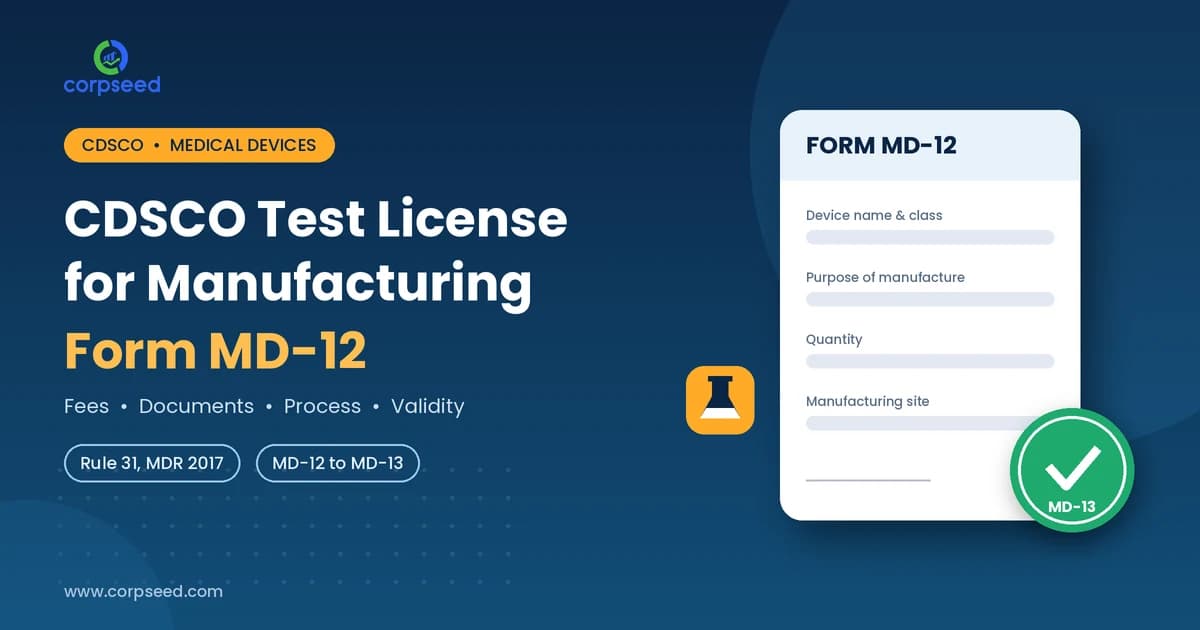
Form MD-12 is the application form under Rule 31 of the Medical Devices Rules, 2017 for a licence to manufacture medical devices (including in vitro diagnostics) only for clinical investigation, test, evaluation, examination, demonstration or training. The application goes to the Central Licensing Authority (CDSCO), and the licence is issued in Form MD-13. Devices made under it cannot be sold.
What Is a CDSCO Test License for Manufacturing?
A CDSCO test license is a limited permission to manufacture medical devices for non-commercial purposes. It lets a company make a defined quantity of a device so it can be tested, evaluated, shown to experts or used in a clinical investigation, without holding a full commercial manufacturing license.
The legal basis is Rule 31 of the Medical Devices Rules, 2017 (MDR 2017), framed under the Drugs and Cosmetics Act, 1940. The Central Drugs Standard Control Organisation (CDSCO), headed by the Drugs Controller General of India, acts as the Central Licensing Authority for this licence.
Form MD-12 vs Form MD-13
- Form MD-12 is the application you file.
- Form MD-13 is the licence CDSCO grants if your application is approved.
People often say “MD-12 license”, but strictly speaking, MD-12 is the request and MD-13 is the permission.
Who Needs a Test License in Form MD-12?
You should consider an MD-12 application if you plan to manufacture a medical device in India for any of these purposes:
- Clinical investigation of a new or investigational medical device.
- Testing and evaluation, such as performance, safety or bench testing at a lab.
- Examination by a notified body, test laboratory or expert committee.
- Demonstration of the device to doctors, hospitals or partners.
- Training of users or staff.
Form MD-12 generally applies to regulated medical devices across Classes A, B, C and D, including applicable in vitro diagnostic (IVD) devices. However, non-sterile and non-measuring Class A medical devices are exempt from the relevant licensing requirements under Chapter IV of the Medical Devices Rules, 2017.
Typical applicants include start-ups building their first product, established manufacturers developing a new model, research labs and incubators, and companies preparing for a clinical investigation.
MD-12 vs Other CDSCO Licenses: Which One Do You Need?
Many applicants file the wrong form. This table shows where MD-12 fits:
| Purpose | Application form | License form | Authority |
|---|---|---|---|
| Manufacture for test, evaluation, clinical investigation, demonstration or training | MD-12 | MD-13 | Central Licensing Authority (CDSCO) |
| Import for test, evaluation, clinical investigation, demonstration or training | MD-16 | MD-17 | Central Licensing Authority (CDSCO) |
| Manufacture for sale or distribution, Class A and B (where licensing applies) | MD-3 | MD-5 | State Licensing Authority |
| Manufacture for sale or distribution, Class C and D | MD-7 | MD-9 | Central Licensing Authority (CDSCO) |
So, if you are importing samples for testing, you need the import test license instead. If you want to sell your device, you need a regular medical device manufacturing license.
Fees for the CDSCO Test License (MD-12)
As per the Second Schedule of the Medical Devices Rules, 2017, the government fee for a test license to manufacture is Rs. 500 for each distinct medical device. The fee is paid online through the portal when you submit the application.
If you are listing several different devices, the fee adds up per device. Always confirm the current fee on the CDSCO website before paying, as fee schedules can be revised by notification.
Documents Required for Form MD-12
CDSCO checks whether your request is genuine, limited in scope and made at a suitable site. The portal checklist may change, but applicants are commonly asked for the following:
- Covering letter explaining the purpose of manufacture (testing, clinical investigation, demonstration or training).
- Duly filled Form MD-12 generated on the online portal.
- Device details: name, model, intended use, risk class and a brief description of design and materials.
- Quantity justification: how many units you need and why (for example, sample size for a test protocol or investigation plan).
- Manufacturing site details: address, layout and proof of possession of the premises (ownership or rent agreement).
- Constitution of the applicant: company incorporation certificate, partnership deed or other proof of legal status.
- Identity and address proof of the authorized signatory, with an authorisation letter or board resolution.
- Testing or investigation details: the protocol, name of the testing lab, or the clinical investigation plan where relevant.
- Undertaking that the devices will be used only for the stated purpose and will not be sold.
- Proof of fee payment generated on the portal.
- Manufacturing and technical details: List of manufacturing and testing equipment, qualified technical personnel, manufacturing process flowchart and applicable testing specifications or protocols.
How to Apply for a CDSCO Test Licence in Form MD-12: Step-by-Step Process
Applying for a CDSCO test licence involves a few steps, from checking the device classification to preparing documents and submitting Form MD-12. Before starting, make sure the device details, manufacturing location and purpose of testing are clearly defined. This can help avoid unnecessary queries during the application process. Here's how to apply:
- Register on the CDSCO medical device portal: Create an account on the CDSCO online portal for medical devices with your company and authorised signatory details.
- Check the device classification: Confirm the risk class (A, B, C or D) and intended use using CDSCO’s published classification lists on the medical devices section of the CDSCO website.
- Prepare documents: Collect and scan the documents listed above. Make sure names, addresses and device details match across every document.
- Fill Form MD-12 online: Enter device details, purpose, quantities and site information.
- Pay the fee: Pay Rs. 500 per distinct device through the portal’s payment gateway.
- Submit and track: Submit the application and track its status on the portal. Reply to any query from CDSCO promptly and completely.
- Receive Form MD-13: If CDSCO is satisfied, it grants the test license in Form MD-13, which you can download from the portal.
How Long Does It Take, and How Long Is the License Valid?
Processing time
Under Rule 31 of the Medical Devices Rules, 2017, the Central Licensing Authority is required to grant or reject the application within 30 days from the application date, subject to the applicable regulatory requirements.
In practice, processing time may depend on the completeness of the application and how quickly the applicant responds to CDSCO queries.
Validity
A test license in Form MD-13 is generally valid for three years from the date of issue. If your testing or investigation runs longer, plan a fresh application well before expiry.
Conditions and Duties After You Get the MD-13 License
Getting the license is not the end of the job. The test license comes with conditions, and CDSCO can inspect your records. Key duties include:
- Use only for the stated purpose. Devices made under the test license cannot be sold or supplied commercially.
- Keep proper records of quantities manufactured, used, tested, distributed to sites and remaining in stock.
- Label units clearly so they are identifiable as test or investigational units.
- Dispose of unused or rejected units safely and keep records of the disposal.
- Cooperate with inspections and share records when the licensing authority asks.
Running these steps through a basic quality system, such as one aligned with ISO 13485, makes record keeping much easier and prepares you for the full manufacturing license later.
Common Mistakes That Delay MD-12 Applications
- Filing the wrong form, for example using MD-12 when you are actually importing samples (MD-16 applies).
- Unclear purpose, such as writing “testing” without saying which tests, where and why.
- Unjustified quantities that look like commercial production.
- Mismatched details between the form, premises proof and company documents.
- Wrong risk class for the device, which can affect later licences too.
- Slow or partial replies to CDSCO queries.
From Test Licence to Market: What Comes Next?
A test license is usually one step on a longer path. Once testing and any clinical investigation are complete, you will typically need to:
- Apply for the applicable commercial manufacturing license (MD-3/MD-5 for Class A and B where licensing applies, or MD-7/MD-9 for Class C and D).
- Put a quality management system in place that meets the requirements of the Medical Devices Rules, 2017.
- Complete labelling, post-market surveillance and other compliance steps before sale.
Planning these steps early saves time. You can learn more in our guide to medical device registration in India.
How Corpseed Can Help
Corpseed’s regulatory team supports medical device and IVD companies with the full CDSCO journey, including:
- Checking whether you need MD-12, MD-16 or a commercial license.
- Device classification and document preparation.
- Filing Form MD-12 on the NSWS portal and handling queries.
- Planning the move from test license to manufacturing or import license.
Ready to start your CDSCO test license? Talk to a Corpseed expert today for a free consultation and a clear document checklist for your device.
Conclusion
A CDSCO test license for manufacturing allows eligible businesses to manufacture medical devices for testing, evaluation, clinical investigation, demonstration or training without obtaining a commercial manufacturing licence. Before applying through Form MD-12, manufacturers should check the applicable requirements, prepare the necessary documents and justify the quantity of devices required. Proper preparation can help avoid unnecessary delays during the approval process.
Need assistance with your CDSCO test licence application? Corpseed helps medical device manufacturers and start-ups with Form MD-12 documentation, application filing and regulatory compliance. Contact our experts for guidance throughout the process.