
Compliance Report for CTO in India: Format, Due Dates & Filing Guide
A factory may have a valid Consent to Operate (CTO) and still receive a notice from the Pollution Control Board. This can happen when the business fails to submit a required compliance report, misses environmental monitoring or cannot provide records supporting its operations.
Schedule a Call Back
1,800+ CTE/CTO and plant setup assignments since 2018
Clients include Magnum Aluminium, Enershell Alloys and Steel, Ganesh Foundry & Cast, Inland Speciality Metals, JK Cement, Sskbp India Alloy, Denso India, Neometrix Defence, PMS Waste Management, Daebak India Recycler, Ganix Rubber Recycling, Pashidaa E Waste Copper Battery Recycling PLT Company (12 of 1,100+ served since 2018).
A few more clients we've served in this industryHide the list
- Engineering and manufacturing
- Magnum Aluminium · Enershell Alloys and Steel · Ganesh Foundry & Cast · Inland Speciality Metals · JK Cement · Sskbp India Alloy · Denso India · Neometrix Defence
- Recycling and waste management
- PMS Waste Management · Daebak India Recycler · Ganix Rubber Recycling · Pashidaa E Waste Copper Battery Recycling PLT Company · Upcycle Debris Management · Ficusa Ewaste Recyclers · Shuchaye Recyclers · Quantara Battery Recycling
- Logistics and trade
- 20Cube Logistics Solutions · Airsurge Logistics · Green Space Logistics · Saap Logistics
- Food and consumer goods
- Bake Wish · Kokora Spices · Babi Beverages · Indraj Beverages and Distilleries · Adheshwar Agro Dairy Products · Venco Research and Breeding Farm · Explore Food · IFF India Frozen Foods
- Energy and power
- Servotech Renewable Power System · Saurya Urja Company of Rajasthan · Sun Mobility · Sun Max Solar · Maxvolt Energy Industries · Rays Power Infra
- Chemicals and materials
- Venkateshwara Roto Pack · Lami Tube · M C Bauchemie I · Pro Flexi Packaging · Rustchem Corrosols · SVN Polymers · Kairaa Polypack · Sanctum Chemicals
- More clients
- Intangles Lab · Alten India · Adit Buildwell · Ecowise Trading · GS E-Commerce · Beaucience India
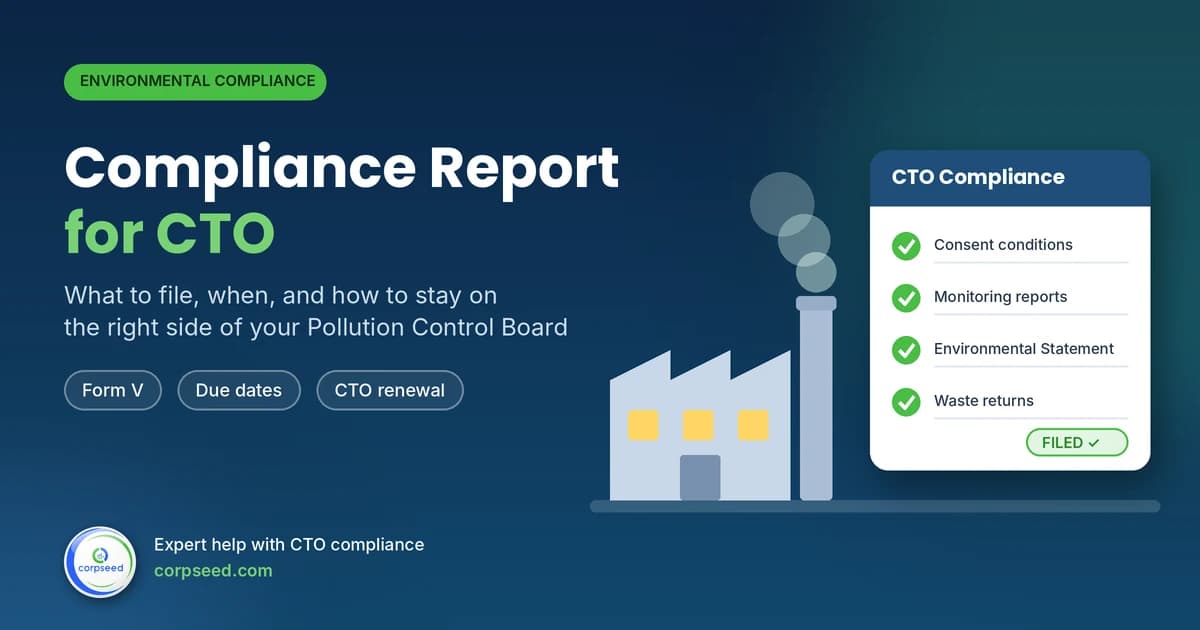
A factory may have a valid Consent to Operate (CTO) and still receive a notice from the Pollution Control Board. This can happen when the business fails to submit a required compliance report, misses environmental monitoring or cannot provide records supporting its operations.
A compliance report for CTO helps industries demonstrate whether they are meeting the environmental conditions applicable to their operations. Depending on the unit, this may involve annual returns, pollution monitoring results and condition-wise compliance statements.
This blog explains which reports may be required, their filing deadlines, the reporting format and how businesses can prepare submissions. Corpseed also assists industries with identifying CTO compliance requirements and preparing applicable environmental reports.
Schedule a Call Back
What Is a Compliance Report for CTO?
A compliance report for CTO is a document that explains how an industrial unit has fulfilled the environmental conditions attached to its Consent to Operate.
The CTO is issued under applicable provisions of the Water (Prevention and Control of Pollution) Act, 1974, and the Air (Prevention and Control of Pollution) Act, 1981.
The consent may specify conditions relating to wastewater treatment, air emissions, waste disposal, production capacity and operation of pollution control equipment.
A compliance report provides records supporting the industry's compliance with these requirements.
However, there is no single nationwide prescribed form called a CTO compliance report. Businesses may need to submit statutory returns, laboratory monitoring results or separate condition-wise reports.
For example, a factory with an Effluent Treatment Plant (ETP) may be required to maintain wastewater testing records. A unit handling hazardous waste may have an additional obligation to submit an annual return.
The actual requirements depend on applicable rules and the consent issued to the industry.
Is a CTO Compliance Report Mandatory for Every Industry?
Not every industry must submit the same CTO compliance reports. The reporting obligations depend on the unit's operations, applicable environmental laws and specific instructions issued by its Pollution Control Board.
Businesses should consider the following:
- Consent conditions: Some CTO orders require periodic condition-wise compliance statements.
- Statutory returns: Environmental Statement Form V applies to industries and operations covered by Rule 14 of the Environment (Protection) Rules, 1986.
- Hazardous waste activities: Relevant occupiers and disposal facility operators may need to submit Form 4.
- Environmental monitoring: Industries may need to conduct and submit stack, effluent or ambient air monitoring as prescribed.
- Industry classification: Red, Orange and Green category units may have different monitoring and consent requirements, subject to applicable exemptions and directions.
A business should review its CTO order alongside the relevant statutory rules. The absence of a specific instruction in the consent does not automatically remove an independent statutory filing obligation.
Which Reports Must Industries Submit for CTO Compliance?
Different environmental reports serve different purposes. Some are annual statutory returns, while others demonstrate compliance with specific conditions.
| Report | Legal basis or requirement | Applicability | Deadline or frequency |
|---|---|---|---|
| Environmental Statement (Form V) | Rule 14, Environment (Protection) Rules, 1986 | Covered industries and operations | 30 September annually |
| Hazardous Waste Annual Return (Form 4) | Rule 20, Hazardous and Other Wastes Rules, 2016 | Applicable occupiers and disposal facility operators | 30 June annually |
| Condition-Wise CTO Compliance Report | Conditions in the CTO order | Units required to submit it | As prescribed |
| Environmental Monitoring Reports | Applicable consent conditions and directions | Industries with monitoring obligations | As prescribed |
| Online Monitoring Data | Applicable CPCB/SPCB requirements | Units required to install online monitoring systems | Continuous, where applicable |
| Environmental Clearance Compliance Report | EC conditions and applicable EIA requirements | Projects holding Environmental Clearance | Generally half-yearly, separately from CTO |
Environmental Statement (Form V)
Environmental Statement Form V is an annual return prescribed under Rule 14 of the Environment (Protection) Rules, 1986.
It records environmental information relating to:
- Water and raw material consumption
- Pollution discharged into the environment
- Hazardous and other waste generation
- Waste management and resource recovery
- Measures taken for environmental protection
The report covers the financial year ending 31 March and must generally be submitted to the concerned State Pollution Control Board by 30 September.
Hazardous Waste Annual Return (Form 4)
Industries handling hazardous or other wastes covered by the Hazardous and Other Wastes (Management and Transboundary Movement) Rules, 2016, may have additional reporting obligations.
Rule 20 requires applicable occupiers and disposal facility operators to maintain prescribed records and submit annual returns in Form 4.
The return records relevant information about waste generation, handling and management. It is due by 30 June following the financial year concerned.
Condition-Wise CTO Compliance Report
A condition-wise compliance report addresses the individual requirements written in an industry's CTO order.
For instance, where the consent requires periodic testing of treated wastewater, the report may include laboratory test results, the applicable discharge limits and details of corrective action, where necessary.
The format and frequency depend on instructions issued by the relevant authority.
Environmental Monitoring Reports
Monitoring reports help establish whether pollution control systems and industrial operations are meeting prescribed limits.
Depending on the unit, these may include stack emission testing, ambient air quality monitoring, effluent analysis and records of treatment plant performance.
Where online monitoring systems are required, the industry must also follow the applicable data transmission and maintenance directions.
Note: Environmental Clearance (EC) compliance is a separate obligation. A project holding both EC and CTO must identify and fulfil the reporting requirements applicable to each approval.
What Are the Due Dates for CTO Compliance Report Filing?
There is no single filing deadline for every type of CTO compliance report in India.
Some dates are prescribed under central environmental rules. Other submission periods are determined by individual consent conditions or specific Pollution Control Board directions.
| Report | Reporting period | Due date or frequency |
|---|---|---|
| Environmental Statement Form V | Financial year ending 31 March | 30 September |
| Hazardous Waste Form 4 | Financial year ending 31 March | 30 June |
| Condition-wise compliance statement | Period mentioned in CTO | As directed by SPCB/PCC |
| Stack and effluent monitoring | Applicable monitoring period | As prescribed |
| Environmental Clearance compliance | Applicable six-monthly reporting period | According to EC requirements |
For example, Form V covering FY 2025–26 was due on 30 September 2026. The corresponding hazardous waste Form 4 annual return was due on 30 June 2026, where applicable.
Businesses should check whether the concerned authority has issued any specific extension, reporting instruction or updated submission procedure.
What Should a CTO Compliance Report Include? Format With Example
A CTO compliance report should allow the Pollution Control Board to understand the industry's operating conditions and check the supporting evidence.
For a condition-wise report, the following information is generally useful:
| Section | Information to include |
|---|---|
| Industry identification | Unit name, address, activity and category |
| Consent details | CTO reference number and relevant consent conditions |
| Production information | Permitted capacity and actual production |
| Water and wastewater | Water use, effluent generation and treatment records |
| Air pollution control | Monitoring results and pollution control systems |
| Waste management | Waste quantities, handling and disposal records |
| Compliance status | Position against each applicable CTO condition |
| Supporting evidence | Laboratory reports, manifests and other relevant documents |
| Verification | Declaration and authorised signature, where required |
These details should be supported by actual operating records.
If a report shows wastewater discharge within prescribed limits, the business should be able to produce the corresponding monitoring results.
Sample CTO Compliance Report Format
The following is an illustrative condition-wise reporting format. It is not a prescribed government form.
| CTO condition | Compliance status | Supporting document | Remarks |
|---|---|---|---|
| Operate the approved ETP | To be verified | ETP operation records | Check treatment plant performance |
| Maintain emissions within applicable limits | To be verified | Stack monitoring reports | Compare results with consent limits |
| Dispose of hazardous waste through authorised facilities | To be verified | Waste manifests and disposal records | Confirm disposal details |
| Conduct periodic environmental monitoring | To be verified | Laboratory reports | Check prescribed frequency |
The final report should use the actual conditions in the issued CTO order.
Businesses should not mark a condition as complied with unless the available records support that statement.
How to Prepare and Submit a CTO Compliance Report to the SPCB?
The process begins by identifying the applicable report. Filing an Environmental Statement is different from submitting a condition-wise compliance report, even though both may relate to the same industrial unit.
A practical filing process involves the following steps.
Step 1: Review the CTO order
Read the consent conditions and identify all reporting, monitoring and record-maintenance obligations.
Step 2: Identify applicable statutory returns
Determine whether the unit must submit Form V, Form 4 or another return under the relevant environmental regulations.
Step 3: Collect supporting records
Gather production figures, pollution monitoring results, waste disposal records and other necessary information.
Step 4: Prepare the report
Complete the prescribed statutory form or prepare a condition-wise statement based on the CTO order.
Step 5: Verify the information
Compare reported figures with laboratory certificates, operating logs and previous records. Identify unexplained differences before submission.
Step 6: Obtain the required authorisation
Arrange verification and signature by the appropriate authorised person according to the applicable filing requirements.
Step 7: Submit the report
File through the designated SPCB/PCC portal or another method prescribed by the concerned authority.
Step 8: Retain the acknowledgement
Save the submission receipt, final report and supporting records for future reference or inspection.
Documents Commonly Required
| Document | Purpose |
|---|---|
| CTO approval copy | Identifies applicable conditions |
| Production records | Establishes actual operational capacity |
| Water consumption details | Supports water-related reporting |
| ETP/STP records | Provides treatment system information |
| Pollution monitoring reports | Supports environmental compliance claims |
| Waste management records | Establishes handling and disposal details |
| Earlier compliance submissions | Helps reconcile reporting history |
| SPCB notices, if any | Identifies pending requirements |
Not every document applies to every industry.
The appropriate submission platform also varies. The 2026 consent guidelines refer to a unified consent and authorisation management portal for consent processing, but businesses should not assume that every annual return or CTO compliance report is filed through that system.
Need assistance preparing a CTO compliance report? Corpseed can help review the consent conditions, organise documentation and prepare applicable SPCB compliance submissions.
Does the 2026 CTO Validity Change Affect Compliance Reporting?
The Central Government introduced amendments to the consent guidelines under the Air and Water Acts through G.S.R. 62(E) and G.S.R. 63(E), dated 23 January 2026 and published in the Gazette on 27 January 2026.
Under these amendments, a Consent to Operate, once granted, continues to remain valid until cancelled under the applicable provisions.
The guidelines also allow State Governments or Union Territory Administrations to determine a one-time CTO fee covering a period of 5–25 years. Further payment provisions apply when extending the period for which the fee has been paid.
However, continuing CTO validity does not eliminate environmental compliance reporting.
Industries must still follow applicable monitoring conditions, statutory returns, pollution control requirements and regulatory directions.
Businesses holding older consent orders that mention an expiry date should check the applicable state instructions and current consent status.
The change should not be interpreted as permission to increase production, change pollution discharge arrangements or ignore existing environmental conditions.
What Happens if a CTO Compliance Report Is Not Submitted?
Missing an applicable reporting requirement may lead to regulatory queries, notices or further action depending on the nature of the non-compliance.
Possible consequences include:
- A request to submit missing records or explain discrepancies
- A show-cause notice from the concerned authority
- Penalties under applicable statutory provisions
- Environmental compensation where legally applicable
- Directions requiring corrective action
- Operational restrictions in serious cases
Under Section 33A of the Water Act and Section 31A of the Air Act, Pollution Control Boards have powers to issue directions, including closure-related directions in appropriate circumstances.
However, a delayed report does not automatically result in factory closure. Enforcement depends on the applicable law, the facts of the case and the authority's decision.
What Should Businesses Do if the Filing Deadline Is Missed?
Start by identifying the missed report and its reporting period. Check whether the authority has issued any notice, extension or special instructions.
The next step is to collect accurate records and determine the appropriate procedure for delayed submission.
Where monitoring results indicate a genuine pollution-control violation, the industry should also take corrective action. Submitting a pending report does not remove the need to resolve the underlying issue.
Businesses facing overdue filings or regulatory queries may seek professional assistance with documentation and the appropriate response to the Pollution Control Board.
Common Mistakes to Avoid While Filing CTO Compliance Reports
Many reporting problems arise from incomplete records rather than difficulties with the filing portal.
| Common mistake | Why it creates problems | How to avoid it |
|---|---|---|
| Missing filing deadlines | May result in regulatory queries | Maintain a compliance calendar |
| Incorrect monitoring figures | Creates inconsistencies with test reports | Verify data before submission |
| Using an outdated format | May lead to an incomplete filing | Check the prescribed form |
| Missing supporting evidence | Makes compliance difficult to demonstrate | Maintain organised records |
| Copying previous-year data | Produces inaccurate annual reporting | Use actual reporting-period figures |
| Confusing EC and CTO filings | May leave obligations incomplete | Track approvals separately |
| Not saving acknowledgements | Makes submission history difficult to establish | Retain digital filing records |
A useful practice is to review reporting obligations at the beginning of each financial year rather than collecting all the documents shortly before the deadline.
When Should Businesses Seek Professional Help for CTO Compliance Filing?
Some industries have relatively straightforward reporting requirements. Others operate multiple production lines, manage hazardous waste, maintain several pollution control systems or hold consents in different states.
Professional assistance may be useful when:
- The CTO contains numerous monitoring and reporting conditions.
- The industry is uncertain about applicable annual returns.
- Compliance reports have not been filed for previous periods.
- Laboratory reports and operating records contain discrepancies.
- The business has received a regulatory notice.
- Several facilities require separate compliance submissions.
An experienced CTO compliance consultant can help identify the relevant obligations, organise supporting evidence and prepare reports in the required format.
Corpseed provides environmental compliance consultancy support to industries, including assistance with consent-condition reviews, preparation of applicable annual returns, condition-wise reporting and related SPCB submissions.
The business remains responsible for supplying accurate information and maintaining the necessary pollution control measures.
Conclusion
A compliance report for CTO helps businesses demonstrate whether they are meeting applicable environmental reporting and monitoring requirements. The first step is to understand which obligations apply to the industrial unit and when the relevant submissions are due.
Accurate records, timely filings and regular review of consent conditions can reduce avoidable compliance problems. The 2026 CTO validity changes also make it important to distinguish continuing consent validity from ongoing reporting duties.
Need help with CTO compliance report filing? Contact Corpseed for assistance with applicable reporting requirements, document preparation and SPCB compliance submissions.
About the Author

Mahek Sancheti
Content WriterMahek Sancheti, BAJMC graduate with a deep passion for writing. As a content writer, video content creator, creative content creator, and scriptwriter, I bring stories to life through words and visuals. I honed my skills by working with a prominent news agency, where I excelled in crafting compelling narratives and engaging content. Coming from a journalism and mass communication background I have skills to craft engaging narratives that captivate audiences. With a keen interest in writing and creativity, I aim to deliver impactful and meaningful content that resonates with diverse audiences.
https://www.linkedin.com/in/mahek-sancheti-837196212
Related articles
CPCB Steel Slag Management Guidelines 2026: Storage, Utilisation and Compliance Requirements
2026-11-16
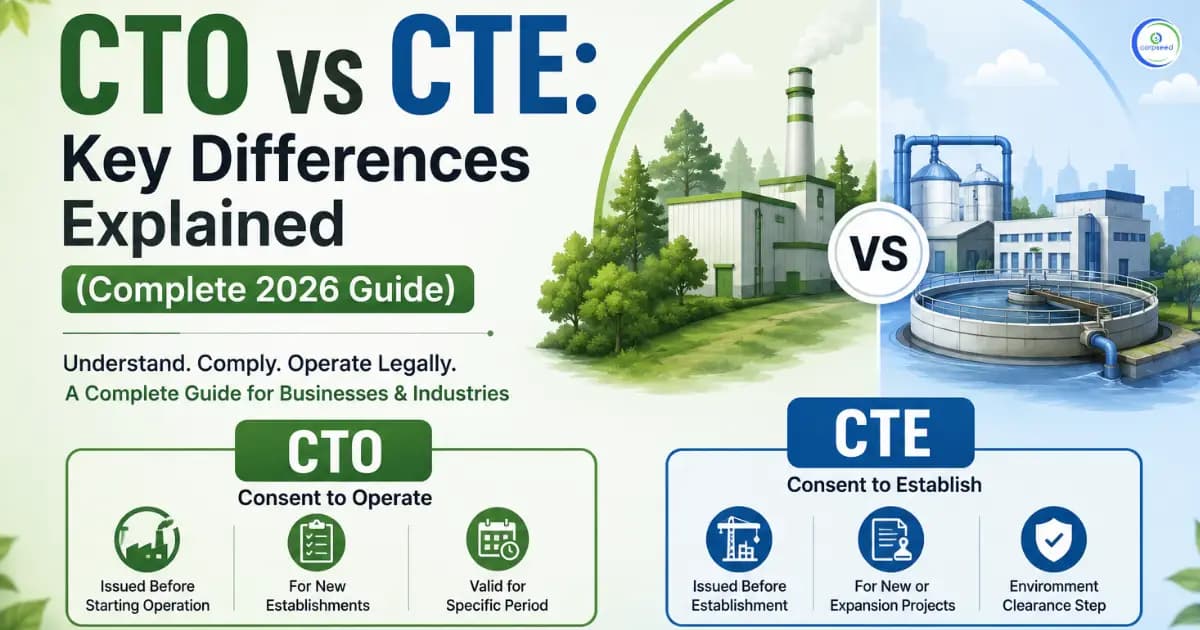
CTO vs CTE: Key Differences Explained (Complete 2026 Guide)
2026-07-31
How to Obtain NOC from the Pollution Control Board in India 2026?
2026-05-29
DPCC Issues SOP for Noise Pollution Enforcement and Compensation in Delhi
2026-05-14
How to Apply for a State Pollution NOC Online in 2026?
2026-04-07
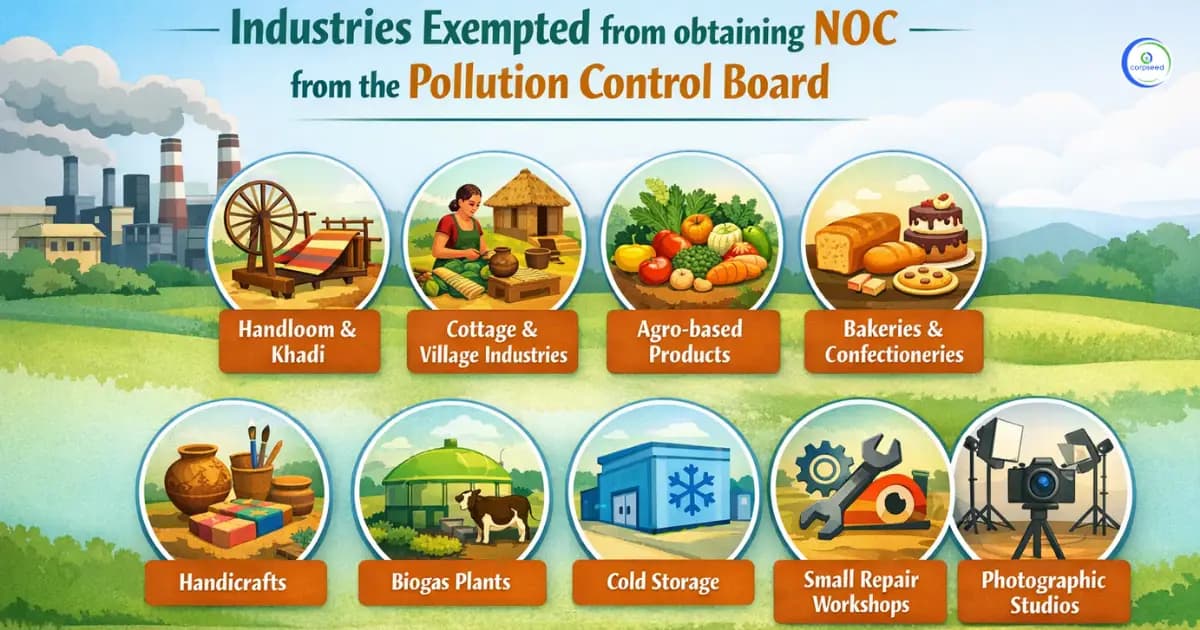
Industries Exempted From Obtaining Noc From The Pollution Control Board
2026-02-18