
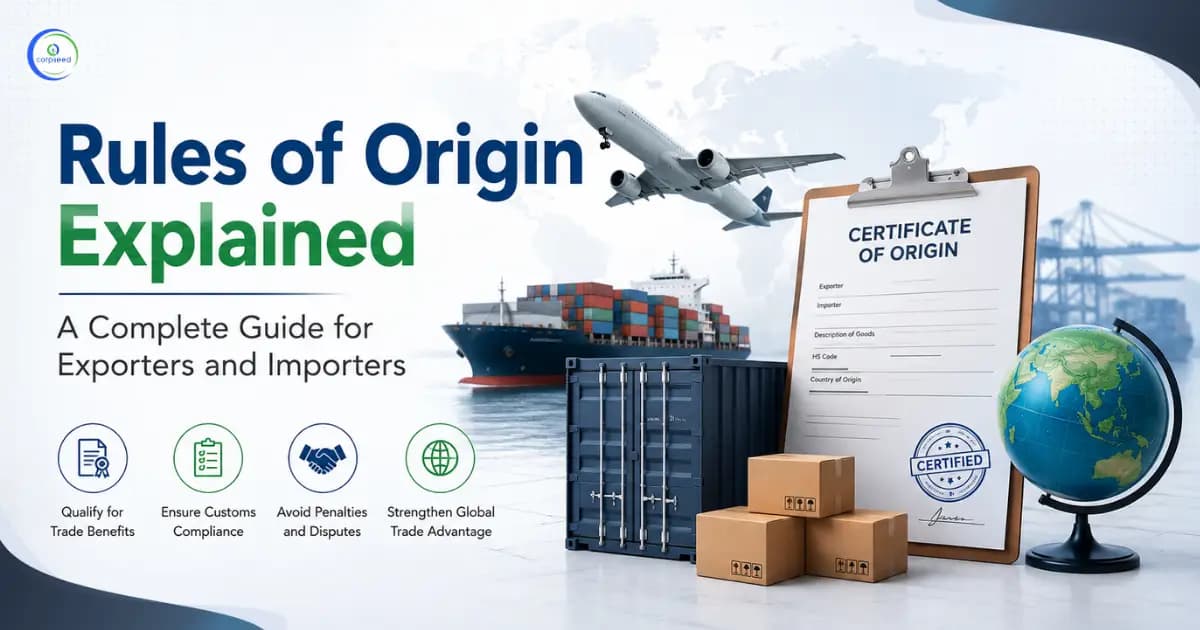
Rules of Origin Explained: A Complete Guide for Exporters and Importers
The Rules of Origin indicate whether the exported goods are eligible for the reduced customs duties under the FTAs and CEPAs.
Schedule a Call Back
Introduction
The Rules of Origin indicate whether the exported goods are eligible for the reduced customs duties under the FTAs and CEPAs. Wrong application of the Rules of Origin will cause rejection of the benefits and increased customs duty charges. The exporters should be able to assess origin requirements and document properly.
Why Rules of Origin Matter for Exporters and Importers
Benefits of international business are not inherent. Although Free Trade Agreements (FTA) and Comprehensive Economic Partnership Agreements (CEPA) enable organizations to enjoy low or no custom duty rates, exporters are required to demonstrate that their products meet the origin criteria set by the agreement.
Rules of Origin compliance ensure that the concerned custom authorities are able to ascertain whether the product under consideration qualifies as being an originated product of the country. Such rules prevent businesses from using their products for transit in other countries in order to gain tariff preferences.
Some of the commercial problems that businesses face due to inaccurate origin assessment include:
- Not getting preferential tariff treatment
- Higher import tariffs for buyers
- Delays in clearing customs
- Conflicts regarding shipment
- Problems with post clearance verification
Businesses exporting their products under the CEPA between India and Oman should comply with the rules of origin specific to the agreement in order to enjoy any preferential treatment.
For organizations engaged in engineering products, pharmaceutical products, chemicals, textiles, food items, and manufacturing industry, Rules of Origin are important.
What Are Rules of Origin?
Rules of Origin are legal criteria used by customs authorities to determine the country where a product originates. These rules establish whether goods qualify for preferential tariff benefits under trade agreements.
The country of shipment does not always determine the origin of goods. Customs authorities examine factors such as:
- Where the product was manufactured
- Where raw materials were sourced
- The level of processing completed
- Whether sufficient value addition occurred
For instance, if a company imports raw materials from one country and manufactures finished goods in another country, customs authorities will evaluate whether the manufacturing activity is enough to establish a new origin.
This assessment ensures that only eligible products receive benefits under trade agreements.
Key Origin Criteria under Rules of Origin
Customs authorities evaluate production activities, tariff classification, value addition and product specific requirements to determine whether goods qualify as originating products.
- Wholly Obtained Goods
Products completely produced or obtained in one country generally qualify as originating goods. Examples include:
- Agricultural products
- Minerals
- Marine products
- Natural resources
These products usually require simpler verification because foreign inputs are not involved.
- Substantial Transformation
Manufactured goods using imported materials are evaluated based on whether significant processing has taken place.
Activities such as manufacturing, processing, or conversion into a new product may establish origin. However, simple activities such as:
- Packaging
- Labelling
- Sorting
- Basic assembly
- Change in Tariff Classification (CTC)
Under this method, customs authorities compare the HS Code of imported inputs with the final exported product.
| Classification | Meaning |
| Change in Chapter | Product changes at HS Chapter level |
| Change in Tariff Heading | Change at four-digit HS level |
| Change in Tariff Subheading | Change at six-digit HS level |
- Regional Value Content (RVC)
Some agreements require businesses to achieve a minimum percentage of local value addition. The calculation may include:
- Local materials
- Manufacturing costs
- Labour expenses
- Production overheads
Businesses must maintain accurate cost records to support their claims.
- Product-Specific Rules
Certain industries have additional requirements depending on their manufacturing process. These may apply to:
- Textiles
- Pharmaceuticals
- Chemicals
- Electronics
- Food processing
Exporters should always review the specific requirements under the applicable trade agreement.
Documents Required for Rules of Origin Compliance
Proper documentation helps exporters prove origin eligibility, claim tariff benefits, and respond effectively during customs verification.
| Document | Purpose |
| Certificate of Origin | Confirms eligibility under trade agreement |
| Commercial Invoice | Provides shipment and product details |
| Manufacturing Records | Shows production activities |
| Bill of Materials | Provides input details |
| Supplier Declaration | Confirms material origin |
| Cost Sheet | Supports value addition calculation |
Maintaining accurate records is important because customs authorities may verify origin claims even after shipment clearance.
Steps to Ensure Rules of Origin Compliance
Businesses can maintain origin compliance by identifying the applicable trade agreement, verifying product eligibility, preparing supporting documents and obtaining a valid Certificate of Origin.
Step 1: Identify Applicable Trade Agreement
Confirm the destination country, available tariff benefits and applicable origin rules.
Step 2: Verify Product Classification
Check HS Code accuracy and applicable origin criteria.
Step 3: Evaluate Origin Eligibility
Assess whether the product meets requirements such as:
- Wholly obtained criteria
- CTC requirements
- Regional value content
- Product-specific rules
Step 4: Prepare Supporting Documents
Maintain manufacturing records, supplier declarations, cost calculations as well as commercial documents.
Step 5: Obtain Certificate of Origin
Apply through the authorised issuing authority after confirming eligibility.
Step 6: Maintain Compliance Records
Keep all supporting documents available for future customs verification.
Common Rules of Origin Compliance Challenges
Even a slight discrepancy with origin determination, or documentations may lead to shipment delays, extra duties payable and also rejection of tariff preferences.
- Having the Wrong HS Code: Having a wrong HS Code means can cause error in determining the origin of the goods and hence rejection of tariff benefits.
- Conflating the Country of Export with Country of Origin: Exporting goods from one particular country does not necessarily mean that the goods are of that particular country under a trade agreement.
- Deficient Supportive Documentation: Failure of having documents such as production records, supplier declaration, and cost sheets means that there will be weaker origin claims.
- Miscalculation of Value Addition: Any miscalculations in RVC will ensure that the products will fail to meet the origin requirements.
- Wrong Trade Agreements Rules Application: Different FTAs and CEPA have different origin rules. Having the wrong rules will mean that there will be rejection of tariff benefits.
Also Read: Certificate of Origin Requirements under India-Oman CEPA: Complete Export Guide
Need Help Assessing Rules of Origin Eligibility?
Determining origin eligibility requires analysis of product classification, manufacturing activities, sourcing structure, and agreement requirements.
Corpseed helps exporters and importers with:
- Rules of Origin assessment
- Certificate of Origin support
- Export documentation review
- Trade agreement compliance
- India-Oman CEPA documentation assistance
Get expert support before claiming preferential tariff benefits and mitigate the risk of customs disputes.
Conclusion
The Rules of Origin help determine if exporters qualify for preferential tariffs in accordance with international trade agreements. Companies that have knowledge of the rules of origin, are able to keep their records in order, and abide by the regulations of the respective trade agreement will be able to minimize risk and enhance efficiency.
If exporters want to take advantage of preferential tariffs, they must first check if their products qualify, and if they do, then make sure that all records are kept in order.
About the Author

Parul Bohral
Legal Content WriterParul Bohral, a BALLB graduate and experienced legal researcher and content writer with expertise in various legal areas, including corporate law and intellectual property. I have gained valuable experience in esteemed legal environments, where I have strengthened my research skills, allowing me to approach legal writing with precision and depth.
As a legal content writer, I am committed to delivering work that not only informs but also engages readers. By staying informed about the latest trends in content marketing and regulatory developments, I ensure that my writing remains sophisticated and meets industry standards. My dedication to thorough research enables me to craft content that is both insightful and impactful.
Related articles
IEC vs Import Licence: When Restricted Goods Need DGFT Approval Beyond IEC
2026-10-26
Can You Import Products Before BIS Certification? What Importers Must Know
2026-10-15

Selling Imported Goods on Amazon & Flipkart? 7 Compliance Checks Before Listing
2026-10-15
DGFT Extends India-UAE CEPA Gold Import TRQ Deadline
2026-07-08

Impact of China’s Lithium Policy Changes on India’s EV Sector
2026-03-18

DGFT Amends IEC Application Process under HBP 2023
2025-12-01