
IEC vs Import Licence: When Restricted Goods Need DGFT Approval Beyond IEC
The difference between IEC and Import Licence is straightforward. IEC identifies a business engaged in importing or exporting goods, while a DGFT Import Licence provides additional authorisation for specified restricted imports.
Schedule a Call Back
300+ import-export and DGFT assignments since 2018
Clients include Advantech Industrial Computing India, Smiths Detection Systems, Areca Embedded Systems, Motorola Solutions India, Trinity Mobile APP Lab, Motorica India, Glocal Healthcare Systems, Tablets (India)Limited, Auroras TEA Company, Surabhi Aqua Minerals, Solankili Logistics Management, ATG Freight India (12 of 250+ served since 2018).
A few more clients we've served in this industryHide the list
- Electronics and technology
- Advantech Industrial Computing India · Smiths Detection Systems · Areca Embedded Systems · Motorola Solutions India · Trinity Mobile APP Lab
- Pharma and healthcare
- Motorica India · Glocal Healthcare Systems · Tablets (India)Limited
- Food and consumer goods
- Auroras TEA Company · Surabhi Aqua Minerals
- Logistics and trade
- Solankili Logistics Management · ATG Freight India
- Jewellery
- Janki Jewellers · Viindhya Bullion
- More clients
- Esskay Compuservices · Welgrow Technologies · Ample Technologies · Aprodite Infotech · Floroma Infinity · Moonlight Technology · NJ Power · Ample Digital · Augustdevices India · Automap Software and Technologies · SNS Metpro Industries · Webmeditech Healthcare · Anagh Traders · Meritech India · Zipped Solutions · Metanovo Health · Kapemai Lifestyle · Zexcorp Services · Agricapita Innotech · Meticulous Networks · Nexavarge · Arng · D13 Business Ventures · Datalux Systems India
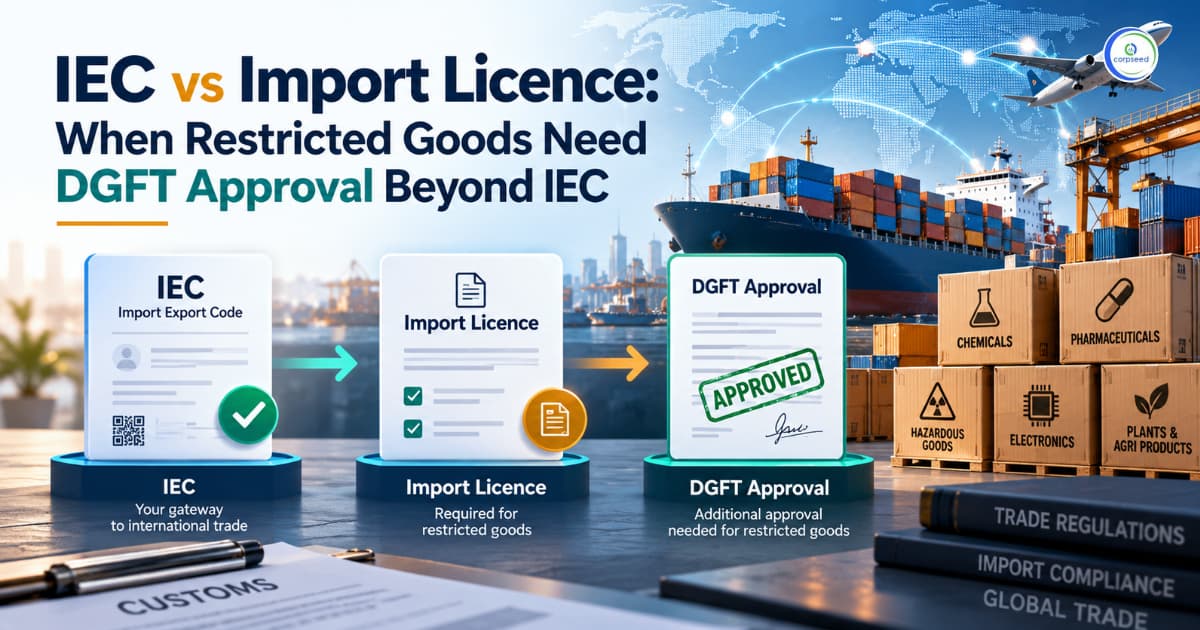
Are an IEC and an import licence the same, or do importers need both? Understanding these is one of the important things that a business should know. An IEC identifies a business for international trade, while a DGFT Import Licence authorises specified restricted imports. They are different requirements, not two names for the same approval. This blog explains IEC vs Import Licence, the purpose of each, their key differences, and why certain restricted goods need separate DGFT approval even when the importer already holds an IEC.
Schedule a Call Back
What Is an IEC Code and Why Do Importers Need It?
An Import Export Code (IEC) is a unique identification number issued by the Directorate General of Foreign Trade (DGFT). Businesses generally need it to import or export goods in India, unless an exemption applies under the Foreign Trade Policy.
Your IEC Code is linked to your business’s Permanent Account Number (PAN). It identifies your business when you import or export goods. Whether you’re buying raw materials from abroad, bringing in products to resell in India or selling your goods overseas, you generally need IEC registration.
Take a business importing furniture classified as Free under the applicable import policy. It would generally not need a separate DGFT restricted-import licence for those goods. However, customs requirements and any product-specific conditions would still apply. “Freely importable” does not mean that the goods are free from all other requirements.
The distinction is straightforward: IEC registration identifies the business; it does not approve every product that business plans to import. India’s ITC (HS) Import Policy determines whether goods are freely importable, restricted, prohibited or subject to other trading conditions. An importer therefore needs to check both its IEC status and the rules that apply to the intended goods.
What Is a DGFT Import Licence?
A DGFT Import Licence is a government authorisation that allows eligible importers to bring specified restricted goods into India, subject to the conditions of the approval.
The Directorate General of Foreign Trade regulates these imports under India's Foreign Trade Policy and the Indian Trade Classification (Harmonised System), commonly known as the ITC (HS).
Unlike IEC, which identifies the importer, an Import Licence concerns the permission required for particular goods.
Certain products are classified as restricted because their import is subject to government controls or specific policy requirements. In such cases, businesses generally cannot rely on IEC alone.
For example, consider a manufacturer that already has an IEC and wishes to import industrial equipment. If the particular equipment is classified as Restricted under the applicable ITC (HS) entry, the manufacturer would generally need DGFT authorisation before importing it. If the equipment is classified as Free, a separate restricted-import licence would ordinarily not be required.
The requirement for DGFT Import Authorisation depends on the product's classification and applicable import conditions, not simply on whether the importer holds an IEC.
A DGFT Restricted Import Licence may also specify conditions relating to the goods, quantity, value or validity. Importers must comply with the terms of the authorisation.
IEC vs Import Licence: What Is the Difference?
The main difference between IEC and Import Licence lies in their purpose. IEC identifies who is importing or exporting goods, while a DGFT Import Licence determines whether specified restricted goods can be imported under the applicable authorisation.
Both are associated with DGFT, but they are not interchangeable.
| Basis of Comparison | IEC Code | DGFT Import Licence |
| Meaning | Import Export Code | Permission to import specific restricted goods |
| Main purpose | Identifies your business when you import or export goods | Allows you to import the restricted goods covered by the licence |
| Issuing authority | DGFT | DGFT |
| Who needs it | Businesses importing or exporting goods, unless an exemption applies | Importers bringing in goods that require separate authorisation |
| What it applies to | Your business, rather than a particular product | The specific goods and conditions listed in the licence |
| Product restrictions | Having an IEC does not remove the restrictions that apply to your goods | The licence covers only the restricted goods specified in the approval |
| Validity | Continues, subject to required updates and other applicable compliance requirements | Depends on the terms of the licence issued |
| Permission for restricted goods | An IEC alone does not provide the required permission | Allows the approved imports, provided you follow the licence conditions |
Why IEC Alone May Not Be Sufficient
A business may have a valid IEC but still need additional approval because Indian import rules distinguish between the importer and the product being imported.
For goods classified as Free, IEC is generally sufficient from the perspective of DGFT's restricted-import licensing requirement, although other legal conditions may apply.
However, when products are classified as Restricted, the importer generally requires a separate DGFT Import Licence unless a specific exemption or alternative authorisation applies.
Consider two businesses importing goods into India.
The first business imports office furniture classified as Free. It generally does not need a DGFT Restricted Import Licence for those products.
The second business imports equipment that falls under a Restricted ITC (HS) classification. Even with an active IEC, it must obtain the applicable authorisation before importing those goods.
This distinction also explains why a business can hold an IEC without holding an Import Licence. Businesses importing only freely importable goods generally do not need a Restricted Import Licence in India.
Getting a DGFT Import Licence does not remove the usual need for an IEC. Each serves a different purpose so that you may need both for the same shipment.
To know whether you need a separate import licence, check the product’s ITC (HS) classification and the import policy that applies to it. Having an IEC alone does not tell you whether the goods need additional approval.
Conclusion
The difference between IEC and Import Licence is straightforward. IEC identifies a business engaged in importing or exporting goods, while a DGFT Import Licence provides additional authorisation for specified restricted imports.
Having an IEC does not automatically permit businesses to import every product into India. Importers must understand whether their goods are classified as Free or Restricted under the applicable import policy.
Before importing, businesses should check the relevant ITC (HS) classification and DGFT requirements to determine whether an IEC alone is sufficient or separate import authorisation is necessary.
About the Author

Mahek Sancheti
Content WriterMahek Sancheti, BAJMC graduate with a deep passion for writing. As a content writer, video content creator, creative content creator, and scriptwriter, I bring stories to life through words and visuals. I honed my skills by working with a prominent news agency, where I excelled in crafting compelling narratives and engaging content. Coming from a journalism and mass communication background I have skills to craft engaging narratives that captivate audiences. With a keen interest in writing and creativity, I aim to deliver impactful and meaningful content that resonates with diverse audiences.
https://www.linkedin.com/in/mahek-sancheti-837196212
Related articles
Can You Import Products Before BIS Certification? What Importers Must Know
2026-10-15

Selling Imported Goods on Amazon & Flipkart? 7 Compliance Checks Before Listing
2026-10-15
Rules of Origin Explained: A Complete Guide for Exporters and Importers
2026-08-06
DGFT Extends India-UAE CEPA Gold Import TRQ Deadline
2026-07-08
Impact of China’s Lithium Policy Changes on India’s EV Sector
2026-03-18

DGFT Amends IEC Application Process under HBP 2023
2025-12-01