
Selling Imported Goods on Amazon & Flipkart? 7 Compliance Checks Before Listing
Your product may have high popularity in other countries, yet require certain permissions before it can be legally imported or marketed in India. For instance, some types of electronic devices require mandatory BIS certification, some pre-packed commodities should conform to the Legal Metrology Act, and certain imported cosmetics need to be registered.
Schedule a Call Back

Introduction
Planning to market your imported goods on Amazon India or Flipkart? Prior to purchasing stock, make sure that your goods comply with Indian import, certification, packaging, environmental, and marketplace rules.
Your product may have high popularity in other countries, yet require certain permissions before it can be legally imported or marketed in India. For instance, some types of electronic devices require mandatory BIS certification, some pre-packed commodities should conform to the Legal Metrology Act, and certain imported cosmetics need to be registered.
Missing a requirement can lead to shipment delays, rejected listings, blocked inventory or regulatory action, depending on the circumstances. The good news is that you can identify many compliance issues before placing your first bulk order.
This guide explains seven compliance checks for selling imported goods on Amazon and Flipkart, the documents you should review, and how to determine which approvals may apply to your business.
Why Should You Check Compliance Before Listing Imported Goods?
Suppose you import 500 wireless accessories, kitchen appliances or skincare products and plan to sell them online. You have already paid the overseas supplier, arranged shipping and created your product photographs. Then you discover that the product requires an approval you have not obtained, or the packaging is missing prescribed declarations.
You may need to delay the launch, correct the labels, arrange additional documentation or review whether the goods can be legally sold at all. This is why import compliance should be part of product selection and budgeting, not a last-minute exercise.
For sellers, there are three separate questions to answer:
- Can the product be imported? Check the applicable import policy, classification and any restrictions or authorisations.
- Can the product legally be sold? Verify the applicable safety, certification, labelling and product-specific requirements.
- Can the product be listed on the chosen marketplace? Check the platform's current seller policies and any product documentation it requests.
These questions are connected, but they are not interchangeable. A successful customs clearance does not automatically establish that a product meets every requirement for retail sale.
1. Check Your Import Documents and IEC Requirements
Start by confirming that your business can legally import the product and that the shipment will have the required documentation.
What is an Importer Exporter Code?
The Importer Exporter Code (IEC) is issued by the Directorate General of Foreign Trade (DGFT). It is generally required for imports and exports, subject to applicable exemptions.
If your business purchases products from an overseas manufacturer and imports them into India for resale, confirm which entity is acting as the importer and whether the IEC requirement has been met.
Documents to review before placing an order
Depending on the transaction, your documentation checklist may include:
- IEC details and applicable import authorisations.
- Commercial invoice and packing list.
- Bill of Entry and customs clearance records.
- Bill of lading or air waybill.
- Purchase orders and supplier agreements.
- Product specifications, model numbers and country-of-origin information.
- Relevant product certificates, test reports and approvals.
The required documents depend on the goods, customs procedure and applicable rules. Do not assume that an overseas supplier's invoice or product declaration is sufficient for every import.
Check the import policy before paying the supplier
Identify the appropriate ITC (HS) classification and check the current import policy. Some products are freely importable, while others may be restricted, prohibited or subject to specific conditions.
A product description supplied by the manufacturer is not necessarily enough to establish its correct classification.
Corpseed lead opportunity: If you are importing a new product category and are unsure which documents or approvals apply, request an import compliance assessment before committing to a large order.
Schedule a Call Back
2. Verify Whether BIS Certification Is Mandatory
Bureau of Indian Standards (BIS) certification is one of the most important checks for sellers importing regulated consumer and industrial products.
BIS certification is generally voluntary unless the Central Government has made conformity with the relevant Indian Standard compulsory for the product through an applicable order or notification. BIS maintains an official list of products covered by compulsory certification. The list and relevant orders should be checked for the specific product and current implementation date.
Which imported products may require BIS certification?
Depending on the applicable order, requirements may cover products such as:
- Certain electronic and information technology equipment.
- Specified electrical appliances and equipment.
- Toys covered by applicable quality control requirements.
- Certain steel, cement and other regulated products.
- Other notified product categories.
These are examples, not a universal list of products that require certification. The precise standard, certification scheme, model coverage and applicable exemptions must be verified.
How to check BIS applicability
Name the product, model number, and specification along with its purpose.
- Verify the BIS Compulsory Certification List.
- Refer to the relevant Quality Control Order or notification for compulsory certification.
- Confirm the required certification scheme and scope of approval.
- Verify that the relevant manufacturer and product are covered by the required licence or registration.
- Does a foreign test report replace BIS certification?
Not automatically. A foreign certificate or test report does not, by itself, establish that an applicable mandatory Indian certification requirement has been fulfilled.
Similarly, approval for one model should not be assumed to cover every model sold under the same brand.
For example, if you import several electronic products from the same supplier, each product category and relevant model must be assessed against the applicable Indian requirements.
Need help identifying the applicable BIS requirement?
Corpseed can assist with a product-level assessment and guidance on the relevant certification process. Before enquiring, prepare the product name, model number, technical specifications, manufacturer details and any existing certificates.
3. Check LMPC Registration and Imported Product Labelling
Legal Metrology compliance is particularly important for businesses importing pre-packaged goods for retail sale.
The Legal Metrology (Packaged Commodities) Rules, 2011, as amended, prescribe declarations and other requirements for applicable packages. Registration obligations may also apply to manufacturers, packers and importers under the relevant provisions.
What is LMPC registration?
LMPC commonly refers to compliance with the Legal Metrology (Packaged Commodities) Rules, including the applicable registration and package-declaration requirements.
An importer of applicable pre-packaged commodities should check whether registration with the competent Legal Metrology authority is required for its business.
Registration and labelling are separate compliance questions. Obtaining a registration does not automatically make every product label compliant.
Which declarations should you check?
For applicable retail packages, review the prescribed declarations, which may include:
- Name and address of the manufacturer, packer or importer, as applicable.
- Country of origin for imported products.
- Common or generic name of the commodity.
- Net quantity or number of items, as applicable.
- Required date-related declarations.
- Maximum retail price (MRP), inclusive of applicable taxes.
- Consumer care details.
- Unit sale price or other declarations where applicable.
The exact declarations and permitted exceptions depend on the applicable rules and product category.
What about the Amazon or Flipkart product page?
The information displayed online must be assessed against the applicable e-commerce and packaged-commodity requirements. The physical package and product listing should not contradict each other.
For example, if the product packaging identifies one importer but the listing contains inconsistent importer information, the discrepancy may create consumer-trust and compliance concerns. Before launching a product, check its packaging, label artwork and online listing together.
LMPC registration for importers: If you are importing packaged goods for retail sale and are unsure about registration or label declarations, a focused LMPC compliance assessment can help identify the requirements to address before launch.
4. Identify Other Product-Specific Licences and Approvals
A product may satisfy its applicable import-documentation and packaging requirements but still need approval under another regulatory framework.
The relevant authority depends on the product's composition, intended use, technical characteristics and regulatory classification.
| Product category | What to check |
| Cosmetics | Applicable import registration under the Drugs and Cosmetics Act, 1940, and Cosmetics Rules, 2020 |
| Food products | Applicable FSSAI licensing, import clearance, food safety and labelling requirements |
| Medical devices | Classification and applicable CDSCO permissions or licences |
| Wireless equipment | Applicable WPC or other radio-equipment requirements |
| Batteries | Applicable Battery Waste Management Rules and other product requirements |
| Electrical and electronic equipment | Applicable BIS requirements and environmental obligations |
| Chemicals and specialised industrial products | Import restrictions, product-specific permissions and relevant safety rules |
This table is a screening guide, not a declaration that every product in each category requires the same approval.
Example: Importing cosmetics for online sale
If you intend to sell imported skincare products, perfumes or other cosmetics, do not stop after checking the supplier invoice and package label.
The importing of cosmetics is regulated under the Drugs and Cosmetics Act, 1940, and the Cosmetics Rules, 2020. The relevant registration requirements need to be checked before importing. Information related to the product, variants, packaging sizes, and manufacturing locations may affect the requirement check.
Example: Import of wireless electronics
A wireless product may require checking its BIS status, applicable requirements for radio equipment, batteries, and packaging declarations. The exact requirements will depend on the product and regulations.
Importers' mistakes to avoid
The importer often assumes that there is only one general certificate that applies to all the variants of the product. This approach is erroneous as various regulators deal with various hazards.
Prepare a list of potentially applicable certifications and approvals product-wise before ordering commercial quantities.
Corpseed service opportunity: Businesses importing cosmetics, electronics, batteries or other regulated goods can enquire about a product-specific compliance assessment to identify the applicable regulatory pathways.
5. Check EPR Registration and Environmental Obligations
Extended Producer Responsibility (EPR) is another area importer should review before launching regulated products.
Under relevant waste-management rules, specified producers and other covered entities may have responsibilities relating to waste collection, recycling, processing, reporting or other prescribed obligations. Importers can fall within a regulated definition, depending on the product and the rules.
When should you check EPR?
Review the relevant framework if you import:
- Electrical and electronic equipment covered by the E-Waste (Management) Rules.
- Batteries covered by the Battery Waste Management Rules, 2022.
- Plastic packaging covered by the applicable Plastic Waste Management Rules.
- Other products or materials covered by an EPR regime.
A product may involve more than one assessment. For example, an imported electronic device may include a battery and plastic packaging. The applicable obligations should be checked separately.
What should an importer verify?
Check:
- Whether the business falls within the relevant definition of producer, importer, brand owner or another regulated entity.
- Whether registration through the applicable CPCB or State Pollution Control Board process is required.
- Whether reporting, record-keeping or other obligations apply.
- Whether the registration and supporting records cover the relevant product category.
- Whether additional requirements apply to the product's packaging or components.
Do not assume that all online resellers need every EPR registration. Equally, do not assume that using an overseas supplier or a marketplace removes an obligation that applies to your business.
Looking for EPR registration guidance? Share your product category, whether you import under your own brand, and details of the packaging and batteries involved. This information helps establish which regulatory framework needs to be assessed.
6. Prepare for Amazon and Flipkart Seller Verification
Legal compliance and marketplace validation are somewhat interrelated but not synonymous.
A document may be legally required even when no such document is requested by the marketplace. On the other hand, the marketplace may also require some documents of its own accord.
What documents should you organise?
Depending on the product, seller account and marketplace request, keep relevant records ready:
- Business identity and address documents.
- PAN, GST and bank details, as applicable.
- Supplier invoices and purchase records.
- Import documents and customs clearance records.
- Product specifications, model numbers and photographs.
- Applicable BIS certificates or registrations.
- LMPC and package-labelling information, where relevant.
- Product-specific licences and environmental registrations.
- Brand authorisation or intellectual property documents, where required.
This is a preparation checklist, not a universal list of documents required for every seller.
Amazon India: Product compliance documents
Amazon's seller guidance has stated that where Amazon requires product-compliance documents, those documents must be submitted and approved before a new product can be listed. Requirements depend on the relevant product and policy.
Check the current requirements for your own account and product category before you rely on any announcement made previously.
Flipkart: Verify the applicable seller and category requirements
For Flipkart, verify the current seller onboarding process, product-category requirements, and compliance documents required through the seller account.
Do not assume that a document accepted by another marketplace will automatically be accepted by Flipkart. The applicable requirements can differ by category and policy.
What if a marketplace rejects your documents?
First, identify the cause for the rejection. Find out whether the document has expired, the model specifications are not consistent, the certificate does not apply to that product, or the listing is inconsistent.
Do not upload a different or unrelated certificate to complete the verification process. Resolve the underlying discrepancy and submit the relevant evidence.
7. Verify Product Claims, Brand Rights and Ongoing Compliance
Before publishing the listing, review the product information customers will see and the records you will need to maintain after launch.
Check product descriptions and origin claims.
Descriptions should accurately state the product's features, specifications, quantity, material and intended use. Do not make unsupported claims about safety, health benefits, certification, performance or environmental benefits. Ensure that country-of-origin information and prescribed package declarations are accurate wherever required.
The Consumer Protection (E-Commerce) Rules, 2020, provide the relevant regulatory framework for e-commerce, alongside other applicable consumer-protection requirements.
Check brand and intellectual property rights.
Purchasing an authentic product from a foreign seller does not always mean that all issues regarding trademarks, distribution constraints, copyrights, and contract terms in India will be settled.
Verify that you have the right to sell the goods and use the relevant brand assets. Use genuine product images and authorised materials where required.
Keep compliance documents updated.
After listing, monitor applicable certificate validity, regulatory amendments, product recalls, changes to labels and marketplace verification requests. If the manufacturer changes a model, manufacturing location or relevant product specifications, check whether the existing approval still covers the product.
Maintain a compliance folder for each SKU, including the relevant supplier records, shipment documents, certificates, label artwork and product specifications. A compliance calendar can help track renewal dates, reporting obligations and scheduled reviews.
A Practical Pre-Listing Compliance Checklist
Before making an imported product available for sale, review each applicable item below.
- Correct import classification and import policy checked.
- IEC requirement assessed and applicable import documents prepared.
- BIS applicability confirmed based on the product and existing orders.
- LMPC and pack registrations checked, if applicable.
- Licences and permissions related to the product identified.
- EPR compliance checked for the product, batteries, and packaging, if applicable.
- Amazon or Flipkart seller and category requirements reviewed.
- Product descriptions, country-of-origin information and brand rights checked.
- Physical packaging and online listing information cross-checked.
- Records, renewals and ongoing compliance responsibilities assigned.
A completed checklist is not a substitute for verifying the underlying documents. It is a way to identify potential gaps before launch.
Planning to Import Products for Amazon or Flipkart?
Before placing your next import order, identify the compliance requirements that apply to your specific products. Checking them early can help you make better purchasing decisions, organise the necessary documentation and reduce avoidable launch delays.
Corpseed can help you assess your product's potential import and regulatory compliance requirements and understand the relevant registration, certification or approval process.
To make the initial enquiry useful, prepare the following information:
- Product name and category: What do you plan to sell?
- Country of origin: Where is the product manufactured?
- Brand and model: Are it branded, private-label or unbranded?
- Import status: Have you already imported it, or are you planning your first shipment?
- Existing documents: Do you have a BIS certificate, supplier test report, LMPC registration or other approvals?
Are you planning to sell on Amazon India, Flipkart or both?
Use Corpseed's verified website contact channel to enquire about the relevant service. Providing these details helps the team understand your requirement and identify the appropriate next step.
Conclusion
Before selling imported products on Amazon or Flipkart, ensure your business meets all applicable import, BIS, LMPC, labelling, EPR, and product-specific compliance requirements. The exact approvals depend on your product category and applicable regulations.
Need help with imported product compliance? Contact Corpseed for guidance on the registrations, certifications, and documents required to list your products confidently and avoid preventable compliance issues.
About the Author

Anshika Jindal
Content WriterAnshika Jindal, a Legal Content Writer with strong expertise in legal research and a solid academic background in BA LLB and LLM (Criminal Law). I specialize in researching statutes, case laws, and legal developments and presenting them in clear, accurate, and engaging written content. With strong analytical skills and attention to detail, I create reliable, well-structured legal content while maintaining professional and ethical standards.
I specialize in conducting in-depth legal research using credible sources and presenting legal information in a structured, reader-friendly manner while maintaining precision and authenticity. My work focuses on simplifying legal language without compromising its meaning, making legal content accessible to a wider audience.
Related articles
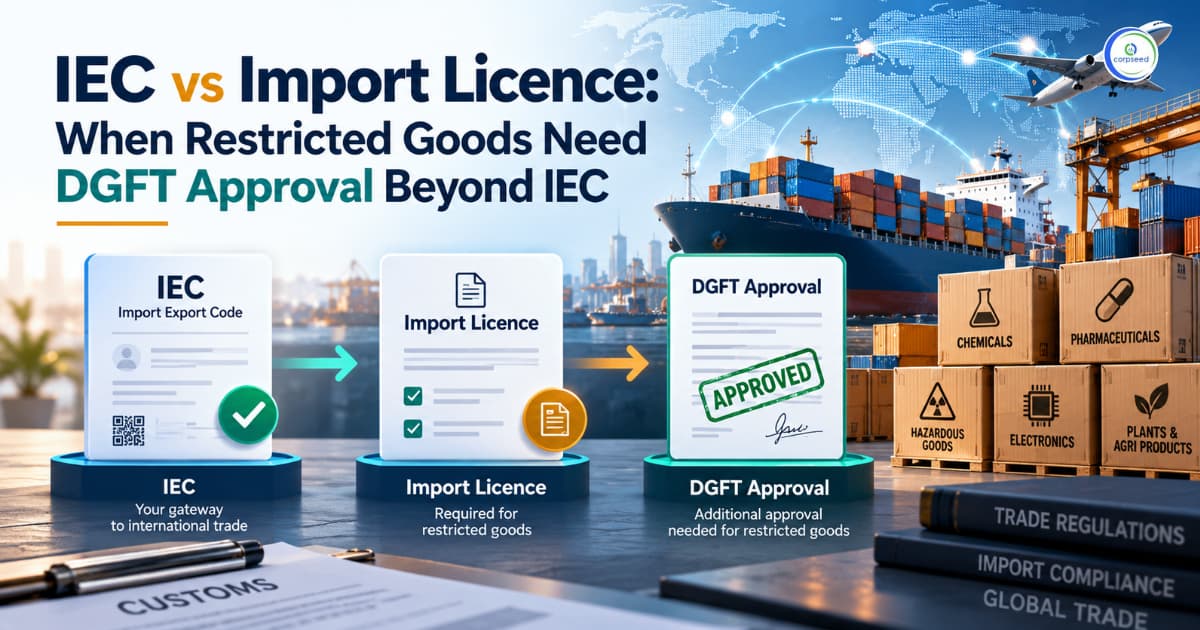
IEC vs Import Licence: When Restricted Goods Need DGFT Approval Beyond IEC
2026-10-26
Can You Import Products Before BIS Certification? What Importers Must Know
2026-10-15
Rules of Origin Explained: A Complete Guide for Exporters and Importers
2026-08-06
DGFT Extends India-UAE CEPA Gold Import TRQ Deadline
2026-07-08

Impact of China’s Lithium Policy Changes on India’s EV Sector
2026-03-18

DGFT Amends IEC Application Process under HBP 2023
2025-12-01