
The Food Safety and Standards Authority of India (FSSAI) has also revised the turnover limits for State Licences, making it important for businesses to check their current licensing category. This guide explains the new FSSAI State Licence renewal rules, documents, fees, FoSCoS procedures, expired licence issues and how Corpseed can assist with ongoing food licence compliance.
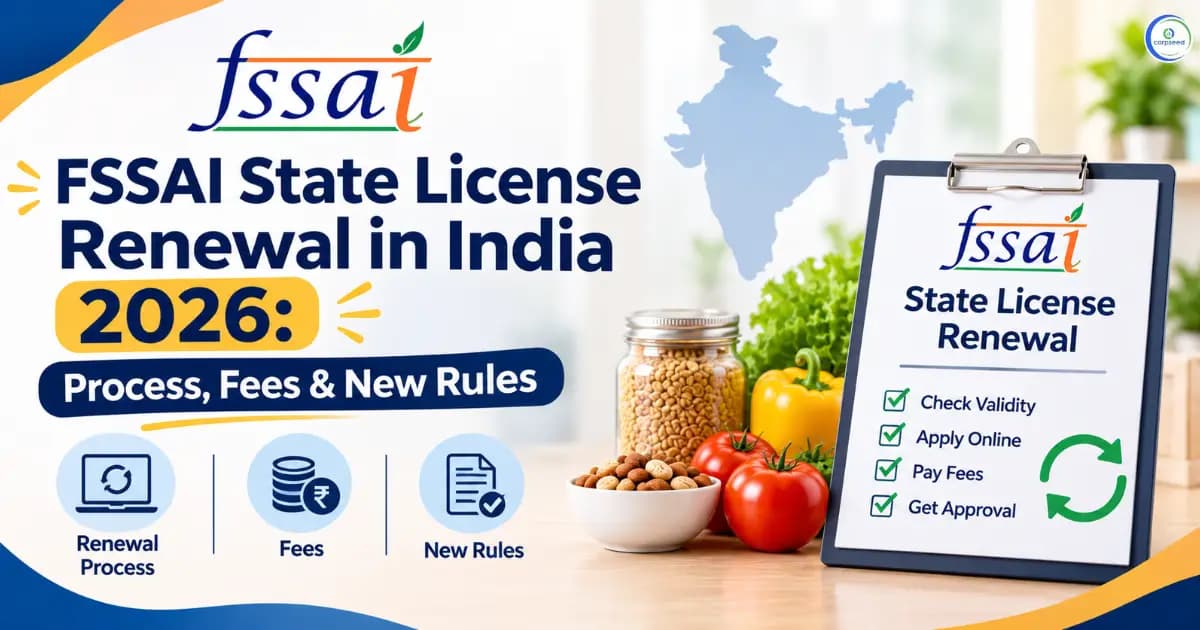
FSSAI State License Renewal in India 2026: Process, Fees & New Rules
The procedure for FSSAI State License renewal has been modified since 2026. Businesses in the food industry who used to get their licenses renewed on a regular basis have the option of obtaining perpetual validity of their license through the revised regulations of FSSAI
103Anshika Jindal
Schedule a Call Back
IN +91
500+ FSSAI licence assignments since 2018
Clients include Bidada Foods, Silvertip Foods, Good Food Innovations, Minimal Food, Alluring India Foods and Beverages, Auroras TEA Company, Ania Consumer Products, Ginger Foods Company, Magnalis Foods, ND Spices, Antara Assisted Care Services, Aggriveda Pharmaceutical (12 of 350+ served since 2018).
A few more clients we've served in this industryHide the list
- Food and consumer goods
- Bidada Foods · Silvertip Foods · Good Food Innovations · Minimal Food · Alluring India Foods and Beverages · Auroras TEA Company · Ania Consumer Products · Ginger Foods Company · Magnalis Foods · ND Spices
- Pharma and healthcare
- Antara Assisted Care Services · Aggriveda Pharmaceutical
- Logistics and trade
- Solankili Logistics Management · 23North Logistics Solutions
- Non-profits and education
- All India Hindu Mahajot Foundation · Manovikas Charitable Society
- More clients
- Cure and Care Wellness · Seven Turns · Akshamaala Solutions · Krisba Healthcare · Matha Exports International · Indo Gulf Company · Crescent Biologicals · Cura Consumer Health · Biolush · Cura Consumer · Ethics Prosperity · Rocking Deals · Subohi Agriparks · Aurous International Merchants · Anagh Traders · Shin Traders · Zexcorp Services · Aprodite Infotech · Grandmaz Organics · Instruments and Chemicals · Aaravbabbar Enterprises · DUA OLD Age Caring Institution · Goenka Scrapco · Prime Health
The procedure for FSSAI State License renewal has been modified since 2026. Businesses in the food industry who used to get their licenses renewed on a regular basis have the option of obtaining perpetual validity of their license through the revised regulations of FSSAI. But the payment of relevant fees continues.
Schedule a Call Back
IN +91
What Is FSSAI State License Renewal?
FSSAI State Licence renewal was the process of extending an existing food business licence before its expiry. Under the earlier system, a Food Business Operator (FBO) had to submit a renewal application through the Food Safety Compliance System (FoSCoS) to continue using the licence after its validity period ended.
It was usually a procedure that entailed the verification of licence information, completion of relevant declarations and payment of fees for renewal. Businesses were also sometimes obliged to address compliance issues. In March 2026, FSSAI brought in the system of perpetual validity via amendments to Food Safety and Standards (Licensing and Registration of Food Businesses) Regulations, 2011.
With the new system, the licenses are perpetual unless suspended, cancelled or surrendered. The proprietors of the food businesses do not have to undertake periodic renewals anymore but should still abide by food safety standards and payments.
New FSSAI State License Renewal Rules in 2026
The most significant amendment for the food industry is the discontinuation of the need for renewal of licences on a regular basis. Food businesses were required to keep track of the expiry date of their licences and make applications for renewal within the allowed time period. With the new amendments in place, businesses will be able to retain their licences without applying for renewal over and over again if the licence is still valid. FSSAI has also amended the turnover limits as of 1 April 2026.
| Licensing category | Revised annual turnover threshold |
|---|---|
| FSSAI Registration | Up to Rs1.5 crore |
| FSSAI State License | Above Rs1.5 crore and up to Rs50 crore |
| FSSAI Central License | Above Rs50 crore |
The applicable kind of business, location and special licensing requirements must also be considered turnover alone should not be used to determine every applicant's licence category.
What Does Perpetual Validity Mean for Food Businesses?
Perpetual validity means an FSSAI licence does not have to be renewed simply because a fixed number of years have passed. However, it does not mean a food business is permanently exempt from compliance.
Food businesses must continue maintaining hygiene standards, complying with food safety requirements, paying applicable annual fees and updating their licence information when necessary.
For example, if a restaurant changes its premises, the owner still needs to check whether an FSSAI licence modification is required. Similarly, food manufacturers must continue meeting the applicable testing, recordkeeping and annual return requirements.
Why Is Maintaining a Valid FSSAI State License Important?
Every food business must hold the appropriate FSSAI registration or licence for its activities. An active licence confirms that the business is operating within the food safety regulatory framework.
Although routine licence renewal has changed, maintaining a valid licence remains important for several reasons.
- Legal compliance: Businesses must comply with the Food Safety and Standards Act, 2006, and applicable licensing conditions.
- Business continuity: Suspension or cancellation of a licence can affect the ability to continue food operations.
- Customer confidence: A valid licence helps establish the business's regulatory status.
- Commercial relationships: Suppliers, distributors, online marketplaces and institutional customers may request licence details.
- Inspection readiness: Updated records, hygiene procedures and food safety documents help businesses respond to regulatory inspections.
Section 63 of the Food Safety and Standards Act provides for imprisonment of up to six months and a fine of up to Rs5 lakh for carrying on a food business without the required licence, where that provision applies.
Businesses should therefore monitor their licence status, even though routine periodic renewal is no longer required.
When Should You Apply for FSSAI State License Renewal?
Under the earlier licensing system, food businesses could apply for renewal up to 180 days before the expiry date. FSSAI's January 2023 order also introduced instant renewal for eligible applications where existing licence details remained unchanged.
The 2026 reforms have changed this position by introducing perpetual validity. Businesses should now check their licence status and applicable fee obligations through FoSCoS instead of assuming that a routine renewal application is necessary.
The table below explains how the earlier rules compare with the current framework.
| Situation | Earlier renewal framework | Position under 2026 reforms |
|---|---|---|
| Licence approaching expiry | Renewal application generally required | Check perpetual validity and current licence status |
| Before expiry | Renewal window opened 180 days before expiry | Routine periodic renewal no longer required |
| Licence already expired | Special post-expiry renewal provisions applied | Check the specific licence record and available regularisation process |
| Licence details changed | Modification could be required | Modification requirements continue |
| Annual compliance | Applicable returns and licence conditions | Applicable returns, fees and safety obligations continue |
The earlier renewal rules are relevant for understanding historical applications and legacy expired licences, but they should not be presented as the standard renewal requirement in 2026.
Documents Required for FSSAI State Licence Renewal and Compliance
The documents required for FSSAI State Licence renewal previously depended on the business category, existing licence information and whether any details had changed.
Although routine renewal has been removed, food businesses must still keep relevant documents available for licence modification, annual compliance, inspections and other applicable regulatory processes.
For example, a restaurant that continues operating from the same premises may have different documentation needs from a food manufacturer adding new products or changing its production capacity.
| Documents or information | Purpose |
|---|---|
| Existing FSSAI licence number | Identifying and verifying the licence |
| FoSCoS login details | Accessing the business's account |
| Business name and address | Checking registered business particulars |
| Authorised signatory details | Identifying the responsible applicant |
| Food Safety Management System (FSMS) plan | Supporting applicable safety compliance |
| Form IX nomination details | Required for relevant business structures and situations |
| Employee medical fitness records | Supporting hygiene compliance where applicable |
| Water testing reports | Applicable to certain manufacturing and processing activities |
| Food product and activity details | Verifying approved products and business activities |
| Premises documents | Supporting changes requiring proof of location |
FSSAI's published renewal document guidance identifies changes in previously submitted information, FSMS records, medical fitness records and technical-personnel details as relevant items under the earlier framework.
Not every document is required for every food business. The correct list depends on the activity, application type and documents requested through FoSCoS.
How to Renew or Manage an FSSAI State License Online Through FoSCoS?
FoSCoS is the official online system used for FSSAI licensing, registration and related compliance activities.
In 2026, an existing licence holder should first confirm whether the licence has perpetual validity and whether any action is required. Businesses should not submit a new renewal application automatically simply because an older licence document mentions an expiry date.
The following steps explain how to review and manage a State Licence.
- Visit the official FoSCoS portal.
- Log in to your account. Use the credentials associated with your FSSAI licence.
- Open the existing licence record. Locate your State Licence and check the licence number, business details, category and current status.
- Check perpetual validity. Review the validity information displayed on the portal and any instructions applicable to an existing licence.
- Verify the business category. Confirm whether your business falls within the revised State Licence eligibility criteria or requires category migration.
- Review business particulars. Check the registered address, authorised person, food categories and business activities for accuracy.
- Identify pending compliance requirements. Review applicable fee payments, annual returns, declarations and regulatory communications.
- Select the appropriate service. Depending on your circumstances, this may involve a licence modification, category migration, payment or another available compliance facility.
- Submit the necessary information. Complete the applicable online form and upload supporting documents if requested.
- Save the acknowledgement. Keep the application reference, payment receipt or updated licence record for future use.
FoSCoS also has an Express Renewal facility, but its availability should not be mistaken for a general requirement to renew licences periodically under the new framework.
For food businesses unsure about their current licence status, Corpseed offers FSSAI licence renewal and compliance assistance to help review the licence record and identify the appropriate action.
FSSAI State License Renewal Fees and Cost in India
The FSSAI State License renewal cost was previously linked to the applicable government licence fee and the period for which renewal was requested.
Under the 2026 perpetual-validity framework, the focus has shifted from repeated renewal applications to applicable annual fee payments and other ongoing compliance obligations. FSSAI's March 2026 FAQs state that businesses may pay fees for multiple years together and can make payments at any time during the year.
The revised official fee structure implemented in April 2026 specifies a State Licence fee of Rs5,000, while the applicable total payment depends on the fee period and the business's particular circumstances.
The overall amount payable for FSSAI licensing or compliance assistance may depend on several factors.
| Cost factor | How it affects total cost |
|---|---|
| Licence category | Determines the applicable government fee |
| Fee payment period | Influences the total amount payable upfront |
| Licence modification | May involve separate charges where applicable |
| Document preparation | Depends on missing or updated records |
| Previous compliance issues | May require additional corrective action |
| Professional assistance | Depends on the services requested |
Professional FSSAI licence consultancy charges are separate from statutory government fees.
Contact Corpseed for a customised FSSAI State Licence compliance quotation, based on your licence status, business activity and documentation requirements.
Can You Renew an Expired FSSAI State Licence in 2026?
Food businesses with an old, expired State Licence should not assume that perpetual validity automatically resolves every historical expiry issue.
Before the March 2026 reforms, FSSAI had allowed eligible businesses to renew an expired licence within 180 days of the original expiry date. Under the 2021 order, the penalty was three times the annual licence fee during the first 90 days and a total of five times the annual fee during days 91-180.
After 180 days, the earlier renewal facility was unavailable. The order also prohibited food operations between the original expiry date and issuance of the renewed licence.
These are historical provisions. For a licence that expired before the 2026 reforms, the owner should check the current record and instructions on FoSCoS to establish whether any regularisation, fresh application or other action is required.
A business should not continue operating on the assumption that an old expired licence has automatically become valid.
How to Check FSSAI State Licence Renewal Status Online
Food businesses can check their licence or application status using the FoSCoS portal.
- Visit the FoSCoS application tracking page and enter the application reference number and requested verification details.
- Existing licence holders can also log in to review licence information, payment records and pending applications.
- Businesses should pay attention to departmental queries, missing information, outstanding compliance requirements and the status of any submitted modification application.
- After approval or completion of an applicable process, download the updated licence or acknowledgement from the portal.
- Keeping copies of these records helps during inspections, vendor registration and commercial verification.
Common Mistakes to Avoid During FSSAI State License Compliance
Even though routine renewal is no longer required, businesses can face difficulties when their licence information is inaccurate or mandatory compliance activities are overlooked.
A common mistake is relying on older FSSAI renewal guidance without checking whether the rules changed in 2026.
| Common mistake | Possible consequence | Recommended action |
|---|---|---|
| Following outdated renewal rules | Unnecessary filing or confusion | Check current FSSAI orders |
| Incorrect licence category | Wrong licensing classification | Review revised eligibility |
| Ignoring annual fee obligations | Outstanding compliance issues | Review payment requirements |
| Failing to update premises details | Incorrect licence information | Apply for modification where needed |
| Missing annual returns | Pending regulatory compliance | File applicable returns |
| Ignoring food safety standards | Inspection findings or enforcement | Maintain required safety records |
| Treating perpetual validity as permanent exemption | Possible regulatory violations | Continue meeting all conditions |
Food manufacturers and importers should pay particular attention to Form D1 annual return requirements, where applicable.
Businesses should also review their licence whenever they significantly change food products, premises, operations or other registered particulars.
FSSAI State License Renewal vs Fresh FSSAI License Application
Renewal and a fresh licence application are different regulatory processes. Under the old system, renewal extended an existing licence, while a fresh application was used to obtain a new one.
The distinction still matters when dealing with historical records, cancelled licences or businesses applying for FSSAI approval for the first time.
| Basis | Earlier licence renewal | Fresh licence application |
|---|---|---|
| Purpose | Extend an existing licence | Obtain a new licence |
| Existing licence | Required | Not necessarily required |
| Application information | Based largely on existing records | New business details required |
| Documents | Relevant updates and declarations | Complete applicable application documents |
| Government charges | Earlier renewal fee provisions | Applicable new licence charges |
| Current relevance | Mainly legacy cases under 2026 reforms | New businesses and cases requiring fresh licensing |
Food businesses must also distinguish between a fresh licence and an FSSAI licence modification.
For example, an existing restaurant adding a new approved activity may need a modification rather than a fresh licence. The correct approach depends on the nature of the change and current FoSCoS rules.
How Corpseed Can Help with FSSAI State License Renewal and Compliance
The FSSAI licensing reforms have reduced the need for repeated renewal applications. However, food businesses still need to maintain accurate licence records, pay applicable fees and comply with food safety requirements.
For an established restaurant, manufacturer or distributor, the main concern is often understanding which requirements still apply and whether changes in turnover or business activities affect the existing licence.
Corpseed provides FSSAI State Licence renewal services and related compliance assistance to help businesses review their current position and complete the necessary formalities.
Our team can assist with:
- Licence status verification: Reviewing existing FSSAI licence information and its current validity.
- Eligibility assessment: Checking whether the business meets the revised State Licence criteria.
- Document preparation: Identifying and organising supporting documents.
- FoSCoS application support: Assisting with applicable applications and online submissions.
- Licence modification: Providing guidance when business particulars need to be changed.
- Annual compliance: Helping businesses understand applicable fee, return and documentation requirements.
- Application follow-up: Supporting responses to relevant departmental communications.
Businesses looking for an FSSAI license renewal consultant in India can contact Corpseed to discuss their existing licence, documentation and ongoing compliance needs.
Conclusion
FSSAI State Licence renewal requirements have changed significantly in 2026 with the introduction of perpetual validity. Food businesses no longer need to renew their licences periodically, but they must continue paying applicable fees, maintaining accurate records and following food safety regulations.
Businesses should check their licence status through FoSCoS and confirm whether any modification, category migration or other compliance action is required. For assistance with FSSAI licensing, documents, online applications or compliance requirements, contact Corpseed for guidance based on your business needs.
About the Author

Anshika Jindal
Content WriterAnshika Jindal, a Legal Content Writer with strong expertise in legal research and a solid academic background in BA LLB and LLM (Criminal Law). I specialize in researching statutes, case laws, and legal developments and presenting them in clear, accurate, and engaging written content. With strong analytical skills and attention to detail, I create reliable, well-structured legal content while maintaining professional and ethical standards.
I specialize in conducting in-depth legal research using credible sources and presenting legal information in a structured, reader-friendly manner while maintaining precision and authenticity. My work focuses on simplifying legal language without compromising its meaning, making legal content accessible to a wider audience.
Related articles
FSSAI Central License Renewal in 2026: Rules, Fees, Documents & Process
2026-11-12

FSSAI Draft Packaging Rules 2026: New Standards for Recycled Plastic in Food Packaging
2026-11-04

Selling Food Online? FSSAI Rules for Amazon, Flipkart, Swiggy, Zomato & Marketplace Sellers (2026)
2026-10-15
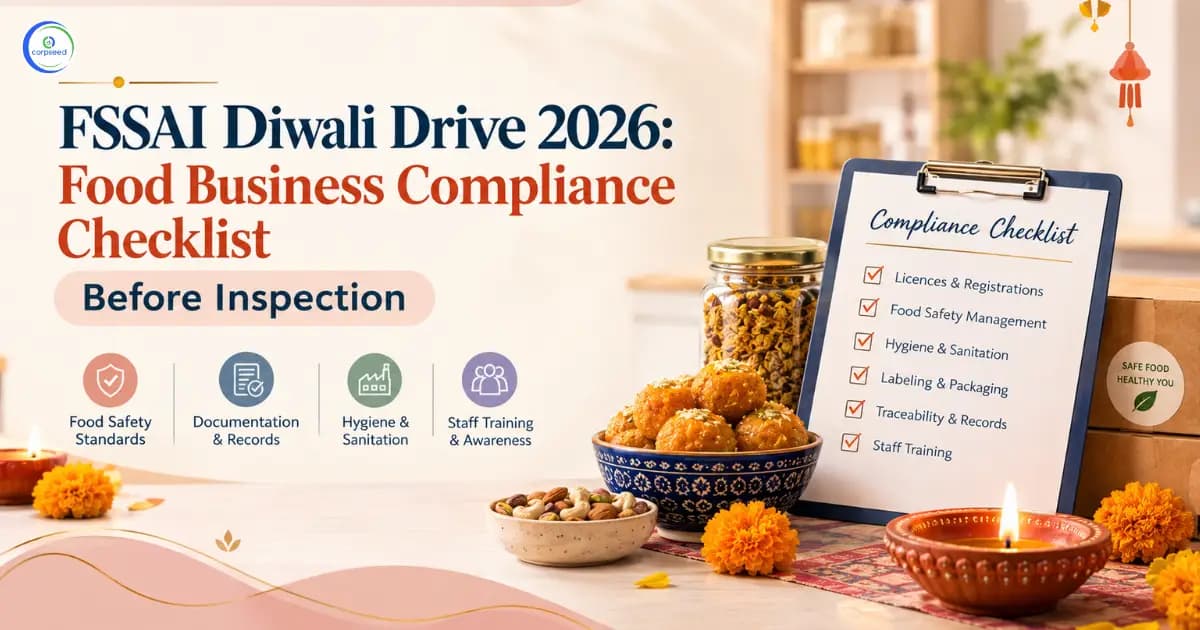
FSSAI Diwali Drive 2026: Food Safety Inspection Checklist for Food Businesses
2026-10-14
FSSAI Licence vs Registration for Sweet Shops, Bakeries & Home Bakers
2026-10-13
Festive Gift Hamper Compliance: FSSAI, Legal Metrology & Labelling Requirements
2026-10-09