Need help with CPCB EPR registration? Book a Free Consultation with our experts.
What Is C&D Waste EPR Registration?
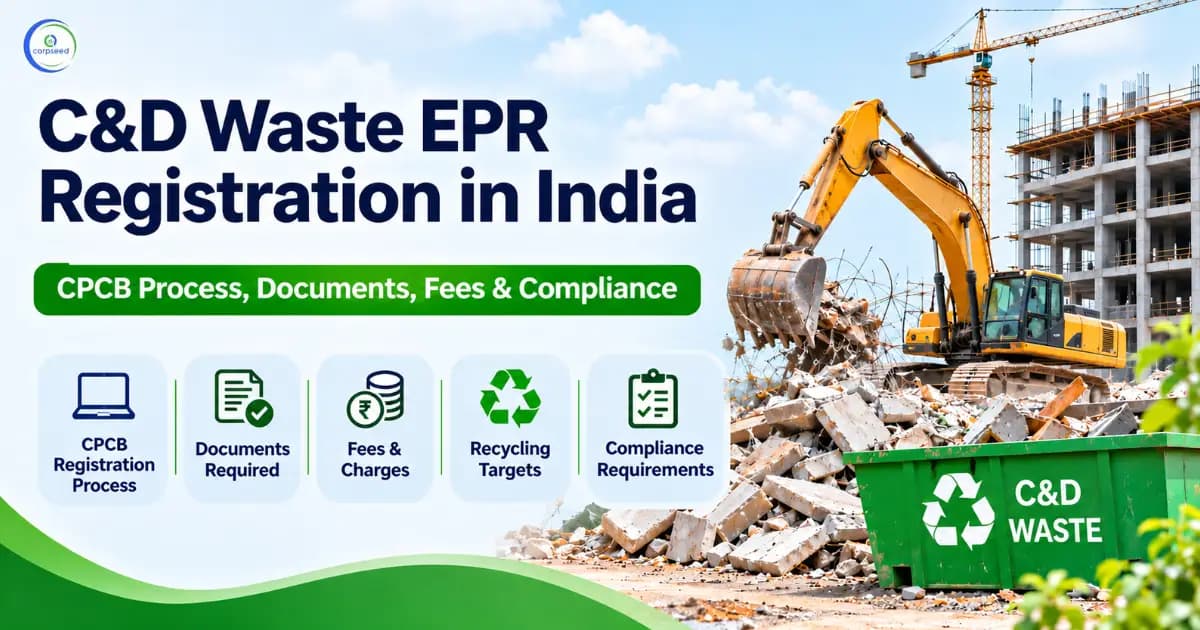
C&D Waste EPR Registration is the online registration process established under the Environment (Construction and Demolition) Waste Management Rules, 2025. It requires specified entities involved in generating, collecting, storing and recycling construction and demolition waste to register through the Central Pollution Control Board (CPCB) portal.
The Ministry of Environment, Forest and Climate Change has notified the Construction and Demolition Waste Management Rules 2025 through G.S.R. 219(E) dated 2nd April 2025. These Rules shall come into effect from the 1st of April 2026 and shall replace the Construction and Demolition Waste Management Rules 2016, with the savings provision.
Through these Rules, the concept of Extended Producer Responsibility (EPR) has been introduced to make certain Producers responsible for management of Construction and Demolition Waste and to achieve the prescribed recycling targets.
The system covers two important obligations:
- EPR recycling: Eligible producers must fulfil recycling targets through the prescribed EPR certificate mechanism.
- Processed waste utilisation: Specified construction, reconstruction and road construction projects must use eligible processed C&D waste according to the applicable utilisation targets.
C&D waste includes materials generated during construction, demolition, reconstruction, renovation and repair, such as concrete, bricks, rubble, sand, metal, wood and other construction materials.
Who Needs C&D Waste EPR Registration?
The 2025 Rules identify four categories under Rule 4(2) for registration on the CPCB online portal. Road construction projects also fall within the separate waste utilisation registration framework under Rule 8.
| Entity | Registration Requirement |
|---|---|
| Producer | A waste generator occupying or in charge of a building or building complex project with a built-up area of 20,000 sq. m. or more |
| Recycler | An entity processing C&D waste to recover reusable materials or manufacture value-added products |
| Intermediate waste storage facility operator | An entity operating a facility for temporary storage of construction and demolition waste |
| Collection point | A collection point established by a local authority or development authority |
| Road construction project | Registration under the applicable waste utilisation framework for road construction activities |
Businesses falling under more than one Rule 4(2) category must register separately for each applicable category.
Important: The 20,000 sq. m. threshold defines a producer under the Rules. It does not automatically exempt smaller construction projects from waste segregation, collection, transportation and disposal obligations.
Road construction registration and utilisation requirements should be assessed separately from producer EPR recycling obligations.
EPR Recycling Targets Under the C&D Waste Management Rules, 2025
The First Schedule of the 2025 Rules establishes annual EPR recycling targets for eligible reconstruction and demolition projects.
The targets are calculated using the recyclable waste generated in the previous year, as assessed by the concerned local authority or development authority.
| Financial Year | EPR Recycling Target |
|---|---|
| 2025-26 | 25% |
| 2026-27 | 50% |
| 2027-28 | 75% |
| 2028-29 onwards | 100% |
Although the First Schedule contains a target for 2025-26, the Rules commenced on 1 April 2026. Businesses should verify how the initial target applies to their projects rather than assuming retrospective liability.
Processed C&D Waste Utilisation Targets
Recycling and waste utilisation are separate regulatory obligations.
Under the Second Schedule, eligible construction and reconstruction projects must use processed C&D waste according to the following targets.
| Financial Year | Construction and Reconstruction Utilisation Target |
|---|---|
| 2026-27 | 5% |
| 2027-28 | 10% |
| 2028-29 | 15% |
| 2029-30 | 20% |
| 2030-31 onwards | 25% |
The targets are measured against the total construction materials required for the project and are determined according to the year of approval of the waste utilisation plan.
Road construction projects have different targets under the Third Schedule.
| Financial Year | Road construction utilisation target |
|---|---|
| 2026-27 | 5% |
| 2027-28 | 5% |
| 2028-29 | 10% |
| 2029-30 | 10% |
| 2030-31 onwards | 15% |
The road construction target is determined according to the year the road construction project commences.
Eligible processed materials must be procured from registered recyclers and used in accordance with the applicable technical, quality and safety requirements.
How Does the C&D Waste EPR Certificate System Work?
The EPR certificate system allows eligible producers to fulfil their recycling obligations through registered C&D waste recyclers.
Under Rule 6, CPCB generates EPR certificates in favour of registered recyclers based on eligible recycling and processing activities reported through the online portal.
Producers purchase the required certificates from registered recyclers to meet their EPR targets.
The process generally involves:
- Registered recyclers process eligible construction and demolition waste.
- Relevant processing and output information is submitted through the CPCB portal.
- CPCB generates EPR certificates according to the prescribed calculation.
- Eligible producers purchase certificates against their recycling obligations.
- Certificate transactions and corresponding obligations are recorded through the portal.
The Rules prescribe certificate denominations of 100, 200, 500 and 1,000 tonnes.
Each certificate carries a unique identification number and remains valid for three years from the end of the financial year in which it was generated.
Certificate transactions are regulated separately from registration fees. The purchase of EPR certificates also does not replace any independent processed waste utilisation requirement.
Documents Required for C&D Waste EPR Registration
The documents required for CPCB registration depend on whether the applicant is a producer, recycler, intermediate storage facility operator, collection point or entity covered by the waste utilisation framework.
Applicants should prepare accurate business, project and waste management information before starting the application.
| Applicant Category | Documents and Information to Prepare |
|---|---|
| Producer | Business details, project address, built-up area, project approvals, estimated waste quantities and waste management plan |
| Recycler | Business registration, facility address, processing capacity, machinery details and waste processing information |
| Intermediate storage facility | Operator details, facility location, storage capacity and applicable supporting approvals |
| Collection point | Local or development authority details, collection point location and operational information |
| Road construction project | Project details, implementing agency information, estimated material requirements and applicable waste utilisation information |
The portal may require additional documents, declarations or technical information.
This table is intended as an application preparation guide. Applicants should follow the current CPCB portal checklist for their category.
Where a recycling or processing facility requires additional environmental approvals, businesses should assess the applicable State Pollution Control Board consent and other local permissions separately.
How to Apply for C&D Waste EPR Registration on the CPCB Portal
Eligible businesses must complete the prescribed registration process through the CPCB C&D Waste Management Portal.
Step 1: Check Your Registration Category
Identify whether the applicant is a producer, recycler, intermediate waste storage facility operator, collection point or road construction project covered by the utilisation framework.
Step 2: Prepare the Required Documents
Collect business information, project, or facility details, waste management records and applicable supporting documents.
Step 3: Visit the CPCB C&D Waste Portal
Access the official portal at cdwm.cpcb.gov.in.
Follow the registration instructions applicable to the entity category.
Step 4: Complete the Online Application
Provide the required information carefully such as applicant details, project/processing facility information and waste management details.
Step 5: Upload Supporting Documents
Submit the documents and declarations requested by the portal.
Step 6: Submit the Application
Check the information and pay the charges (if any) before submitting the application. The application acknowledgement will be sent to you electronically.
Step 7: Respond to CPCB Queries
If CPCB has any queries or requires additional information, respond to such queries as per the prescribed procedure.
Step 8: Obtain the Registration Certificate
Once registration is approved, retain the certificate and follow the applicable operating and reporting conditions.
As per Rule 4(4), the Central Pollution Control Board (CPCB) should issue a registration certificate to an applicant within 15 days of receiving such an application. Applicants, however, should not consider this as a guarantee of approval in case information required to evaluate the application is missing or further verification of information is required.
Planning to register? Corpseed can assist with eligibility assessment, documentation and CPCB application filing.
C&D Waste EPR Registration Fees in India
The Environment (Construction and Demolition) Waste Management Rules, 2025 authorise CPCB to charge registration and portal-maintenance fees as determined in consultation with the Central Government.
The Rules do not prescribe one fixed registration amount for every applicant category.
The total cost may include:
- Government registration fees: Charges prescribed by CPCB for the relevant registration category.
- Portal-related charges: Additional charges where applicable under the prescribed fee framework.
- Professional consultancy fees: Charges for document preparation, application filing and compliance assistance.
- Other regulatory expenses: Costs relating to separate approvals or technical requirements, where applicable.
Businesses should check the current CPCB fee schedule before making payments.
The price of purchasing EPR certificates is separate from the government registration fee.
Corpseed's service charges depend on the applicant's category, project details, documentation and assistance required.
Reporting and Ongoing Compliance Under C&D Waste EPR
C&D Waste EPR Registration is not a one-time obligation. Registered entities must maintain the records and submit the information required for their respective categories.
The applicable requirements may include:
- Maintaining accurate records of C&D waste generation, collection, storage and processing.
- Recording recycling quantities and processed waste outputs.
- Following approved waste management or waste utilisation plans.
- Maintaining supporting documents for EPR certificate transactions.
- Submitting prescribed information through the CPCB portal.
- Filing applicable returns within the regulatory deadlines.
- Ensuring that regulated transactions take place through appropriately registered entities.
For recyclers, operators of intermediate storage facilities and collection points, the 2025 Rules stipulate that half-yearly returns be submitted by 15th October and 15th April, along with an annual return to be submitted by 30th May of the relevant financial year.
Applicants are advised to confirm their specific reporting requirements through the CPCB portal and relevant rules.
Proper record keeping would help smoothen the process during compliance monitoring and regulatory verification.
Penalties for Non-Compliance With C&D Waste EPR Rules
Failing to comply with the Environment (Construction and Demolition) Waste Management Rules, 2025 may result in the imposition of environmental compensation and regulatory action. Failing to comply with obligations to meet EPR targets for recycling or waste utilisation may also result in the imposition of penalties.
As per Rule 4(7), the CPCB may, for a period of five years, withdraw registration for provision of false information, intentional concealment or specified irregularities and, in such a case, afford the concerned entity an opportunity of being heard. Paying environmental compensation does not clear the entity from EPR obligations. Entities are required to maintain accurate records.
How Corpseed Can Help With C&D Waste EPR Registration
Applying for C&D Waste EPR Registration requires businesses to identify the correct category, prepare project or facility information and understand the compliance obligations that follow registration.
Corpseed provides end-to-end assistance with CPCB registration and related environmental compliance requirements.
Our services include:
- Eligibility Assessment: Identifying the applicable CPCB registration category based on business activities and project details.
- Document Preparation: Helping applicants prepare and review the information needed for registration.
- CPCB Application Filing: Assisting with online registration, form completion and document submission.
- Regulatory Query Support: Helping businesses respond to clarification requests raised during application processing.
- EPR Compliance Guidance: Explaining recycling targets, EPR certificates and reporting responsibilities relevant to the applicant.
- Related Environmental Approvals: Assisting businesses with applicable pollution control permissions and waste management authorisations.
Businesses establishing recycling or processing facilities may also require additional regulatory permissions.
Corpseed can help assess the need for Construction and Demolition Waste Authorization and other applicable environmental approvals.
Whether you are a construction project developer, demolition contractor, recycling facility operator or another business covered by the C&D waste framework, understanding the applicable obligations is important for maintaining compliance.
Need assistance with C&D Waste EPR Registration in India?
Contact Corpseed for help with eligibility assessment, documentation, CPCB application filing and ongoing regulatory compliance.
Book a Free Consultation with Corpseed.
Conclusion
C&D Waste EPR Registration is an important compliance requirement for eligible businesses under the Environment (Construction and Demolition) Waste Management Rules, 2025. With CPCB registration, recycling targets, EPR certificates and waste utilisation obligations now forming part of the regulatory framework, businesses must understand their responsibilities and maintain accurate waste management records.
Whether you are a construction project developer, recycler or waste management operator, completing the applicable registration and following the prescribed requirements can help avoid regulatory complications. Corpseed provides end-to-end C&D Waste EPR registration services, including eligibility assessment, documentation, CPCB application filing and ongoing compliance support.