
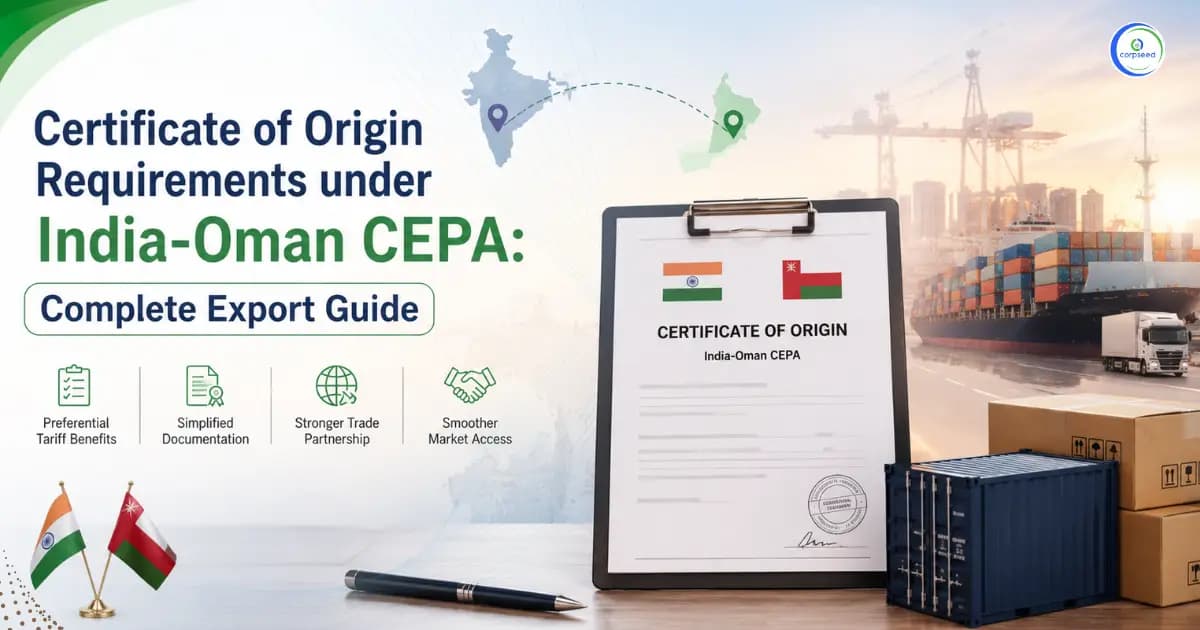
Certificate of Origin Requirements under India-Oman CEPA: Complete Export Guide
Certificate of Origin Requirements under India-Oman CEPA are an important part of claiming preferential tariff benefits when exporting eligible goods from India to Oman. Without a valid Certificate of Origin (CoO) businesses may not be able to avail reduced customs duties under the agreement, even if their products otherwise qualify.
Schedule a Call Back
Introduction
The India-Oman CEPA, which came into force on 1 June, 2026, requires exporters claiming tariff preferences to comply with the prescribed Rules of Origin, and submit the necessary supporting documents. Incorrect origin declarations or incomplete documentation can result in customs delays, denial of preferential duty benefits, or additional import costs.
Whether you are an MSME, manufacturer, export house or exporter of food products, pharmaceuticals, textiles, engineering goods, or other eligible products, understanding the Certificate of Origin requirements before shipment can help ensure smoother customs clearance.
This guide explains the eligibility criteria, required documents, application process, and common compliance mistakes, along with how Corpseed can support your export documentation needs.
Why is a Certificate of Origin Important under India-Oman CEPA?
A Certificate of Origin (eCoO) is one of the key documents required to claim preferential tariff benefits under the India-Oman CEPA. It certifies that the exported goods satisfy the applicable Rules of Origin allowing Omani customs authorities to determine whether the shipment qualifies for reduced, or zero customs duties under the agreement.
Without a valid Certificate of Origin, eligible products may be treated as regular imports, resulting in higher customs duties, and delays during clearance. For businesses exporting to Oman obtaining the certificate is therefore an important step in ensuring compliance with CEPA requirements.
Common key benefits include:
- Access Lower Customs Duties: A valid Certificate of Origin enables eligible shipments to claim the reduced, or zero customs duties available under the India-Oman CEPA.
- Reduce Customs Delays: When the origin documents are complete and accurate, customs authorities can process the shipment more efficiently making clearance smoother.
- Reduced Compliance Risks: Proper origin documentation lowers the chances of customs queries, penalties or rejection of tariff claims.
- Greater Confidence for Buyers: Importers receive the documentation needed to claim CEPA benefits, supporting smoother cross-border trade.
Which Businesses May Need a Certificate of Origin under India-Oman CEPA?
Businesses exporting eligible products from India to Oman and seeking preferential tariff treatment under the India-Oman CEPA may need a Certificate of Origin. The requirement is based on the product's eligibility and compliance with the applicable Rules of Origin, rather than the size or type of business.
This may apply to:
- MSMEs exporting eligible goods
- Food and agricultural exporters
- Pharmaceutical and medical device manufacturers
- Textile and apparel exporters
- Engineering goods and machinery manufacturers
- Chemical and specialty chemical exporters
- Auto component manufacturers
- Electrical and electronics manufacturers
- Export houses trading in qualifying products
Before applying for a Certificate of Origin, businesses should verify that their products meet the origin criteria specified under the India-Oman CEPA.
Certificate of Origin Requirements under India-Oman CEPA
To obtain preferential tariff benefits under the India-Oman CEPA exporters must comply with the prescribed Certificate of Origin requirements. These requirements help establish that the exported goods originate in India, and satisfy the agreement's Rules of Origin.
Key requirements include:
- Eligible Products: Not every product exported to Oman qualifies for CEPA benefits. Confirm that your product is covered under the agreement.
- Compliance with Rules of Origin: Products must meet the applicable origin criteria, such as wholly obtained status or the required value addition and product-specific rules.
- Accurate HS Classification: An incorrect HS Code can create problems during verification and may affect your eligibility for preferential tariffs. So ensure a correct HS code should be used to determine product eligibility and applicable origin requirements.
- Supporting Documents: Exporters should maintain documents such as the commercial invoice, packing list, manufacturer declaration, production records, and other evidence supporting the origin claim.
- Valid export Documents: Shipping documents including the Bill of Lading, or Air Waybill, and export declaration should be consistent with the Certificate of Origin application.
- Accurate Declarations: All information provided in the application should match the supporting documents to avoid customs queries or rejection.
Meeting these requirements helps exporters claim preferential tariff benefits while reducing the risk of delays, or compliance issues during customs clearance.
Documents Required to Obtain a Certificate of Origin
The documentation may vary depending on the product, issuing authority and applicable origin criteria. However, exporters generally need the following documents when applying for a Certificate of Origin under the India-Oman CEPA.
| Document | Purpose |
| Certificate of Origin application | Formal request for certificate issuance |
| Commercial Invoice | Confirms product details, and transaction value |
| Packing List | Provides shipment and packaging information |
| Bill of Lading or Air Waybill | Evidence of shipment |
| Shipping Bill / Export Declaration | Proof of export from India |
| Manufacturer Declaration | Supports the origin claim where applicable |
| Product manufacturing or production records | Demonstrates compliance with Rules of Origin, if required |
| Any additional documents requested by the issuing authority | Required for verification based on the product or application |
Step-by-Step Process to Obtain a Certificate of Origin under India-Oman CEPA
Applying for a Certificate of Origin involves more than submitting an application. Exporters must first confirm that their products qualify under the India-Oman CEPA and ensure all supporting documents are accurate before requesting the certificate.
- Confirm Product Eligibility
The process begins with confirming that the product is eligible for preferential tariff benefits under the India-Oman CEPA. This also involves identifying the correct HS Code.
- Verify the Rules of Origin
The next step is to determine whether the product meets the applicable Rules of Origin. Only products that satisfy these requirements can claim CEPA benefits.
- Prepare the Required Documents
After confirming eligibility the required documents are compiled. These typically include the commercial invoice, packing list, shipping documents, and other records supporting the origin claim.
- Apply for the Certificate of Origin
The application is then submitted to the authorised issuing authority along with the supporting documents. Any mismatch or irregularity in the information provided can delay the process.
- Verification by the Issuing Authority
Before issuing the certificate the authority reviews the application, and supporting documents. If any clarification is required, the exporter may be asked to provide additional information.
- Obtain the Certificate of Origin
Once the application is approved the Certificate of Origin is issued for the shipment. Exporters should review the certificate carefully to ensure all details are accurate before use.
- Submit the Certificate during Customs Clearance
The Certificate of Origin is provided along with the export documentation to enable the importer to claim preferential tariff benefits during customs clearance in Oman.
Common Mistakes That Can Lead to Certificate of Origin Rejection
Even small mistakes in a Certificate of Origin application can create problems during customs clearance, and prevent importers from claiming preferential tariff benefits under the India-Oman CEPA. Taking the time to review your application and supporting documents before submission can help avoid unnecessary delays and compliance issues.
Some common mistakes include:
- Using an incorrect HS Code
- Failing to meet the Rules of Origin
- Providing inconsistent information
- Submitting incomplete supporting documents
- Incorrect exporter or manufacturer details
- Applying without verifying eligibility
How Certificate of Origin Errors Can Affect Exporters
A rejected or inaccurate Certificate of Origin can create more than just documentation issues. It can affect shipment timelines, increase export costs as well as, impact business relationships with overseas buyers.
Some of the key business implications include:
- Loss of Preferential Tariff Benefits: Importers may have to pay the standard customs duty if the Certificate of Origin is not accepted.
- Customs Clearance Delays: Additional verification by customs authorities can hold shipments at the port which may result in extend delivery timelines.
- Higher Import Costs: Denial of tariff concessions can increase the landed cost of goods, reducing price competitiveness.
- Risk of Shipment Detention: Significant discrepancies in origin documentation may lead to additional inspections, or temporary detention of the consignment.
- Buyer Disputes and Commercial Impact: Delays, or unexpected duty liabilities can affect customer satisfaction and future business opportunities.
- Additional Compliance Costs: Correcting documentation errors, or reapplying for certificates may result in extra administrative expenses, and operational delays.
Also Read: How to Claim Zero Duty Benefits in Oman| Complete Export Guide
How Corpseed Helps Businesses Meet Certificate of Origin Requirements
Obtaining a Certificate of Origin under the India-Oman CEPA requires more than completing an application. Exporters must assess product eligibility, comply with the applicable Rules of Origin, and maintain accurate documentation to support their claim for preferential tariff benefits. Corpseed provides end-to-end assistance to help businesses manage this process with greater confidence.
Our services include:
- Product Eligibility Assessment: We evaluate whether your products qualify for preferential tariff benefits under the India-Oman CEPA.
- Rules of Origin Review: Our experts assess the applicable origin criteria and identify the documents needed to support your claim.
- Documentation Support: We help prepare and review commercial invoices, manufacturer declarations, packing lists, and other supporting documents.
- Certificate of Origin Application Assistance: We guide businesses through the application process and help address documentation-related queries.
- DGFT and Export Compliance Advisory: Our team provides support on export documentation and regulatory requirements relevant to international trade.
- End-to-end Compliance Support: From pre-export assessment to documentation review, we help businesses reduce compliance risks and facilitate smoother exports to Oman.
Whether you are an MSME, manufacturer, or export house, Corpseed helps simplify Certificate of Origin compliance so you can focus on expanding your business in the Omani market.
Final Thoughts
The Certificate of Origin Requirements under India-Oman CEPA play an important role in helping exporters claim preferential tariff benefits and demonstrate compliance with the agreement's Rules of Origin. A well-prepared application supported by accurate documentation, and product eligibility assessment, can reduce customs-related issues, and improve the overall export process.
As India and Oman strengthen bilateral trade through the CEPA businesses should treat Certificate of Origin compliance as an essential part of their export planning rather than a last-minute documentation requirement. Seeking professional guidance can help minimise errors, avoid delays and ensure that eligible shipments receive the tariff benefits available under the agreement.
About the Author

Parul Bohral
Legal Content WriterParul Bohral, a BALLB graduate and experienced legal researcher and content writer with expertise in various legal areas, including corporate law and intellectual property. I have gained valuable experience in esteemed legal environments, where I have strengthened my research skills, allowing me to approach legal writing with precision and depth.
As a legal content writer, I am committed to delivering work that not only informs but also engages readers. By staying informed about the latest trends in content marketing and regulatory developments, I ensure that my writing remains sophisticated and meets industry standards. My dedication to thorough research enables me to craft content that is both insightful and impactful.
Related articles

India-New Zealand FTA: How Startups Can Export Duty-Free and Enter the New Zealand Market
2026-10-23

Exporting Handicrafts & Home Decor from India: IEC, DGFT & Customs Compliance Checklist
2026-10-14
How to Export Through Amazon Global & Etsy From India: Complete MSME Export Guide
2026-10-13

Textile & Apparel Testing in India: Export Compliance with REACH, Azo Dyes & ISO 105 Guide 2026
2026-09-02

India's Engineering Exports Rise 21% to 11.48 Billion US Dollar: Opportunities for Indian Exporters
2026-07-31
Export Compliance Checklist for Oman: A Complete Guide for Indian Exporters to Avoid Customs Delays
2026-07-29