
Impact of China’s Lithium Policy Changes on India’s EV Sector
China has recently introduced export restrictions and licensing requirements on key components of the lithium-ion battery value chain.
Schedule a Call Back
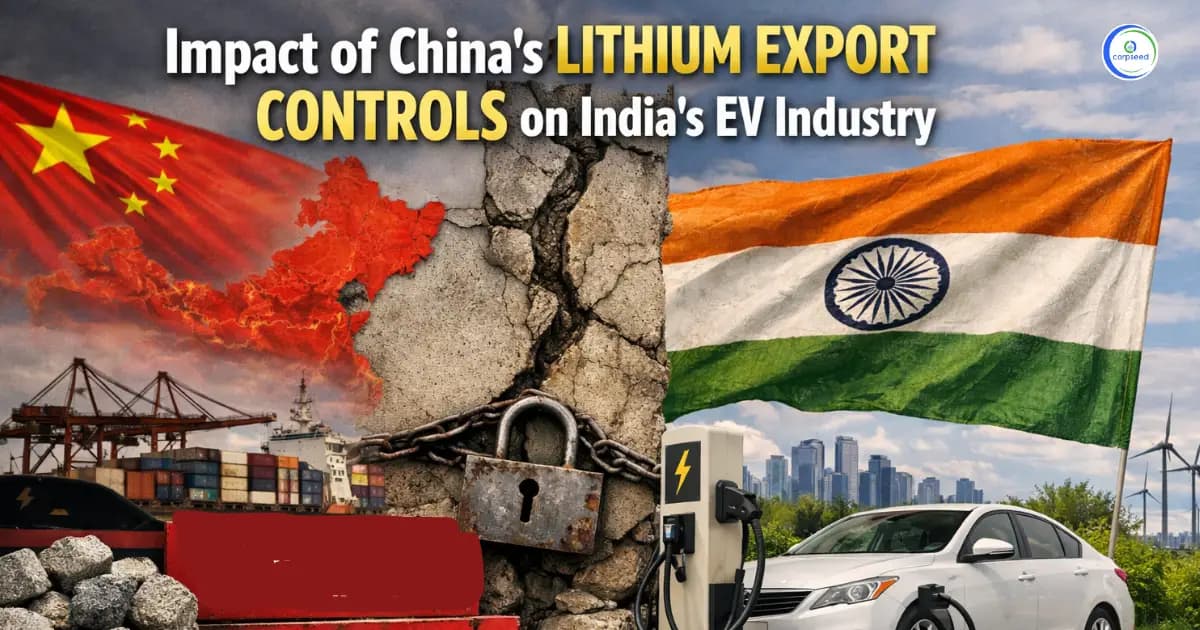
India's electric vehicle industry has been growing gradually, driven by government initiatives, environmental concerns, and increased consumer adoption in India’s EV market. However, the industry remains heavily dependent on imported critical minerals, including lithium, an essential component of lithium-ion batteries.
New policy changes implemented by the Chinese government, including export control policies and licensing requirements on advanced lithium-ion batteries and technology, may affect India’s EV industry in the coming days, especially in terms of the industry's cost structure and long-term sustainability.
India’s Dependence on Lithium Imports
India currently relies almost entirely on imports to meet its lithium requirements. This includes not only raw lithium but also processed battery components such as cathodes and anodes.
According to the Society of Indian Automobile Manufacturers, this high level of import dependence exposes the Indian EV sector to global supply disruptions. As a large portion of lithium processing and battery component manufacturing is concentrated in China, any regulatory changes in that market can directly impact India’s EV market.
China’s Export Controls on Lithium: What Has Changed?
China has recently introduced export restrictions and licensing requirements on key components of the lithium-ion battery value chain, including:
- High-performance lithium-ion batteries (≥300 Wh/kg)
- Cathode materials
- Artificial graphite anodes
- Battery manufacturing technologies
Under the new regulations, exporters must secure prior approvals before exporting these materials and technologies to foreign markets, which may result in additional compliance necessities and extended processing timelines.
China's export regulations are intended to control the export of advanced battery technologies, including lithium-ion, and strengthen the country's battery technology supply chain. As China dominates the global lithium processing industry, these regulations may affect the global lithium supply, predominantly for countries like India that rely on China's midstream processing.
Schedule a Call Back
Implications for India’s Electric Vehicle Industry
China’s recent export controls on lithium and related battery materials are expected to have several implications for India’s electric vehicle sector, particularly in the areas of supply chain stability, cost structures, and market adoption.
- Supply Chain Disruptions: The EV industry in India heavily depends on imported battery parts, with a considerable percentage being imported from China. The imposition of export restrictions may cause disruptions in the supply chain, thereby affecting the smooth functioning of the industry in the near future.
- Increase in Battery Costs: Lithium, cobalt, and nickel are internationally traded metals with prices determined by global demand-supply balance. The imposition of export restrictions on these metals may cause a fluctuation in their prices, thereby affecting battery manufacturing costs, as battery costs constitute a significant part of overall EV costs.
- Impact on EV Adoption: The imposition of export restrictions on battery parts may cause a rise in overall EV costs, thereby affecting consumer behaviour in a price-sensitive market like India. The long-term outlook for EV adoption is positive, but in the near future, such supply uncertainties may cause a decline in the overall growth rate.
Government Initiatives to Strengthen Domestic Capabilities
In response to these challenges, the Government of India has undertaken several measures to reduce import dependence and strengthen the Indian EV ecosystem and critical mineral supply chain.
National Critical Mineral Mission
The Union Cabinet approved the National Critical Mineral Mission on January 29, 2025. The mission aims to secure a sustainable supply of critical minerals and develop a comprehensive value chain covering exploration, mining, processing, and recycling to support India’s EV market.
Key Policy Measures
- Amendments to the Mines and Minerals Development and Regulation Act have enabled the auction of 46 blocks of critical and strategic minerals.
- Introduction of a Rs 1,500 crore incentive scheme to promote the recycling of critical minerals.
- Issuance of guidelines for pilot projects focused on mineral recovery from industrial waste such as fly ash and tailings.
- Establishment of Centres of Excellence to enhance research and development in the critical mineral sector.
International Collaboration for Lithium Sourcing
India is also looking for international partnerships to expand its lithium supply. For this purpose, Khanij Bidesh India Limited has signed an agreement with CAMYEN in Argentina for the exploration and development of lithium brine blocks.
This move indicates a strong effort to source lithium from multiple countries rather than rely on a single source. This will be beneficial for the long-term sustainability of the Indian EV sector.
Long-Term Outlook for the EV Sector
While China’s policy changes may form short-term challenges, they also demonstrate the significance of creating a resilient and self-reliant supply chain within India’s EV market. Continued government support, technological advancements, and amplified domestic production capacity are expected to play a major role in reducing these risks.
Over time, these developments may contribute to a more stable and sustainable EV ecosystem in India.
Conclusion
Export restrictions by China on Lithium and its derivatives have created uncertainties in the global supply chain, which affects India’s electric vehicle sector directly. The immediate effect may include supply restrictions and cost pressure however, the ongoing initiatives by the government suggest that there is a high commitment level towards reducing import dependence.
A balanced approach relating domestic capabilities and global partnerships would be the key to ensuring the long-term sustainability and stability of India’s electric vehicles sector.
About the Author

Parul Bohral
Legal Content WriterParul Bohral, a BALLB graduate and experienced legal researcher and content writer with expertise in various legal areas, including corporate law and intellectual property. I have gained valuable experience in esteemed legal environments, where I have strengthened my research skills, allowing me to approach legal writing with precision and depth.
As a legal content writer, I am committed to delivering work that not only informs but also engages readers. By staying informed about the latest trends in content marketing and regulatory developments, I ensure that my writing remains sophisticated and meets industry standards. My dedication to thorough research enables me to craft content that is both insightful and impactful.
Related articles
IEC vs Import Licence: When Restricted Goods Need DGFT Approval Beyond IEC
2026-10-26
Can You Import Products Before BIS Certification? What Importers Must Know
2026-10-15

Selling Imported Goods on Amazon & Flipkart? 7 Compliance Checks Before Listing
2026-10-15
Rules of Origin Explained: A Complete Guide for Exporters and Importers
2026-08-06
DGFT Extends India-UAE CEPA Gold Import TRQ Deadline
2026-07-08

DGFT Amends IEC Application Process under HBP 2023
2025-12-01