
Medical Devices PLI Scheme 2026: New Applications, Eligibility, Incentives & Benefits
The Government of India announced major changes to the Production Linked Incentive (PLI) Scheme for Medical Devices on 10 November 2026. The scheme has been extended till the financial year 2035-36, with around 2,700 crore rupees available. Applications for the scheme have been invited again, and the government has made changes to the plan to make it easier for eligible medical device manufacturers.
Schedule a Call Back
2,100+ CDSCO medical device assignments since 2018
Clients include Endolite India, Mankind Pharma, Ossur India, ADK Health Care, Credence Prosthetic India, V2U Physio Asia, International Electro Medical Company, Radimage Healthcare India, Istok New Hearing AID, Simpladent Implant Solutions, Starkey Laboratories India, Gentec Medical (12 of 1,100+ served since 2018).
A few more clients we've served in this industryHide the list
- Pharma and healthcare
- Endolite India · Mankind Pharma · Ossur India · ADK Health Care · Credence Prosthetic India · V2U Physio Asia · International Electro Medical Company · Radimage Healthcare India · Istok New Hearing AID · Simpladent Implant Solutions · Starkey Laboratories India · Gentec Medical · Cureesse Pharma · Hygiene Medicus · Nexus Surgical and Medicare
- More clients
- Meditronix Corporation · Nilkamal · Haesi GHL · GHL · Servotech Power Systems · Elektrocraft India · Happy Medicare · Anantaa Gsk Innovations · Cogmac Technologies · Aficionados Tech · Superceuticals · Truevis Technologies · 1008 Digital Health · BDS Services · Evoq Imaging Technologies · Premier Medical Systems and Devices · Riransa · Vitrag Infra Projects · Insta Biotech · Digital Acoustics · Artificial Learning Systems India · Nfilade Security Solutions · Humors Tech · K2O Consulting
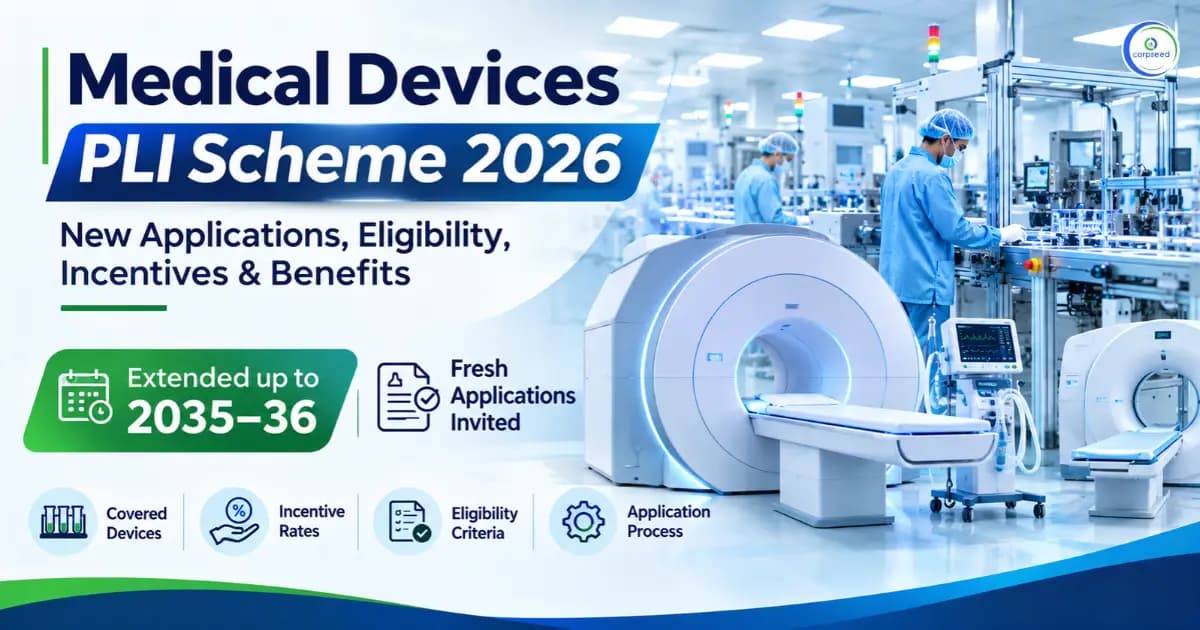
The Government of India announced major changes to the Production Linked Incentive (PLI) Scheme for Medical Devices on 10 November 2026. The scheme has been extended till the financial year 2035-36, with around 2,700 crore rupees available. Applications for the scheme have been invited again, and the government has made changes to the plan to make it easier for eligible medical device manufacturers.
The revised framework, also referred to as PLI-MD 2.0, focuses on manufacturing critical components, medical consumables and advanced medical equipment in India. The changes are particularly relevant to businesses planning new manufacturing facilities, expanding production capacity or developing domestic supply chains. However, applicants must check the eligibility and investment requirements for their proposed products before applying.
For businesses comparing medical device manufacturing incentives in India, the first step is to identify the correct target segment and verify the medical device PLI scheme eligibility criteria.
Schedule a Call Back
What Is the PLI Scheme for Medical Devices in India?
The Production Linked Incentive Scheme for Promoting Domestic Manufacturing of Medical Devices is a government initiative designed to encourage medical device manufacturing in India. It provides financial incentives to approved manufacturers based on qualifying incremental sales and compliance with prescribed conditions.
Introduced in 2020-21, the scheme aims to support domestic manufacturing of advanced medical equipment, reduce dependence on imports and strengthen India's medical technology industry.
The Department of Pharmaceuticals, under the Ministry of Chemicals and Fertilizers, administers the scheme.
According to the government's November 2026 announcement, the earlier phase has achieved:
- Domestic manufacturing of more than 60 high-end medical devices and components.
- Production valued at over 16,000 crore rupees.
- Manufacturing of X-ray tubes, detectors, CT scanners and 1.5T MRI systems.
- Production of orthopaedic implants, cardiac implants, dialysers and other medical devices.
The revised scheme builds on these developments while placing greater emphasis on domestic component manufacturing and increasing value addition within India.
What Are the Latest Changes in the Medical Devices PLI Scheme 2026?
The government has revised several provisions to make the Medical Devices PLI Scheme more suitable for manufacturers planning new investments.
The revised guidelines apply to applications submitted after 10 November 2026. Applicants already approved up to 31 October 2026 continue under the guidelines dated 25 February 2023.
- Extension of the Scheme Until 2035-36
The scheme has been extended until FY 2035-36, giving eligible manufacturers a longer policy framework for developing manufacturing projects.
- Fresh Applications Invited
New applications are invited under the revised scheme. Businesses planning medical device manufacturing projects can assess their eligibility and prepare applications under the updated conditions.
- Removal of the Minimum Sales Threshold
The earlier minimum sales threshold for claiming incentives has been removed. However, certain target segments still have prescribed sales-growth requirements.
- Reduction in Minimum Investment Requirements
The revised guidelines introduce differentiated investment requirements based on the target segment and the applicant's average annual turnover.
For example, TS2 does not have a prescribed minimum investment threshold, while different conditions apply to TS1, TS3 and TS4.
- Simplified Application Guidelines
There have been some modifications in terms of the eligibility requirements and incentive claims process. The information is available in the new guidelines for PLI-MD, which have been updated on 10 November 2026.
- Multiple Applications Within/Across Target Segments
One can apply for multiple applications either within or across target segments. Each application has to meet its own set of criteria.
When the same product is included in different target segments, then one cannot just make multiple claims on different segments but has to follow the product classification criteria in Annexure 2.
Key Changes in the Medical Devices PLI Scheme 2026
| Change announced in November 2026 | Updated scheme position | Why it matters to applicants |
|---|---|---|
| Scheme extension | Up to FY 2035-36 | Provides an extended framework for eligible projects |
| Fresh PLI applications | Invited | Eligible manufacturers can consider applying under the revised guidelines |
| Available scheme outlay | Approximately 2,700 crore rupees | Indicates funds available under the existing approved scheme |
| Minimum sales threshold | Discontinued | Segment-specific sales-growth conditions may still apply |
| Investment requirement | Revised by segment and turnover | Applicants must check Annexure 2 before investment planning |
| Target segments | TS1, TS2, TS3 and TS4 | Product classification determines the applicable conditions |
| Multiple applications | Permitted, subject to eligibility | Each application must independently satisfy the scheme requirements |
| Manufacturing setup allowance | Up to three years | Helps applicants plan facility establishment and commissioning |
These changes may make certain manufacturing projects more attractive. Nevertheless, an applicant's eligibility depends on the specific product, investment, manufacturing plan and other scheme conditions.
Who Is Eligible for the Medical Devices PLI Scheme 2026?
The revised PLI-MD guidelines allow eligible companies and Limited Liability Partnerships (LLPs) registered in India to seek benefits under the scheme.
Applicants must satisfy the prescribed eligibility conditions, including positive net worth and the applicable investment, manufacturing and sales requirements.
Businesses that may consider applying include:
- Existing manufacturers: Firms seeking increased production capacity for qualifying goods.
- New manufacturers: Firms seeking to set up factories for the manufacture of medical devices under the scheme.
- MSMEs: Eligible small and medium enterprises, particularly those planning to manufacture critical components.
- Component manufacturers: Businesses producing parts used in advanced medical equipment.
- High-end medical equipment manufacturers: Businesses developing products covered under TS3 or TS4.
The revised guidelines also specify that applicants must not have been declared bankrupt, wilful defaulters, defaulters, or reported as fraudulent by the relevant financial institutions.
Important eligibility condition: TS1 applicants must also consider the requirement concerning regulatory approval from a recognised stringent regulatory authority jurisdiction and sales in such a jurisdiction, as specified in Annexure 3.
For TS1 and TS3, the scheme generally requires greenfield projects. Under the guidelines, a greenfield project may include a new plant established within the premises of an existing facility, provided the applicable requirements are met. TS4 instead focuses on deeper domestic value addition.
MSME status alone does not guarantee eligibility or exemption from investment requirements.
Which Medical Devices Are Covered Under the PLI Scheme?
The Medical Devices PLI Scheme 2026 covers four target segments. Each segment focuses on a different part of the medical device manufacturing industry.
TS1: Medical Consumables, Disposables and Implants
This segment covers medical products used in healthcare procedures, treatment and patient care.
Examples listed in the revised guidelines include disposable syringes, IV cannulas, blood collection products, catheters, dialysers and certain medical implants.
The focus is on developing manufacturing capacity and improving product quality.
TS2: Critical Medical Device Components
TS2 covers components used to manufacture finished medical devices.
Examples include X-ray tubes, detector modules, MRI components, ultrasound transducer modules and electronic components used in advanced diagnostic equipment.
This segment is particularly relevant to businesses planning to supply parts to medical equipment manufacturers.
TS3: High-End Medical Devices at an Early Stage of Domestic Manufacturing
TS3 focuses on advanced medical technologies with limited manufacturing capacity in India.
Examples from the revised guidelines include 3 Tesla MRI scanners, digital PET-CT systems, ultrasound probes and high-throughput fully automatic IVD analysers.
The government's objective is to encourage the development of advanced manufacturing capabilities within India.
TS4: High-End Medical Devices Currently Assembled in India
TS4 focuses on equipment for which domestic manufacturing currently includes assembly operations.
The indicative list includes patient monitors, ventilators, infusion pumps, CT scanners and other advanced equipment.
Manufacturers in this segment must work towards increasing domestic value addition by localising important components.
The complete indicative product lists are provided in Annexures 1 and 1A of the revised guidelines. Products outside these lists require approval from the competent authority.
Medical Devices PLI Scheme 2026: Target Segments at a Glance
| Target segment | Covered manufacturing focus | Product examples discussed above | Approximate average incentive rate |
|---|---|---|---|
| TS1 | Medical consumables, disposables and implants | Disposable syringes, IV cannulas, catheters and implants | 5% |
| TS2 | Critical components for medical devices | X-ray tubes, detector modules and MRI components | 9% |
| TS3 | High-end devices at an early stage of domestic manufacturing | 3 Tesla MRI scanners, PET-CT systems and certain IVD analysers | 9% |
| TS4 | High-end devices currently assembled in India | Patient monitors, ventilators and infusion pumps | 6% |
These are average tapering rates announced by the government. The year-wise rates and eligibility conditions are addressed in the next section.
What Are the Incentive Rates Under the Medical Devices PLI Scheme 2026?
Under the revised scheme, incentives are linked to qualifying incremental sales of manufactured products.
The government has introduced different incentive structures for the four target segments, with rates generally decreasing across the five performance years.
The detailed annual rates are:
- TS1: 7%, 7%, 4%, 3% and 3%.
- TS2: 10%, 10%, 10%, 8% and 6%.
- TS3: 10%, 10%, 10%, 8% and 6%.
- TS4: 7%, 7%, 7%, 5% and 4%.
These are the prescribed segment-wise rates. Actual entitlement depends on satisfying the applicable conditions.
For instance, the CAGR for sales in TS1 is 10%. In TS2, there are sales growth criteria and another incentive criterion tied to value chain integration.
TS3 does not prescribe a sales CAGR condition but includes requirements relating to domestic value addition. TS4 also focuses on meeting its committed value-chain integration requirements.
Manufacturers should not calculate expected incentives by simply multiplying total sales by the advertised average rate. The eligible sales base, performance year, segment-specific conditions and approval terms must first be established.
How Can Manufacturers Apply for the Medical Devices PLI Scheme 2026?
Applications under the revised scheme must be submitted online through the mechanism designated by the Department of Pharmaceuticals and its Project Management Agency (PMA).
The following steps can help manufacturers prepare.
Before beginning the Medical Devices PLI Scheme 2026 application process, a manufacturer should confirm the product's classification and whether the business meets the relevant investment, financial and manufacturing conditions.
Step 1: Review the revised guidelines
Consult the official guidelines released on 10 November 2026, along with the list of eligible products, investment conditions, and incentive criteria.
Step 2: Identifying the right target segment
Find out which of the following segments TS1, TS2, TS3, and TS4 applies to the proposed product. Refer to the particular product entry rather than just the category.
Step 3: Check eligibility
Review the applicant's legal status, net worth, turnover, investment requirements and other conditions for the selected segment.
Step 4: Prepare the manufacturing proposal
Develop a project plan showing the proposed products, manufacturing location, investment, production capacity, projected sales and value-chain integration.
Step 5: Arrange the prescribed application documents
Ensure that the relevant company documents, statements, and other certificates and regulatory information are available as per Annexure 4.
Step 6: Submit the application online
Utilize the designated portal once it is ready for use. The modified application form requires an Entity Locker ID.
Step 7: Pay the application fee
According to the modified guidelines, there will be a non-refundable application fee of 1,00,000 rupees per application, which needs to be paid online.
Step 8: Answer queries regarding applications
The PMA can consider the application and ask for any missing information. This needs to be done within the stipulated time period.
Step 9: Monitor application and compliance
Once the application is submitted, the applicant will have to follow the relevant process. An acknowledgement does not imply approval, and even approval does not ensure entitlement to incentive payments.
What Documents Are Required to Apply for the Medical Devices PLI Scheme?
The revised guidelines contain a prescribed application form and supporting-document requirements.
Applicants should refer to Annexures 4, 5 and 6 to confirm the applicable documents and information.
Medical Devices PLI Scheme Application Documents Checklist
| Document or information | Purpose | Source or applicability |
|---|---|---|
| Certificate of incorporation | Identifies the applicant company | Annexure 4 enclosure |
| Audited balance sheet and profit and loss statement | Supports financial review | Annexure 4 specifies copies for the last two years, other financial information may cover a longer period |
| PAN card and GST details | Provides tax identification | Annexure 4 enclosure |
| Memorandum and Articles of Association | Confirms the company's constitution | Annexure 4, where relevant to the applicant |
| Letter authorising the signing authority | Confirms who can submit the application | Annexure 4 enclosure |
| Shareholder ownership details | Establishes ownership information | Annexure 4, specifically identified for foreign companies |
| Product, target-segment and investment proposal | Describes the proposed manufacturing project | Annexure 4 application information |
| Proposed sales and domestic value-chain integration | Supports incentive and project assessment | Annexures 4 and 6, where applicable |
| Regulatory clearances and proposed approval timelines | Identifies approvals needed to execute the project | Annexure 4 application information |
| Proof of application-fee submission | Confirms payment for the application | Annexure 4, 1,00,000 rupees per application |
| Audit consent undertaking | Permits verification of submitted information | Annexure 5 |
Applicants should use the official application form and prescribed enclosure list for their legal structure and target segment.
The application form also seeks information about key personnel, manufacturing locations, existing manufacturing activities and applicable intellectual property or technology-transfer arrangements.
Some documents depend on the applicant's legal structure and circumstances. For example, foreign shareholding information may be relevant to certain applicants.
Applicants should prepare the exact documents specified by the portal and applicable guidelines rather than assuming that one universal checklist covers every business.
What Is the Investment Requirement Under the Medical Devices PLI Scheme?
The revised investment requirements are particularly important for manufacturers planning new facilities.
According to Clause 4.2.2 and Annexure 2 of the guidelines:
- TS1, TS3 and TS4: Applicants with average annual turnover below 150 crore rupees during the preceding three years must meet a minimum investment requirement of 50 crore rupees.
- TS1, TS3 and TS4: Applicants with average annual turnover of at least 150 crore rupees do not have a prescribed minimum investment threshold.
- TS2: No minimum investment threshold applies.
Medical Devices PLI Scheme Investment Requirements by Segment
| Target segment | Applicant's average annual turnover during the preceding three years | Minimum investment threshold |
|---|---|---|
| TS1, TS3 and TS4 | Below 150 crore rupees | 50 crore rupees |
| TS1, TS3 and TS4 | 150 crore rupees or above | No prescribed minimum investment threshold |
| TS2 | Any turnover category | No prescribed minimum investment threshold |
For TS1 and TS3, the applicable investment relates to greenfield manufacturing, for TS4, the focus is on increased domestic value-chain integration. Other eligibility conditions still apply.
For TS1 and TS3, the investment is linked to greenfield manufacturing. TS4 focuses on achieving greater value-chain integration and does not require a new greenfield facility.
A company without a prescribed minimum investment threshold must still meet the other eligibility conditions and carry out its approved manufacturing commitments.
The guidelines recognise qualifying expenditure on plant, machinery, equipment and certain research, development and technology-related activities.
But land and building costs are not included in the investment eligible for the scheme.
Manufacturers should evaluate their investment plans based on the definitions before investing. The new guidelines indicate that 1 April 2026 will be the cut-off date for investment calculations.
What Is the Application Timeline for the Medical Devices PLI Scheme 2026?
Fresh applications were announced on 10 November 2026. The government stated that the online portal was expected to become operational within the following ten days.
There are a number of key timeframes set out in the new guidelines:
Application period: To be kept open for a long time period, subject to any notifications given by the Department of Pharmaceuticals.
- Preliminary application review: The PMA has to complete this within 15 working days.
- Incomplete applications: Applicants are given 15 working days to address identified deficiencies after receiving the relevant communication.
- Application finalisation: The guidelines prescribe 60 days from the date applications are taken up from the portal for processing.
- Manufacturing setup: A maximum gestation period of three years.
- Incentive performance period: A maximum of five years.
- Scheme extension: Until FY 2035-36, inclusive of processing and release of incentives for the last performance year.
The periods of the review prescribed above cannot be considered as the date of approval.
As of 12 November 2026, the operational status of the new portal and the final deadline for applications can be confirmed from the Department of Pharmaceuticals before applying.
What Are the Benefits of the Medical Devices PLI Scheme for Manufacturers and MSMEs?
The revised scheme creates opportunities for businesses interested in developing medical device manufacturing capabilities in India.
- More opportunities for component manufacturers
The focus on TS2 could encourage businesses to manufacture specialised components used in diagnostic and therapeutic equipment.
- Reduced investment restrictions in selected segments
The new investment structure could allow some companies to take part without fulfilling the previous investment criteria.
- Support for domestic manufacturing
Financial incentives can help qualifying manufacturers manage part of the cost disadvantages associated with domestic production.
- Opportunities in advanced medical technology
The scheme encourages manufacturing in areas such as advanced imaging, diagnostics and other specialised medical technologies.
- Greater domestic value addition
Component localization would benefit the domestic suppliers and lessen the dependency on imported components.
- Opportunities for MSMEs
Small enterprises having the appropriate technical expertise can consider manufacturing components or collaborating with larger firms manufacturing medical equipment.
These are potential benefits. Financial incentives remain subject to approval, available scheme funds and the applicable conditions.
What Licences and Regulatory Approvals Are Required for Medical Device Manufacturing in India?
A manufacturer planning to apply for PLI incentives should separately identify the approvals required to manufacture and market medical devices in India.
The PLI scheme provides financial incentives. It does not replace statutory manufacturing or product-related regulatory obligations.
CDSCO Medical Device Manufacturing Licence
In India, medical devices are regulated as per the Medical Devices Rules, 2017. The manufacturing license will depend on the risk class of the product. While Class A and B medical devices are governed by the State Licensing Authority, licenses for Class C and Class D medical devices are provided by the Central Licensing Authority.
Class A non-sterile and non-measuring devices have a unique registration-based exemption. It is recommended that manufacturers ascertain the relevant license or registration process prior to manufacture.
ISO 13485 Quality Management System
ISO 13485 specifies the framework for the quality management of medical devices. It is mandatory for manufacturers to evaluate the quality management requirements under Medical Devices Rules, including the Fifth Schedule.
Independent ISO 13485 certification should not automatically be treated as compulsory for every medical device or component manufacturer.
Factory Licence and Facility Approvals
Businesses establishing manufacturing units may require factory-related registrations, licences and approvals, depending on their location and operational activities.
Environmental Permissions and Pollution Control Compliance
Consent to Establish (CTE), Consent to Operate (CTO) or any other form of environmental consent may be applicable based on the process of manufacture, type of pollution and requirements by the State Pollution Control Board.
Product Testing and Relevant BIS Requirements
Manufacturers need to determine the standards applicable to the product and testing requirements. Certification from BIS is mandatory only when there is a legal requirement for the product.
Regulatory Approvals for Medical Device Manufacturing
| Approval or compliance area | Purpose | When it may apply |
|---|---|---|
| CDSCO medical device manufacturing licence or applicable registration | Establishes the appropriate regulatory pathway for manufacturing | Depends on device risk class and applicable exemptions |
| Medical device quality management system | Supports quality and regulatory requirements | According to the Medical Devices Rules, 2017 and relevant schedules |
| ISO 13485 certification | Provides independent certification against a medical device quality management standard | When commercially required or otherwise applicable, not automatically compulsory for every business |
| Factory Licence and facility approvals | Covers applicable factory and site requirements | Depends on location and operations |
| Consent to Establish / Consent to Operate | Addresses applicable environmental permissions | Depends on the manufacturing activity and pollution-control requirements |
| BIS standards and product testing | Addresses product-specific standards and testing requirements | Where relevant standards or mandatory certification rules apply |
Manufacturers should establish their compliance obligations early so that licensing requirements do not delay the proposed production schedule.
What Should Medical Device Manufacturers Consider Before Applying for PLI Incentives?
Before applying, manufacturers should review both their proposed business model and the requirements of the selected target segment.
A practical pre-application checklist includes:
- Product eligibility: Check whether the proposed product is included in Annexure 1A or requires specific approval.
- Correct target segment: Identify TS1, TS2, TS3 or TS4 according to the product and manufacturing activity.
- Applicant eligibility: Review the legal structure, net worth and financial conditions.
- Investment planning: Confirm whether the 50 crore rupees minimum investment requirement applies.
- Conditions for sales: Consider CAGR conditions if any.
- Infrastructure needs for manufacturing: Decide on the need for greenfield infrastructure or value chain involvement.
- Regulatory requirements: Find out CDSCO, factory, environment, and product regulations.
- Documentation: Prepare the required business records, financial statements and manufacturing proposals.
- Incentive planning: Assess the proposed project against the applicable performance-year requirements.
- Application readiness: Verify the official portal, application notice and fee-payment instructions.
Manufacturers should also consider whether their production plan can support the commitments made in the application.
How Can Corpseed Help Medical Device Manufacturers?
Businesses planning medical device manufacturing projects may require assistance with facility establishment, product classification, licensing and quality compliance.
Businesses looking for a medical device manufacturing licence in India, CDSCO medical device registration or medical device manufacturing plant setup services should first identify the permissions and quality requirements relevant to their products.
Corpseed provides relevant services that can support manufacturers during these stages, including:
- Medical device registration in India: Guidance on applicable CDSCO registration and licensing requirements.
- CDSCO Form MD-7 assistance: Support for manufacturing licence applications involving Class C and Class D medical devices.
- ISO 13485 implementation: Assistance with medical device quality management system implementation.
- Factory setup services: Support for planning and establishing manufacturing facilities.
- Factory Licence: Assistance with applicable factory licensing requirements.
These services can help businesses address the manufacturing and regulatory requirements associated with their projects.
Planning to establish a medical device manufacturing unit in India?
Book a Free Consultation with Corpseed to discuss your manufacturing project, required regulatory approvals and compliance obligations.
Conclusion
The Medical Devices PLI Scheme 2026 offers a revised framework for eligible manufacturers to invest in domestic production, critical components and advanced medical technologies.
The extension until 2035-36, revised investment thresholds and differentiated incentive structure create opportunities for businesses across the four target segments.
If manufacturers are thinking of applying to the program, they need to ensure that the product is eligible and what investments are required, along with all other necessary approval processes and incentive conditions. A well-formulated manufacturing plan can assist in evaluating whether this program suits their business.
About the Author

Mahek Sancheti
Content WriterMahek Sancheti, BAJMC graduate with a deep passion for writing. As a content writer, video content creator, creative content creator, and scriptwriter, I bring stories to life through words and visuals. I honed my skills by working with a prominent news agency, where I excelled in crafting compelling narratives and engaging content. Coming from a journalism and mass communication background I have skills to craft engaging narratives that captivate audiences. With a keen interest in writing and creativity, I aim to deliver impactful and meaningful content that resonates with diverse audiences.
https://www.linkedin.com/in/mahek-sancheti-837196212
Related articles
CDSCO MD-7 Endorsement for Medical Devices: A Practical Guide for Manufacturers
2026-10-23
CDSCO Export NOC for r-DNA Products: Who Needs It?
2026-10-21
CDSCO Registration: A Simple Guide to Getting Your License in India 2026
2026-10-21

Importing Cosmetic Gift Sets into India? CDSCO, LMPC & Labelling Checklist
2026-10-14
CDSCO Medical Device Registration Consultant
2026-09-23
CDSCO Registration for Lab Equipment and Diagnostic Devices
2026-09-22