
India Bans Lithium-Ion Battery Black Mass Exports in 2026: What It Means for Businesses
India has stopped exports of specified battery waste and scrap, including lithium-ion battery black mass, from 10 November 2026. This changes things for businesses that recover black mass from used batteries and sell it overseas.
Schedule a Call Back
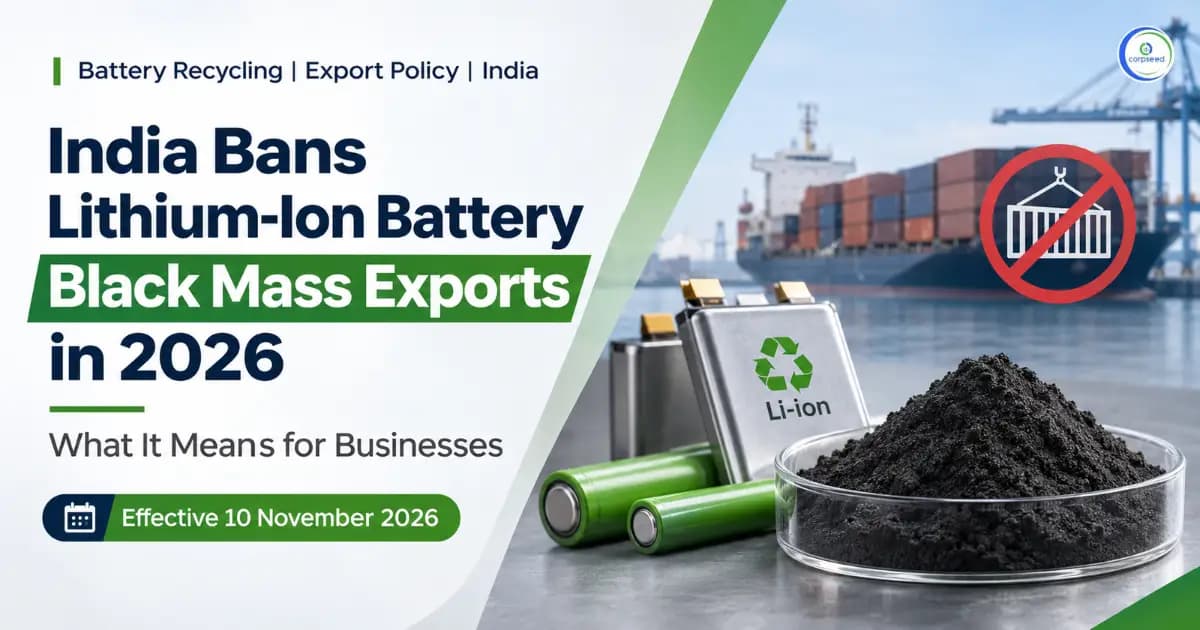
India has stopped exports of specified battery waste and scrap, including lithium-ion battery black mass, from 10 November 2026. This changes things for businesses that recover black mass from used batteries and sell it overseas. Although it looks like ordinary black powder, the material can contain valuable minerals such as lithium, nickel and cobalt. The government wants more of these materials to be recovered and processed within India. But what does the black mass export ban mean for exporters, battery recyclers and businesses planning a lithium-ion battery recycling plant in India? Here's what has changed and why it matters.
The lithium-ion battery black mass export ban in India in 2026 raises another practical question: how will businesses manage the battery waste that they previously supplied to overseas buyers?
Schedule a Call Back
What Is Lithium-Ion Battery Black Mass and Why Is It Valuable?
Used lithium-ion batteries contain valuable materials that can be recovered and used again. One of the important materials obtained during recycling is known as black mass.
Black mass is a dark, powder-like substance produced when used lithium-ion batteries or battery manufacturing waste undergo mechanical processing, including shredding and separation.
Depending on the battery chemistry, it may contain recoverable materials such as:
- Lithium: Used in rechargeable batteries for electric vehicles, electronics and energy storage systems.
- Cobalt: Used in certain battery cathode materials.
- Nickel: An important component of several high-energy battery chemistries.
- Manganese: Used in certain lithium-ion battery cathodes.
Not every battery contains all these minerals, and the composition of black mass varies according to the batteries being processed.
The value of black mass comes from the minerals that can be extracted through further recycling and refining. Instead of relying entirely on freshly mined resources, battery manufacturers can potentially use recovered materials in new production.
This makes black mass an important part of the circular economy, where valuable materials are recovered and reused rather than discarded.
For India, which depends on imports for several critical minerals, recovering these materials domestically has become an important industrial priority.
This is also why lithium-ion battery recycling in India is closely connected with battery raw material recovery and the development of domestic mineral supply chains.
Why Has India Banned Lithium-Ion Battery Black Mass Exports?
India's decision to prohibit exports of specified lithium-ion battery black mass is closely linked to the country's efforts to strengthen domestic recycling and critical mineral recovery.
According to the Ministry of Commerce & Industry, India has developed capacity to recycle battery waste and recover valuable minerals. However, some domestic recycling and refining facilities have not been operating at full capacity because of limited availability of material for processing.
Black mass generated in India has also been exported for refining in other countries. As a result, some Indian recycling businesses have had to import material to meet their processing requirements.
The government has imposed restrictions with several objectives in mind.
1. Increasing domestic availability of black mass
Retaining more black mass within India is intended to improve the supply of material available to domestic recycling and refining facilities.
2. Strengthening critical mineral recovery
Black mass contains minerals that are utilized in batteries and other technologies. Extraction of these minerals can help India in its critical minerals supply chain.
3. Reducing dependence on imported minerals
The government aims to encourage domestic recovery of minerals such as lithium, cobalt and nickel, reducing dependence on imported resources over time.
4. Supporting India's battery manufacturing industry
A stronger domestic mineral recovery industry could support manufacturers producing batteries for electric vehicles, energy storage systems and electronics.
The export ban is therefore not simply a change in international trade rules. It forms part of the government's wider effort to develop India's recycling and mineral processing capabilities.
What Has Changed in India's Black Mass Export Policy in 2026?
The Directorate General of Foreign Trade (DGFT) issued Notification No. 49/2026-27 on 10 November 2026, changing the export policy for specified battery waste and scrap under ITC (HS) Code 85491400.
Before the amendment, exports of goods covered by this entry were classified as Free. The revised policy now classifies them as Prohibited.
The restriction took effect immediately on 10 November 2026 and will remain applicable until further notice.
Black Mass Export Policy: Before and After the Ban
| Particular | Before 10 November 2026 | From 10 November 2026 |
|---|---|---|
| ITC (HS) Code | 85491400 | 85491400 |
| Export policy for the specified goods | Free | Prohibited |
| Policy period | Before the notification took effect | With immediate effect, until further orders |
| Transitional provisions | No change in policy to assess | Paragraph 1.05 of the Foreign Trade Policy, 2023, applies subject to its conditions |
The notification covers specified waste and scrap of primary cells, primary batteries and electric accumulators, along with spent cells, batteries and accumulators.
The product description refers to goods that are unsorted and do not contain lead, cadmium or mercury. The notification identifies the entry as relating to lithium-ion battery black mass.
This distinction matters because not every battery-related product automatically falls under the same HS code.
Exporters dealing in recovered metals, processed battery materials or other types of battery scrap should verify the correct product classification and applicable export policy separately.
These battery waste export restrictions in India concern the specified tariff entry, so an accurate HS code review is important for businesses handling different types of battery scrap.
What Happens to Existing Black Mass Export Orders and Shipments?
Businesses that have pending orders for exports will wonder if those contracts made before 10 November 2026 will be able to be completed. This will depend on the nature of the deal and the transitional provisions as per Paragraph 1.05 of the Foreign Trade Policy 2023.
Under these provisions, exports completed before the policy restriction are generally unaffected by the subsequent change.
For transactions occurring after the restriction, transitional protection may apply where an exporter had a qualifying Irrevocable Commercial Letter of Credit (ICLC) before the restriction was imposed.
Such arrangements are subject to conditions, including limits on the remaining quantity, value and period covered by the ICLC. The policy also requires registration of the qualifying ICLC with the jurisdictional Regional Authority within 15 days of the restriction.
Neither a purchase order nor an already existing business arrangement can be presumed to be sufficient.
For example, the firm involved in recycling batteries that received an international order prior to 10 November 2026 but has not yet exported the product needs to check its documentation and laws first.
Businesses should check the Foreign Trade Policy, 2023 and obtain transaction-specific guidance where necessary.
Whether lithium-ion battery black mass can still be exported from India in a particular pending transaction depends on the applicable classification and transitional conditions, not simply on when an order was placed.
How Will the Export Ban Affect Battery Recyclers and Exporters?
The black mass export ban may affect different businesses in different ways, depending on their operations and existing commercial arrangements.
1. For black mass exporters and traders
Businesses supplying the covered batteries’ raw materials to foreign customers should evaluate their current orders, shipping and export requirements. Businesses that depended on foreign buyers should evaluate their other business opportunities in India.
2. For lithium-ion battery recyclers
Recycling companies that produce black mass may have to reconsider how they sell or further process recovered material.
For some businesses, this could involve finding domestic refining partners or evaluating additional processing capabilities.
3. For overseas buyers
Companies from other countries who buy black mass from India might face alterations in their source of material. It will depend on their contracts and the availability of alternatives.
4. For domestic recycling and refining companies
Businesses with existing mineral recovery facilities may find opportunities to source material that would otherwise have been exported.
However, greater domestic availability does not necessarily guarantee lower raw material costs or higher profitability.
The actual impact will depend on supply quality, mineral content, processing capabilities, demand and commercial pricing.
Businesses assessing the impact of the black mass export ban on battery recyclers should therefore consider both their existing overseas sales commitments and the availability of suitable domestic buyers.
Can India's Black Mass Export Ban Create Opportunities for Domestic Recyclers?
The restriction may encourage more attention towards domestic battery recycling and critical mineral recovery.
India already has businesses involved in collecting, dismantling and processing used batteries. Other facilities focus on further refining materials to recover minerals that can be supplied to manufacturers.
Keeping more black mass within India could encourage these different parts of the recycling industry to work more closely together.
Some possible opportunities include:
Greater focus on domestic mineral recovery
Recycling and refining companies may evaluate opportunities to process more black mass within India rather than depending on overseas processing arrangements.
Potential demand for additional refining capacity
If domestically available black mass volumes increase, businesses may assess whether expanding their refining capacity is commercially viable.
Stronger recycling supply chains
Battery waste processors, refiners and manufacturers may explore domestic sourcing arrangements for recovered minerals.
Investment interest in recycling infrastructure
Recycling or refining plants that are being planned by firms can take into account the impact of this policy change on the supply of raw materials.
The government has also introduced initiatives supporting critical mineral recovery.
Through the National Critical Mineral Mission, an Incentive Scheme for Critical Mineral Recycling worth 1,500 crore rupees was sanctioned in September 2025 to encourage the growth of mineral recovery infrastructure from secondary sources such as battery and electronic waste.
The DGFT export prohibition complements this broader policy direction. However, the ban does not automatically make a business eligible for financial incentives. Any subsidy or incentive must be assessed under the eligibility criteria of the relevant scheme.
For investors, the important question is whether a proposed facility has a commercially viable processing model, reliable material sourcing arrangements and the required regulatory approvals.
Anyone comparing battery recycling business opportunities in India should also distinguish between a plant that produces black mass and one that refines it into recovered minerals.
What Should Battery Waste Exporters and Recyclers Do Next?
Businesses affected by the restriction should first understand whether their materials fall within the prohibited export category.
The next step depends on whether a company exports black mass, operates a recycling facility or plans to establish a new processing business.
What Should Different Battery Businesses Do?
| Business type | Potential impact | Recommended next step |
|---|---|---|
| Exporters of covered black mass | Existing overseas supply arrangements may be affected | Confirm product classification, shipment status and any relevant transitional provisions |
| Battery recycling companies | Overseas buyers may no longer be an available sales channel for covered material | Assess domestic buyers, storage arrangements and permitted processing options |
| Domestic mineral refiners | Supply of locally produced black mass may change | Evaluate feedstock quality, sourcing contracts and available refining capacity |
| Businesses planning recycling facilities | Market assumptions and compliance needs may need updating | Assess feasibility, battery recycler registration and applicable plant approvals |
A business reviewing the restriction should pay particular attention to the product description, existing shipping records and current export-policy requirements.
Companies considering domestic processing should also check whether their existing facility approvals cover the activities they intend to undertake.
For example, an operation that currently processes used batteries into black mass may need to assess different technical and regulatory requirements before adding further mineral refining activities.
The important point is to make decisions based on the actual business activity rather than assuming the export ban automatically permits or requires domestic processing.
Planning a Lithium-Ion Battery Recycling Business in India?
Businesses interested in establishing a recycling facility should understand that battery recycling involves more than collecting used batteries and recovering valuable materials.
The proposed facility must be evaluated for technical feasibility, environmental compliance, waste handling arrangements and applicable registrations.
As per the Battery Waste Management Rules, 2022 (amended), battery recyclers are mandated to register themselves through the prescribed online system with the respective State Pollution Control Board/Pollution Control Committee.
Depending on the proposed activities, businesses may also need pollution control consents and other applicable environmental permissions.
The approvals required for a lithium-ion battery recycling plant in India can vary depending on whether the facility dismantles batteries, produces black mass or undertakes further mineral recovery.
Some important considerations include:
- Battery recycler registration: Identify the registration requirements applicable to the proposed recycling activities.
- Environmental approvals: Assess whether Consent to Establish, Consent to Operate or other permissions are required.
- Waste handling: Plan for the safe management of batteries, recovered materials and process residues.
- Processing activities: Determine whether the facility will dismantle batteries, produce black mass or undertake further mineral recovery.
- Regulatory documentation: Prepare the information and supporting records relevant to the proposed operations.
Companies planning lithium-ion battery recycling plant setup in India should examine these requirements before investing in facilities or expanding existing operations.
Businesses can also review the requirements for EPR battery registration for recyclers, which is relevant to participating in India's regulated battery waste recycling framework.
These requirements arise from environmental regulations and are separate from the DGFT export prohibition.
How Can Corpseed Help with Battery Recycling Compliance?
The changes in India's black mass export policy may encourage businesses to reconsider their recycling operations, processing arrangements and plans for domestic expansion.
Understanding the applicable regulatory requirements is an important part of making these decisions.
Businesses looking for battery recycling compliance services may need support in identifying which approvals apply to their operations before preparing applications.
Corpseed assists businesses with:
- Battery recycler registration and applicable EPR-related requirements.
- Assessment of regulatory approvals for battery recycling facilities.
- Documentation and application support for relevant environmental permissions.
- Identifying compliance requirements for new or expanding recycling operations.
- Guidance on applicable battery waste management obligations.
The assistance required depends on the nature of the business, its location and the activities it plans to undertake.
Planning a Lithium-Ion Battery Recycling Plant in India?
Whether you are establishing a new recycling facility or expanding an existing operation, Corpseed can help you understand the applicable registration and approval requirements.
Book a Free Consultation to discuss your business requirements.
Conclusion
India’s black mass export ban has changed how battery recyclers and exporters can handle their business. Companies that previously sold black mass overseas will now need to review their existing orders and look at other options. Meanwhile, the restriction could bring more business to domestic recycling and mineral recovery facilities. For anyone planning a lithium-ion battery recycling plant in India, understanding the market is only part of the process. The right registrations and environmental approvals matter too. Corpseed can help businesses with EPR battery registration for recyclers, necessary approvals and other compliance requirements for setting up or expanding recycling operations.
About the Author

Mahek Sancheti
Content WriterMahek Sancheti, BAJMC graduate with a deep passion for writing. As a content writer, video content creator, creative content creator, and scriptwriter, I bring stories to life through words and visuals. I honed my skills by working with a prominent news agency, where I excelled in crafting compelling narratives and engaging content. Coming from a journalism and mass communication background I have skills to craft engaging narratives that captivate audiences. With a keen interest in writing and creativity, I aim to deliver impactful and meaningful content that resonates with diverse audiences.
https://www.linkedin.com/in/mahek-sancheti-837196212
Related articles
Fertilizer Testing in India: FCO 1985 Mandatory Quality Compliance Guide 2026
2026-09-02
Can Lithium-Ion Batteries Go in the Recycling Bin?
2026-08-27
Can a Dead Electric Vehicle Battery Ever Be Used Again Without Melting It?
2026-08-18
India’s Tyre Recycling Opportunity: What HSN, GST and EPR Changes Could Mean
2026-08-13
CPCB Guidelines for Recycling of Waste Batteries (Lead Acid & Lithium-ion): Complete Compliance Guide 2026
2026-07-24
How to Start a Lithium-Ion Battery Recycling Plant in India (2026): Complete Business & Compliance Guide
2026-07-16