
Importing Cosmetic Gift Sets into India? CDSCO, LMPC & Labelling Checklist
Importing cosmetic gift sets into India involves more than arranging international shipping. Depending on the products and how they are packed and sold, importers may need to consider registration with the Central Drugs Standard Control Organization (CDSCO), Legal Metrology requirements, cosmetic labelling rules and customs documentation.
Schedule a Call Back
100+ cosmetics licence assignments since 2018
Clients include Afrodite Beauty, Mojs Food and Beverages, Noniz Beauty, Adullam India, Lesterel India, Insta Biotech, Seven Turns, Aneafra Traders, Skinjewells Aesthetics, AAZ Progressive, Bilberry Brands India, Blackfarm Agro India (12 of 90+ served since 2018).
A few more clients we've served in this industryHide the list
- Food and consumer goods
- Afrodite Beauty · Mojs Food and Beverages · Noniz Beauty
- More clients
- Adullam India · Lesterel India · Insta Biotech · Seven Turns · Aneafra Traders · Skinjewells Aesthetics · AAZ Progressive · Bilberry Brands India · Blackfarm Agro India · La Vida Bella · Prime Health · Shras Lifestyle · T Commercialization Global · Boujee Beauty · Janiwa Global · RAI Family Corp · RF3 World India Marketing · Suchiverse · Mercurius Advisory Services · Primelaze · Statera Industries · Techno Inspecta · Unistar Corporation · ZEN Exim
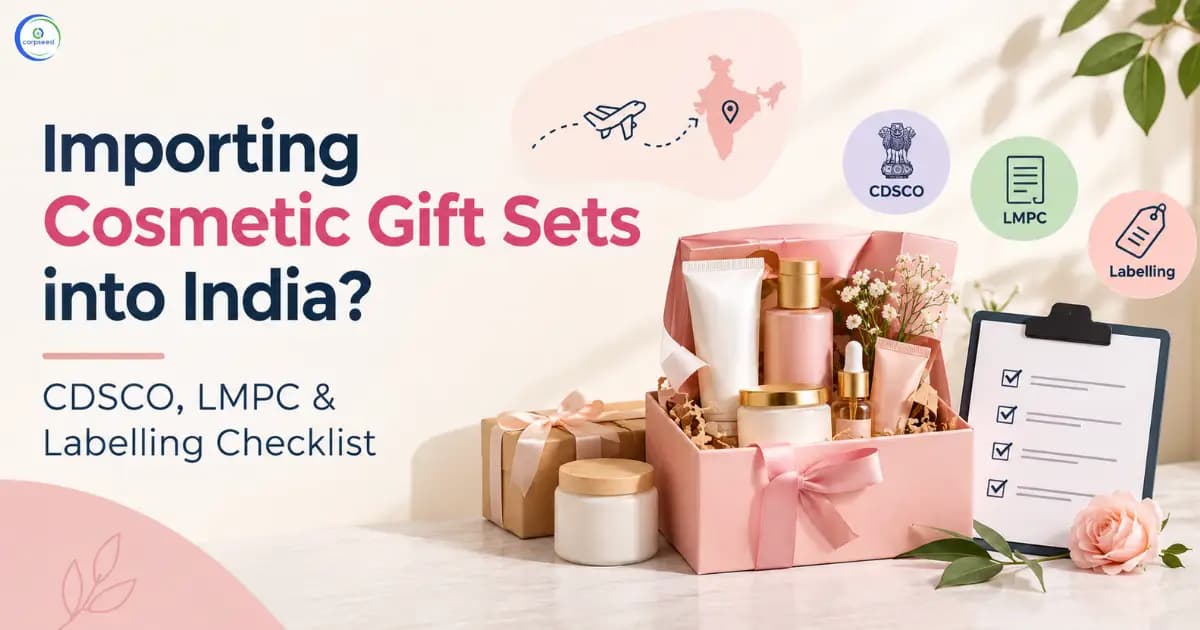
Introduction
Planning to import cosmetic gift sets into India? Whether you sell skincare hampers, makeup kits, perfume gift boxes or beauty products under your own brand, checking compliance before placing an import order can help you avoid unnecessary delays, relabelling expenses and customs-related problems.
Importing cosmetic gift sets into India involves more than arranging international shipping. Depending on the products and packaging, importers may need to check registration with the Central Drugs Standard Control Organization (CDSCO), Legal Metrology requirements, cosmetic labelling rules and customs documentation.
Consider a business importing a festive beauty hamper containing a face wash, moisturiser, lipstick and serum. The products may come from the same manufacturer, but that does not automatically mean that one registration covers every item. Similarly, placing already registered cosmetics inside a new festive box does not necessarily mean that all existing compliance checks can be skipped.
The importer must review the actual products, variants, pack sizes, manufacturing premises, registration particulars and retail packaging before shipment.
This guide explains how to assess these requirements, avoid common mistakes and determine when professional CDSCO cosmetic registration and LMPC compliance assistance may be useful.
What Are the Compliance Requirements for Importing Cosmetic Gift Sets into India?
Before confirming an order, review the following areas:
| Compliance area | What to check |
| CDSCO registration | Whether the individual cosmetics, variants, pack sizes and manufacturing premises are covered by the applicable registration |
| Cosmetic classification | Whether each product falls within the definition of a cosmetic or another regulatory category |
| Cosmetic labelling | Whether individual containers carry the applicable declarations under the Cosmetics Rules, 2020 |
| Legal Metrology | Whether the individual retail packages and outer gift box require declarations under the Packaged Commodities Rules, 2011 |
| LMPC importer registration | Whether importer registration under Rule 27 applies to the business |
| Manufacturing details | Whether the manufacturer and manufacturing-site particulars match the relevant registration and supporting documents |
| Customs documentation | Whether invoices, packing lists and product descriptions match the actual shipment |
| Additional regulations | Whether non-cosmetic products inside the hamper require separate compliance checks |
The exact requirements depend on product classification, packaging, intended use, applicable exemptions and the relevant regulatory provisions.
CDSCO Cosmetic Registration for Imported Gift Sets
The Central Drugs Standard Control Organization (CDSCO), under the Ministry of Health and Family Welfare, regulates cosmetic imports under the Drugs and Cosmetics Act, 1940, and the Cosmetics Rules, 2020.
Under Rule 12(1) of the Cosmetics Rules, 2020, cosmetics generally cannot be imported unless registered under the applicable provisions.
CDSCO registration is not determined simply by the number of gift boxes being imported. The importer must check whether the registration covers the actual cosmetics, relevant variants and pack sizes, and the manufacturing premises.
Which products may require registration?
- Cosmetic gift sets commonly contain:
- Face washes, moisturisers and serums
- Face creams and facial masks
- Lipsticks, lip glosses and other makeup products
- Shampoos and conditioners
- Perfumes and body-care products
- Other skincare and beauty products that fall within the cosmetic definition
Each product should be assessed according to its composition, intended use and claims. A product's marketing name alone does not determine its regulatory classification.
Which CDSCO forms may apply?
The applicable process depends on the product's registration status and the circumstances of the application.
- Form COS-1: Application for an Import Registration Certificate.
- Form COS-2: Import Registration Certificate.
- Forms COS-4 and COS-4A: Relevant to the process for obtaining an Import Registration Number for cosmetics already registered, where applicable.
Applications are handled through the applicable CDSCO process, including the SUGAM portal where relevant. The importer or authorised representative should confirm the appropriate route and prepare the required product, manufacturer, authorisation and labelling documents.
Schedule a Call Back
One Gift Set, Three Business Decisions: What Should You Check?
Let us follow the same festive beauty hamper through three common business situations. The compliance position can change depending on what the importer decides to sell.
Situation 1: Existing cosmetics placed inside a new festive outer box
Assume that the company is currently importing a registered moisturiser and face wash in the regular retail packaging. It now intends to pack both items in an elaborately decorated gift box for the festival of Diwali.
What needs checking?
First, verify that the existing CDSCO registration covers both products, their actual pack sizes and the relevant manufacturing premises. Check that the manufacturer's name and address, product particulars and registration details remain consistent with the supporting documents.
Then, check the new outer packaging. It is possible that just because there is a new gift box, it doesn’t mean that the cosmetic itself is newly formulated. But it is still recommended to check whether the new packaging or presentation impacts anything related to registration requirements.
The individual containers and the outer retail box must be assessed separately for labelling and Legal Metrology purposes. Do not assume that declarations on the outer box automatically satisfy every requirement applicable to the bottles, tubes or jars inside.
Practical decision: When only the exterior presentation of a product has changed, check the existing registration of the product and evaluate the new packaging prior to shipping. It is not necessary to register a new product however, one should not assume that the change in packaging is unimportant.
Situation 2: A new variant or pack size is introduced
Now suppose the same business decides to add a 30 ml serum to the hamper, although its existing registration covers a different pack size. Alternatively, the manufacturer introduces a new formulation or product variant.
What needs checking?
The importer should compare the proposed product with the existing registration particulars. Review the product identity, variant, formulation where relevant, pack size and manufacturing site.
Just being of the same brand does not imply that a different pack or variant falls under the same registration. It is important to consult the registration requirements and the CDSCO guidelines to establish whether the registration coverage is sufficient or whether more steps are needed.
The labels and supporting documents should also match the product that will actually be imported. If the manufacturer's details, product specifications or registration particulars have changed, those differences should be resolved before dispatch.
Practical decision: Check the registration of the new variant or new pack size prior to ordering. If there is a need for extra registration or other regulatory requirements, fulfill those first before importing the product.
Situation 3: A mixed hamper contains cosmetics and non-cosmetic products
Suppose the festive hamper now includes a moisturiser, perfume, chocolates and an electrical beauty device.
The hamper is no longer made up entirely of cosmetics. Each item must be reviewed under its relevant regulatory framework.
What needs checking?
Check the cosmetic category and whether CDSCO approval is required for the moisturizer and perfume.
If you want to know about any food product such as chocolate, then check the food safety, import and food labeling requirements.
For an electrical beauty device, check its product classification and determine whether applicable BIS, electrical safety or other product-specific requirements apply.
The outer hamper also needs a separate packaging review. The business should determine which declarations apply to the combined retail pack and whether the individual items retain their own required information.
Practical decision: Prepare a product-by-product compliance list. Do not assume that the regulatory approval for the cosmetics covers the chocolates, electrical device or other non-cosmetic items.
LMPC Registration for Cosmetic Gift Set Importers
CDSCO registration and Legal Metrology compliance serve different purposes. One does not automatically replace the other.
The Legal Metrology Act, 2009, and the Legal Metrology (Packaged Commodities) Rules, 2011, govern applicable declarations on pre-packaged commodities sold in India.
With regard to imports, LMPC registration is often associated with the concept of importing company registration as per Rule 27 of the Packaged Commodities Rules, 2011. It will depend on the specific nature of the business and relevant rules/exemptions.
Before bringing a cosmetic gift set into the country, consider whether:
- Rule 27 registration is needed for the importer.
- Each item is subject to the requirements of the particular packaged commodity.
- Declaration is necessary for the outside retail gift box.
- Whether the importer’s name and address are correctly stated where required.
- Whether net quantity, country of origin, MRP and consumer-care details are provided where applicable.
- Whether any specific exemption applies to the package or transaction.
A company needs to ascertain its registration status with the relevant Legal Metrology authority before undertaking any importation processes. With the assistance of an expert LMPC registration consultant, a company can determine its registration status.
Imported Cosmetics Labelling Requirements in India
Labelling is one of the most important checks before a cosmetic shipment leaves the exporting country. A label that is acceptable in another market may not contain all the information required for sale in India.
Cosmetic labelling is covered under Rule 34 of the Cosmetics Rules 2020. Specifically, Rule 34(9) covers imported cosmetics and gives the details of the registration certificate and the name and address of the registration certificate holder.
The rule also provides for certain India-specific labelling to be affixed to unit packs at a bonded warehouse in the circumstances described in the provisions. Importers should confirm whether that route is available for their shipment rather than assuming that every labelling defect can be corrected after arrival.
Individual containers versus the outer gift box
This distinction is essential when importing gift sets.
Individual containers: Review each bottle, tube, jar, lipstick or perfume container and its unit packaging for the declarations applicable to that product and package. Depending on the product and applicable provisions, checks may include product identity, manufacturer particulars, batch or lot identification, expiry or use-before information, ingredient declarations, warnings and relevant CDSCO registration details.
Outer retail gift box: Review the packaging used to present and sell the complete hamper. Check which Legal Metrology declarations apply to the outer pack, including applicable information relating to the importer, country of origin, net quantity, MRP and consumer care.
Do not assume that the outer box replaces the labelling required on individual containers. Equally, do not assume that every declaration must be repeated identically on every packaging layer. The applicable requirements depend on the product, package type and relevant legal provisions.
Cosmetic gift set labelling checklist
| Label detail | What to verify |
| Product identity | The product name and identity are stated as required |
| Manufacturer details | The required manufacturer name and address are provided |
| Manufacturing premises | Details are consistent with the relevant registration and supporting records |
| CDSCO registration | Applicable registration number and holder particulars are included |
| Batch or lot number | Required identification is present |
| Expiry or use-before information | Applicable date information is provided |
| Ingredients | Declarations comply with applicable cosmetic labelling provisions |
| Net contents | Net quantity is declared in the required format |
| Warnings and directions | Applicable precautions and instructions are included |
| Importer details | Required importer name and address are provided |
| Country of origin | The applicable declaration is included |
| MRP | Maximum retail price inclusive of applicable taxes is declared where required |
| Consumer-care details | Applicable consumer-care information is provided |
| Outer gift box | The combined retail packaging is reviewed separately |
The exact declarations should be checked against the applicable provisions and any relevant exemptions. A pre-shipment label review can help identify missing particulars before the products are dispatched.
Documents Required to Import Cosmetic Gift Sets into India
The required documents depend on the products and the applicable regulatory route. Importers should generally prepare the following for review.
Business and importer documents
- Importer business identification and constitution documents.
- Import Export Code (IEC), where required.
- Importer address and contact details.
- Authorisation documents for an agent or representative, where applicable.
- Details of the Indian entity responsible for importing and marketing the products.
Product and manufacturer documents
- Complete list of products included in each hamper.
- Product names, variants, shades and pack sizes.
- Manufacturer name, address and manufacturing-site details.
- Product composition and ingredient information.
- Relevant product specifications and quality or safety information.
- Individual label artwork and outer packaging artwork.
- Manufacturer authorisations and supporting declarations, where required.
- Existing CDSCO registration details, where applicable.
Legal Metrology and customs documents
- Applicable LMPC importer registration details.
- Proposed individual-package and outer-box declarations.
- Commercial invoice and packing list.
- Bill of lading or air waybill, as applicable.
- Country-of-origin documentation, where required.
Other documents required by customs, the carrier or the relevant authority.
This is a preparation checklist rather than a universal statutory document list. Confirm the final requirements for the particular products and import transaction.
Step-by-Step Process for Cosmetic Gift Set Import Compliance
Step 1: Finalise the gift set contents. Prepare a complete list of products, including variants, shades, pack sizes and manufacturers.
Step 2: Classify every item. Determine which products qualify as cosmetics and which may fall under separate regulatory frameworks.
Step 3: Verify CDSCO registration. Match the products, relevant pack sizes, variants and manufacturing premises against the existing registration particulars.
Step 4: Review proposed changes. Determine whether a new outer box, new product variant, revised formulation or different pack size affects the applicable regulatory requirements.
Step 5: Assess LMPC applicability. Confirm the importer's registration position and the declarations required on individual retail packs and the outer gift box.
Step 6: Check the labels. Review the actual container labels, unit packaging and outer retail packaging separately.
Step 7: Prepare supporting documents. Collect manufacturer authorisations, product information, registration records, label artwork and import documents.
Step 8: Complete a pre-shipment review. Match the final product list and packaging against the registrations, invoices and packing list.
Step 9: Arrange customs clearance and retail readiness. Provide the required import documents and ensure that applicable registration, labelling and packaging requirements have been addressed before sale.
Common Mistakes to Avoid
- Treating the entire hamper as one registered cosmetic: Check each cosmetic product and its applicable registration coverage.
- Assuming an existing registration covers every new pack size: Verify the actual registration particulars before importing a new variant or pack size.
- Reviewing only the outer gift box: Individual containers and the outer retail package may have different applicable requirements.
- Ignoring manufacturing details: Check that the manufacturer and manufacturing premises match the relevant registration and supporting documents.
- Assuming a new festive box requires no compliance review: Even when the cosmetic itself remains unchanged, the revised retail packaging should be assessed.
How Corpseed Can Help with Cosmetic Import Compliance
Importing cosmetic gift sets involves several connected checks. A gap in product coverage, manufacturing details or packaging declarations can create avoidable complications.
Corpseed can help businesses assess their proposed imports and identify the next compliance steps. Depending on the requirements, assistance may include:
- CDSCO cosmetic registration assistance: Reviewing product lists, existing registration particulars, variants and pack sizes.
- LMPC registration assistance: Assessing importer registration requirements and applicable packaged-commodity declarations.
- Cosmetic labelling compliance services: Reviewing individual container labels and outer gift packaging.
- Import documentation support: Identifying inconsistencies in manufacturer records, product details and supporting documents.
- Pre-import compliance review: Highlighting issues that should be addressed before the supplier dispatches the goods.
The scope of assistance depends on the products, available documentation and applicable requirements. Registration, approval and customs clearance cannot be guaranteed, as decisions rest with the competent authorities.
Conclusion
The importation of gift packs for cosmetic products to India entails an assessment of each and every product included in it. Ensure that you carry out an evaluation of CDSCO registration, manufacturing information, product types, and pack sizes individually, after which, evaluate the individual product labeling and the retail packaging individually.
A pre-import compliance review can help businesses identify gaps before shipment and reduce avoidable delays and relabelling costs. Contact Corpseed for assistance with CDSCO cosmetic registration, LMPC registration and cosmetic import compliance services.
Planning to Import Cosmetic Gift Sets into India?
Before placing your next import order, confirm whether your products are covered by the applicable CDSCO registration, whether LMPC requirements apply and whether the individual labels and outer gift packaging meet the relevant requirements.
Contact Corpseed to discuss your proposed product range, CDSCO cosmetic registration requirements and LMPC compliance before shipment.
Call Now | Request a Consultation
About the Author

Anshika Jindal
Content WriterAnshika Jindal, a Legal Content Writer with strong expertise in legal research and a solid academic background in BA LLB and LLM (Criminal Law). I specialize in researching statutes, case laws, and legal developments and presenting them in clear, accurate, and engaging written content. With strong analytical skills and attention to detail, I create reliable, well-structured legal content while maintaining professional and ethical standards.
I specialize in conducting in-depth legal research using credible sources and presenting legal information in a structured, reader-friendly manner while maintaining precision and authenticity. My work focuses on simplifying legal language without compromising its meaning, making legal content accessible to a wider audience.
Related articles

Medical Devices PLI Scheme 2026: New Applications, Eligibility, Incentives & Benefits
2026-11-12
CDSCO MD-7 Endorsement for Medical Devices: A Practical Guide for Manufacturers
2026-10-23

CDSCO Export NOC for r-DNA Products: Who Needs It?
2026-10-21
CDSCO Registration: A Simple Guide to Getting Your License in India 2026
2026-10-21

CDSCO Medical Device Registration Consultant
2026-09-23

CDSCO Registration for Lab Equipment and Diagnostic Devices
2026-09-22