
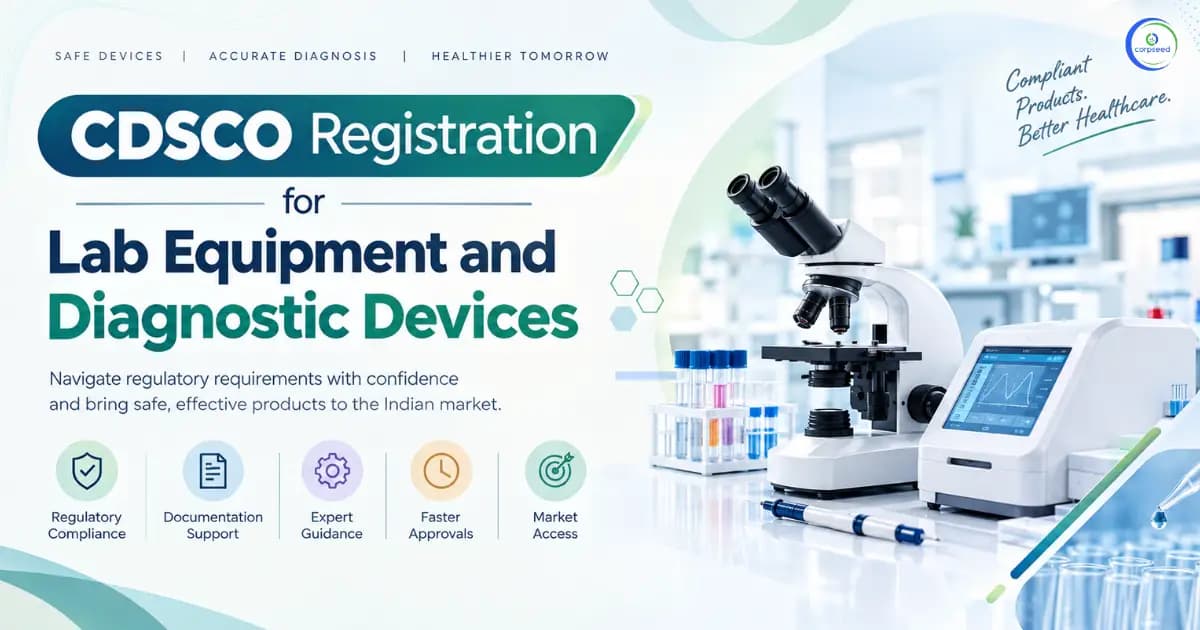
CDSCO Registration for Lab Equipment and Diagnostic Devices
CDSCO registration for lab equipment and diagnostic devices depends on the product's intended use, regulatory status and classification under the Medical Devices Rules, 2017.
Schedule a Call Back
2,100+ CDSCO medical device assignments since 2018
Clients include Endolite India, Mankind Pharma, Ossur India, ADK Health Care, Credence Prosthetic India, V2U Physio Asia, International Electro Medical Company, Radimage Healthcare India, Istok New Hearing AID, Simpladent Implant Solutions, Starkey Laboratories India, Gentec Medical (12 of 1,100+ served since 2018).
A few more clients we've served in this industryHide the list
- Pharma and healthcare
- Endolite India · Mankind Pharma · Ossur India · ADK Health Care · Credence Prosthetic India · V2U Physio Asia · International Electro Medical Company · Radimage Healthcare India · Istok New Hearing AID · Simpladent Implant Solutions · Starkey Laboratories India · Gentec Medical · Cureesse Pharma · Hygiene Medicus · Nexus Surgical and Medicare
- More clients
- Meditronix Corporation · Nilkamal · Haesi GHL · GHL · Servotech Power Systems · Elektrocraft India · Happy Medicare · Anantaa Gsk Innovations · Cogmac Technologies · Aficionados Tech · Superceuticals · Truevis Technologies · 1008 Digital Health · BDS Services · Evoq Imaging Technologies · Premier Medical Systems and Devices · Riransa · Vitrag Infra Projects · Insta Biotech · Digital Acoustics · Artificial Learning Systems India · Nfilade Security Solutions · Humors Tech · K2O Consulting
Introduction
Not every laboratory instrument requires CDSCO approval. The first step is to check whether the particular lab equipment is regulated under the Medical Devices Rules, 2017 or falls outside their scope. Where a product is regulated as a medical device or in vitro diagnostic medical device (IVD), the applicable route may involve an import licence, manufacturing licence or, for eligible Class A non-sterile and non-measuring medical devices, a registration number.
IVDs are classified into Class A, B, C and D based on risk, with different licensing authorities and requirements depending on whether the product is manufactured in India or imported.
What Does CDSCO Registration Cover for Lab Equipment and Diagnostic Devices?
The Central Drugs Standard Control Organisation regulates medical devices and IVDs under the applicable provisions of the Drugs and Cosmetics Act, 1940 and the Medical Devices Rules, 2017.
The important point for businesses dealing with laboratory products is that lab equipment is not automatically a regulated medical device just because it is used in a laboratory, hospital or diagnostic centre.
CDSCO's published IVD FAQ specifically states that instruments, equipment and software used with IVDs are not covered under the Medical Devices Rules, 2017. The regulatory position therefore needs to be checked for the particular product rather than assumed from where the equipment is used.
For an actual medical device or IVD, the intended purpose, function, risk classification and route of supply determine the applicable requirements.
This distinction is important when businesses search for CDSCO medical device registration because the correct regulatory route starts with identifying what the product legally is, not simply what it is called commercially.
Which Diagnostic Products Are Regulated by CDSCO?
IVDs are products intended for the in-vitro examination of specimens derived from the human body for purposes covered by the applicable medical device framework. CDSCO regulates their import, manufacture, sale and distribution under the Medical Devices Rules, 2017.
IVDs are divided into four risk classes:
| IVD Class | Risk Category |
| Class A | Low risk |
| Class B | Low-moderate risk |
| Class C | Moderate-high risk |
| Class D | High risk |
The classification is based on the risk parameters specified in Part II of the First Schedule to the Medical Devices Rules, 2017. CDSCO also publishes classification information for IVDs and provides a specific checklist for device risk classification.
For businesses looking for CDSCO registration for diagnostic devices, this classification is one of the first things to establish because the authority, application and supporting requirements can change with the class.
CDSCO Registration for Medical Devices: Which Route Applies?
There is no single CDSCO registration process for every medical device. The applicable route depends on whether the product is being manufactured in India, imported into India, or falls under a specific exemption or registration mechanism.
- For Imported Medical Devices and IVDs
For imported medical devices and IVDs, the applicant applies through the SUGAM online portal in Form MD-14 for an import licence in Form MD-15. CDSCO lists MD-14 as the import application for IVDs and medical devices.
- For Manufacturing
The applicable application depends on the device class and whether the product is an IVD or another medical device.
For IVDs:
- Class C and Class D IVDs: Form MD-7 or MD-8 is used for the manufacturing or loan licence application.
- The corresponding licences are issued in Form MD-9 or MD-10.
For Class A and Class B medical devices:
- Form MD-5 is the licence for manufacture for sale or distribution.
- The applicable requirements depend on the device classification and regulatory provisions.
- Class A non-sterile and non-measuring devices follow a separate registration-number mechanism instead of the ordinary licensing route, subject to applicable conditions.
The CDSCO registration process should therefore be determined only after the product, intended use and classification have been reviewed.
Who Regulates Diagnostic Devices in India?
The licensing authority also depends on the type of product and its class. For IVDs, CDSCO currently specifies that the Central Licensing Authority is responsible for:
- Import of all classes of IVDs
- Manufacture of Class C and Class D IVDs
- Clinical performance evaluation and approval of new IVDs
- Coordination with State Licensing Authorities
The State Licensing Authority is responsible for:
- Manufacture for sale or distribution of Class A and Class B IVDs
- Sale, stock, exhibition, offer for sale and distribution of IVDs of all classes.
Knowing the correct authority before preparing an application can save time because the route for an imported diagnostic product is not the same as the route for an Indian manufacturer.
What Is the CDSCO Online Registration Process?
The CDSCO online registration process should begin with product assessment rather than immediately opening an application form.
For lab equipment and diagnostic devices, the process generally follows these steps:
- Identify the product and intended use
Start with the manufacturer's product description, intended use, function and claims. Check these details to see whether the product comes under medical device or IVD regulation.
- Check the regulatory status
A laboratory product should not be treated as a regulated medical device simply because it is used in a laboratory. CDSCO's IVD FAQ specifically excludes instruments, equipment and software used with IVDs from the scope of MDR 2017.
- Determine the classification
Where the product is a regulated medical device, or IVD identify the applicable risk class. Medical devices, and IVDs follow risk-based classification under the Medical Devices Rules.
- Identify the applicant and regulatory route
Determine whether the applicant is an Indian manufacturer, overseas manufacturer through an authorised agent or another eligible applicant. The route also depends on the product class.
- Prepare the application documents
The documents should match the particular application. Depending on the route, these can include technical information, manufacturing-site details, product information, quality documentation, declarations and other prescribed records.
- File through the applicable online system
Applications for relevant medical device and IVD services are submitted through the CDSCO's online systems, including SUGAM for the services specified by CDSCO.
- Respond to regulatory queries
If the authority raises a query, or requests additional information, the applicant needs to provide the required clarification, or documents.
- Obtain the applicable licence or registration
Depending on the product and route, the outcome may be an import licence, manufacturing licence, permission or registration number.
CDSCO Registration Requirements for Lab Equipment and Diagnostic Devices
The CDSCO registration requirements are not identical for every laboratory or diagnostic product.
Before preparing an application, businesses should establish:
- Whether the product falls within the definition of a medical device or IVD
- The intended use and claims of the product
- The applicable risk classification
- Whether the product is manufactured in India or imported
- The applicable licensing authority
- The correct application form
- The technical and quality documents required
- Whether performance evaluation or other product-specific requirements apply
- Whether the product falls under a specific exemption or registration mechanism
This product-specific approach is particularly important for lab equipment because not every laboratory instrument is covered by MDR 2017.
Documents Required for CDSCO Registration
The CDSCO registration documents depend on the product, applicant and regulatory route.
For an imported medical device or IVD, CDSCO's application checklists can require information and documents relating to the applicant, authorised agent, manufacturing site, product, technical documentation and applicable regulatory evidence. CDSCO maintains separate checklists for services including Form MD-14 and manufacturing applications.
Depending on the application, documents may include:
- Manufacturer and applicant details
- Product name, model and description
- Intended use
- Risk classification
- Device or IVD specifications
- Manufacturing-site information
- Site or Plant Master File, where applicable
- Device Master File, where applicable
- Essential Principles checklist
- Declaration of Conformity
- Quality management system documentation, where applicable
- Test, evaluation or performance information, where applicable
- Labelling and packaging information
- Free Sale Certificate or equivalent regulatory evidence, where applicable
- Power of Attorney for an overseas manufacturer, where applicable
- Other documents specified in the relevant CDSCO checklist
The exact document list should always be checked against the current application checklist. Submitting the same document set for every product can lead to unnecessary documents being prepared or product-specific requirements being missed.
CDSCO Registration Fees for Diagnostic Devices and Lab Equipment
The CDSCO registration fees depend on the regulatory service being used. There is no single government fee applicable to every laboratory product, diagnostic device or medical device.
For example, an import application is subject to the applicable fee under the Medical Devices Rules. Manufacturing applications have their own prescribed fees.
There is also an important distinction for Class A non-sterile and non-measuring medical devices. CDSCO states that these devices do not require a licence under the applicable exemption, but mandatory registration through the Medical Devices Online system is required, and no fee is required for obtaining the registration number.
Businesses should therefore identify the correct regulatory route before calculating the government fee.
Class A Non-Sterile and Non-Measuring Medical Devices
Certain Class A medical devices follow a separate registration route instead of the usual licensing process. Class A non-sterile and non-measuring medical devices are exempt from the relevant licensing requirements under the applicable provisions, but mandatory registration and other applicable requirements still apply.
| Aspect | Details |
| Device category | Class A non-sterile and non-measuring medical devices |
| Licensing requirement | Exempt from the relevant licensing requirements under the applicable provisions |
| Registration requirement | Mandatory registration through the Online System for Medical Devices |
| Registration number | A system-generated registration number is issued after the required information is furnished |
| Information required | Generic name, brand name where applicable, model number, intended use, material of construction, dimensions and shelf life where applicable |
| Manufacturer declarations | Prescribed undertakings and self-certifications are required |
| Classification status | CDSCO's classification notice dated 31 October 2025 states that the list is dynamic and may be revised |
| Devices not covered | Devices with a measuring function or supplied in sterile condition are not treated as Class A non-sterile and non-measuring devices under the applicable classification list |
Why Medical Device Classification Matters
Classification affects the regulatory route, authority, documents and approval requirements.
For example, an IVD classified as Class A does not follow the same manufacturing route as a Class C or Class D IVD. Similarly, an imported product follows a different process from an Indian manufacturing application.
CDSCO currently maintains classification information for medical devices and IVDs and continues to update its regulatory resources. Its medical device section lists risk-based classification updates, while the IVD section provides classification resources and a device-risk-classification checklist.
For this reason, CDSCO medical device classification should be confirmed before documents are prepared or an application is filed.
CDSCO Registration for Laboratory Equipment: What Should Businesses Check?
Before applying for CDSCO registration for laboratory equipment, businesses should first confirm whether the particular product falls under the Medical Devices Rules, 2017.
The following points should be checked:
- Intended Use: What does the manufacturer state as the intended purpose of the product?
- Product Status: Is the equipment itself a medical device or is it an instrument used with an IVD?
- Classification: If it is regulated, what medical device or IVD class applies?
- Manufacturing or Import: Is the product manufactured in India or imported?
- Regulatory Authority: Which licensing authority handles the applicable route?
- Application Route: Does the product require an import licence, manufacturing licence, permission or registration number?
- Documents: What technical, quality and product-specific documents are required?
- Exemptions: Does the product fall under any applicable exemption or separate registration mechanism?
Also Read: CDSCO Registration for Orthopaedic and Implantable Devices
How Can Corpseed Help?
Understanding whether a product needs a licence, registration or no CDSCO approval can be difficult when the product is marketed as laboratory or diagnostic equipment. Corpseed helps businesses review the applicable regulatory route before moving ahead with the application.
With our CDSCO registration services, businesses can get assistance with:
- Product and Classification Review: Understanding the product's intended use and identifying the applicable regulatory category and risk class.
- Documentation Support: Reviewing and preparing the documents required for the relevant application.
- Application Assistance: Helping with the applicable online filing and information required for submission.
- Regulatory Coordination: Supporting responses to queries and additional requirements raised during the application process.
- Diagnostic Device Support: Assisting businesses seeking CDSCO registration for diagnostic devices with the applicable regulatory pathway.
- Expert Guidance: A CDSCO registration consultant and CDSCO medical device consultant can help businesses navigate product-specific requirements rather than using the same process for every device.
Planning to register a lab or diagnostic product? Contact Corpseed experts for professional assistance and book your free consultation today.
Conclusion
CDSCO registration for lab equipment and diagnostic devices is not a one-size-fits-all process. The first step is to identify whether the product is actually regulated as a medical device or IVD and then determine its classification, applicant type and applicable regulatory route.
For IVDs, CDSCO follows four risk classes: A, B, C and D. Import of all IVD classes is handled by the Central Licensing Authority, while manufacturing of Class A and B IVDs falls under the State Licensing Authority and manufacturing of Class C and D IVDs falls under the Central Licensing Authority.
Certain Class A non-sterile and non-measuring medical devices follow a separate registration-number mechanism instead of the ordinary licensing route.
For businesses, getting the product classification and regulatory route right at the beginning can make the rest of the application much clearer. Professional assistance can also help when the product documentation, classification or application requirements are difficult to interpret.
Need Help with CDSCO Registration?
Getting the right classification, documents and application route can make the CDSCO process easier to manage. Consult Corpseed experts for CDSCO registration services and get professional guidance for your lab or diagnostic device.
Book Your Free Consultation Today
About the Author

Parul Bohral
Legal Content WriterParul Bohral, a BALLB graduate and experienced legal researcher and content writer with expertise in various legal areas, including corporate law and intellectual property. I have gained valuable experience in esteemed legal environments, where I have strengthened my research skills, allowing me to approach legal writing with precision and depth.
As a legal content writer, I am committed to delivering work that not only informs but also engages readers. By staying informed about the latest trends in content marketing and regulatory developments, I ensure that my writing remains sophisticated and meets industry standards. My dedication to thorough research enables me to craft content that is both insightful and impactful.
Related articles
CDSCO MD-7 Endorsement for Medical Devices: A Practical Guide for Manufacturers
2026-10-23
CDSCO Export NOC for r-DNA Products: Who Needs It?
2026-10-21
CDSCO Registration: A Simple Guide to Getting Your License in India 2026
2026-10-21

Importing Cosmetic Gift Sets into India? CDSCO, LMPC & Labelling Checklist
2026-10-14
CDSCO Medical Device Registration Consultant
2026-09-23
CDSCO Approval for Imported Medical Devices: End-to-End Process
2026-09-21