9311255283
×

Welcome to Corpseed. Please type your query, and we shall provide immediate assistance.

×

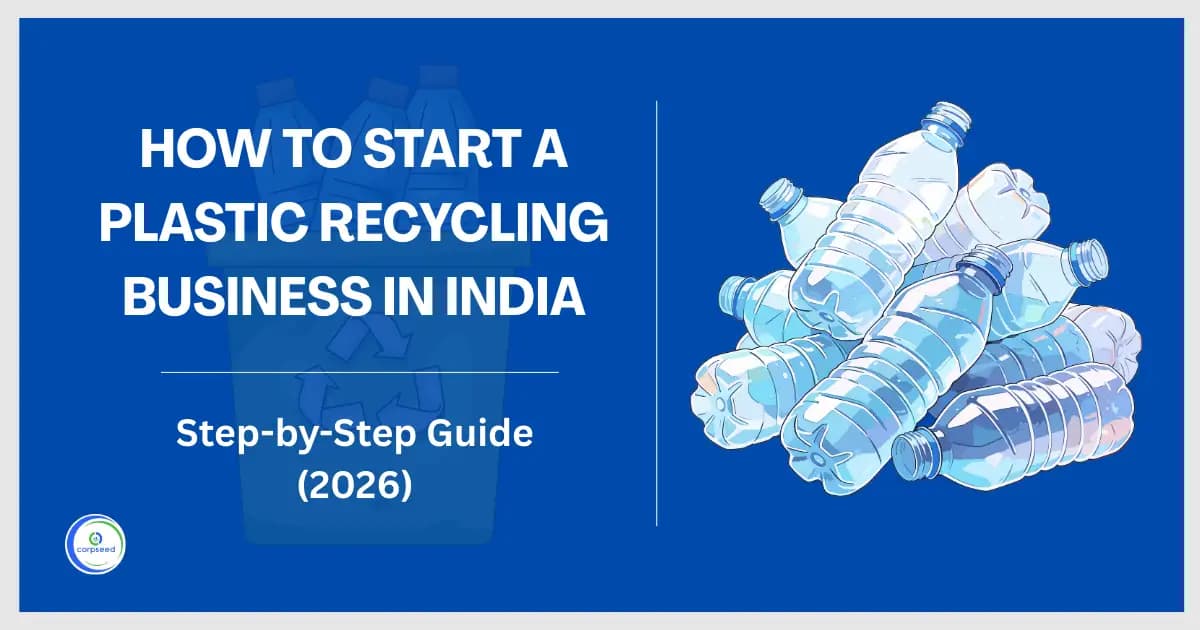
How to Start a Plastic Recycling Business in India: Step-by-Step Guide (2026)

How_to_Start_a_Plastic_Recycling_Business_in_India_Corpseed_2026.webp
Last updated : 2026-02-05

Plastic waste has become one of the greatest environmental issues in India. Plastic recycling is a necessity and a good business opportunity with the rise in consumption and strict environmental laws. The Government of India has intensified the Plastic Waste Management Rules and the Extended Producer Responsibility (EPR) system, making compliance-driven recycling essential in 2026.
Not only does a plastic recycling business contribute to the sustainability of the environment, but it's also crucial in assisting the producers and brand owners to fulfil their legal duties. However, the initiation of such a business requires proper planning, approval by the regulations, and technical knowledge.

What Is Plastic Recycling?

Plastic recycling can be defined as the collection of waste plastic and then transforming it into reusable raw material which can be utilized to produce new products. Plastic recycling is an alternative to landfill or burning of plastic, which puts plastic back into the production cycle. This is typically done through collection, segregation, washing, shredding, melting and reprocessing plastic into flakes or granules. The recycled materials are utilized in the production of packaging products, containers, pipes, sheets, textiles and industrial components.

Plastic recycling in India is controlled by the Plastic Waste Management Rules, 2016, and the following amendments. Recyclers should seek permission of the Pollution Control Boards (PCBs) and enroll in the CPCB EPR portal. Recycling activities are not legal unless they are registered.

Plastic recycling is also beneficial to the circular economy because it decreases the reliance on virgin plastic, saves natural resources, and lowers environmental pollution. By 2026, recycling will no longer be an informal process but a regulated industrial process associated with national sustainability objectives.

--------------Blog Contact Form-------------

Benefits of Starting a Plastic Recycling Business in 2026

Starting a Plastic recycling business in India in 2026 provides strong environmental value, regulatory and commercial potential in the long term. Due to the strict EPR compliance, growing plastic waste production, and the rising demand of recycled materials, the sector has sustainable growth opportunities. The key benefits include:

  • High Market Demand: The growing requirements of Extended Producer Responsibility have greatly enhanced the demand of certified plastic recyclers because producers and brand owners need certified recycling partners to achieve their annual EPR requirements under Plastic Waste Management Rules.
  • EPR Credit Generation: Registered plastic recycling companies can earn EPR credits using the CPCB portal and sell them to the producers, importers, and brand owners (PIBOs), which is an added source of income to the sale of recycled plastic material.
  • Strong Environmental Impact: Plastic recycling can reduce the amount of landfill, avoid plastic leakages into the soil and water bodies, and enable sustainable management of waste by recycling the plastic waste back into the production cycle rather than disposing it.
  • Government and Policy Support: Indian government is actively encouraging recycling of plastic waste by imposing stringent rules, EPR policies and sustainability policies, which provide regulatory support in the long-term and business relevance of recycling units that comply with the policies.
  • Stable Revenue and Industrial Demand: Recycled plastic granules and flakes are extensively utilized in the packaging, manufacturing, and construction sectors, which offers a constant demand and predictable income to plastic recycling companies that work with quality and compliance.
  • Reduced Raw Material Price: Waste plastic is cheaper than virgin plastic, and thus recyclers can keep their input costs, better profit margins, and competitive prices, and contribute to the goals of the circular economy and ESG.

Eligibility Criteria to Start a Plastic Recycling Business in India

In order to commence a plastic recycling business, one should have basic eligibility requirements as mentioned by the regulatory bodies.

  • The candidate should be a registered business organization, such as a Proprietorship, Partnership, LLP, or Company.
  • The company should be engaged in the recycling of plastic waste.
  • The recycling unit should be situated in a recognised industrial or designated location.
  • The applicant should adhere to the Plastic Waste Management Rules.
  • The company should be in a position to keep records and regulatory reporting.
  • There should be adherence to environmental and safety standards.

Documents Required for Plastic Recycling Authorization

Correct documentation is essential in securing a plastic recycling license and legal, uninterrupted operations. Proper and full documentation assists the Pollution Control Boards in checking the legitimacy of the business, environmental compliance, and the capacity of the business, which helps in minimizing delays and chances of rejection in the process of approval. The commonly required documents include:

  • Business registration certificate
  • PAN card of business or proprietor
  • GST registration certificate
  • Factory or unit address proof
  • Layout plan and process flow diagram
  • Machinery details and capacity
  • Water and electricity connection proof
  • Consent to Establish (CTE) application
  • Authorisation signatory identity proof

Step-by-Step Process to Start a Plastic Recycling Business in India

The plastic recycling business in India must have a clear and compliance-oriented approach to start. A simplified step-by-step process will help ensure easy approvals, legal operation, and sustainability in the long run as per the Plastic Waste Management and EPR regulations.

  • Step 1: Confirm Business Eligibility: The business must be legally registered, involved in the plastic recycling business, and must be in a position to comply with environmental, safety, and reporting requirements.
  • Step 2: Choose an Approved Location: Select an industrial or a designated area that has been approved by the State Pollution Control Board (SPCB) and has adequate space to carry out the recycling process and the pollution control system.
  • Step 3: Prepare Required Documents: Collect appropriate business registration documents, layout plans, machinery, utility connection documents, and authorized signatory documents to be submitted to the regulatory authorities.
  • Step 4: Obtain Pollution Control Board Approvals: Apply for Consent to Establish (CTE), install machinery on approval, and Consent to Operate (CTO) to be able to start recycling operations legally.
  • Step 5: Get Plastic Recycling Authorization: To legally process and recycle plastic waste materials, it is necessary to obtain the required authorization under the Plastic Waste Management Rules.
  • Step 6: Register on CPCB EPR Portal: Complete registration on CPCB EPR portal to allow compliance reporting and generation of EPR credits.
  • Step 7: Start Operations and Maintain Compliance: Start recycling activities, keep proper records, submit periodic returns, and enforce ongoing compliance with environmental and EPR laws.

Profitability of Plastic Recycling Business

In India, plastic recycling has strong profit potential because of regulatory support, increasing demand for recycled materials, and business opportunities driven by EPR.

  • It generates a consistent income by selling recycled plastic granules and flakes to manufacturing and packaging companies.
  • Makes extra revenue through the production and sale of EPR credits to producers and brand owners through the CPCB portal.
  • Advantages of reduced input prices as waste plastic is less expensive than virgin plastic raw material.
  • Ensures steady demand because of the obligatory compliance with the Plastic Waste Management and EPR regulations.
  • Achieves faster break-even periods, which are typically 12 to 24 months for efficiently managed recycling units.

Conclusion

Starting a plastic recycling business in India in 2026 is a responsible and lucrative one. With strict regulations, increased plastic waste, and the necessity to use EPR, the role of authorized recyclers has become more valuable than ever. Plastic recycling not only ensures that the producers are in compliance with the law, but it also contributes to environmental protection and sustainable development.

By understanding the eligibility criteria, documentation, and complying with the systematic process of approval, the businesses can set up a compliant and scalable recycling unit. With the proper planning and compliance with regulations, plastic recycling offers long-term growth and stability in India’s booming waste management ecosystem.

This portion of the site is for informational purposes only. The content is not legal advice. The statements and opinions are the expression of author, not corpseed, and have not been evaluated by corpseed for accuracy, completeness, or changes in the law.

BOOK A FREE CONSULTATION

Get help from an experienced legal adviser. Schedule your consultation at a time that works for you and it's absolutely FREE.

Author

Parul Bohral, a BALLB graduate and experienced legal researcher and content writer with expertise in various legal areas, including corporate law and intellectual property. I have gained valuable experience in esteemed legal environments, where...

Learn More >>