
India’s Tyre Recycling Opportunity: What HSN, GST and EPR Changes Could Mean
India’s tyre recycling sector is gaining importance as regulatory focus on waste tyre management and Extended Producer Responsibility (EPR) increases. This article examines how HSN classification, GST treatment and EPR requirements could influence tyre recycling businesses, manufacturers, importers and recyclers.
Schedule a Call Back
Businesses we've worked with on tyre EPR
Clients include Nilkamal, Volvo CE India, Escorts Kubota, Immortal Tyres (4 of 5+ served since 2018).
See our tyre EPR service →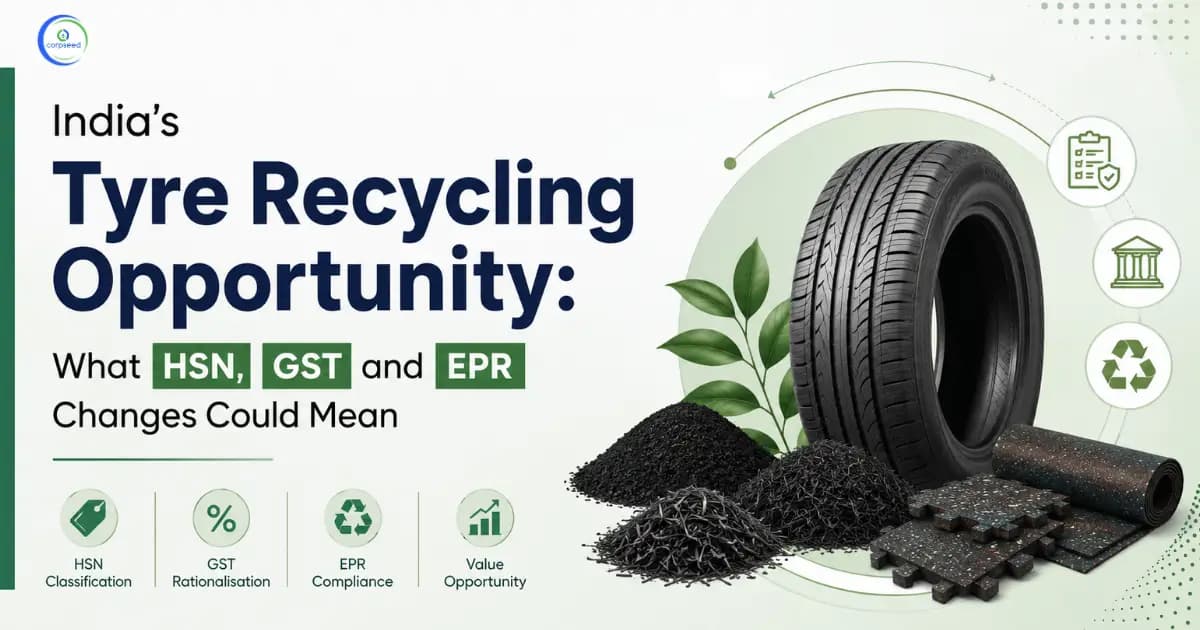
Introduction
India recycles millions of tonnes of waste tyres, yet a major question remains: why is so much of that material still failing to reach higher-value applications?
NITI Aayog has highlighted gaps in value recovery, product standards and market acceptance in India’s waste tyre recycling sector. Its recommendations include clearer HSN classification for waste tyres and recycled products such as crumb rubber.
The report also discusses GST rationalisation for end-of-life tyres (ELTs) and recycled products. A reduction from 18% to 5% has been proposed by recycling industry stakeholders as a measure that could support formalisation. However, this is not a notified GST rate change.
These are recommendations, not changes already in force. They do not automatically change existing GST rates, HSN classifications or CPCB requirements. For tyre recyclers, the discussion goes beyond taxation. HSN classification, product documentation, EPR registration and recycling records could all become increasingly important as India moves towards a more formal and traceable tyre recycling framework.
Schedule a Call Back
Quick Take: What Does the NITI Aayog Report Recommend?
NITI Aayog’s recommendations could affect how tyre recyclers classify, process and document recycled materials. Here are the key areas to consider:
| Issue | Recommendation / Current Position |
| Value recovery | Focus on moving waste tyres towards higher-value recycling and end-use applications |
| HSN classification | Separate codes have been recommended for waste tyres and recycled products |
| GST | GST rationalisation has been discussed/recommended; 18% to 5% is a proposed reduction, not a current notified rate |
| rCB | Clearer quality and application standards have been recommended |
| TPO | Standards for quality, composition and contaminants have been recommended |
| Waste tyre EPR | Existing CPCB requirements continue unless formally changed |
Why Is Higher-Value Tyre Recycling Important?
The Rs 7,700 crore figure is not a confirmed GST loss or government revenue shortfall. The report estimates approximately Rs 7,700 crore in potential savings from import substitution through recycled tyre products. The estimate is based on recycling industry figures and EXIM data cited in the report.
The potential value comes from recycled products that can substitute imported conventional materials, including:
- Recovered carbon black (rCB): A recycled material that can be used in applications where conventional carbon black is required.
- Tyre Pyrolysis Oil (TPO): A product recovered through tyre pyrolysis that can have industrial applications.
- Reclaim rubber: Processed rubber that can be used in various rubber-based products.
The value of these recovered materials depends on factors such as:
- Quality and consistency
- Product specifications
- Market acceptance
- Suitability for industrial applications
- Ability to substitute conventional or imported materials
This is where the policy discussion becomes important. India is not only looking to recycle more waste tyres. The broader focus is also on improving the economic value recovered from tyres already entering recycling channels.
What Is the HSN Classification Problem?
NITI Aayog has recommended separate six-digit HSN codes for waste tyres and processed products such as crumb rubber. The report also recommends a separate HSN classification for Micronized Rubber Powder (MRP).
The issue arises because waste tyres and processed rubber products do not represent the same stage of the recycling chain.
Waste tyre - Processing - Recycled product
Once a waste tyre is processed, the resulting material can have a different form, use and commercial value. That distinction can affect how businesses approach classification, invoicing, tax treatment and documentation.
HSN classification and GST rate are separate questions, so a change in classification would not by itself mean that a different GST rate automatically applies.
Why does clearer classification matter?
| Issue | Possible impact |
| Product identification | Distinguishes waste tyres from processed materials |
| Traceability | Makes movement through the recycling chain easier to track |
| Trade | Helps differentiate raw end-of-life tyres from processed products |
| Formalisation | Gives value-added recycled materials clearer recognition |
| Tax & documentation | Helps businesses assess the applicable classification, invoicing and tax treatment |
Why Does HSN Classification Matter to Tyre Recyclers?
For a tyre recycler, HSN classification becomes important when waste tyres are processed into commercially saleable materials.
Take crumb rubber as an example. A used tyre is an end-of-life material. After processing, it can be converted into a rubber-based product supplied to businesses for specific industrial applications.
In a 2021 ruling, the Maharashtra Authority for Advance Ruling (AAR) classified crumb rubber/granules manufactured from used tyres under Heading 4004, and held that the product attracted 18% GST based on the facts and classification considered in that case.
This was a product-specific ruling based on the facts presented before the AAR. It should not be treated as a universal classification or GST rate for every recycled tyre product.
The example shows why accurate HSN classification matters for recyclers. It can affect how a product is identified for invoicing, tax assessment and commercial transactions.
NITI Aayog's proposed HSN reforms seek clearer classification of waste tyres and processed recycled products, which could help distinguish end-of-life tyre materials from value added outputs such as crumb rubber.
Could GST on Recycled Tyre Products Fall From 18% to 5%?
The GST rate has not been reduced from 18% to 5% based on the NITI Aayog recommendations. NITI Aayog has discussed the need for GST rationalisation for end-of-life tyres and recycled products, while recycling industry representatives have proposed reducing the rate from 18% to 5% for relevant recycled products. Any change in the applicable GST rate would require an official notification.
For example:
| Base Product Value | GST at 18% | GST at 5% | Tax-Inclusive Value at 18% | Tax-Inclusive Value at 5% |
| Rs 1,00,000 | Rs 18,000 | Rs 5,000 | Rs 1,18,000 | Rs 1,05,000 |
A change from 18% to 5% would mean a Rs13,000 difference in GST on a taxable value of Rs1 lakh, assuming the same taxable value and no other changes.
If a lower GST rate is formally notified for eligible recycled products, it could make those products more price-competitive and potentially improve their commercial appeal.
Illustration only: This calculation assumes the same taxable value and does not represent the current GST treatment of every recycled tyre product.
Why Are Standards for rCB and TPO Important?
Product standards could influence whether recycled tyre outputs are accepted for higher-value applications.
For rCB, NITI Aayog has highlighted gaps around product quality, application grades and acceptable contamination levels.
For TPO, the report has identified gaps concerning quality, composition and permissible contaminants, along with the need for clearer standards for its use.
Without consistent specifications, industrial buyers may find it difficult to compare recycled materials with conventional alternatives.
That can keep recycled outputs in lower-value markets.
Clear standards could help recyclers produce materials that buyers can evaluate with greater confidence, potentially supporting higher-value domestic applications and export opportunities.
What Does This Mean for Waste Tyre EPR Compliance?
The HSN and GST proposals should not be confused with waste tyre EPR compliance. They are connected to the wider business environment, but they serve different purposes. For recyclers, maintaining accurate EPR records remains important.
Under the existing waste tyre EPR framework, recyclers have registration, documentation and reporting responsibilities. CPCB's FAQ states that recyclers with valid SPCB/PCC authorisation must also register on the centralised EPR portal.
For recyclers covered by the waste tyre EPR framework, maintaining accurate registration, processing and reporting records remains important. Businesses that need help with these requirements can also seek support from a waste tyre EPR consultant or compliance service provider.
Depending on the applicable CPCB requirements, a recycler's compliance records may include:
- SPCB/PCC authorisation
- Centralised waste tyre EPR registration
- Waste tyre procurement and processing records
- Details of recycled outputs
- EPR certificate-related information
- Supporting transaction and production records
A change in HSN classification would not automatically change EPR obligations. Businesses should follow the applicable CPCB requirements unless a formal notification or direction changes them.
What Should Tyre Recyclers Do About HSN, GST and EPR?
Tyre recyclers do not need to change their tax or compliance processes based only on a policy recommendation.
5 compliance checks tyre recyclers should make now
1. Review HSN classification
Check the classification being used for each recycled output and whether it matches the product actually being supplied.
2. GST treatment
Apply the GST rate currently applicable to the specific product and classification. Do not shift to 5% based on a recommendation alone.
3. EPR records
Keep waste tyre quantities, processing information and recycled outputs properly documented.
4. Product documentation
Maintain clear information for crumb rubber, rCB, TPO and other recycled outputs.
5. Regulatory updates
Track official notifications relating to HSN, GST, CPCB EPR requirements and product standards.
Businesses producing multiple recycled outputs should review each product separately because classification and supporting documentation may differ.
If you are unsure whether your waste tyre EPR registration, HSN classification, GST treatment or supporting records are aligned with your current operations, a compliance review can help identify potential gaps before they create operational or regulatory issues.
Need help with waste tyre EPR registration, HSN classification or compliance? Talk to a Corpseed expert for waste tyre EPR registration services and a review of your current requirements and documentation.
Key Takeaway
India’s waste tyre recycling policy is increasingly focused on higher-value recovery, clearer product classification, GST rationalisation, product standards and stronger traceability. However, the recommendations discussed by NITI Aayog are not automatically applicable law. Tyre recyclers should continue following the current GST, CPCB EPR and environmental requirements while reviewing their HSN classification, registrations, records and product documentation.
About the Author

Parul Bohral
Legal Content WriterParul Bohral, a BALLB graduate and experienced legal researcher and content writer with expertise in various legal areas, including corporate law and intellectual property. I have gained valuable experience in esteemed legal environments, where I have strengthened my research skills, allowing me to approach legal writing with precision and depth.
As a legal content writer, I am committed to delivering work that not only informs but also engages readers. By staying informed about the latest trends in content marketing and regulatory developments, I ensure that my writing remains sophisticated and meets industry standards. My dedication to thorough research enables me to craft content that is both insightful and impactful.
Related articles
India Bans Lithium-Ion Battery Black Mass Exports in 2026: What It Means for Businesses
2026-11-12
Fertilizer Testing in India: FCO 1985 Mandatory Quality Compliance Guide 2026
2026-09-02
Can Lithium-Ion Batteries Go in the Recycling Bin?
2026-08-27
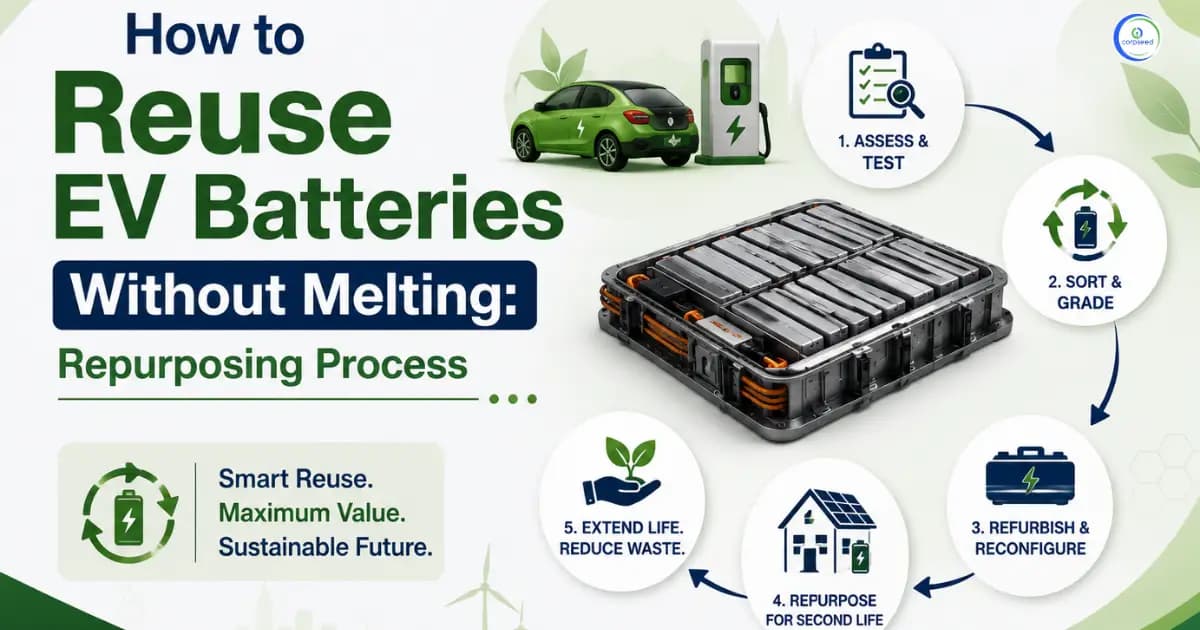
Can a Dead Electric Vehicle Battery Ever Be Used Again Without Melting It?
2026-08-18
CPCB Guidelines for Recycling of Waste Batteries (Lead Acid & Lithium-ion): Complete Compliance Guide 2026
2026-07-24
How to Start a Lithium-Ion Battery Recycling Plant in India (2026): Complete Business & Compliance Guide
2026-07-16