
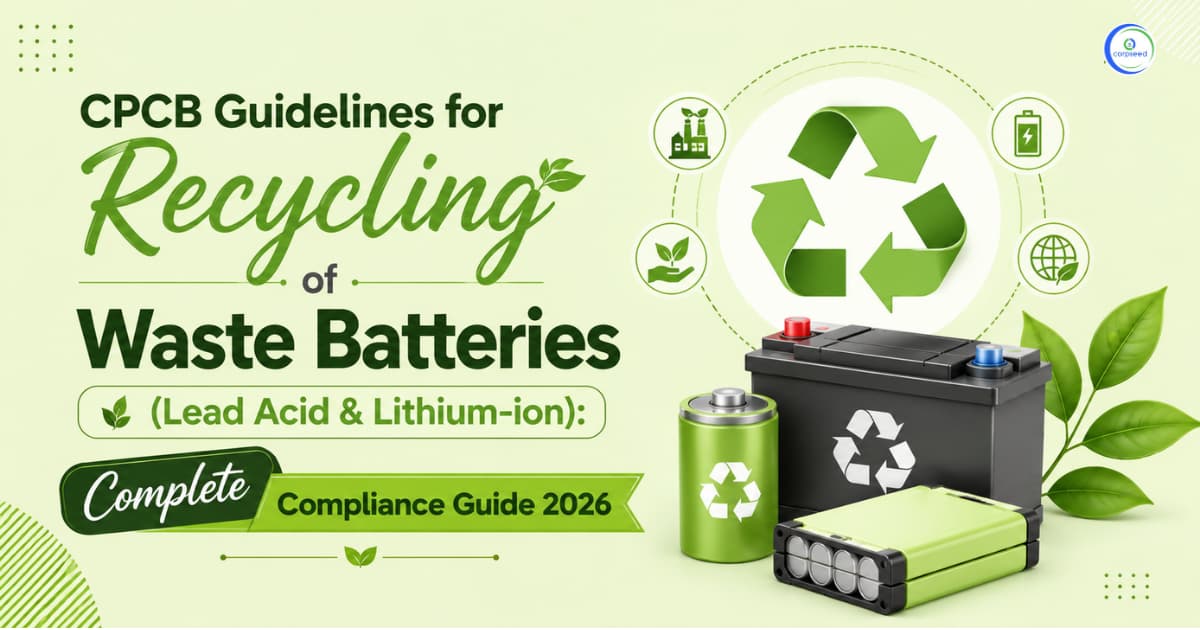
CPCB Guidelines for Recycling of Waste Batteries (Lead Acid & Lithium-ion): Complete Compliance Guide 2026
The Central Pollution Control Board (CPCB) has issued comprehensive Guidelines for Recycling of Waste Batteries (Lead Acid & Lithium-ion) to strengthen environmentally sound battery recycling practices in India.
Schedule a Call Back
250+ battery EPR assignments since 2018
Clients include Emerson Automation Solutions Intelligent Platforms, Colt Technology Services India, Intangles Lab, Emerson Process Management (India), Watthut Electronics, KWW Electricals & Electronics, El Sewedy Electrometer India, Smiths Detection Systems, Om Electronic Corporation, Stmd Semiconductor, Techjockey Infotech, NI Systems (India) (12 of 150+ served since 2018).
A few more clients we've served in this industryHide the list
- Electronics and technology
- Emerson Automation Solutions Intelligent Platforms · Colt Technology Services India · Intangles Lab · Emerson Process Management (India) · Watthut Electronics · KWW Electricals & Electronics · El Sewedy Electrometer India · Smiths Detection Systems · Om Electronic Corporation · Stmd Semiconductor · Techjockey Infotech · NI Systems (India)
- Pharma and healthcare
- Endolite India · Starkey Laboratories India · Radimage Healthcare India · Agfa Healthcare India · Sonova Hearing India · Ossur India · Antara Assisted Care Services · Dental Tree Supply Company · Sanrai MED India
- Engineering and manufacturing
- Hilti India · Wacker Neuson Equipment · Denso India · Aptiv Components India · Franklin EV India · Technotorc Tools · JMS Mining · L&T-Mhi Power Turbine Generators · Tresa Motors
- Energy and power
- Bitek Solar · Nash Energy (I) · Rocky Batteries
- More clients
- Nilkamal · Meditronix Corporation · M.C. Dean Systems India · Galeno Metallics · BTL India · Esskay Compuservices · Picotech Energy · Anmay Solutions · Cart 2 India Online Retail · Tomra Sorting India · NTH Iconic Party Solutions · Amo Mobility Solutions · SDI Business Services India · GHV Medical Anchor · Ample Digital
Introduction
Vehicles, solar energy systems, mobiles, and industries are operating through the use of batteries. There is an emerging issue associated with such a rapid rise in the consumption of batteries. Used batteries are accumulating rapidly, most of which consist of harmful materials like lead, acid, cobalt, and lithium.
Improper disposal and burning of these hazardous materials contaminate soil, water, and air. Workers dealing with such materials can get sick from exposure to a hazardous environment without protective equipment. This is precisely why waste battery recycling is crucial in the present day.
The CPCB Guidelines for Recycling of Waste Batteries, issued in July 2026 under the Battery Waste Management Rules, 2022, provide clear rules for every company involved in lead acid battery recycling and lithium-ion battery recycling. From battery recycling registration to CPCB registration for battery recyclers, these guidelines cover the entire compliance process for businesses across India.
They build on the Battery Waste Management Rules, 2022, and explain exactly how a battery recycling plant should collect, store, and process batteries. The guidelines also lay out the CPCB registration and Battery Waste EPR Registration steps every recycler must complete.
Understanding the CPCB Guidelines for Recycling of Waste Batteries early helps your business avoid delays, plan the right infrastructure, and stay fully compliant from day one.
In this post, you will learn what the guidelines say, who must follow them, and how to build a plant that meets every rule. You will also learn what happens if a business skips compliance, and how a battery recycling consultant can make the process easier.
Schedule a Call Back
What Are the CPCB Guidelines for Recycling of Waste Batteries?
The CPCB Guidelines for Recycling of Waste Batteries are technical instructions from the Central Pollution Control Board. They tell recyclers how to run a plant the right way.
These guidelines were written under Rule 11(17) of the Battery Waste Management Rules, 2022. This law was notified on 22nd August 2022 by the Ministry of Environment, Forest and Climate Change.
The rules apply to every type of battery. This includes lead acid, lithium-ion, nickel-cadmium, and zinc-based batteries. Portable, automotive, industrial, and EV batteries are all covered too.
The goal is simple. Batteries should be collected, stored, transported, and recycled without harming the environment. Metals like lithium, cobalt, nickel, and lead should go back into use instead of the ground.
This directly supports India's circular economy, where materials get reused again and again instead of thrown away.
Key objectives of the guidelines:
- Establish technical standards for recycling facilities
- Control pollution from battery crushing, melting, and shredding
- Recycle metals to use in making new products
- Ensure safety of workers in the recycling process
- Harmonize processes among all recycling companies in India
Why Has CPCB Issued New Waste Battery Recycling Guidelines?
Battery waste is rising fast in India, and EV adoption is a big reason. Lakhs of EV batteries will reach end-of-life in the coming years. Old, informal recycling methods cannot handle this volume safely. Many small units still break batteries by hand without pollution control.
CPCB wrote these new guidelines to fix several problems at once. Metal recovery needed to improve. Pollution from lead dust and acid needed control. Workers needed better protection from fumes and fire risks. The guidelines also strengthen how EPR (Extended Producer Responsibility) targets get tracked and verified across the industry.
Why These Guidelines Matter for Businesses
- They offer recyclers a definite technical standard
- They lower the risk of legal uncertainties
- They allow companies to invest in infrastructure effectively
- They establish trust with producers who require compliant recyclers
Who Must Comply with the CPCB Battery Recycling Guidelines?
Every stakeholder in the battery chain has a defined role under these rules.
- Producers, manufacturers, and importers must design recyclable batteries and meet their EPR targets each year.
- Brand owners selling batteries under their own name share responsibility with producers for proper collection.
- Dealers must help take back old batteries from customers and pass them to authorised collection points.
- Collection centres must store batteries safely before sending them onward.
- Refurbishers must check if a battery can be reused before sending it for recycling.
- Recyclers carry the heaviest technical duty, from infrastructure to emission control.
- Consumers and bulk consumers, like offices or fleet operators, must hand over batteries only to authorised points.
| Stakeholder | Main Responsibility | Why It Matters |
| Producers/Importers | Meet EPR targets, design recyclable batteries | Drives the whole compliance chain |
| Dealers | Take back old batteries from customers | Keeps batteries out of informal scrap |
| Collection Centres | Safe storage before onward transfer | Prevents leaks and fire risks |
| Refurbishers | Assess second-life potential | Extends battery use before recycling |
| Recyclers | Build compliant infrastructure, recover metals | Directly controls pollution outcomes |
| Consumers/Bulk Users | Hand batteries to authorised points | Stops improper disposal at the source |
What is the Battery Recycling Process Under the CPCB Guidelines?
The guidelines lay out one connected process from pickup to metal recovery.
- Collection: Batteries are gathered from consumers, dealers, and producers.
- Transportation: Batteries move to the plant under safe conditions.
- Safe Storage: Batteries wait in covered, secure areas.
- Sorting: Batteries get separated by type and chemistry.
- Inspection: Each unit is checked for refurbishment or recycling.
- Battery Discharging: Any remaining charge or acid is safely removed.
- Dismantling: Casings, electrodes, and electrolytes are separated.
- Shredding or Battery Breaking: Batteries are broken into raw materials.
- Material Separation: Metals like copper, iron, and aluminium are sorted out.
- Metal Recovery: Valuable metals and salts are extracted through smelting or hydrometallurgy.
- Safe Disposal of Residual Waste: Slag, sludge, and plastic waste go to authorised handlers.
This flow applies to both battery types, though lead acid and lithium-ion differ once dismantling begins.
CPCB Guidelines for Lead Acid Battery Recycling Plants
Lead acid recycling starts with battery breaking, either by manual cutting or a mechanical breaking system. Plants above 5,000 MTA must switch to mechanical breaking within one year of notification. Smaller units get three years.
Plastic parts go to plastic recyclers. Drained sulphuric acid is neutralized and treated in an Effluent Treatment Plant (ETP). Lead components then move to smelting, using additives like charcoal and soda ash to produce re-melted lead.
The re-melted lead goes through refining in an alloying kettle before being cast into ingots.
Key Compliance Requirements:
- Suction hoods connected to Air Pollution Control Systems (APCS) on furnaces
- Stack height of at least 30 metres with a monitoring platform
- Covered, acid-proof storage for used batteries
- ETP for wastewater from battery breaking
- Annual blood lead testing for workers
- PPE such as gloves, masks, boots, and aprons
CPCB Guidelines for Lithium-ion Battery Recycling Plants
Recycling of lithium-ion batteries starts with discharging them safely. In this step, a salt solution is used to ensure that any remaining charge is removed. Safety from fire is paramount since lithium-ion batteries are capable of undergoing thermal runaway.
After discharge, batteries go through crushing and shredding, producing copper, aluminium, iron, and black mass. Magnetic separation removes iron, and density separation splits copper from aluminium.
The black mass then goes through hydrometallurgical processing, recovering lithium, cobalt, nickel, manganese, copper, and graphite through chemical extraction.
| Feature | Lead Acid Recycling | Lithium-ion Recycling |
| Main process | Smelting and refining | Shredding and hydrometallurgy |
| Key output | Refined lead ingots | Metal salts from black mass |
| Fire risk | Lower | Higher, needs strong fire safety |
| Main pollutant | Lead dust and acid fumes | Acidic fumes and VOCs |
Infrastructure Requirements for Battery Recycling Plants in India
A compliant infrastructure ensures the safety of both employees and the environment.
- Storage sites should be covered and segregated according to the type of battery used.
- Fire safety systems such as sprinklers and foam fire extinguishers ensure that lithium-ion batteries do not catch fire.
- APCS include cyclone separators and bag filters to collect dust before it goes into the atmosphere.
- Wet scrubbers remove any acids or particulate matter from the exhaust gases.
- Bag filters collect dust generated in black mass or lead operations.
- ETP treats wastewater generated from floor cleaning, battery crushing, and reactor cleaning processes.
Safety, Pollution Control, and Environmental Compliance for Battery Recycling Plants
Daily discipline keeps a plant safe, not just good design on paper.
Best Safety Practices Checklist:
- Provision of personal protective equipment for all workers, all shifts
- Testing of fire extinguishing equipment at regular intervals
- Regular maintenance of APCS and scrubbers
- All industrial effluents treated via ETP before discharge
- Storage of toxic sludge and slag in covered areas
- Blood tests of workers' lead content once a year
- Have an emergency action plan for any spills and fires
- Quarterly testing of stack and work area emissions
- Spill management reduces environmental impact of accidents.
Emission Standards for Lead Acid and Lithium-ion Battery Recycling Plants
CPCB sets clear numeric limits for emissions and workplace air quality.
| Parameter | Lead Acid Plants | Lithium-ion Plants |
| Lead (stack) | 10.0 mg/Nm³ | Not applicable |
| Lead (work area, 8-hr avg) | 0.05 mg/m³ | Not applicable |
| Particulate Matter | - | 50 mg/Nm³ |
| Sulphuric acid mist | - | 50 mg/Nm³ |
| Hydrogen fluoride | - | 4 mg/Nm³ |
| Manganese | - | 5 mg/Nm³ |
| Cobalt (work zone) | - | 0.1 mg/m³ |
| Nickel (work zone) | - | 1 mg/m³ |
| Copper (work zone) | - | 1 mg/m³ |
Wastewater discharge must meet the limits set in each plant's Consent to Operate (CTO). Emission testing should be done by ISO 17025 accredited labs, quarterly in the first year and annually after that.
Battery Waste EPR Registration and CPCB Portal Compliance for Recyclers
Every recycler must complete Battery Waste EPR Registration and CPCB Registration for Battery Recyclers on CPCB's online EPR portal. Through this portal, recyclers generate EPR certificates and transfer them to producers so producers can meet their own recycling targets.
Recyclers have to submit data on the purchase, recycling, and sale of batteries, grouped per financial year. The quarterly and annual submission of reports has to be made on time. Registration is not just a formality. It is the means of getting recognition of your recycling activities legally.
Record Keeping and Return Filing Requirements for Battery Recyclers
Accurate records protect a business during audits and inspections. Documents recyclers should maintain:
- Waste battery procurement records
- Recycling volume records
- Sales records for recovered metals
- Material recovery records by metal type
- EPR certificate records
- Quarterly return filings
- Annual return filings
- Digital backups of all compliance documents
Digital documentation reduces errors and makes compliance reporting far quicker during regulatory checks.
Consequences of Non-Compliance with CPCB Battery Recycling Guidelines
Ignoring these rules creates real risk for any recycling business.
- Environmental compensation penalties are provided for in accordance with the CPCB Guidelines for Environmental Compensation, released in September 2024.
- Possible legal and administrative sanctions could include notice or plant inspections.
- Suspension of approvals, such as the Consent to Operate, can halt operations entirely.
- Financial losses pile up quickly once production stops.
- Reputational damage also hurts. Producers avoid partnering with recyclers who have compliance problems.
- Proactive compliance costs less than fixing violations after they happen.
Benefits of the New CPCB Battery Recycling Guidelines for Businesses
These guidelines create real advantages for compliant businesses.
- Increased clarity in technical standards will prevent any surprises during inspection
- Good infrastructure ensures a high metal recovery rate
- Proper use of PPE ensures worker safety
- Environmental sustainability is achieved with minimal pollution
- Investors have confidence in firms with clean compliance for India
- Support for India's circular economy objectives increases
- Business growth becomes possible with a clean compliance record
Challenges Battery Recyclers May Face While Implementing the New Guidelines
- Meeting these standards takes real effort, especially for newer businesses.
- High investment costs for APCS, ETP, and fire safety systems can strain budgets. Phased investment planning helps spread this cost over time.
- Infrastructure upgrades take space and time. Early planning during plant design avoids costly rework later.
- Technical expertise is needed for hydrometallurgical processing. Partnering with experienced technology providers fills this gap.
- Lithium-ion plant fire safety requires continuous vigilance. Regular practice and equipment inspections decrease risks.
- Shortages of skilled personnel can affect efficiency. Training programs help develop this capacity.
- Documentation and EPR reporting confuse many first-time recyclers. Working with a Battery Recycling Consultant solves this quickly.
How to Ensure Compliance with CPCB Battery Recycling Guidelines?
- Complete your CPCB Registration and Battery Waste EPR Registration first.
- Pick the right category (R2, R3, or R4) for your recycler according to your scope of processing.
- Design infrastructure for APCS, ETP, and fire safety systems.
- Apply for the CTE before construction.
- Create SOPs for all stages of the recycling process.
- Train staff about PPE and how to respond to emergencies.
- Apply for the CTO before initiating the operations.
- Conduct internal audits to avoid delays and identify potential non-compliance issues at an early stage.
- Keep track of your emissions and effluents using certified laboratories.
- File digital documentation and EPR returns on time.
Adhering to this order helps you avoid unnecessary work, as your category of registration defines your infrastructure decisions.
Conclusion
CPCB Guidelines on Recycling of Waste Batteries provide a clear roadmap to the recycling industry in India. Compliance will safeguard the health of workers and reduce pollution as well as help the industry extract precious metals effectively. Safe recycling is not just a regulatory obligation, it will also help in achieving sustainable growth.
If your business is planning a new battery recycling plant or needs help with Battery Recycling Registration, Battery Waste EPR Registration, or CPCB Registration for Battery Recyclers, expert guidance can make the process faster and less stressful.
About the Author

Mahek Sancheti
Content WriterMahek Sancheti, BAJMC graduate with a deep passion for writing. As a content writer, video content creator, creative content creator, and scriptwriter, I bring stories to life through words and visuals. I honed my skills by working with a prominent news agency, where I excelled in crafting compelling narratives and engaging content. Coming from a journalism and mass communication background I have skills to craft engaging narratives that captivate audiences. With a keen interest in writing and creativity, I aim to deliver impactful and meaningful content that resonates with diverse audiences.
https://www.linkedin.com/in/mahek-sancheti-837196212
Related articles

Fertilizer Testing in India: FCO 1985 Mandatory Quality Compliance Guide 2026
2026-09-02
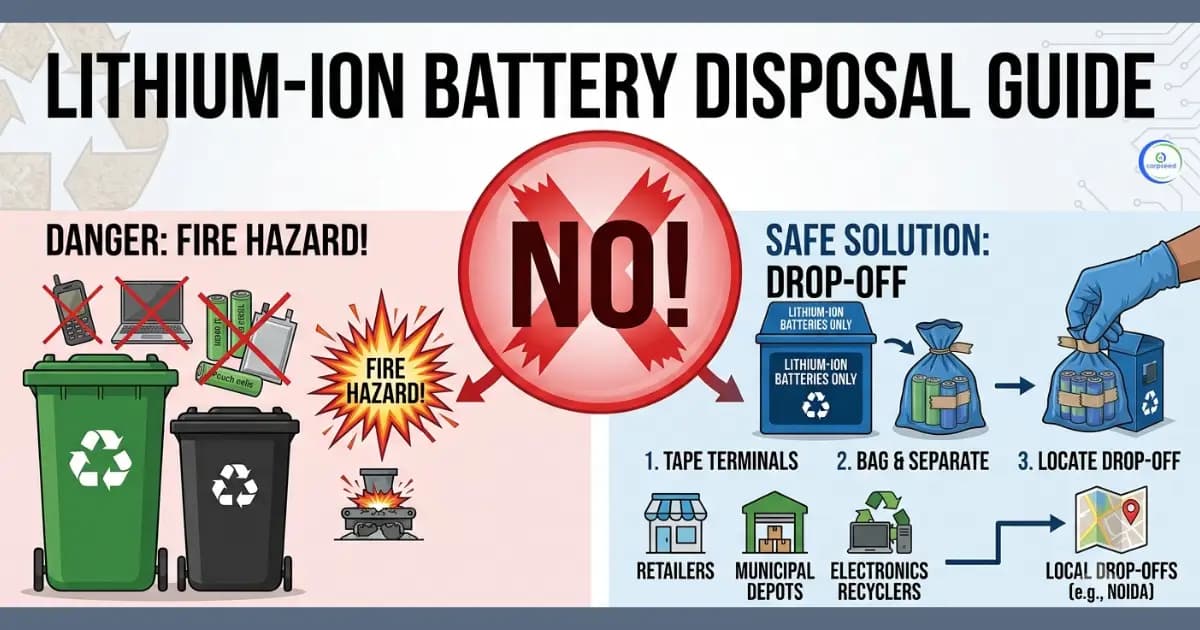
Can Lithium-Ion Batteries Go in the Recycling Bin?
2026-08-27
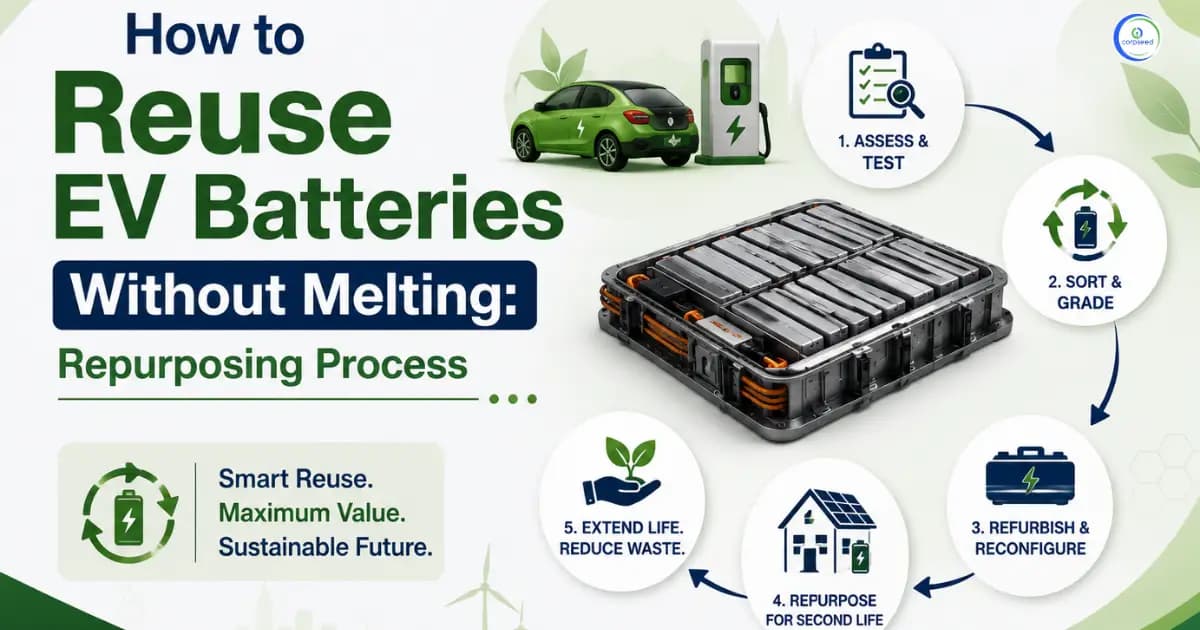
Can a Dead Electric Vehicle Battery Ever Be Used Again Without Melting It?
2026-08-18
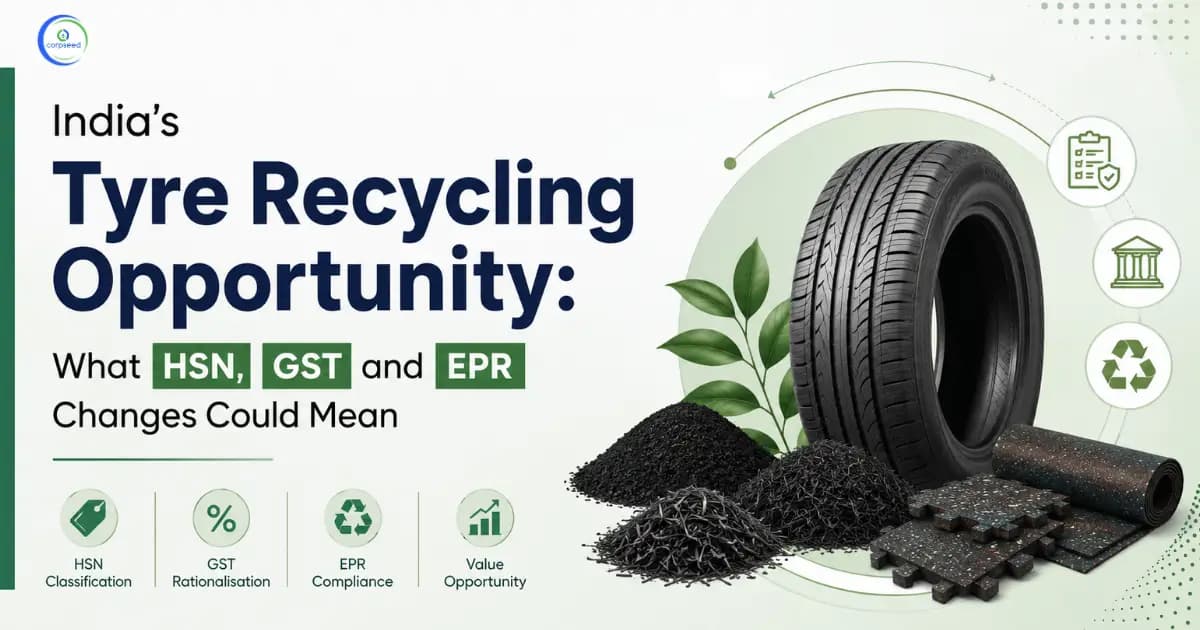
India’s Tyre Recycling Opportunity: What HSN, GST and EPR Changes Could Mean
2026-08-13
How to Start a Lithium-Ion Battery Recycling Plant in India (2026): Complete Business & Compliance Guide
2026-07-16
How to Buy Authentic Recycled Plastic Granules in India: Complete Buyer's Guide (2026)
2026-07-13