
FSSAI Draft Packaging Rules 2026: New Standards for Recycled Plastic in Food Packaging
On 3 November 2026, the Food Safety and Standards Authority of India (FSSAI) published draft changes to the rules for recycled plastic in food packaging. The proposal covers chemically recycled polyethylene (PE) and polypropylene (PP), as well as recycled polymers used in multilayer packaging. It sets different conditions for each use. For food manufacturers, packaging suppliers and plastic recyclers, the important question is not simply whether recycled material can be used, but which material qualifies and under what conditions.
Schedule a Call Back
4,500+ plastic EPR assignments since 2018
Clients include Brenntag Ingredients India, Reliant Packaging Films, Taurus Packaging, Axel Polymers, Lintec India, Kumar Organic Products, HP Adhesives, DDP Speciality Products India, Colt Technology Services India, Emerson Automation Solutions Intelligent Platforms, Intangles Lab, Shindengen India (12 of 1,700+ served since 2018).
A few more clients we've served in this industryHide the list
- Chemicals and materials
- Brenntag Ingredients India · Reliant Packaging Films · Taurus Packaging · Axel Polymers · Lintec India · Kumar Organic Products · HP Adhesives · DDP Speciality Products India
- Electronics and technology
- Colt Technology Services India · Emerson Automation Solutions Intelligent Platforms · Intangles Lab · Shindengen India · Emerson Process Management (India) · Lianchuang Electronic India · Emerson Process Management Chennai · Hayakawa Electronics India
- Pharma and healthcare
- Beryl Drugs · Ascent Meditech · Eli Lilly and Company (India) · Q-Line Biotech · Rajasthan Antibiotics · G D Pharmaceuticals · Micro Labs · ADK Health Care
- Engineering and manufacturing
- Essel Mining & Industries · Juki India · Hilti India · Bundy India · Hilti Manufacturing India · KJS Cement (I) · Mangalam Cement · Birla Precision Technologies
- Food and consumer goods
- Onest · AVT McCormick Ingredients · Akay Natural Ingredients · Ugraya Foods and Feeds · AVT Natural Products · Jalpaiguri Food Industries · Param Dairy · Esther Parfumerie
- Logistics and trade
- Siddhartha Logistics · Siddhartha Logistics Ftwz · Honda Trading Corporation India · Dksh India · MOL Logistics (India) · Fibs Logistics India · Zenexpress Logistics
- More clients
- Nilkamal
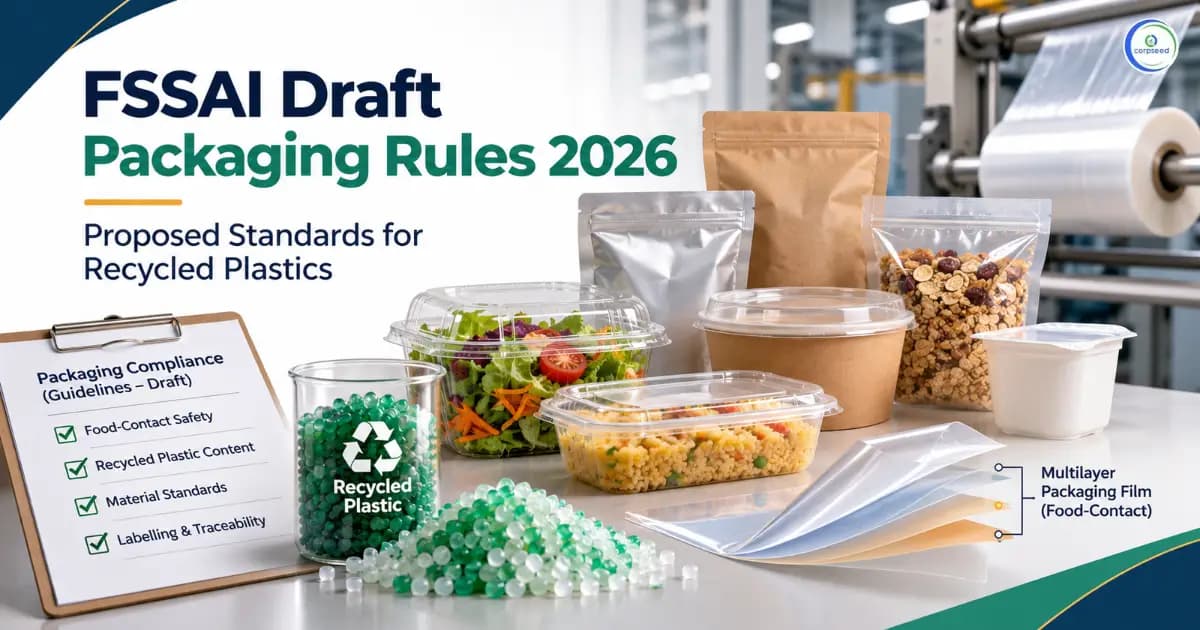
On 3 November 2026, the Food Safety and Standards Authority of India (FSSAI) published draft changes to the rules for recycled plastic in food packaging. The proposal covers chemically recycled polyethylene (PE) and polypropylene (PP), as well as recycled polymers used in multilayer packaging. It sets different conditions for each use. For food manufacturers, packaging suppliers and plastic recyclers, the important question is not simply whether recycled material can be used, but which material qualifies and under what conditions. These are proposed amendments, not final permissions.
Schedule a Call Back
What Are the FSSAI Draft Packaging Amendment Regulations, 2026?
The draft Food Safety and Standards (Packaging) Amendment Regulations, 2026 would amend the Food Safety and Standards (Packaging) Regulations, 2018. FSSAI issued the notification on 2 November 2026, and it appeared in the Gazette of India on 3 November 2026.
The proposal relates to Regulation 4(4), which covers plastic materials intended to come into contact with food. Two clauses, (f) and (g), would be added after the existing clause (e).
Publication of a draft does not make these proposed clauses enforceable. Existing requirements continue to apply. The notification invites public objections and suggestions for 60 days, calculated from the date Gazette copies are made available to the public.
For businesses following FSSAI food packaging regulations, these proposed amendments are particularly relevant to the use of recycled plastic in food packaging in India. They address specific materials and safety conditions rather than introducing a general permission for all recycled plastics.
Key Changes Proposed Under the FSSAI Packaging Rules 2026
The proposed FSSAI recycled plastic packaging rules describe two separate routes for using recycled polymers in food packaging.
| Proposed Clause | Material Covered | Proposed Requirements | Business Relevance |
| Clause 4(4)(f) | Chemically recycled polyethylene (PE) and polypropylene (PP) | The material must be produced through the monomer route as defined in IS 14534. The final output must be equivalent to virgin material and meet applicable criteria. | Relevant to chemical recyclers, polymer suppliers and food packaging manufacturers |
| Clause 4(4)(g) | Recycled polymers used in the outermost layer of multilayer food packaging | Recycled polymers must be derived exclusively from food-grade packaging. Inner layers must provide adequate barriers against migration and meet prescribed limits. | Relevant to multilayer packaging manufacturers, food manufacturers and material suppliers |
The first proposal concerns recycling method and material quality; the second concerns recycled-material origin and its position in a multilayer package. Neither gives blanket approval.
These proposed FSSAI food-contact material requirements could influence how manufacturers select recycled polymers, assess suppliers and review the suitability of packaging materials.
New Conditions for Using Recycled PE and PP in Food Packaging
PE and PP are common packaging plastics, but the draft does not cover every recycled PE or PP product.
Under proposed clause (f), the PE or PP must be produced by chemical recycling through the monomer route, with the process referenced to IS 14534. The final material must be considered equivalent to virgin plastic and satisfy the criteria applicable to virgin material. Virgin material is made from new feedstock.
A supplier calling its resin chemically recycled would not, by that claim alone, show that it meets these conditions. Buyers should examine material specifications and credible supporting evidence.
For recycled PE and PP food packaging applications, manufacturers should consider the recycling method, final polymer quality and applicable food-contact safety standards before making material changes. A recycled material's origin alone does not establish compliance with the proposed requirements.
What Is Chemical Recycling Through the Monomer Route?
In monomer-route chemical recycling, chemical building blocks are recovered for producing polymers again. Mechanical recycling, by contrast, generally sorts, cleans and remelts plastic.
The FSSAI draft specifically mentions the monomer route for recycled PE and PP. It should not be read as permission for every chemical recycling method or for mechanically recycled PE and PP in direct food-contact applications. A particular process must be assessed against the standard and final rules.
This distinction is relevant when assessing recycled plastic food-contact materials because the draft places specific conditions on the recycling process and the quality of the final polymer.
FSSAI Requirements for Recycled Polymers in Multilayer Food Packaging
Multilayer food packaging combines two or more layers, which may provide strength, sealing or protection from moisture and oxygen.
Proposed clause (g) addresses recycled polymer used in the outermost layer of such packaging. It has two central conditions. First, the recycled polymer must come exclusively from food-grade packaging material. Second, the layers between that recycled outer layer and the food must provide an adequate barrier against substance migration, while complying with prescribed migration limits.
General plastic waste is not necessarily food-grade packaging waste. Manufacturers must distinguish the source of recycled inputs, and the proposal does not permit unrestricted use in every layer.
For food-grade recycled polymers in multilayer packaging, the origin of the recycled material, the properties of the inner layers and the applicable migration limits must be considered together when assessing the proposed conditions.
Why Do Barrier Properties and Migration Limits Matter?
Migration is the transfer of substances from packaging into food. Existing FSSAI rules set overall and specific migration limits; barriers aim to prevent transfer from the recycled outer layer.
The complete packaging structure matters because the suitability of the recycled outer layer depends on the protective inner layers. Other food-contact safety rules still apply.
Under food contact material regulations in India, packaging safety cannot be assessed only by looking at the outer layer. The complete material structure and applicable migration limits in food packaging are relevant to determining suitability for food contact.
How Will the Proposed Rules Affect Food and Packaging Businesses?
The impact depends on business activity.
Food Manufacturers
Food businesses using plastic trays, pouches or containers may need clearer information from packaging suppliers about recycled content, polymer type and suitability for the intended food. Existing food safety responsibilities remain.
Packaging Manufacturers
Manufacturers of films, laminates and rigid packaging may need to review material specifications and packaging designs against the proposed clauses. For multilayer packaging, the position of recycled material and the ability of inner layers to act as a barrier are especially relevant. Design changes require technical and legal evaluation.
Plastic Recyclers
Chemical recyclers may wish to assess whether their process and recovered PE or PP output match the conditions proposed under clause (f). Suppliers of recycled polymer for multilayer packaging may instead need to consider the food-grade origin of their input material.
The fact that a company is registered as a plastic waste processor or adheres to Extended Producer Responsibility (EPR) does not mean that the recycled polymer complies with the food contact packaging requirements. The two concepts have different goals.
The following table outlines practical areas that different businesses may wish to review under the proposed FSSAI recycled plastic packaging rules.
| Business Category | Potential Impact | Suggested Preparation |
| Food manufacturers | Greater attention to the suitability of recycled packaging materials | Review packaging specifications and supplier information |
| Plastic packaging manufacturers | Possible changes to recycled-material selection and multilayer packaging design | Assess material specifications, barrier properties and migration requirements |
| Chemical plastic recyclers | Potential relevance of monomer-route recycling and virgin-material equivalence | Review recycling processes and technical material information |
| Recycled polymer suppliers | Greater emphasis on the origin and quality of recycled materials | Maintain clear information about recycled polymer sources and material properties |
| Multilayer packaging manufacturers | Proposed conditions for recycled polymers in outermost layers | Evaluate multilayer structure and applicable food-contact safety requirements |
These are potential business implications and recommended preparation measures, not additional obligations created by the draft.
Existing FSSAI Packaging Regulations vs Proposed Changes in 2026
The November draft builds on an existing framework. It does not replace the entire 2018 regulation.
| Regulation or Amendment | Key Provision | Regulatory Status |
| Food Safety and Standards (Packaging) Regulations, 2018 | Establishes food packaging requirements, including provisions for food-contact plastic materials and migration limits | Existing regulatory framework |
| FSSAI Packaging First Amendment Regulations, 2025 | Addresses recycled PET for food packaging, subject to applicable FSSAI standards and guidelines and relevant national standards or regulations | Final amendment |
| Proposed FSSAI Packaging Amendment Regulations, 2026 – Clause (f) | Introduces proposed conditions for chemically recycled PE and PP produced through the monomer route | Draft proposal |
| Proposed FSSAI Packaging Amendment Regulations, 2026 – Clause (g) | Introduces proposed conditions for food-grade recycled polymers used in the outermost layer of multilayer food packaging | Draft proposal |
PET differs from PE and PP. The 2025 provision for PET should not automatically be applied to other polymers; the proposed clauses would be additional provisions if finalised.
Businesses should therefore distinguish existing recycled PET provisions from the proposed standards for recycled PE and PP food packaging. The conditions applicable to one polymer cannot automatically be assumed to apply to another.
How Businesses Can Prepare for the Proposed FSSAI Packaging Changes
The November draft does not prescribe a new application procedure, but businesses can review their materials.
- Identify the packaging used. List products that use PE, PP, PET or multilayer structures, and note which layers may contact food.
- Check the source of recycled inputs. Ask suppliers whether the recovered polymer comes from food-grade packaging or other plastic waste.
- Review the recycling route. For PE and PP, distinguish monomer-route chemical recycling from other processes.
- Examine technical information. Review available material specifications, food-contact suitability information and relevant testing evidence.
- Understand multilayer design. Identify the outermost layer and the layers intended to stop migration into food.
- Check any current obligations. Review FSSAI packaging guidelines for any obligations related to plastics or extended producer responsibility (EPR).
- Watch the consultations. Stay informed about the progress of the consultations and review the final document before making any purchase or production decisions based on the draft.
These are recommended steps, not a new mandatory checklist.
For food packaging regulatory compliance in India, businesses should separately review food-contact material requirements and plastic waste obligations. EPR requirements arise under the applicable plastic waste management framework and should not be confused with FSSAI approval of packaging materials.
How Corpseed Can Help with Food Packaging Compliance?
Food-contact packaging and plastic waste activities may involve different regulatory obligations.
Corpseed provides FSSAI licensing and registration assistance for relevant food businesses and Plastic Waste Processor (PWP) Authorisation support for applicable recycling activities. Businesses seeking FSSAI packaging compliance services can discuss which available services fit their needs.
Businesses looking for a food packaging compliance consultant in India should first identify whether their requirements concern FSSAI licensing, packaging material suitability or recycling authorisation. An FSSAI compliance consultant can help clarify the relevant regulatory framework, while technical material testing and assessment may require specialised laboratories.
Need compliance guidance? Contact Corpseed about your business activity. FSSAI licensing or PWP authorisation alone does not approve a recycled food-contact material.
Conclusion
The FSSAI Draft Packaging Rules 2026 propose two distinct conditions for recycled plastics in food packaging: one for chemically recycled PE and PP, and another for the outer layer of multilayer packaging. Businesses should review their materials, understand the proposed safeguards and follow the consultation process. Any production decision must still meet the rules currently in force.
About the Author

Mahek Sancheti
Content WriterMahek Sancheti, BAJMC graduate with a deep passion for writing. As a content writer, video content creator, creative content creator, and scriptwriter, I bring stories to life through words and visuals. I honed my skills by working with a prominent news agency, where I excelled in crafting compelling narratives and engaging content. Coming from a journalism and mass communication background I have skills to craft engaging narratives that captivate audiences. With a keen interest in writing and creativity, I aim to deliver impactful and meaningful content that resonates with diverse audiences.
https://www.linkedin.com/in/mahek-sancheti-837196212
Related articles

Selling Food Online? FSSAI Rules for Amazon, Flipkart, Swiggy, Zomato & Marketplace Sellers (2026)
2026-10-15
FSSAI Diwali Drive 2026: Food Safety Inspection Checklist for Food Businesses
2026-10-14
FSSAI Licence vs Registration for Sweet Shops, Bakeries & Home Bakers
2026-10-13
Festive Gift Hamper Compliance: FSSAI, Legal Metrology & Labelling Requirements
2026-10-09
Spice Export Testing in India: FSSAI, Spice Board & EU Compliance Guide 2026
2026-09-09
Edible Oil Testing in India: FSSAI, IS: 547 & Mandatory Compliance Guide 2026
2026-09-04