
FSSAI Diwali Drive 2026: Food Safety Inspection Checklist for Food Businesses
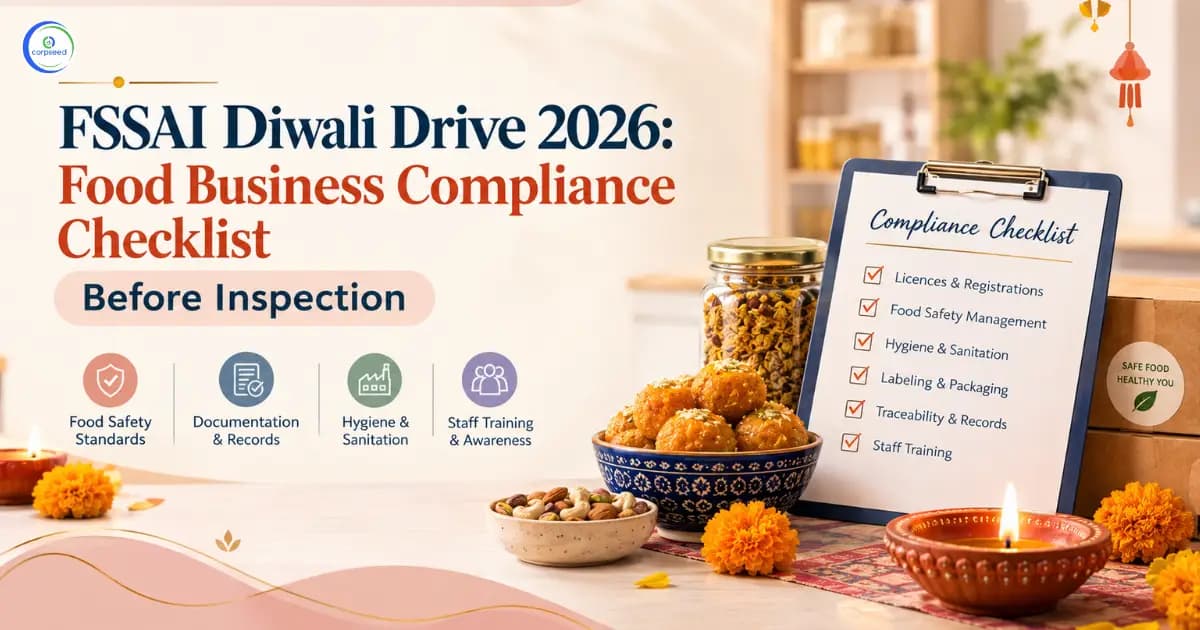
The FSSAI Diwali Drive 2026 aims to check food safety, maintain quality and prevent adulteration during the festive season.
Schedule a Call Back
500+ FSSAI licence assignments since 2018
Clients include Bidada Foods, Silvertip Foods, Good Food Innovations, Minimal Food, Alluring India Foods and Beverages, Auroras TEA Company, Ania Consumer Products, Ginger Foods Company, Magnalis Foods, ND Spices, Antara Assisted Care Services, Aggriveda Pharmaceutical (12 of 350+ served since 2018).
A few more clients we've served in this industryHide the list
- Food and consumer goods
- Bidada Foods · Silvertip Foods · Good Food Innovations · Minimal Food · Alluring India Foods and Beverages · Auroras TEA Company · Ania Consumer Products · Ginger Foods Company · Magnalis Foods · ND Spices
- Pharma and healthcare
- Antara Assisted Care Services · Aggriveda Pharmaceutical
- Logistics and trade
- Solankili Logistics Management · 23North Logistics Solutions
- Non-profits and education
- All India Hindu Mahajot Foundation · Manovikas Charitable Society
- More clients
- Cure and Care Wellness · Seven Turns · Akshamaala Solutions · Krisba Healthcare · Matha Exports International · Indo Gulf Company · Crescent Biologicals · Cura Consumer Health · Biolush · Cura Consumer · Ethics Prosperity · Rocking Deals · Subohi Agriparks · Aurous International Merchants · Anagh Traders · Shin Traders · Zexcorp Services · Aprodite Infotech · Grandmaz Organics · Instruments and Chemicals · Aaravbabbar Enterprises · DUA OLD Age Caring Institution · Goenka Scrapco · Prime Health
Introduction
In its advisory dated 29 September 2026, the Food Safety and Standards Authority of India (FSSAI) asked enforcement authorities to increase surveillance and inspections during Navratri and Diwali, with particular attention to sweets, milk and milk products, snacks, savouries, edible oils, beverages and ghee. The advisory calls on enforcement authorities to carry out inspections and collect food samples in their respective areas.
For food business operators (FBOs), this is a practical reason to review applicable licensing conditions, hygiene practices, product storage, supplier records and food safety documentation before festive demand increases. The advisory does not introduce a single new checklist for every business. The appropriate inspection criteria depend on the type of food business and the requirements already applicable to its operations.
What Is the FSSAI Diwali Drive 2026?
FSSAI's advisory issued by its Regulatory Compliance Division on 29 September 2026, asks Commissioners of States and Union Territories, and FSSAI Regional Directors to arrange heightened surveillance, and enforcement during the festive period.
The advisory identifies several measures for enforcement authorities:
- Conduct inspections and collect food samples in their respective jurisdictions.
- Focus on identified hotspots, and sensitive locations.
- Deploy Food Safety on Wheels units in prominent marketplaces wherever available, including for on-the-spot testing and consumer awareness.
- Record inspection, sampling and outcome data on FoSCoS or FoSCoRIS in real time.
These are directions to the relevant enforcement authorities. Food businesses should not interpret them as a separate universal licence, a new filing requirement for every operator or a guarantee that every establishment will be inspected.
The practical takeaway is that businesses handling high-demand festive foods should review their existing obligations and correct any food safety deficiencies they identify.
Which Food Businesses and Products Are in Focus?
The official advisory highlights food categories that experience increased demand during Navratri and Diwali. It also allows authorities to consider regional food habits when identifying products and locations for surveillance.
| Food Business | Areas to Review Before the Festive Rush |
| Sweet shops and mithai manufacturers | Ingredient quality, preparation hygiene, storage, shelf life and supplier traceability |
| Dairy businesses | Milk and milk product handling, temperature control, cleaning procedures and applicable testing records |
| Snack and savoury manufacturers | Ingredient sourcing, frying oil management, production hygiene, storage and packaging |
| Restaurants and caterers | Kitchen sanitation, food-handler hygiene, safe storage, cross-contamination prevention and supplier records |
| Edible oil and ghee businesses | Product identity, sourcing, applicable quality standards, storage and traceability |
| Packaged-food businesses | Applicable labelling, packaging, batch identification, date marking and storage requirements |
| Seasonal food vendors | Applicable registration or licensing, hygienic handling, clean equipment and protection of food from contamination |
The categories in this table are a practical interpretation of the advisory for business preparation. They are not a published FSSAI ranking of businesses by inspection probability.
Why sweet shops and dairy businesses deserve particular attention
Indian sweets often contain milk, khoya, paneer, nuts, edible fats or other ingredients that require suitable handling and storage. High sales volumes can put pressure on refrigeration, preparation areas, cleaning schedules and stock rotation.
A business should review the safety of its ingredients, the conditions under which products are prepared and stored, and the records it maintains. It should not rely only on the appearance, or smell of a finished product to establish food safety.
The same principle applies to savouries, edible oils and packaged foods. A clean-looking retail counter does not, by itself, demonstrate that products have been sourced, stored and handled correctly.
What Does an FSSAI Food Safety Inspection Cover?
FSSAI publishes official food safety inspection checklists for different business sectors. These checklists are based on the relevant requirements of Schedule 4 of the Food Safety and Standards (Licensing and Registration of Food Businesses) Regulations, 2011, and help Food Safety Officers assess compliance.
The available checklists cover general manufacturing, milk processing, catering, retail, transport and storage. Businesses should use the checklist that applies to their operations instead of following the same checklist for every activity.
- Licensing and registration
Check that the business holds the appropriate FSSAI registration or licence for its activity and premises, as applicable. Review the validity, details and conditions of the authorisation, including whether the activities carried out match those covered by it.
Businesses that have expanded into new products, additional premises or different activities should verify whether a modification or separate authorisation is required.
Do not rely on old turnover thresholds or another business's licence category. Check the current eligibility criteria applicable to your business on the official FoSCoS portal.
- Premises hygiene and food handling
Review the cleanliness and condition of food preparation, processing, storage and service areas. Pay attention to:
- Cleaning and sanitation procedures.
- Handwashing facilities and hygienic food handling.
- Protection of food from dust, pests and other contamination.
- Separation of raw materials from ready-to-eat foods where required.
- Clean food-contact surfaces, utensils and equipment.
- Waste handling and drainage.
- Measures to prevent cross-contamination.
The precise requirements depend on the type of operation and the applicable hygiene provisions. Businesses should use the relevant Schedule 4 requirements and sector-specific inspection checklist to identify their obligations.
- Storage, temperature control and pest prevention
Review how ingredients, work-in-progress and finished products are stored. Products requiring refrigeration or other controlled conditions should be kept under suitable conditions throughout the relevant handling and storage stages.
Check that storage areas are clean, stock is organised, damaged or unsuitable products are segregated, and pest-control measures are appropriate.
Where temperature monitoring is relevant to the operation, review the applicable limits, monitoring frequency and records. Do not apply a single temperature limit to every food product.
- Supplier records, traceability and food testing
Businesses should review purchase invoices, supplier details and relevant batch or lot information. Where required, they should be able to trace ingredients and products through the relevant stages of receipt, storage, production and distribution.
Check whether applicable product specifications, testing reports or other supporting records are available and current. Testing requirements vary by product, business activity and applicable regulations.
If a product or ingredient raises a safety concern, isolate the affected stock where appropriate, investigate its source and take corrective action under the applicable procedures.
- Packaging, labelling and product information
For packaged foods, review the labelling requirements applicable to the product, including the relevant declarations, ingredient information, allergen information, date marking, batch identification and FSSAI licence details where required.
The exact declarations depend on the product and applicable exemptions or special provisions. A business should not assume that every packaged and unpackaged food follows the same labelling rules.
Also review whether packaging materials are suitable for their intended food-contact use and are handled hygienically.
FSSAI Diwali Inspection Checklist for Food Businesses
Use the following checklist as an initial internal review. It supplements, but does not replace, the applicable FSSAI inspection checklist or the full requirements of the law.
| Check | What to review |
| Applicable authorisation | Registration or licence, validity and covered activities |
| Supplier records | Purchase invoices and relevant supplier details |
| Ingredient quality | Condition, suitability and traceability of ingredients |
| Premises hygiene | Cleaning, sanitation and maintenance |
| Food-handler hygiene | Handwashing, safe handling and relevant training |
| Storage conditions | Suitable conditions, stock rotation and segregation |
| Pest prevention | Inspection, preventive measures and relevant service records |
| Product traceability | Batch or lot details and relevant production or dispatch records |
| Testing records | Reports and evidence required for the particular activity or product |
| Packaged-food labels | Applicable declarations, date marking and batch information |
| Food-contact materials | Suitability and hygienic handling of relevant packaging and equipment |
| Corrective actions | Outstanding observations, complaints or identified deficiencies |
Mark each item based on the records and practices you can verify. For example, a cleaning schedule should match the cleaning actually carried out and the records maintained.
Checklist for sweet shops and mithai manufacturers
Before the Diwali sales rush, review the following areas:
- Ingredients: Check the condition, source and traceability of milk, khoya, paneer, nuts, edible fats, sugar and other ingredients used in production.
- Preparation: Review the cleanliness of work surfaces, utensils, equipment and food preparation areas.
- Storage: Keep products under appropriate conditions and follow applicable storage and shelf-life requirements.
- Stock Rotation: Identify older, damaged, unsuitable or expired stock and handle it appropriately.
- Food Colours and Additives: Verify that any colours or additives used are permitted for the relevant food category and comply with applicable conditions.
- Packaging and Display: Protect products from contamination and use suitable food-contact materials.
- Records: Keep relevant purchase invoices, supplier information, batch details and testing reports where applicable.
For example, if a mithai shop buys khoya from an outside supplier, it should review the supplier's details, purchase records, receipt conditions and the way the ingredient is handled after delivery. A supplier invoice alone does not demonstrate that the ingredient was stored safely or that the finished product meets every applicable requirement.
Checklist for dairy businesses
Dairy processors, milk product manufacturers and businesses handling dairy ingredients should review:
- The condition and traceability of incoming milk and other ingredients.
- Cleaning and sanitation of equipment and containers.
- Temperature control at the relevant processing, storage and transport stages.
- Separation of unsuitable or potentially contaminated products.
- Applicable product testing and quality records.
- Batch identification and distribution records.
- Compliance with the relevant dairy-specific hygiene and product requirements.
The applicable inspection criteria depend on whether the business handles raw milk, processes dairy products, stores them, transports them or sells them at retail.
Checklist for restaurants, caterers and cloud kitchens
Food service businesses should review:
- The condition and cleanliness of kitchens, utensils and food-contact surfaces.
- Personal hygiene and safe food-handling practices.
- Separation of raw and ready-to-eat foods where appropriate.
- Refrigeration and other storage conditions required for ingredients.
- Cleaning, pest-control and waste-management practices.
- Supplier records and traceability for relevant ingredients.
- The applicable FSSAI authorisation and food safety management procedures.
Businesses operating multiple kitchens or premises should review each location separately where its activities and authorisation require it.
Checklist for packaged-food manufacturers and retailers
Manufacturers and retailers should check:
- Whether products are sourced from appropriate suppliers.
- Whether relevant batch, lot and invoice records are available.
- Whether packages are intact and products are stored as required.
- Whether labels comply with the requirements applicable to the product.
- Whether stock rotation and handling procedures are followed.
- Whether complaints, suspected defects or other product safety concerns have been investigated appropriately.
Retailers should not assume that their responsibilities end when a packaged product arrives from a supplier. They still need to follow the obligations applicable to their own activities.
Which Documents Should Be Ready Before an FSSAI Inspection?
The documents required depend on the business category, its activities and the relevant licence conditions. The following table is a practical preparation guide, not a claim that every record is mandatory for every FBO.
| Document or Record | Why it may be Relevant |
| FSSAI registration or licence | Establishes the business's applicable authorisation |
| Purchase invoices and supplier details | Supports sourcing and traceability checks |
| Food safety management system documentation | Relevant to applicable licensing and hygiene requirements |
| Cleaning and sanitation records | Helps demonstrate implementation of cleaning procedures |
| Pest-control records | Supports review of pest prevention measures |
| Temperature logs | Relevant where temperature monitoring is applicable |
| Testing reports | Required or useful where applicable to the product or operation |
| Batch, production and dispatch records | Supports traceability where relevant |
| Packaging and label specifications | Helps review applicable packaging and labelling obligations |
| Corrective-action records | Shows how identified deficiencies have been addressed |
| Relevant staff training records | Supports review of applicable food-handler training practices |
Keep the records that apply to your activity organised and accessible. If a particular record is not required for your business, do not create a document solely because it appears on a generic online checklist.
What Happens If an Inspector Finds a Food Safety Violation?
The consequences depend on the nature of the finding, the applicable provision of law and the facts of the case. An inspection observation does not automatically mean that every business will receive the same penalty.
Depending on the circumstances an authority may require corrective action, issue an improvement notice, initiate proceedings concerning a licence, or take other action authorised under the applicable law.
The Food Safety and Standards Act, 2006 contains provisions dealing with licensing, improvement notices, offences and penalties. For example, Section 32 addresses improvement notices, while Section 31 deals with licensing and registration. Other provisions may apply depending on the violation.
A business should not assume that every hygiene observation results in licence cancellation, nor should it assume that an informal correction resolves a serious food safety issue.
If an inspection identifies a deficiency:
- Read the observation carefully and identify the requirement involved.
- Take immediate steps to address any risk to food safety.
- Segregate or otherwise manage affected products where necessary.
- Preserve relevant records and evidence.
- Prepare a corrective-action plan that addresses the underlying cause.
- Follow the directions and deadlines in any formal notice or order.
- Seek qualified assistance if the finding involves a disputed legal interpretation, a licence action or a potentially serious violation.
Where a formal notice has been issued, the business should follow the applicable procedure and obtain legal or regulatory advice appropriate to the issue.
How to Prepare Your Food Business Before Diwali
A practical preparation process can help businesses identify deficiencies before festive demand increases.
Step 1: Identify the requirements applicable to your business
Confirm your business activity, premises, registration or licence category, relevant licence conditions and the appropriate sector-specific inspection checklist.
A sweet manufacturer, a restaurant and a warehouse do not necessarily have the same requirements.
Step 2: Conduct a premises review
Inspect preparation areas, storage spaces, equipment, food-contact surfaces, waste-handling arrangements and pest-prevention measures.
Record each issue, assign responsibility for correcting it and set a completion date.
Step 3: Review ingredients and suppliers
Check incoming materials, supplier records, storage conditions and product traceability. Investigate missing information or concerns about an ingredient's condition before it enters production.
Step 4: Check applicable records and labels
Check the documents required for your business, including food safety procedures, relevant testing records and product labels. Fix any errors, or missing information before the inspection rather than promising to provide the records later.
Step 5: Verify corrective actions
Go back to the issues identified at the time of the review, and check whether they have been fixed. Keep supporting documents, or other evidence of the changes wherever needed.
Step 6: Review the official checklist again
Use the current checklist for your business sector to identify any additional requirements that the initial review missed.
FSSAI's official inspection resources can be accessed at Food Safety Inspection Checklists.
Common FSSAI Compliance Mistakes to Address
Food businesses can run into problems during inspections because of small gaps in their daily practices or records. Before the festive rush, review these common mistakes and address any issues at your premises.
- Treating a valid licence as proof of complete compliance: An applicable licence or registration is important, but it does not by itself demonstrate that day-to-day food handling, hygiene, storage and recordkeeping requirements are being followed.
- Using the same checklist for every business: A retail shop, dairy processor, caterer and food manufacturer have different operations. Use the relevant sector-specific inspection checklist and applicable regulations.
- Maintaining procedures without following them: A cleaning schedule or temperature log is useful only when it accurately reflects what happens at the premises. Records should be genuine, current and consistent with actual practices.
- Ignoring traceability: Missing invoices, incomplete supplier details or inconsistent batch records can make it harder to investigate a food safety concern. Review traceability before the festive rush rather than waiting for a problem to arise.
- Assuming every festive advisory creates new legal duties: The September 2026 advisory asks enforcement authorities to step up inspections during the festive season. Businesses should follow it along with the food safety laws, regulations, licence conditions and other directions that already apply to them.
Also Read: FSSAI Licence vs Registration for Sweet Shops, Bakeries & Home Bakers
How Can Corpseed Help with FSSAI Compliance?
Food businesses may need assistance when they are unsure which licence or registration applies, need help with an application or modification, or want to review their compliance documentation against the requirements relevant to their operations.
Corpseed can use this opportunity to connect businesses with relevant FSSAI licensing, registration and compliance assistance, subject to the services actually offered and applicable professional scope.
Depending on the requirement, the engagement may involve:
- Reviewing the business activity and the applicable licensing or registration route.
- Identifying documentation gaps in an application or renewal.
- Helping organise relevant compliance records.
- Reviewing applicable regulatory requirements and identifying areas that need attention.
- Referring technical, testing or legal questions to the appropriate qualified professionals where necessary.
A compliance review cannot guarantee that a business will pass an inspection, and it does not replace an inspection by the relevant authority.
Conclusion
With the FSSAI Diwali Drive 2026 underway, food businesses should check whether their licences, food labels, hygiene practices and records are in order. Sweet shops, dairy units, restaurants and food manufacturers should pay close attention to how food is handled, stored and prepared during the festive rush. Missing records, poor storage or lapses in hygiene can lead to problems during an inspection.
Preparing for the FSSAI Diwali Drive 2026? Consult Corpseed's experts to discuss your applicable licensing requirements and compliance documentation. Start by identifying the issues affecting your business, so you can seek assistance that matches your actual requirements.
About the Author

Parul Bohral
Legal Content WriterParul Bohral, a BALLB graduate and experienced legal researcher and content writer with expertise in various legal areas, including corporate law and intellectual property. I have gained valuable experience in esteemed legal environments, where I have strengthened my research skills, allowing me to approach legal writing with precision and depth.
As a legal content writer, I am committed to delivering work that not only informs but also engages readers. By staying informed about the latest trends in content marketing and regulatory developments, I ensure that my writing remains sophisticated and meets industry standards. My dedication to thorough research enables me to craft content that is both insightful and impactful.
Related articles
FSSAI State License Renewal in India 2026: Process, Fees & New Rules
2026-11-12
FSSAI Central License Renewal in 2026: Rules, Fees, Documents & Process
2026-11-12

FSSAI Draft Packaging Rules 2026: New Standards for Recycled Plastic in Food Packaging
2026-11-04

Selling Food Online? FSSAI Rules for Amazon, Flipkart, Swiggy, Zomato & Marketplace Sellers (2026)
2026-10-15
FSSAI Licence vs Registration for Sweet Shops, Bakeries & Home Bakers
2026-10-13
Festive Gift Hamper Compliance: FSSAI, Legal Metrology & Labelling Requirements
2026-10-09