
Festive Gift Hamper Compliance: FSSAI, Legal Metrology & Labelling Requirements
Ensure full regulatory compliance for festive gift hampers in India by verifying FSSAI licensing, mandatory food labelling, and Legal Metrology package declarations. Protect your brand, ensure consumer safety, and prevent costly delivery delays during peak gifting seasons.
Schedule a Call Back
700+ Legal Metrology assignments since 2018
Clients include Mankind Pharma, Ascent Meditech, Asio Healthcare, Naik Meditechs and Devices, Meora Healthcares, Radimage Healthcare India, ADK Health Care, Anglo French Drug and Industries, Antara Assisted Care Services, Gentec Medical, Aum Houseware, Esther Parfumerie (12 of 550+ served since 2018).
A few more clients we've served in this industryHide the list
- Pharma and healthcare
- Mankind Pharma · Ascent Meditech · Asio Healthcare · Naik Meditechs and Devices · Meora Healthcares · Radimage Healthcare India · ADK Health Care · Anglo French Drug and Industries · Antara Assisted Care Services · Gentec Medical
- Food and consumer goods
- Aum Houseware · Esther Parfumerie · Sats Food Solutions India · Rk Cosmetics · Afrodite Beauty
- Electronics and technology
- Martelx Electronics · Waites Sensor Technologies · Fleetx Technologies · Ingar Electronics · Watthut Electronics · Stmd Semiconductor · Agnext Technologies · Aten Advance
- Logistics and trade
- G Unit Logistics (India) · Honda Trading Corporation India · Zenexpress Logistics
- Engineering and manufacturing
- Juki India · Nibav Lifts · Birla Durotool · Inevia Automotiive
- More clients
- Telematics Design Solutions · Netgroove Distribution · Groag Products · GHV Medical Anchor · Viion Systems · Techno Sales Corporation · Nirvana India · Crystal Presentation Solutions · Seven Turns · Zivov Technologies · Mycelium Sona Biotech · Ratuman · Kleo Consumer Brands · Snuhi Retails · Virtual Instrumentation & Software Applicationsltd · Vitrag Infra Projects · Ample Digital · Abbie IT Mart
Introduction
The compliance requirements for a festive gift hamper depend on what your business actually does. Buying sealed products from another brand is different from repacking dry fruits, selling food under your own brand or importing packaged products.
Before finalising your hamper design, identify your business activity and assess the applicable FSSAI registration or licence, food labelling and Legal Metrology requirements.
What Is Festive Gift Hamper Compliance?
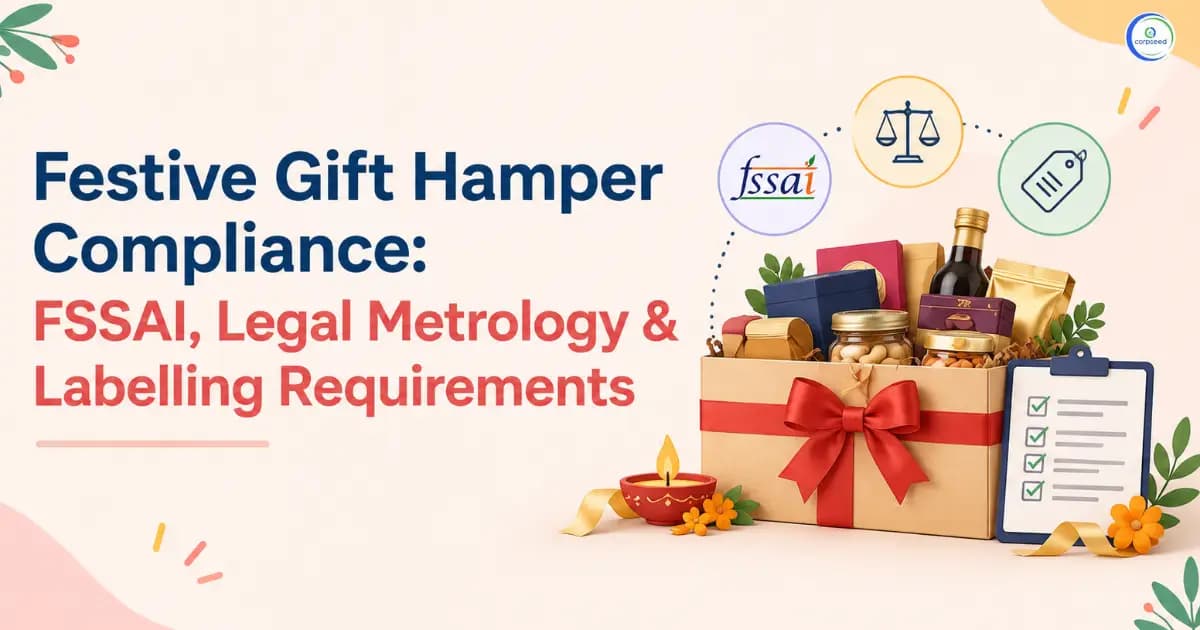
Festive gift hamper compliance means meeting the applicable food safety, licensing, packaging and labelling requirements when preparing or selling gift hampers in India. These hampers may contain chocolates, sweets, dry fruits, cookies, beverages or imported packaged foods.
The requirements depend on how the business operates. A retailer placing sealed products from different brands into a decorative box may have different responsibilities from a business that repacks loose dry fruits, sells food under its own brand or imports packaged products.
Three key areas require attention:
- FSSAI compliance: Assess the applicable food business registration or licence, food safety obligations and labelling requirements.
- Legal Metrology compliance: Check the declarations applicable to pre-packaged commodities, including quantity, price and relevant business details.
- Packaging and labelling: Review the labels on individual food products and determine whether the finished outer hamper requires additional declarations.
For example, a Diwali hamper containing sealed chocolates and cookies may require a different compliance assessment from a hamper containing dry fruits repacked into branded 250 g packets. Identifying these differences before printing packaging can help prevent avoidable costs and delays.
Schedule a Call Back
Reselling Sealed Products Bought from Other Brands
Example: A corporate gifting company purchases sealed chocolate boxes, branded cookies, packaged almonds and honey jars from different manufacturers and places them inside a decorative Diwali hamper.
If the company does not open or alter the individual food packages, its role may primarily involve trading, distribution or retail sale rather than food manufacturing. However, the correct FSSAI category must be assessed according to its actual activities, premises and applicable eligibility criteria.
Before selling the hamper, the business should check:
- Whether its existing FSSAI registration or licence covers its actual activities.
- Whether each food product retains its required label, FSSAI details and applicable date and batch information.
- Whether products are sealed, undamaged and suitable for the intended storage and delivery period.
- Whether the outer gift box requires separate declarations under the applicable Legal Metrology and food-labelling rules.
- Whether any claims printed on the hamper accurately describe its contents.
Practical takeaway: Placing sealed products in a decorative box does not automatically make the business a food manufacturer. However, the business should not assume that the original product labels resolve every compliance requirement for the finished hamper.
Repacking Loose Food, Such as Dry Fruits
Example: A seller purchases 20 kg of loose almonds, cashews and raisins, divides them into smaller quantities and packs them into branded festive gift boxes.
This business is doing more than reselling sealed products. Repacking food can change its regulatory responsibilities because the business is handling the food and creating new packages for sale.
Before beginning, assess:
- The FSSAI registration or licence category applicable to the repacking activity.
- The required food safety, hygiene, handling and storage arrangements.
- The product identity, ingredients and allergen information, wherever applicable.
- The applicable net quantity, date marking, batch or lot details and food business operator information.
- The Legal Metrology declarations and any registration requirements applicable to the new retail packages.
- Whether the proposed shelf life and storage conditions are appropriate for the repacked products.
For instance, a 250 g pack of almonds should not carry a quantity declaration copied from the original bulk sack. The declared quantity must correspond to the new retail pack, and the applicable labelling requirements must be reviewed for that package.
Practical takeaway: Finalise the repacking process, label details and applicable regulatory requirements before purchasing labels or packaging materials in bulk.
Selling Food Products Under Your Own Brand
Example: A gifting business sells a hamper under its own brand, with branded boxes of cookies, chocolates and roasted nuts manufactured by third-party suppliers.
Using a third-party manufacturer does not automatically remove the brand owner's compliance responsibilities. The business must establish whether it acts as a brand owner, marketer, manufacturer, packer or another type of food business operator under the applicable rules.
The assessment should cover:
- The FSSAI registration or licence requirements for each relevant business role and activity.
- The identity of the actual manufacturer or packer and the business responsible for marketing the product.
- The appropriate FSSAI logo and licence or registration details on the relevant labels.
- Whether ingredient, allergen, nutritional, date and batch declarations are accurate and complete, wherever required.
- Whether the brand name, product description and promotional claims could mislead customers.
- Whether the outer hamper packaging creates additional labelling or Legal Metrology obligations.
For example, if a third-party bakery produces cookies for a gifting company, the gifting company should not simply replace the bakery's label with its own logo. The label and supporting records should correctly reflect the parties' roles and the declarations required for that product.
Practical takeaway: Before launching a private-label hamper, agree on labelling responsibilities with the manufacturer and review the final artwork against the applicable regulations.
Importing Packaged Food Products
Example: An importer plans to sell festive hampers containing imported chocolates, biscuits, premium nuts and confectionery sourced from overseas suppliers.
Imported food products require additional assessment because import clearance, food safety requirements and declarations for the Indian market may apply. The requirements depend on the products, their packaging, the import arrangement and the applicable regulations.
Before placing a bulk order, check:
- The applicable FSSAI licence and import-related requirements for the business.
- Whether the products are eligible for import and meet the relevant Indian food safety requirements.
- The required Indian-market label declarations, including importer details and country of origin where applicable.
- Whether the product information, ingredients, allergens, dates and other declarations meet applicable requirements.
- The relevant import documentation and food clearance process.
- Whether the imported products and the finished outer hamper require separate or additional declarations.
For example, an imported chocolate bar may have packaging designed for another market. Its existing foreign-language label or overseas product information should not be assumed to satisfy all Indian requirements.
Practical takeaway: Review the product details, import documentation and proposed Indian-market labels before confirming the shipment or promising a delivery date to a corporate customer.
Legal Metrology Compliance: Check the Individual Packs and the Outer Hamper
Assessment for compliance with Legal Metrology requirements must be done independently of Food Labelling by the FSSAI. The provisions for declaring details under the Legal Metrology Act, 2009, and the Legal Metrology (Packaged Commodities) Rules, 2011 (as amended) apply to pre-packaged goods.
Depending on the package and business arrangement, the declarations to review may include the name and address of the manufacturer, packer or importer; common or generic product name; net quantity; maximum retail price (MRP), inclusive of taxes; consumer care details; and country of origin for imported products, where applicable.
These are not universal requirements that apply identically to every hamper. The actual package and applicable exemptions must be examined.
Worked Example: An Opaque Gift Box Containing Individually Packed Products
Think of a firm manufacturing an opaque Diwali gift box comprising:
- A closed box of chocolates.
- One packet of roasted almonds.
- One packet of cookies.
- One jar of honey.
All the items are packed individually, and the opaque gift box will not allow customers to read the labels of the products in the hamper.
The business should conduct two separate checks.
Check 1: Individual product packages.
Review each product's own label and confirm that the required information is present and accurate. Depending on the product and applicable rules, this may include:
1. Product name and other required food declarations.
2. Ingredients, allergen information and nutritional information, where applicable.
3. Applicable date marking and batch or lot details.
4. Relevant FSSAI logo and licence or registration information.
5. Net quantity and MRP, where required.
6. Manufacturer, packer or importer details and other applicable declarations.
The business should also confirm that the products are within their applicable shelf life and that their storage requirements can be maintained throughout assembly, storage and delivery.
Check 2: The outer gift box.
Next, assess whether the finished hamper is itself a pre-packaged commodity covered by the Legal Metrology rules and whether any separate food-labelling declarations apply to the outer packaging.
The review should establish:
1. Whether the outer box needs its own product or commodity description.
2. Whether a total net quantity or other package declaration is required for the way the hamper is sold.
3. Whether the relevant manufacturer, packer, importer or responsible business details must appear on the outer package.
4. Whether MRP, consumer care details, country-of-origin information or other declarations apply.
5. Whether the packaging arrangement falls within any relevant exception or special provision.
Important: An opaque box should not be treated as compliant merely because the individual products have labels inside. Equally, businesses should not copy every individual declaration onto the outer box without checking the applicable requirements. A regulatory specialist should review the actual hamper design, the intended sale arrangement and any applicable exceptions before the artwork is approved.
What If the Hamper Contains Loose Products?
The position may differ if the seller opens bulk packages and places loose almonds, sweets or cookies into a new gift box. In that case, the business should assess its responsibilities as a food handler or repacker, the applicable food-label requirements for the new package, and the relevant Legal Metrology declarations.
The distinction is important: a decorative box containing original sealed products is not necessarily regulated in the same way as a new retail package created by the seller.
| Business situation | Information to prepare | Next action |
| Reselling sealed branded products | Supplier invoices, product labels, pack sizes and shelf-life details | Verify product labels and assess the outer hamper |
| Repacking loose dry fruits or snacks | Ingredients, actual net quantities, packing process and proposed shelf life | Review FSSAI and Legal Metrology requirements for the new packs |
| Selling own-brand products | Brand-owner and manufacturer details, licence information and final label artwork | Confirm each party's responsibilities and approve the labels |
| Importing packaged food | Product specifications, supplier details, import documents and Indian-market label artwork | Verify import eligibility, clearance and applicable declarations |
| Selling an opaque multi-product hamper | Individual pack labels, outer-box dimensions, product inventory and sale price | Obtain a package-specific review before printing |
This checklist is a planning aid, not a substitute for checking the applicable rules and exemptions for the actual products and package.
Different Types of Festive Hampers: Practical Compliance Examples
- Chocolate and confectionery hampers: Check each product's ingredients, allergen declarations, applicable dates and storage instructions. Imported products may require additional import and Indian-market labelling checks.
- Dry-fruit and nut hampers: Establish whether the products remain in their original sealed packs or are repacked into new quantities. The latter requires a separate assessment of the business's role and the declarations for the new packages.
- Traditional sweets and snack hampers: Businesses preparing or packing sweets should assess their FSSAI category, hygiene arrangements, packaging suitability and applicable labelling requirements. Do not assume that requirements for factory-packed sweets automatically apply to freshly prepared products sold under a different arrangement.
- Corporate gift hampers: For bulk orders, confirm the final product list, branding, price, quantities and label artwork before production. A customised sleeve or promotional message must not obscure required declarations or create misleading claims.
- Imported food hampers: Confirm the applicable import and food safety requirements, importer details and Indian-market labelling before accepting delivery commitments. Review any proposed relabelling or repacking separately.
Common Compliance Mistakes: Examples Businesses Can Avoid
- In case sealed packaging makes the overall packing compliant: A vendor might inspect the chocolate and cookie labeling but not consider the labeling that is relevant for the final outer packing. Check all the layers of packing.
- Food repacking without changing the information on the labels: A vendor might portion out one bulk bag of almonds into 250 g packages and keep the information about the initial bulk quantity of the product.
- Using an own-brand label without checking business roles: A gifting company may put its logo on third-party-manufactured cookies without verifying the required manufacturer, brand-owner and food business details. Agree on responsibilities before approving the label.
- Assuming overseas packaging meets Indian requirements: Imported products may need additional checks before being marketed in India. Review the applicable import and labelling requirements before shipment or sale.
- Printing the entire order before the review: A company may print 5,000 opaque gift boxes and later discover that the proposed packaging or declarations need revision. Review the individual labels, outer packaging and relevant exemptions before placing the printing order.
What to Prepare Before Accepting a Bulk Gift Hamper Order
Before committing to a corporate gifting order or printing packaging, prepare a product-wise inventory with the brand, product name, supplier, pack size, ingredients or product specifications, relevant date details and existing label artwork.
Also document whether your business will resell, repack, manufacture, market under its own brand or import the products. Keep the proposed outer-box design, intended sale price, business details and relevant licence documents ready for review.
This allows the applicable FSSAI and Legal Metrology requirements to be assessed against the actual business model and packaging arrangement, rather than making assumptions after production has started.
How Corpseed Can Help
Corpseed can assist businesses in assessing their FSSAI licensing, food labelling and Legal Metrology compliance requirements, depending on the scope of the service engaged.
Support may include reviewing business activities, identifying the relevant registration or licensing category, checking proposed label artwork, assessing package declarations and organising supporting documentation.
Planning a festive hamper launch or corporate bulk order? Have your business activity, product list, individual labels and outer packaging reviewed before printing or dispatch. Contact Corpseed to discuss the compliance requirements applicable to your business.
Conclusion
Festive gift hampers offer an opportunity for retailers, food brands and corporate gifting businesses, but compliance should be assessed before packaging is printed or bulk orders are accepted. The applicable requirements depend on whether you resell sealed products, repack food, sell under your own brand or import packaged goods.
Review the relevant FSSAI requirements, individual product labels, Legal Metrology declarations and outer packaging together. Where the rules or exemptions are unclear, seek a product-specific regulatory review before finalising the artwork.
Planning a festive gift hamper launch or corporate order? Contact Corpseed for assistance in assessing your FSSAI licensing, food labelling and Legal Metrology compliance requirements before production and dispatch.
Call Now | Request a Consultation | Enquire About Compliance Support
About the Author

Anshika Jindal
Content WriterAnshika Jindal, a Legal Content Writer with strong expertise in legal research and a solid academic background in BA LLB and LLM (Criminal Law). I specialize in researching statutes, case laws, and legal developments and presenting them in clear, accurate, and engaging written content. With strong analytical skills and attention to detail, I create reliable, well-structured legal content while maintaining professional and ethical standards.
I specialize in conducting in-depth legal research using credible sources and presenting legal information in a structured, reader-friendly manner while maintaining precision and authenticity. My work focuses on simplifying legal language without compromising its meaning, making legal content accessible to a wider audience.
Related articles
FSSAI State License Renewal in India 2026: Process, Fees & New Rules
2026-11-12
FSSAI Central License Renewal in 2026: Rules, Fees, Documents & Process
2026-11-12
FSSAI Draft Packaging Rules 2026: New Standards for Recycled Plastic in Food Packaging
2026-11-04

Selling Food Online? FSSAI Rules for Amazon, Flipkart, Swiggy, Zomato & Marketplace Sellers (2026)
2026-10-15
FSSAI Diwali Drive 2026: Food Safety Inspection Checklist for Food Businesses
2026-10-14
FSSAI Licence vs Registration for Sweet Shops, Bakeries & Home Bakers
2026-10-13