
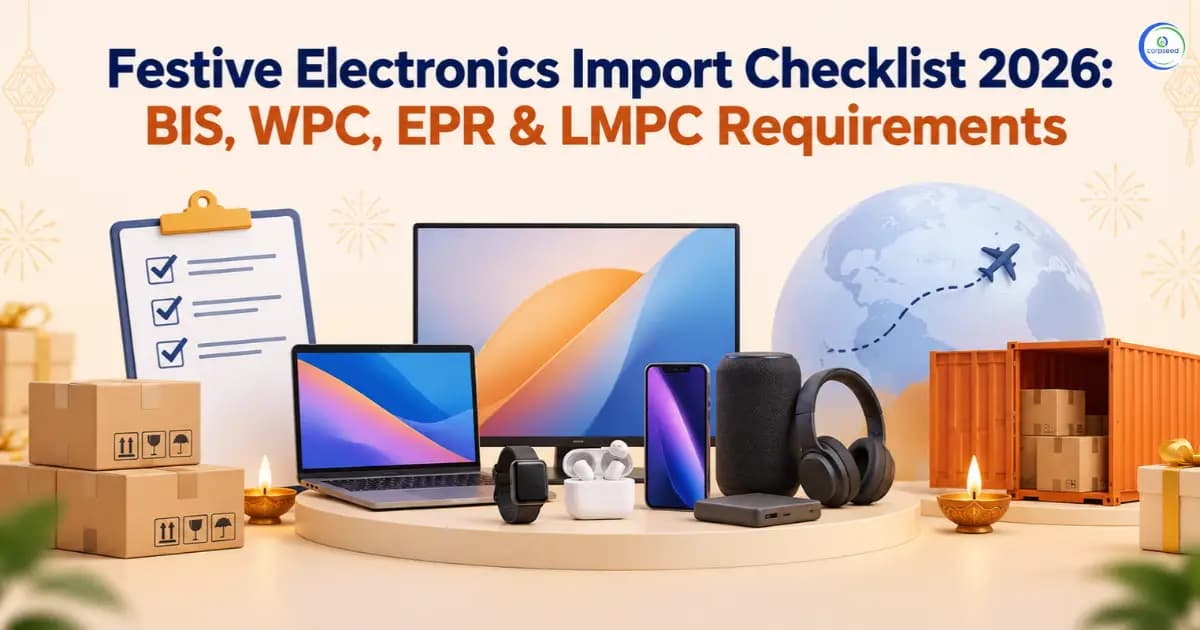
Festive Electronics Import Checklist 2026: BIS, WPC, EPR & LMPC Requirements
Ensure smooth festive electronics imports to India in 2026 by verifying BIS CRS registration, WPC ETA approval, EPR waste management obligations, LMPC packaging declarations, and DGFT import licenses for restricted items. Avoid shipment delays, penalties, and customs issues with proactive product compliance assessments.
Schedule a Call Back
8,300+ EPR assignments since 2018
Clients include Emerson Automation Solutions Intelligent Platforms, Intangles Lab, Colt Technology Services India, Deki Electronics, Amzetta Technologies, Shindengen India, Emerson Process Management (India), Lianchuang Electronic India, Beryl Drugs, Q-Line Biotech, Ascent Meditech, Eli Lilly and Company (India) (12 of 2,300+ served since 2018).
A few more clients we've served in this industryHide the list
- Electronics and technology
- Emerson Automation Solutions Intelligent Platforms · Intangles Lab · Colt Technology Services India · Deki Electronics · Amzetta Technologies · Shindengen India · Emerson Process Management (India) · Lianchuang Electronic India
- Pharma and healthcare
- Beryl Drugs · Q-Line Biotech · Ascent Meditech · Eli Lilly and Company (India) · Endolite India · Rajasthan Antibiotics · G D Pharmaceuticals · Micro Labs
- Engineering and manufacturing
- Juki India · Hilti India · Essel Mining & Industries · Bundy India · Hilti Manufacturing India · KJS Cement (I) · Mangalam Cement · Birla Precision Technologies
- Chemicals and materials
- Brenntag Ingredients India · Reliant Packaging Films · Taurus Packaging · Axel Polymers · Lintec India · Kumar Organic Products · DDP Speciality Products India · HP Adhesives
- Food and consumer goods
- Onest · AVT McCormick Ingredients · Akay Natural Ingredients · AVT Natural Products · Ugraya Foods and Feeds · Jalpaiguri Food Industries · Milano Ice Cream · Milano22 Foods
- Logistics and trade
- Siddhartha Logistics · Siddhartha Logistics Ftwz · Honda Trading Corporation India · Zenexpress Logistics · MOL Logistics (India) · Dksh India · Fibs Logistics India
- More clients
- Nilkamal
Introduction
India’s festive season offers significant opportunities for electronics importers, retailers and e-commerce businesses. However, timely product launches depend on meeting the applicable import and regulatory requirements.
Before importing products such as Bluetooth speakers, wireless earphones, power banks, smartwatches and IT hardware, businesses should assess BIS certification, WPC ETA, EPR, LMPC and DGFT requirements based on the product, manufacturer and packaging.
This checklist highlights the key compliance requirements, essential documents and pre-dispatch checks businesses should complete to reduce avoidable delays and prepare for the 2026 festive season.
Why Is Electronics Import Compliance Important in 2026?
There are a number of regulatory bodies whose regulations govern electronics imports, each of which plays a unique role.
The Bureau of Indian Standards (BIS) is the body responsible for certifying and registering the relevant products. The WPC Wing is the agency that manages the relevant approval of wireless equipment. The Central Pollution Control Board (CPCB) manages the EPR registration and compliance systems. Legal Metrology applies to relevant packaged goods, while DGFT governs imports according to India's foreign trade policy.
These requirements are separate. A BIS registration does not automatically satisfy WPC, EPR, LMPC or DGFT requirements.
If a mandatory approval is missing, a business may face customs clearance issues, shipment delays, additional costs or restrictions on sale. The practical solution is to assess each product before placing the purchase order or dispatching the goods.
BIS CRS Registration for Imported Electronics
The Bureau of Indian Standards (BIS) is India’s national standards body. Its Compulsory Registration Scheme (CRS), also known as Scheme II, covers specified electronic and IT products notified by the government.
BIS CRS registration is required when a product falls within the applicable compulsory registration requirements. Importers should verify the product category, relevant Indian Standard and current notification rather than relying only on a supplier’s statement. The official BIS list should be checked because product coverage and applicable standards can change.
Which electronic products should be checked for BIS requirements?
Depending on the applicable notification, product categories may include:
- Laptops, notebooks and tablets
- Specified power adaptors and power banks
- Notified LED lighting products
- Certain televisions and display equipment
- Other electronic and IT products included in the relevant compulsory certification schedule
This is an indicative list, not a confirmation that every product in these categories follows the same requirements. A Bluetooth speaker, charger, accessory or other gadget should be assessed against the exact product category and applicable notification.
How does BIS CRS registration work?
The typical process would involve selecting the applicable Indian standard, conducting the necessary tests at an appropriate laboratory, preparing the manufacturer documentation, and then filing the application according to the appropriate BIS procedure.
BIS reviews the application and supporting documents before deciding whether to grant registration. Where applicable, foreign manufacturers must also assess the requirements relating to an Authorised Indian Representative (AIR).
Before ordering, verify the registered manufacturer, exact model or product family, applicable standard and validity/status of the relevant registration. Do not assume that a certificate for one model or manufacturer covers every similar-looking product.
Practical tip: Ask your supplier for the exact model number, manufacturer details and available BIS documentation before confirming a bulk order.
WPC ETA Approval for Bluetooth and Wireless Electronics
If an imported product uses Bluetooth, Wi-Fi or another radio-frequency feature, its wireless compliance requirements should be checked before shipment.
The WPC Wing of the Department of Telecommunications (DoT) provides an Equipment Type Approval (ETA) route for eligible equipment operating in permitted licence-exempt frequency bands. The official service information identifies commercial finished products such as smartphones, laptops, smartwatches, speakers, headphones, earphones and other eligible short-range devices as examples that may use the self-declaration route, subject to applicable conditions.
Which products may need WPC ETA assessment?
Products to review may include:
- Bluetooth speakers and headphones
- Wireless earphones
- Wi-Fi-enabled devices
- Smartwatches with wireless communication features
- Wireless cameras and accessories
- Other radio-frequency equipment
A product having a wireless feature does not, by itself, establish the precise approval route. The frequency band, technical specifications and applicable regulatory conditions must be verified.
Documents and application process
Depending on the specific route, the documents could consist of the RF test report, technical literature, details about the product and authorisation from the manufacturer for the Indian representative, when applicable.
The appropriate route has to be chosen by either the importer or his authorised representative, who will then apply for the relevant approvals or documentation.
Remember: WPC ETA and BIS CRS serve different purposes. If both apply to a product, satisfying one does not replace the other.
EPR Registration for Electronics Imports: E-Waste, Batteries and Packaging
The EPR program imposes certain obligations related to waste management on the regulated party. The process of importing an item may put an enterprise under the regulations.
Importers should assess each applicable waste stream separately. Three areas deserve particular attention: electronic waste, batteries and plastic packaging.
E-Waste EPR Registration
The E-Waste (Management) Rules, 2022, as amended, cover specified electrical and electronic equipment. Under the rules, registration obligations apply to entities covered by the relevant definitions, including producers of equipment listed in Schedule I.
The importer should verify whether the product falls within the scope of the regulations, whether the company itself is a producer, and what registration and compliance obligations exist. According to the CPCB, registration is mandatory for those companies that fall under the definition of a producer according to the rules.
Battery EPR Registration
If the imported product contains a battery, assess the Battery Waste Management Rules, 2022, as amended.
Products such as power banks, rechargeable speakers, wireless earphones and other battery-powered equipment may require a separate battery-related assessment. The relevant question is whether the business and battery fall within the applicable rules and producer obligations.
Do not assume that the E-Waste EPR scheme would automatically cover any battery-related obligations since both schemes have a different scope. Battery guidelines issued by the CPCB must be referred to for the respective category and business profile.
Plastic Packaging EPR
Electronic products may arrive in plastic trays, protective films, pouches or other plastic packaging. If the business falls within a regulated category under the Plastic Waste Management Rules and amendments, applicable EPR obligations should be assessed.
The applicability is dependent on many things, such as the function of the party, packaging, definition, and exclusion, if any. The issue should not be treated as if every importer is equally responsible.
What should importers prepare?
Depending on the relevant EPR framework, the information required may include company details, product descriptions, manufacturer and supplier information, import or sales quantities, battery specifications, packaging details and supporting records.
Practical example: An importer purchasing rechargeable Bluetooth speakers should assess the applicable product requirements, the battery-related rules and the packaging used for the products. These checks should be completed before the business relies on a single registration as evidence of full compliance.
LMPC Registration for Imported Electronics
Legal Metrology Packing Commodities (LMPC): This pertains to legal metrology provisions concerning certain packaged goods. The provisions are covered by the Legal Metrology Act 2009 and the Legal Metrology (Packaged Commodities) Rules 2011.
Where applicable, importers of pre-packaged commodities for sale must assess registration under Rule 27 and ensure that the prescribed declarations appear on the package. The Department of Consumer Affairs provides official information on Rule 27 registration for manufacturers, packers and importers.
Which imported electronics should be reviewed?
Depending on the packaging and intended sale, the review may cover:
- Packaged mobile accessories
- Smartwatches and fitness bands
- Bluetooth speakers and headphones
- Power banks and chargers
- Other pre-packaged electronic gadgets
The precise requirement depends on the product, how it is packaged, the intended transaction and any applicable exclusions or exemptions.
What declarations may be required?
Subject to the applicable rules and product circumstances, package declarations may include:
- Name and address of the manufacturer
- Name and address of the importer
- Country of origin
- Generic name of the commodity
- Net quantity or number of units, as applicable
- Maximum Retail Price (MRP), inclusive of all taxes
- Consumer-care details
- Other prescribed declarations, where applicable
The exact declaration requirements should be checked against the current rules. Do not use a generic label template without confirming that it suits the product and package.
How should importers prepare?
Obtain the final retail packaging artwork from the overseas supplier. Check the importer and manufacturer details, country of origin, MRP and other applicable declarations before bulk production or dispatch.
If the supplier changes the package design or importer details, review the artwork again. Correcting labelling errors after goods arrive can be more difficult than identifying them before shipment.
DGFT Import Authorisation for Restricted Electronics
The Directorate General of Foreign Trade (DGFT), under the Ministry of Commerce and Industry, administers India’s Foreign Trade Policy and related import procedures.
Before importing a product, identify its correct ITC (HS) classification and check the current import policy. Depending on the classification and applicable conditions, goods may be freely importable, restricted or prohibited. A restricted product may require authorisation or compliance with a specific import management system.
DGFT import authorisation for specified IT hardware in 2026
DGFT Policy Circular No. 08/2025-26, dated 17 December 2025, sets out the 2026 procedure for the Import Management System covering specified restricted IT hardware, including laptops, tablets, all-in-one personal computers, ultra-small form factor computers and servers under HSN 8471.
Under that circular, the application portal is scheduled to remain open from 22 December 2025 to 15 December 2026, and authorisations issued under the system are valid until 31 December 2026, subject to the circular and any subsequent amendments. Importers should check the latest DGFT instructions before applying or planning a shipment.
What should importers verify?
Before dispatch, check:
- The correct ITC (HS) code and product description
- The current import policy status
- Whether an authorisation or import management application is required
- Applicable application dates and authorisation validity
- Whether the shipment details match the authorisation
- Any additional product-specific requirements
A DGFT authorisation does not replace applicable BIS, WPC, EPR or LMPC compliance.
Product-Wise Electronics Import Compliance Checklist
The table below has been created for effective transportation planning. It lists the issues that need to be evaluated, but that doesn’t imply that each approval is necessary for every product/importer.
| Product or import scenario | Requirement to assess | Responsible entity | Approval coverage to verify | Action before dispatch |
| Bluetooth speaker same model and manufacturer as an earlier import | BIS, WPC ETA, applicable e-waste and battery EPR, plastic packaging EPR and LMPC | Importer manufacturer and relevant regulated entity, as applicable | Exact model, manufacturer, technical specifications, registration status and packaging declarations | Match the new shipment against existing documents and verify that they remain applicable. |
| Existing product new supplier or manufacturer | Product certification, wireless compliance, EPR, LMPC and import policy, as applicable | Importer and relevant manufacturer or regulated entity | Whether existing approvals cover the new manufacturer and product source | Obtain new manufacturer documents and determine whether amendment, fresh testing or a new application is needed |
| Existing product changed model number, hardware or wireless specifications | BIS and WPC applicability, EPR category, packaging and import policy | Importer and manufacturer | Whether the changed model or specification remains within existing approval coverage | Compare technical documents and obtain confirmation on amendment, testing or fresh approval requirements. |
| New Bluetooth speaker or wireless earphones | Product-specific BIS assessment, WPC ETA, relevant EPR and LMPC | Importer, manufacturer and applicable regulated entity | Applicable standards, RF details, manufacturer information, battery and packaging details | Complete applicability checks and obtain required approvals before the relevant import or sale activity |
| New power bank or battery-powered product | Applicable BIS requirements, battery EPR, e-waste EPR, packaging EPR and LMPC | Importer and relevant producer or regulated entity | Product category, battery type, specifications, model and packaging | Check each applicable framework separately and prepare the supporting documents |
| Laptop, tablet or covered IT hardware | BIS, DGFT import policy or authorisation, relevant EPR and LMPC WPC where applicable | Importer and manufacturer or relevant regulated entity | Product classification, model, registration status and authorisation validity | Verify the current DGFT procedure and confirm all applicable requirements before dispatch |
| LED lighting product | Applicable BIS requirements, relevant EPR, packaging EPR and LMPC | Importer and relevant regulated entity | Exact product category, applicable standard, model and packaging | Verify current BIS coverage and complete the applicable documentation |
| Wired accessory without a relevant wireless function | Product-specific BIS assessment, applicable EPR and LMPC | Importer and relevant regulated entity | Exact product type, components, packaging and classification | Do not assume WPC applies verify the product’s actual technical features and applicable rules. |
Scenario 1: Importing the same approved model again
A repeat shipment may be simpler if the product, manufacturer and specifications remain unchanged. However, a previous shipment does not automatically establish that every requirement for a new shipment has been met.
Confirm that the relevant registration or approval is valid and covers the exact model and manufacturer. Recheck EPR responsibilities, packaging declarations and any applicable DGFT conditions.
Scenario 2: Changing the supplier or model
A product that looks identical may have a different manufacturer, model number, internal components or wireless specifications. Those differences can affect approval coverage.
Compare the new product’s technical documents with the existing approval records. Ask the relevant manufacturer or compliance specialist whether an amendment, additional testing or a fresh application is required. Do not assume that an old certificate covers the changed product.
Scenario 3: Introducing a new product
If it is for a new product, do not copy the checklist of the last shipment. Start with an applicability assessment. The following are the parameters to consider: product type, technical specifications, manufacturer, battery information, packaging, and HS Classification.
Then determine the applicable approvals and complete the required process before the relevant import, clearance or sale activity. An application receipt alone is not proof that an approval has been granted.
Documents Required for Electronics Import Compliance
Preparing documents early helps importers identify gaps before goods are dispatched. The final document list will depend on the product and applicable regulatory route.
| Document category | Examples to prepare |
| Business documents | IEC, PAN, GST registration, incorporation or constitution documents and authorised signatory details, where applicable |
| Product documents | Product datasheet, exact model number, technical specifications, user manual, photographs and manufacturer details |
| BIS documents | Applicable test reports, manufacturer details, prescribed application documents and registration information |
| WPC documents | RF test report, technical literature, applicant information and manufacturer authorisation where required |
| EPR documents | Product and waste-category details, quantities, battery specifications, packaging information and supporting business records |
| LMPC documents | Importer details, relevant registration documents, final packaging artwork and prescribed declarations |
| DGFT and customs documents | IEC, ITC (HS) classification, authorisation where required, commercial invoice, packing list and shipment documents |
Not every importer needs every document in this table. Prepare a product-specific checklist based on the applicable requirements and the role of the business.
Step-by-Step Process for Festive Electronics Imports
Step 1: Finalise the product list. Record each product’s name, model number, manufacturer, technical specifications, quantity and intended use.
Step 2: Confirm the ITC (HS) classification. Check the correct product classification and current DGFT import policy. Do not rely solely on the supplier’s suggested code.
Step 3: Assess regulatory applicability. Review BIS, WPC, E-Waste EPR, Battery EPR, Plastic Packaging EPR and LMPC requirements wherever relevant.
Step 4: Collect supplier documents. Obtain technical datasheets, test reports, manufacturer details, existing approvals and final packaging artwork.
Step 5: Complete the required approval processes. Apply through the appropriate procedure and respond to any queries from the relevant authority. Remember that filing an application is not the same as receiving approval.
Step 6: Check product and packaging details. Match model numbers, manufacturer information, importer details and applicable package declarations against the documents.
Step 7: Prepare customs documentation. Coordinate with the customs professional handling the shipment to verify classification, invoices, packing lists, transport documents and required authorisations.
Step 8: Maintain ongoing compliance. Keep records, follow registration conditions and meet applicable reporting or EPR obligations after import.
Starting these checks before the final purchase order gives a business more time to resolve documentation, testing and approval issues.
Common Mistakes Electronics Importers Should Avoid
- Assuming one certificate covers everything: BIS, WPC, EPR, LMPC and DGFT requirements have different purposes. Assess them separately.
- Checking compliance after dispatch: Missing documents and incorrect packaging declarations can be harder to address once goods are in transit or have arrived.
- Using the wrong product classification: An incorrect ITC (HS) code can lead to an inaccurate assessment of import restrictions or authorisation requirements.
- Ignoring batteries and packaging: A product may require separate assessment under battery and packaging waste rules, depending on the business and product.
- Relying only on the supplier: Supplier-provided certificates and declarations should be checked against the exact product and applicable Indian requirements.
How Corpseed Can Help with Electronics Import Compliance
Planning a festive-season electronics shipment can involve multiple documents, approvals and regulatory checks. Corpseed can help businesses assess the requirements relevant to their product and import activity.
Support may include:
- BIS CRS registration assistance: Assessing applicability and supporting the relevant registration process.
- WPC ETA assistance: Reviewing wireless compliance requirements and helping with the applicable process.
- EPR registration support: Assessing applicable obligations relating to electronic waste, batteries and plastic packaging.
- LMPC registration assistance: Reviewing applicable importer registration and packaged commodity declarations.
- DGFT import compliance support: Assessing import policy and authorisation requirements for restricted goods.
- Product-wise import compliance assessment: Reviewing product classifications, technical documents and relevant regulatory requirements together.
The precise scope depends on the product, applicant, applicable law and authority requirements. Registrations and approvals are granted by the relevant government authorities; engaging a consultant does not guarantee approval.
Why Choose Corpseed for Import Compliance Support?
A clear compliance plan helps importers understand which requirements apply, which documents are missing and what needs to be completed before dispatch.
Rather than approaching each approval separately without reviewing the full product, businesses can seek support to organise their compliance requirements, identify documentation gaps and plan the applicable processes.
Planning electronics import for the festive season? Share your product list, model numbers, manufacturer details and intended import date with Corpseed to discuss the compliance requirements relevant to your shipment.
Conclusion
Before importing electronics into India for the 2026 festive season, verify the applicable BIS, WPC, EPR, LMPC and DGFT requirements for each product. Do not assume that a previous approval covers a changed model, a new manufacturer or every part of a shipment.
Need help checking your electronics import compliance? Contact Corpseed for a product-wise assessment before dispatch. Early planning can help identify approval gaps, reduce avoidable documentation issues and support a smoother import process.
About the Author

Anshika Jindal
Content WriterAnshika Jindal, a Legal Content Writer with strong expertise in legal research and a solid academic background in BA LLB and LLM (Criminal Law). I specialize in researching statutes, case laws, and legal developments and presenting them in clear, accurate, and engaging written content. With strong analytical skills and attention to detail, I create reliable, well-structured legal content while maintaining professional and ethical standards.
I specialize in conducting in-depth legal research using credible sources and presenting legal information in a structured, reader-friendly manner while maintaining precision and authenticity. My work focuses on simplifying legal language without compromising its meaning, making legal content accessible to a wider audience.
Related articles
BIS Hallmarking Centre Setup Scheme 2026-31
2026-11-02
BIS Establishes Three New Indian Standards for Electric Cycles, Therapeutic Footwear and EV Charging Cables
2026-10-19
Importing Toys into India: BIS Toy Certification & Battery EPR Requirements
2026-10-19
BIS Notifies 33 New and Revised Indian Standards in October 2026: Compliance Guide
2026-10-16
BIS Certification for Electrical Appliances: 2026 Guide for Manufacturers & Importers
2026-10-14
BIS Solar PV Module Model Number Update: New MNRE SOP and Registration Requirements
2026-10-09