
BIS Solar PV Module Model Number Update: New MNRE SOP and Registration Requirements
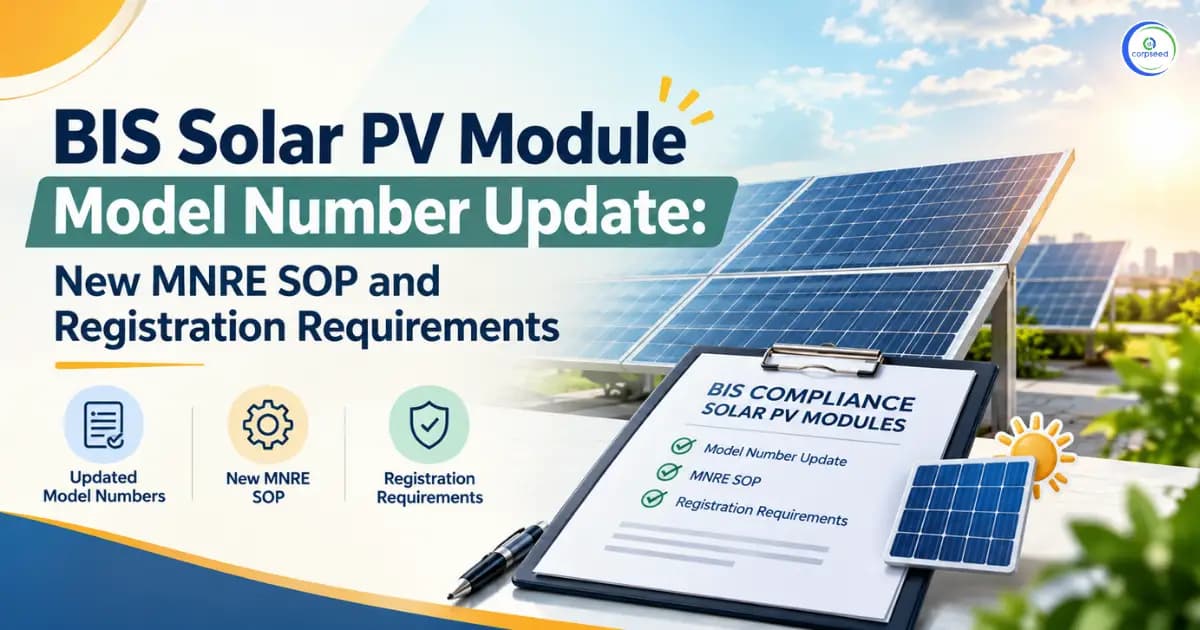
The new BIS solar PV module model number update requirements issued by the Ministry of New and Renewable Energy (MNRE) introduce a four-character country-code suffix for solar PV module models.
Schedule a Call Back
750+ BIS certification assignments since 2018
Clients include Juki India, Nibav Lifts, Normet India, Hirotec India, Kito India, Technotorc Tools, N Steels, Agromach Engineering, Emerson Automation Solutions Intelligent Platforms, Intangles Lab, Deki Electronics, Emerson Process Management (India) (12 of 450+ served since 2018).
A few more clients we've served in this industryHide the list
- Engineering and manufacturing
- Juki India · Nibav Lifts · Normet India · Hirotec India · Kito India · Technotorc Tools · N Steels · Agromach Engineering
- Electronics and technology
- Emerson Automation Solutions Intelligent Platforms · Intangles Lab · Deki Electronics · Emerson Process Management (India) · Martelx Electronics · Waites Sensor Technologies · Fleetx Technologies · Comap India
- Jewellery
- Swarnmala Jewellers · Muktavali Jewellers · Omana Jewels · Escarl Jewels · Aahaana Mooguthi · Aparna Jewels · Arraa Gold · DV Jewellery
- Pharma and healthcare
- Radimage Healthcare India · Sonova Hearing India · Agfa Healthcare India
- Energy and power
- Bitek Solar · Sodion Energy · Essar Oil and Gas Exploration and Production
- Chemicals and materials
- Sreechem Resins · Appl GOR Plastics India · Global Colours and Chemicals
- More clients
- Nilkamal · Siddhartha Logistics · GHV Medical Anchor · Geepas India · Smarthome Solutions India · Lumiere Technologies · Tegamen Safety Products · Patel Agrotech · Abbie IT Mart · Aqua Water Systems (India) · Pentair Water Treatment · WIN the BUY BOX · TNY Services (India) · Silcom (PTY) · Zeal Medical
Introduction
The format identifies the countries where the module, and solar cells are manufactured. Existing BIS-registered models must also be updated within 180 days of the Office Memorandum's issue date.
The Standard Operating Procedure (SOP) applies to solar PV module manufacturers, the Bureau of Indian Standards (BIS) and BIS-recognised or approved test laboratories. It explains how manufacturers must create additional model numbers, separate Bill of Materials (BOM) configurations based on cell-manufacturing country, and obtain revised certification documents.
The procedure also clarifies when an existing test report can be used instead of conducting fresh tests. Manufacturers should review their registered models, and approved BOMs before submitting applications for the required changes.
What Is the New MNRE SOP for BIS Solar PV Module Registration?
MNRE issued the SOP to establish a consistent method for identifying solar PV modules through their model numbers. Previously, manufacturers had flexibility in assigning model numbers because the applicable Quality Control Order and series approval guidelines did not prescribe a specific naming format.
The SOP introduces country identification as part of the model number used for BIS registration and certification.
The requirement follows the Solar Systems, Devices and Components Goods Order, 2025, notified by MNRE on 27 January, 2025. Under this Quality Control Order (QCO) covered solar PV modules must conform to the applicable Indian Standards and bear the BIS Standard Mark under the required licence.
Manufacturers should review their existing BIS registrations and approved BOMs to identify which model numbers need updating and whether the revised configurations require fresh testing.
What has changed under the new SOP?
The main changes are:
- Country-coded Model Numbers: New solar PV module registrations and inclusions must use a four-character suffix.
- Separate Numbers for Different Cell Origins: BOM configurations using cells manufactured in different countries cannot share one suffixed model number.
- Updates to Existing Registrations: Manufacturers must create corresponding country-coded model numbers for existing BIS-registered models.
- Testing Clarification: Fresh testing is not required for qualifying changes limited to deleting, restricting or separating already-approved solar cells from an existing BOM, provided no other changes requiring testing are introduced.
- Revised Certification Documents: BIS may issue a revised certificate or addendum after the applicable requirements are fulfilled.
The SOP also requires BIS and the concerned test laboratories to incorporate these directions into their registration, inclusion, testing and certification procedures.
What Is the New BIS Solar PV Module Model Number Format (MMCC)?
Under the new procedure, manufacturers must add a distinct four-character country identifier to the original or identified model number.
The prescribed format is:
Original Model Number: MMCC
Here, each pair of characters identifies a different manufacturing location.
| Code | What it represents | Requirement |
| MM | Solar PV module manufacturing country | ISO 3166-1 alpha-2 country code for the country where the module manufacturing unit is located |
| CC | Solar cell manufacturing country | ISO 3166-1 alpha-2 country code for the country where the solar cells used in that BOM are manufactured |
The four-character suffix becomes an integral part of the model number for BIS certification and subsequent identification.
How does the MMCC format work?
For a solar PV module manufactured in India using solar cells made in China, the four-character suffix would be INCN. Here, IN represents India, where the module is manufactured, and CN represents China, where the solar cells are manufactured.
The following examples illustrate the format:
| Module Manufacturing Country | Solar Cell Manufacturing Country | Illustrative Suffix |
| India | India | ININ |
| India | China | INCN |
| Vietnam | India | VNIN |
These are illustrative examples of the country-code format, not actual BIS-approved model numbers. The final model number must retain the manufacturer's original or identified model number before the suffix.
Manufacturers should verify the country codes against ISO 3166-1 alpha-2 and confirm that they reflect the actual manufacturing locations relevant to the proposed BOM.
Why must the suffix be part of the model number?
The country identifier allows the model number to distinguish between modules manufactured in different countries and modules incorporating solar cells manufactured in different countries.
The suffix must be treated as part of the complete model number, not as an optional description or a separate note. The approved number must remain consistent across the relevant registration, certification, test and product documents.
Rules for Solar Cells and Multiple BOM Configurations
The new model-number requirements directly affect manufacturers that use different solar cell sources, or maintain multiple BOM configurations under the same original model number.
A Bill of Materials identifies the components and materials used in a product configuration. For this SOP, the manufacturing country of the solar cells is particularly important because it determines the last two characters of the model-number suffix.
Different cell-manufacturing countries require separate model numbers
If a manufacturer uses cells made in different countries for the same model, each BOM must have its own model number with the matching country code.
A single country-coded model number cannot cover BOMs containing solar cells manufactured in different countries.
For example, suppose a manufacturer's existing model has two approved BOM configurations:
- One BOM uses solar cells manufactured in India.
- Another BOM uses solar cells manufactured in China.
If the module manufacturing unit is in India, the corresponding suffixes would be ININ and INCN, respectively. Each model number must be associated with the appropriate BOM.
This separation allows the approved model number to correspond to the cell-manufacturing country recorded in the BOM.
Can a model use solar cells from multiple manufacturers?
Yes. The SOP permits solar cells from more than one manufacturer under a particular model, provided all those cell manufacturers are located in the same country.
The approved BOM must clearly identify each solar cell manufacturer and the relevant cell details.
The distinction is important: the SOP does not prohibit multiple solar cell manufacturers from supplying one model. It prohibits one suffixed model number from covering BOM configurations with solar cells manufactured in different countries.
Manufacturers should therefore review their approved BOMs before assigning suffixes. The cell-manufacturing country, rather than the supplier's registered office or the location from which the cells are shipped, is the country identifier specified by the SOP.
Is Fresh Testing Required for Solar Module Model Number Updates?
Fresh testing is not required for every model-number update. Under the SOP, an existing test report can be relied upon when the change only involves deleting, restricting or separating one or more already-approved solar cells or cell variants from the existing BOM.
This exemption applies only when the change does not introduce or modify any BOM item, component, material, manufacturing process or design in a way that requires testing under the applicable guidelines.
When can the original test report be used?
A manufacturer may use the original test report when all the following conditions are met:
- The proposed model number is created by restricting, separating or deleting already-approved solar cells or cell variants from the existing BOM.
- No new component, material, design change or manufacturing-process change requiring testing is introduced.
- The revised BOM is verified by the test laboratory against the original test report.
- The revised configuration meets the applicable series approval and retesting requirements.
After satisfactory documentary verification, the test laboratory can issue a supplementary test report containing the additional model number and revised BOM. The report must refer to the original test report on which the change is based.
No fresh testing fee is charged for a supplementary report covered by this exemption, although applicable charges for marking, documentation or other relevant clauses may still apply.
When may retesting be required?
If the manufacturer adds a new BOM or introduces changes that require testing under the applicable guidelines, the testing exemption cannot automatically be applied.
The manufacturer must follow the applicable retesting guidelines, series approval guidelines and model-number identification SOP.
Practical point: A new model number does not, by itself, determine whether fresh testing is necessary. The nature of the BOM change and the test laboratory's verification are decisive.
Documents Required for BIS Solar PV Module Model Number Updates
Manufacturers applying to add or include a country-coded model number must submit the information required by the SOP to the concerned test laboratory.
The prescribed documents and details include:
| Document or Detail | Purpose |
| Original test report or reports | Provides the reference for the existing registered model and approved BOM |
| Revised BOM | Identifies the cell configuration proposed for the additional model number |
| Solar cell model number | Identifies the solar cell model used, except for thin-film solar modules |
| Solar cell manufacturer's name and address | Identifies the manufacturer supplying the cells |
| Country of solar cell manufacture | Establishes the country represented by the last two characters of the suffix |
| Manufacturer's declaration | Confirms that all solar cells covered by the particular suffixed model are manufactured in the country identified by the suffix |
The revised BOM must correspond to the proposed model number. The manufacturer should check the cell details and country of manufacture before submitting the application.
For an existing registered model, the application for the additional model number must be submitted through the existing BIS application or inclusion procedure.
What should manufacturers check before submission?
Before filing the application, manufacturers should confirm that:
- The original model number matches the existing BIS registration, and test report.
- The revised BOM clearly identifies the solar cells covered by the proposed model.
- The solar cell manufacturer details and manufacturing country are documented.
- The declaration matches the revised BOM, and the country-code suffix.
- Any changes requiring fresh testing are identified before relying on the original test report.
Accurate documentation helps the laboratory establish whether the proposed model number and BOM meet the SOP's requirements.
How Do BIS and Test Laboratories Verify Revised Model Numbers?
The SOP assigns separate responsibilities to manufacturers, test laboratories and BIS. Manufacturers prepare the application and supporting documents, test laboratories verify the proposed model and BOM, and BIS handles the applicable registration and certification decision.
Test laboratory verification
The test laboratory must check the proposed model number against the original test report and revised BOM. Its verification must establish that:
- The module manufacturing location corresponds to the first two characters of the suffix.
- The solar cell manufacturing country corresponds to the last two characters.
- The solar cells covered by the BOM are manufactured only in the country represented by the suffix.
- The revised BOM does not introduce a component, material, design or manufacturing-process change that requires testing.
Where the conditions for the testing exemption are met, the laboratory issues a supplementary test report without fresh testing. That report must identify the additional model number and reference the original report.
BIS certificate revision
Following satisfactory verification and fulfilment of the applicable requirements, BIS may issue a revised certificate, or an addendum to the existing certificate incorporating the new model number or numbers.
The addition of a model number is not complete merely because the manufacturer has prepared a revised BOM or received a supplementary test report. The applicable BIS registration and certification process must also be completed.
Manufacturers should retain the revised certification documents and check that the approved model number matches the one used in their product and technical records.
Deadline for Updating Existing BIS Solar Module Registrations
The SOP gives manufacturers of existing BIS-registered solar PV module models 180 days from the date of issue of the MNRE Office Memorandum to submit the required applications in time to complete the BIS registration process for the country-coded model numbers.
The requirement applies to existing registered models. Manufacturers should not wait until the end of the period to review their registrations, particularly if they have several BOM configurations or use cells manufactured in different countries.
What happens after the 180-day period?
With effect from 180 days after the Office Memorandum's issue date, applications for registration, inclusion or addition of solar PV module models must comply with the prescribed model-number identification mechanism.
BIS will not accept or process a new model for registration where the applicable model-number and corresponding BOM requirements have not been met.
Manufacturers should distinguish between the deadline for updating existing registered models and the requirement governing applications submitted after the 180-day period. Both are addressed by the SOP.
How should manufacturers prepare?
A practical approach is to:
- Compile the list of existing BIS-registered solar PV module models.
- Map each model to its approved BOM configurations.
- Identify the country where the module and the solar cells in each BOM are manufactured.
- Determine how many additional country-coded model numbers are required.
- Prepare the revised BOMs, supporting documents and declarations.
- Coordinate with the test laboratory and submit the required applications through the applicable BIS procedure.
The calendar deadline should be calculated from the issue date shown on the original Office Memorandum, rather than from the date a manufacturer first reads the notice. Manufacturers should also check the latest MNRE notice for any subsequent clarification or amendment.
Where Must the Revised Solar PV Module Model Number Be Declared?
The complete country-coded model number approved by BIS must be used consistently wherever the model number is required to be declared.
The SOP specifically identifies the following records and product information:
- Product label and marking, as required under the applicable series guidelines
- Test report
- BIS certificate
- Solar PV module datasheet
- Other documents in which the model number must be declared
For example, if the approved model number ends in INCN, the same complete model number must appear in the relevant documents. A manufacturer should not use the country-coded version in the BIS certificate but continue using only the original number in the datasheet or product marking where the full model number is required.
Why consistency matters
The model number connects the product to its approved BOM, test report and BIS certification. Inconsistent identifiers can make it harder to match a physical module with the corresponding registration as well as technical records.
Manufacturers should review the product label, datasheet and certification documents together after the revised model number is approved. Any related document updates should follow the applicable marking and registration requirements.
Common Mistakes to Avoid During BIS Solar Module Registration Updates
Manufacturers should pay attention to the following points when implementing the new model-number requirements.
- Using only the module manufacturing country's code
The suffix has four characters, not two. The first pair identifies the module manufacturing country, while the second pair identifies the solar panel manufacturing country.
- Keeping one model number for cells made in different countries
A single suffixed model number cannot cover BOM configurations containing cells manufactured in different countries. Separate model numbers are required for those configurations.
- Treating the supplier's location as the cell manufacturing country
The SOP identifies the country where the solar cells are manufactured. Manufacturers should verify the actual manufacturing country rather than relying solely on the supplier's address.
- Assuming every model-number change requires fresh testing
The SOP provides an exemption for qualifying changes limited to deleting, restricting or separating already-approved cells or cell variants from an existing BOM. The exemption depends on the nature of the change, and satisfactory laboratory verification.
- Applying the testing exemption to a new BOM without checking the rules
The exemption does not automatically cover a newly added BOM, or changes to components, materials, design or manufacturing processes that require testing. The applicable guidelines must be followed.
- Submitting incomplete BOM information
The proposed model number, revised BOM, cell manufacturer details, and declaration must align. Inconsistent or incomplete information can prevent the laboratory from verifying the proposed configuration.
- Updating the certificate but not the product documents
The complete approved model number must be used consistently on the product label, marking, test report, BIS certificate, datasheet and other relevant documents.
- Waiting until the deadline to begin the process
Manufacturers with several registered models should start by mapping existing registrations to their BOMs. This makes it easier to identify how many additional model numbers are needed and which configurations may qualify for the testing exemption.
How Can a BIS Certification Consultant Help Solar Module Manufacturers?
The new model-number requirements involve more than adding four letters to an existing product identifier. Manufacturers must map their registered models to the correct BOMs, verify cell-manufacturing countries, prepare declarations and follow the applicable test laboratory and BIS procedures.
A BIS certification consultant can assist manufacturers with the administrative and documentation work involved in this process.
Support may include:
- Reviewing existing BIS registrations and model-number records.
- Mapping model numbers to their approved BOM configurations.
- Checking country-code assignments against the documented manufacturing locations.
- Preparing or reviewing the documentation needed for model inclusion.
- Coordinating supplementary test-report documentation with the concerned laboratory.
- Assisting with the applicable BIS certificate revision or addendum process.
- Reviewing model-number consistency across datasheets, labels and certification records.
The scope of assistance depends on the manufacturer's existing registrations, the number of BOM configurations and whether the proposed changes require fresh testing.
Manufacturers should confirm the applicable requirements with BIS and the concerned test laboratory before submitting an application. A consultant can help organise the process, but the required verification and approval remain subject to the applicable regulatory procedure.
If your organisation needs help reviewing its solar PV module registrations, consult BIS certification experts to assess the applicable documentation and model-number update requirements.
Conclusion
The MNRE SOP introduces a country-coded model-number format for solar PV modules registered with BIS. Under the MMCC system, the first two characters identify the module manufacturing country and the next two identify the solar cell manufacturing country.
Manufacturers must assign separate model numbers when solar cells in the BOM come from different countries. Existing BIS registrations must be updated within 180 days of the MNRE Office Memorandum. If the change only involves removing or separating already-approved cells, the existing test report can be used after the test laboratory checks the revised BOM.
The immediate task for manufacturers is to review their registered models, map the corresponding BOMs, prepare the required declarations and coordinate with the test laboratory and BIS. The complete approved model number must then be used consistently across the relevant product and certification documents.
About the Author

Parul Bohral
Legal Content WriterParul Bohral, a BALLB graduate and experienced legal researcher and content writer with expertise in various legal areas, including corporate law and intellectual property. I have gained valuable experience in esteemed legal environments, where I have strengthened my research skills, allowing me to approach legal writing with precision and depth.
As a legal content writer, I am committed to delivering work that not only informs but also engages readers. By staying informed about the latest trends in content marketing and regulatory developments, I ensure that my writing remains sophisticated and meets industry standards. My dedication to thorough research enables me to craft content that is both insightful and impactful.
Related articles

BIS Hallmarking Centre Setup Scheme 2026-31
2026-11-02
BIS Establishes Three New Indian Standards for Electric Cycles, Therapeutic Footwear and EV Charging Cables
2026-10-19
Importing Toys into India: BIS Toy Certification & Battery EPR Requirements
2026-10-19
BIS Notifies 33 New and Revised Indian Standards in October 2026: Compliance Guide
2026-10-16

BIS Certification for Electrical Appliances: 2026 Guide for Manufacturers & Importers
2026-10-14

BIS Certification for Aluminium Utensils: October 2026 Compliance Guide for Importers
2026-10-09