
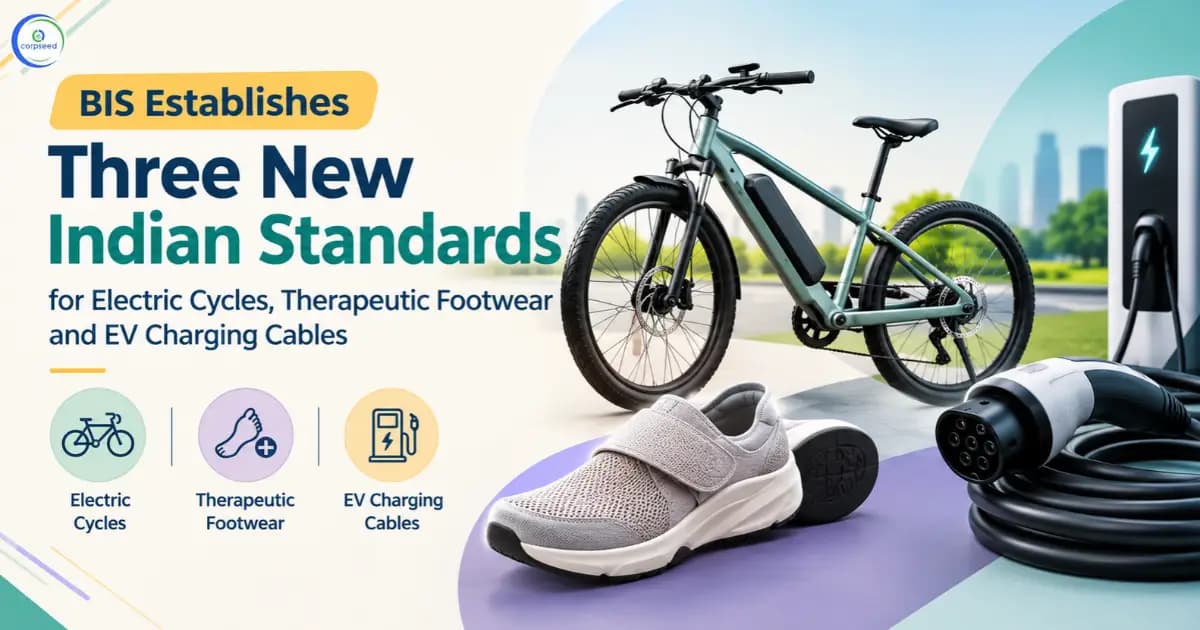
BIS Establishes Three New Indian Standards for Electric Cycles, Therapeutic Footwear and EV Charging Cables
The Bureau of Indian Standards (BIS) established three new Indian Standards on 14 October 2026 for pedal-assisted bicycles (IS 19891:2026), therapeutic footwear (IS 19956:2026) and electric vehicle charging cables (IS 19967:2026).
Schedule a Call Back
750+ BIS certification assignments since 2018
Clients include Juki India, Nibav Lifts, Normet India, Hirotec India, Kito India, Technotorc Tools, N Steels, Agromach Engineering, Emerson Automation Solutions Intelligent Platforms, Intangles Lab, Deki Electronics, Emerson Process Management (India) (12 of 450+ served since 2018).
A few more clients we've served in this industryHide the list
- Engineering and manufacturing
- Juki India · Nibav Lifts · Normet India · Hirotec India · Kito India · Technotorc Tools · N Steels · Agromach Engineering
- Electronics and technology
- Emerson Automation Solutions Intelligent Platforms · Intangles Lab · Deki Electronics · Emerson Process Management (India) · Martelx Electronics · Waites Sensor Technologies · Fleetx Technologies · Comap India
- Jewellery
- Swarnmala Jewellers · Muktavali Jewellers · Omana Jewels · Escarl Jewels · Aahaana Mooguthi · Aparna Jewels · Arraa Gold · DV Jewellery
- Pharma and healthcare
- Radimage Healthcare India · Sonova Hearing India · Agfa Healthcare India
- Energy and power
- Bitek Solar · Sodion Energy · Essar Oil and Gas Exploration and Production
- Chemicals and materials
- Sreechem Resins · Appl GOR Plastics India · Global Colours and Chemicals
- More clients
- Nilkamal · Siddhartha Logistics · GHV Medical Anchor · Geepas India · Smarthome Solutions India · Lumiere Technologies · Tegamen Safety Products · Patel Agrotech · Abbie IT Mart · Aqua Water Systems (India) · Pentair Water Treatment · WIN the BUY BOX · TNY Services (India) · Silcom (PTY) · Zeal Medical
Introduction
Issued under Rule 15(1) of the Bureau of Indian Standards Rules, 2018, the notification establishes these standards but does not, by itself, make BIS certification mandatory.
Manufacturers, importers and suppliers should check the full standards and applicable Quality Control Orders (QCOs) to determine the requirements for their products.
Key Details of the BIS Notification Issued in October 2026
The BIS notification lists three new standards for pedal-assisted bicycles, therapeutic footwear and EV charging cables. All three came into effect as established Indian Standards on 14 October 2026.
| IS Number | Standard Title | Establishment Date |
| IS 19891:2026 | Cycles- Electrically Power Assisted Cycles (EPAC), Part 1: Pedal-Assisted Bicycles | 14 October 2026 |
| IS 19956:2026 | Therapeutic Footwear- Specification | 14 October 2026 |
| IS 19967:2026 | Charging Cables for Electric Vehicles | 14 October 2026 |
The schedule does not identify any earlier standards for withdrawal against these entries. It also does not specify a separate implementation deadline or declare that certification under these standards is compulsory.
IS 19891:2026: Standard for Electrically Power Assisted Cycles
IS 19891:2026 covers electrically power assisted cycles, specifically pedal-assisted bicycles under Part 1 of the standard.
Pedal-assisted bicycles combine conventional cycling with electric assistance. Their design and electrical systems raise product-specific considerations that manufacturers need to examine when assessing safety and performance.
The standard is relevant to manufacturers and suppliers working with electrically assisted cycles. Businesses should consult the complete standard to understand its scope, technical specifications and testing requirements rather than relying on the title alone.
Before introducing a product into the Indian market, manufacturers and importers should also check whether any separate regulatory requirement applies to the particular model.
IS 19956:2026: Standard for Therapeutic Footwear
IS 19956:2026 establishes a specification for therapeutic footwear. BIS recorded its establishment date as 14 October 2026.
Therapeutic footwear is a specialised product category, and the applicable specifications should be checked against the complete Indian Standard. The notification provides the standard's title but does not reproduce its detailed technical requirements.
Footwear manufacturers, suppliers and importers dealing in this category should review the official document to identify the products covered and understand the requirements relevant to their operations.
They should avoid assuming that every type of footwear falls within the scope of this standard. The actual coverage must be determined from the published document.
IS 19967:2026: Standard for Electric Vehicle Charging Cables
IS 19967:2026 covers charging cables for electric vehicles with rated voltages up to and including 1,100 V AC or up to and including 1,500 V DC.
The standard is relevant to manufacturers and suppliers of EV charging cables within its stated scope. Businesses should examine the complete document to understand the applicable construction, performance and testing provisions.
The establishment of this standard gives businesses a specific Indian Standard reference to consult when reviewing the requirements for relevant charging cables. However, the voltage limits in its title should not be treated as a complete description of all technical requirements.
Importers should also verify whether the particular cable they intend to supply is subject to any separate compulsory certification or other legal requirement.
Why Are the New BIS Standards Important?
The three new Indian Standards cover different product categories, from pedal-assisted bicycles to therapeutic footwear and EV charging cables. For businesses working with these products, the standards provide a reference for checking the specifications applicable to their product category.
Their importance lies in having a defined Indian Standard that manufacturers and other stakeholders can consult when reviewing product requirements. However, the actual technical provisions, and their application depend on the full text of each standard.
What Are the Benefits of These New Indian Standards?
The three new Indian Standards give manufacturers, importers and suppliers a reference for reviewing product specifications and discussing requirements with buyers and suppliers. They can be useful during product development, sourcing and internal product reviews.
- Clearer product requirements: Businesses can refer to the relevant standard to understand the specifications applicable to products within its scope.
- Better communication with buyers: Manufacturers and suppliers can use the same standard when discussing product specifications and customer expectations.
- Support for product development: Manufacturers can consult the relevant standard when planning product designs, and specifications.
- Informed sourcing decisions: Importers and buyers can refer to the standard when discussing product requirements with suppliers and evaluating products for purchase.
The benefits depend on how the standards apply to the products concerned. Their establishment alone does not make BIS certification compulsory.
Are the Three New BIS Standards Voluntary or Mandatory?
The distinction between an Indian Standard and mandatory BIS certification is important.
BIS states that its certification scheme is generally voluntary. However, the Central Government can make compliance compulsory for specified products through Quality Control Orders (QCOs) or other applicable legal requirements.
The October 2026 notification, establishes IS 19891:2026, IS 19956:2026 and IS 19967:2026. It does not, by itself, state that businesses must obtain BIS certification for all products covered by these standards.
Businesses should verify the current position for each product category before deciding whether certification is necessary. A standard may be available for voluntary adoption while a separate order may impose compulsory requirements on a specified product.
The relevant checks include:
- Whether the product falls within the scope of an applicable QCO.
- Whether the order is currently in force, or has a future implementation date.
- Whether any exemption or special provision applies.
- Whether the required conformity assessment involves a BIS licence, Certificate of Conformity or another approval route.
The current status should be confirmed through official BIS records and the relevant government notification.
Impact of the New BIS Standards on Manufacturers and Importers
The establishment of these three Indian Standards gives manufacturers, importers and suppliers new product-specific references to review. The impact on each business will depend on the products it handles and whether any separate certification requirement applies.
- Product specifications: Manufacturers can review the relevant standard to understand the specifications applicable to their products.
- Quality checks: Businesses can refer to the published standards when assessing their existing product quality and testing procedures, where relevant.
- Import requirements: Importers can check whether their products fall within the scope of any applicable Quality Control Order (QCO) or other mandatory requirement.
- Certification planning: Businesses can determine whether BIS certification is voluntary or compulsory for their specific products before starting an application.
- Supplier coordination: Manufacturers and suppliers can review the relevant specifications together to clarify product requirements.
- Compliance costs and timelines: If a separate mandatory requirement applies, businesses may need to account for applicable testing, documentation and certification timelines. The new standards notification alone does not establish any additional cost or deadline.
What Should Manufacturers and Importers Do After the New Standards?
Businesses dealing with pedal-assisted bicycles, therapeutic footwear or EV charging cables can take a few practical steps.
- Identify the Applicable Standard: Match the product with its correct IS number and review the scope of the published document.
- Check the Certification Requirement: Search the latest compulsory certification lists and relevant QCOs. Do not assume that the establishment of a new standard automatically creates a mandatory certification obligation.
- Review Technical Requirements: Obtain the full standard to understand the specifications and testing provisions applicable to the product.
- Check for Later Notifications: Regulatory requirements can change. Businesses should review subsequent amendments, implementation dates and product-specific directions before finalising compliance plans.
- Maintain Supporting Records: Keep relevant standards, regulatory references, test reports and certification documents where applicable.
These checks are particularly useful for businesses planning to launch new products, source components from overseas or review their existing product compliance procedures.
When Should You Consult a BIS Certification Consultant?
Businesses that are unsure about the requirements for a particular product can consult a BIS certification consultant to assess the applicable standard, check whether a QCO applies and identify the relevant certification procedure.
This can be useful for manufacturers and importers who need to distinguish between voluntary adoption of a standard and a compulsory legal requirement. A product-specific assessment can also help identify the documentation and testing requirements that may apply.
However, the need for certification depends on the applicable rules and orders. Businesses should confirm the regulatory position before beginning an application, or making changes to their compliance process.
How Can Businesses Check the Latest BIS Standards?
The official BIS website provides a facility called Know Your Standard, where users can search by an Indian Standard number or product keyword.
Businesses can use this facility to look up:
- IS 19891:2026 for pedal-assisted bicycles.
- IS 19956:2026 for therapeutic footwear.
- IS 19967:2026 for EV charging cables.
The portal also provides access to available standard documents, amendments, Gazette notifications and other standard-related information.
Businesses should additionally review the official list of products under compulsory certification to determine whether their products are subject to mandatory requirements.
Conclusion
BIS established three new Indian Standards on 14 October 2026 covering pedal-assisted bicycles, therapeutic footwear and EV charging cables. The notification records the establishment of these standards but does not, by itself, make certification compulsory. Manufacturers, importers and suppliers should review the relevant documents and verify the latest regulatory position before deciding what compliance steps are required.
About the Author

Parul Bohral
Legal Content WriterParul Bohral, a BALLB graduate and experienced legal researcher and content writer with expertise in various legal areas, including corporate law and intellectual property. I have gained valuable experience in esteemed legal environments, where I have strengthened my research skills, allowing me to approach legal writing with precision and depth.
As a legal content writer, I am committed to delivering work that not only informs but also engages readers. By staying informed about the latest trends in content marketing and regulatory developments, I ensure that my writing remains sophisticated and meets industry standards. My dedication to thorough research enables me to craft content that is both insightful and impactful.
Related articles
BIS Hallmarking Centre Setup Scheme 2026-31
2026-11-02
Importing Toys into India: BIS Toy Certification & Battery EPR Requirements
2026-10-19
BIS Notifies 33 New and Revised Indian Standards in October 2026: Compliance Guide
2026-10-16
BIS Certification for Electrical Appliances: 2026 Guide for Manufacturers & Importers
2026-10-14
BIS Solar PV Module Model Number Update: New MNRE SOP and Registration Requirements
2026-10-09
BIS Certification for Aluminium Utensils: October 2026 Compliance Guide for Importers
2026-10-09