
BIS Certification for Electrical Appliances: 2026 Guide for Manufacturers & Importers
Yes, BIS certification is mandatory for those electrical products that fall under a QCO. But certification depends on the type of product and also on the Indian standard. Under the 2026 QCO, covered household, commercial and similar electrical appliances must comply with IS 302 (Part 1):2024 / IEC 60335-1:2020 and bear the BIS Standard Mark under a valid licence.
Schedule a Call Back
750+ BIS certification assignments since 2018
Clients include Juki India, Nibav Lifts, Normet India, Hirotec India, Kito India, Technotorc Tools, N Steels, Agromach Engineering, Emerson Automation Solutions Intelligent Platforms, Intangles Lab, Deki Electronics, Emerson Process Management (India) (12 of 450+ served since 2018).
A few more clients we've served in this industryHide the list
- Engineering and manufacturing
- Juki India · Nibav Lifts · Normet India · Hirotec India · Kito India · Technotorc Tools · N Steels · Agromach Engineering
- Electronics and technology
- Emerson Automation Solutions Intelligent Platforms · Intangles Lab · Deki Electronics · Emerson Process Management (India) · Martelx Electronics · Waites Sensor Technologies · Fleetx Technologies · Comap India
- Jewellery
- Swarnmala Jewellers · Muktavali Jewellers · Omana Jewels · Escarl Jewels · Aahaana Mooguthi · Aparna Jewels · Arraa Gold · DV Jewellery
- Pharma and healthcare
- Radimage Healthcare India · Sonova Hearing India · Agfa Healthcare India
- Energy and power
- Bitek Solar · Sodion Energy · Essar Oil and Gas Exploration and Production
- Chemicals and materials
- Sreechem Resins · Appl GOR Plastics India · Global Colours and Chemicals
- More clients
- Nilkamal · Siddhartha Logistics · GHV Medical Anchor · Geepas India · Smarthome Solutions India · Lumiere Technologies · Tegamen Safety Products · Patel Agrotech · Abbie IT Mart · Aqua Water Systems (India) · Pentair Water Treatment · WIN the BUY BOX · TNY Services (India) · Silcom (PTY) · Zeal Medical
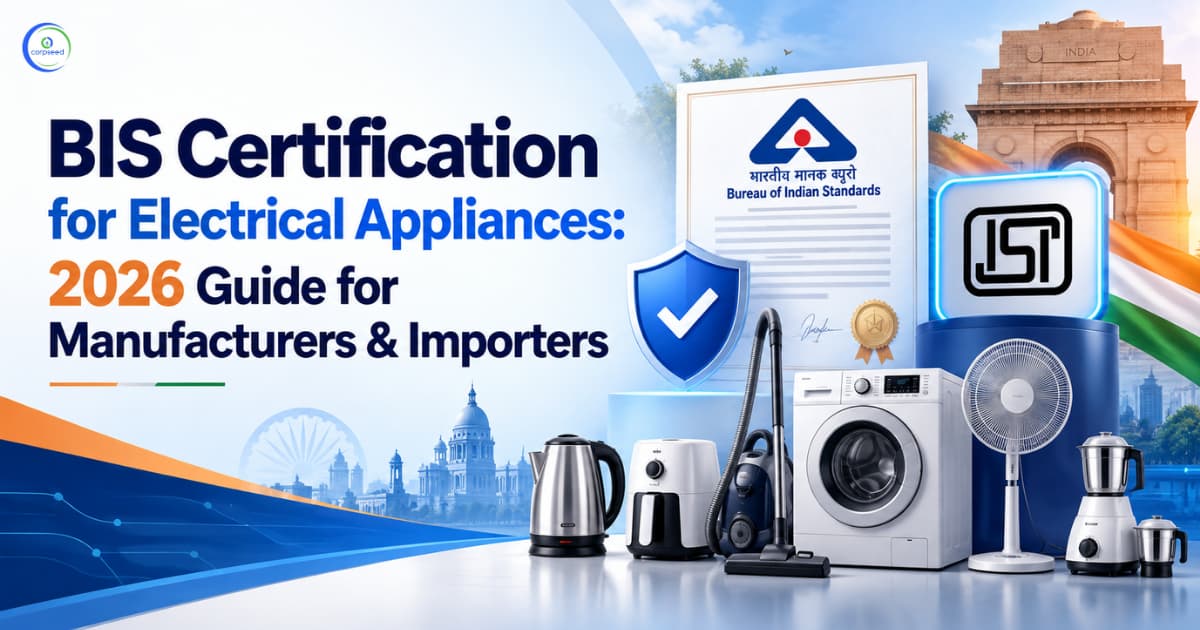
Manufacturing electrical appliances or importing them to India? Your product may be perfect to enter the market, but without the BIS certificate, you may face compliance issues.
India has updated its electrical appliance requirements under the Safety of Household, Commercial and Similar Electrical Appliances (Quality Control) Order, 2026. The first implementation date has already passed, so businesses should review their obligations.
However, not all electrical appliances follow the same certification rules. Some products are covered under separate mandatory requirements.
Here's what manufacturers and importers should know about BIS certification for electrical appliances in India in 2026.
Schedule a Call Back
Is BIS Certification Mandatory for Electrical Appliances in India in 2026?
Yes, BIS certification is mandatory for those electrical products that fall under a QCO. But certification depends on the type of product and also on the Indian standard.
Under the 2026 QCO, covered household, commercial and similar electrical appliances must comply with IS 302 (Part 1):2024 / IEC 60335-1:2020 and bear the BIS Standard Mark under a valid licence.
The order covers appliances with rated voltages not exceeding:
- 250 V for single-phase appliances.
- 480 V for other appliances.
Applicable DC-powered and battery-operated appliances are also included.
Products already regulated under another mandatory BIS notification or QCO are excluded from this particular order. However, they may still require separate certification or registration.
This is why manufacturers and importers must check the exact product requirements rather than assuming every appliance needs the same certificate.
Electrical Appliances QCO 2026: What Has Changed for Manufacturers and Importers?
The Department for Promotion of Industry and Internal Trade (DPIIT) issued the Safety of Household, Commercial and Similar Electrical Appliances (Quality Control) Order, 2026, through notification S.O. 1739(E), dated 6 April 2026.
The new order superseded the 2025 QCO and revised the implementation dates.
Latest BIS Implementation Deadlines
| Enterprise category | Implementation date |
| General enterprises | 1 October 2026 |
| Small enterprises | 1 January 2027 |
| Micro enterprises | 1 April 2027 |
October 2026 is the period that has become effective for the general implementation period.
Are There Any Exemptions?
The Electrical Appliances QCO 2026 provides conditional exemptions from mandatory BIS certification for:
- Domestically manufactured electrical appliances intended for export.
- Imports of up to 200 units per year for research and development (R&D), subject to specified conditions.
- Qualifying pre-implementation stock of electrical appliances, which may be sold under certain conditions.
In addition, the Transition Facilitation (Quality Control) Order, 2026 provides an alternative BIS certification arrangement for eligible manufacturers, subject to specified conditions.
Businesses should verify their eligibility before relying on any exemption or transitional provision.
Which Electrical Appliances Come Under Mandatory BIS Certification?
The 2026 QCO covers household, commercial and similar electrical appliances used for cleaning, heating, cooking, personal care and other purposes.
However, the applicable BIS requirements depend on the exact product. Some appliances are covered under separate QCOs or the Compulsory Registration Scheme (CRS).
Electrical Appliances and Relevant BIS Requirements
| Electrical appliance | Relevant BIS requirement |
| Vacuum cleaners | Broad electrical appliances QCO 2026 |
| Electric kettles | Heating-liquid appliance category under the 2026 QCO |
| Electric shavers and hair clippers | Broad electrical appliances QCO 2026 |
| Microwave ovens | Separate BIS CRS requirements |
| Electric fans | Separate electrical appliance fans QCO |
| Domestic washing machines | Separate domestic clothes washing QCO |
These are illustrative examples, not a complete list of regulated appliances.
Manufacturers should check the product's specifications, applicable Indian Standard and relevant notification before choosing a certification route.
A BIS licence for one appliance, model or manufacturing unit should not be assumed to cover every product offered by the same business.
What Is IS 302 (Part 1):2024 and Why Does It Matter?
IS 302 (Part 1):2024 / IEC 60335-1:2020 specifies general safety requirements for household and similar electrical appliances.
It addresses risks relating to electrical safety, appliance construction and safe operation.
For manufacturers, compliance involves meeting the relevant technical requirements and obtaining the applicable BIS licence before using the Standard Mark.
Certain appliances may also have product-specific standards with additional safety requirements.
For example, an electric kettle and a vacuum cleaner perform different functions and may need different safety assessments.
Checking the correct standards early can help manufacturers prepare their appliances for testing and certification.
BIS ISI vs CRS: Which Certification Applies to Electrical Appliances?
BIS has different conformity assessment arrangements. The correct route depends on the appliance and its governing notification.
| Route | What it means |
| Scheme-I (ISI Mark) | BIS certification under a Standard Mark licence |
| CRS (Scheme-II) | Compulsory registration for specified electronic and IT products |
| FMCS | Certification arrangement for eligible foreign manufacturers seeking a BIS Standard Mark licence |
QCO for electrical appliances in April 2026 needs certification based on Scheme-I.
Scheme-II is an exceptional scheme available as per the 2026 Transition Facilitation Order, which has different eligibility requirements and cannot be considered as CRS registration.
ISI certification and CRS registration are not interchangeable. Businesses must confirm which requirements apply to their products.
What Should Manufacturers and Importers Do to Meet BIS Requirements?
Before manufacturing, importing or selling electrical appliances, businesses should complete a few essential compliance checks.
- Identify the appliance: Check its category, intended use and rated voltage.
- Applicable QCO Check: Verify whether the Electrical Appliances QCO 2026 or a separate mandatory BIS notification applies to the product.
- Verification of Indian Standards: Identify the relevant general and product-specific BIS safety standards for electrical appliances.
- Check for BIS Certification: Confirm whether the manufacturing facility holds a valid BIS licence for the electrical appliances.
- Testing Verification: Ensure the appliance meets the applicable BIS testing and conformity assessment requirements for electrical products.
- Check markings and records: Verify the authorised BIS marking and supporting compliance documents.
What Should Importers Check Before Shipping?
Importers should confirm that their overseas manufacturer's BIS certification covers the relevant manufacturing unit and product.
BIS certification for electrical appliances might be required for foreign manufacturers under the Foreign Manufacturers Certification Scheme (FMCS), depending on the applicable requirements.
An international safety certificate is not a substitute for mandatory BIS certification in India.
Such BIS compliance checks before shipment can help importers avoid potential customs clearance and regulatory issues.
What Happens If Electrical Appliances Are Sold Without Mandatory BIS Certification?
Manufacturing, importing or selling regulated appliances without meeting applicable BIS requirements can create legal and commercial problems.
Depending on the circumstances, businesses may face:
- Regulatory action for non-compliance.
- Restrictions on selling or distributing regulated products.
- Customs-clearance difficulties.
- Penalties under applicable provisions of the BIS Act, 2016.
The penalties will depend on the type of offense and applicable laws.
Companies must accordingly be sure about the certification requirements for bringing regulated devices to India’s market.
Common BIS Compliance Mistakes Manufacturers and Importers Should Avoid
Several problems arise when businesses assume every electrical appliance follows the same BIS rules.
Common mistakes include:
- Wrong Indian Standard selection.
- Following the wrong QCO or deadline.
- Ignoring the product-specific certification requirements.
- Bringing in appliances without checking the foreign manufacturer’s BIS license.
- Assuming certification of one model automatically covers other models or factories.
These mistakes can lead to avoidable testing, documentation and supply difficulties.
Reviewing the applicable requirements before manufacturing or importing is a sensible first step.
How Can Corpseed Help with BIS Compliance for Electrical Appliances?
Not sure which BIS requirements apply to your electrical appliance? Different product categories, Indian Standards and certification rules can make compliance difficult.
Corpseed provides BIS certification services to assist manufacturers and importers with understanding applicable standards, documentation and certification procedures.
Are you planning to manufacture or import electrical appliances in India? Contact Corpseed to understand the BIS requirements for your product.
Conclusion
BIS certification for electrical appliances is an important requirement for manufacturers and importers dealing with products covered by mandatory Indian Standards. With the 2026 Quality Control Order already effective for general enterprises, businesses must check their product category, applicable standards and certification obligations before supplying appliances in India. Small and micro enterprises should also prepare for their respective implementation dates.
Checking these requirements early can help prevent documentation issues, import difficulties and compliance violations. Businesses should remember that different appliances may fall under separate BIS certification schemes. Corpseed provides BIS certification services to assist you in learning about the relevant requirements for your product. Contact Corpseed for guidance on your electrical appliance certification requirements.
About the Author

Mahek Sancheti
Content WriterMahek Sancheti, BAJMC graduate with a deep passion for writing. As a content writer, video content creator, creative content creator, and scriptwriter, I bring stories to life through words and visuals. I honed my skills by working with a prominent news agency, where I excelled in crafting compelling narratives and engaging content. Coming from a journalism and mass communication background I have skills to craft engaging narratives that captivate audiences. With a keen interest in writing and creativity, I aim to deliver impactful and meaningful content that resonates with diverse audiences.
https://www.linkedin.com/in/mahek-sancheti-837196212
Related articles
BIS Hallmarking Centre Setup Scheme 2026-31
2026-11-02
BIS Establishes Three New Indian Standards for Electric Cycles, Therapeutic Footwear and EV Charging Cables
2026-10-19
Importing Toys into India: BIS Toy Certification & Battery EPR Requirements
2026-10-19
BIS Notifies 33 New and Revised Indian Standards in October 2026: Compliance Guide
2026-10-16
BIS Solar PV Module Model Number Update: New MNRE SOP and Registration Requirements
2026-10-09
BIS Certification for Aluminium Utensils: October 2026 Compliance Guide for Importers
2026-10-09