
MPCB Orders Stop-Work at Adani's Tarali Pumped Storage Project in Satara Over Environmental Clearance Concerns
MPCB orders a halt to Adani's Tarali project excavation in Satara. Understand the November 2026 stop-work notice, EC, CTE and compliance requirements.
Schedule a Call Back
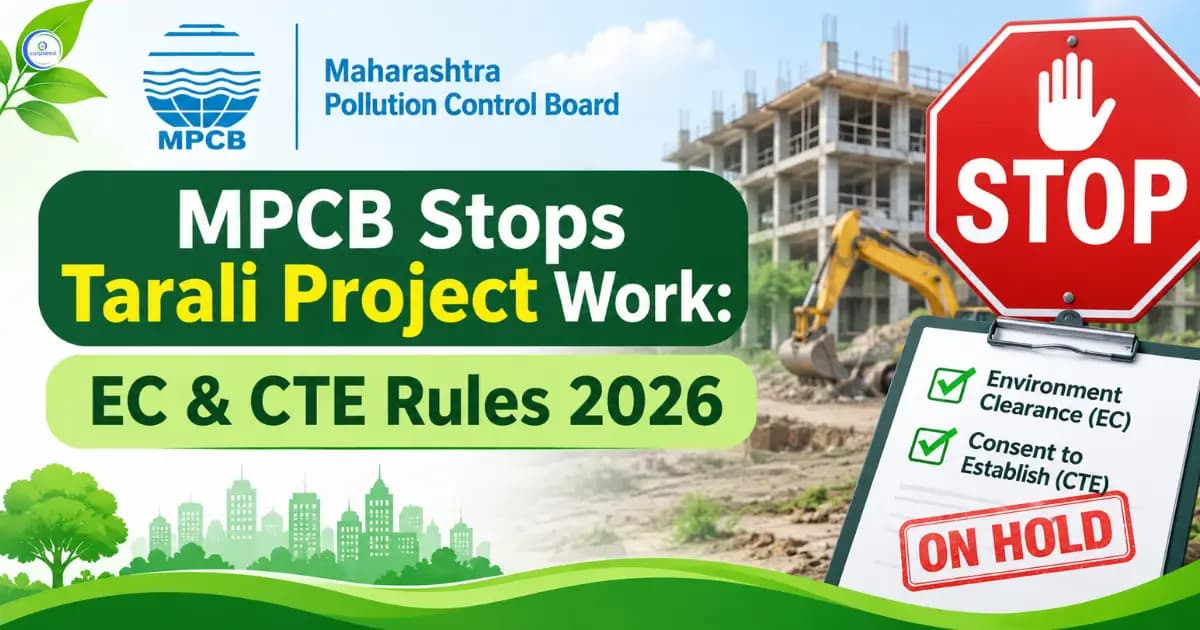
The Maharashtra Pollution Control Board (MPCB) has issued a stop-work direction concerning excavation and construction activities associated with Adani Green Energy Limited's 1,500 MW Tarali Pumped Storage Project in Satara, Maharashtra. The direction, dated 20 November 2026, follows an inspection of temporary construction-support facilities at Sawarghar village in Patan taluka.
According to the reported MPCB stop-work order, excavation and development work at Gat Nos. 33 and 34 had commenced without the necessary intimation, consent or permissions from the Board. The regulator also raised concerns about environmental clearance for the identified activities. The company has been directed to stop the affected work and obtain prior permission from MPCB before resuming it.
Adani Green Energy has maintained that the permanent components of the Tarali project have the required statutory approvals and that the affected land parcels are being used for temporary facilities already considered in the Central Electricity Authority-approved layout.
The development has brought renewed attention to MPCB environmental compliance, Environmental Clearance, Consent to Establish (CTE), and pollution-control permissions for infrastructure and renewable energy projects. It highlights why companies must verify the scope of their environmental approvals before beginning excavation, construction or additional site-development activities.
MPCB Stop-Work Order for Tarali Project at a Glance
| Particulars | Details |
|---|---|
| Regulatory authority | Maharashtra Pollution Control Board (MPCB) |
| Regional office | MPCB, Pune |
| Date of direction | 20 November 2026 |
| Issuing officer | Kiran Hasabnis, Regional Officer |
| Company | Adani Renewable Energy One Limited, a subsidiary of Adani Green Energy Limited |
| Project name | Tarali Pumped Storage Project |
| Project capacity | 1,500 MW |
| Project location | Patan taluka, Satara district, Maharashtra |
| Affected location | Sawarghar village |
| Land parcels identified | Gat Nos. 33 and 34 |
| Activities under scrutiny | Excavation, development, temporary labour camp and material storage |
| Reported non-compliance | Activities allegedly undertaken without necessary MPCB permissions and environmental-clearance coverage |
| Principal legislation | Water Act, 1974 and Air Act, 1981 |
| Enforcement provisions | Section 33A of the Water Act and Section 31A of the Air Act |
| Existing project consent | Consent to Establish issued on 7 April 2025 |
| Earlier related action | Forest Department stop-work direction dated 13 November 2026 |
| Immediate requirement | Stop the specified activities and obtain prior MPCB permission before resuming |
| Status as of 23 November 2026 | Stop-work direction reported no subsequent withdrawal independently verified |
| Businesses concerned | Infrastructure developers, renewable energy companies, EPC contractors and industrial project proponents |
Important: This is a project-specific MPCB enforcement action. It is not a new environmental notification imposing additional approval requirements on every business in Maharashtra.
What Happened at Adani's Tarali Pumped Storage Project in Satara?
The latest MPCB action concerns excavation and development work undertaken at Sawarghar village for temporary facilities supporting the Tarali Pumped Storage Project.
On 20 November 2026, MPCB officials inspected the affected site. The inspection reportedly identified excavation activities at Gat Nos. 33 and 34, where arrangements for a temporary labour camp and storage facilities were being developed.
Following the inspection, the Satara sub-regional office submitted a proposal for regulatory action. The Board raised concerns about whether the work had been undertaken with the necessary environmental permissions and whether the activities were covered by the project's existing approvals.
According to the reported direction, MPCB identified two principal issues:
- Excavation and development activities had commenced without the required intimation or consent from the Board.
- The necessary Environmental Clearance for the activities under inspection had not been obtained or demonstrated to the regulator's satisfaction.
MPCB subsequently instructed the company to stop the affected excavation and construction activities.
The reported MPCB stop-work notice in Maharashtra also states that the company must not resume the specified activities without prior permission from the Board.
Failure to comply could result in further action under the Water (Prevention and Control of Pollution) Act, 1974, and the Air (Prevention and Control of Pollution) Act, 1981.
The direction should not be interpreted as cancellation of every statutory approval for the 1,500 MW project. The immediate dispute concerns the identified Sawarghar activities and their approval status.
What Is the Tarali Pumped Storage Project in Maharashtra?
The Tarali Pumped Storage Project is a proposed 1,500 MW energy storage development associated with the Tarali dam reservoir in Satara district. The project is reported to cover approximately 150.74 hectares of non-forest land across Nivade, Tondoshi, Kalambe and Jalu villages in Patan taluka. It is being developed to provide energy storage capacity that can help manage electricity demand and improve the integration of renewable power into the grid.
How Does a Pumped Storage Project Work?
- A pumped storage project operates by transferring water between reservoirs at different elevations.
- When electricity is available for storage, pumps move water to an upper reservoir. During periods of higher demand, the stored water is released through turbines to generate electricity.
- This makes pumped storage an important technology for supporting solar and wind power generation.
- However, these projects often involve substantial excavation, tunnels, access roads, water infrastructure and temporary construction facilities.
- Consequently, environmental clearance requirements for pumped storage projects must be examined across both construction and operational activities.
- For the Tarali project, the overall estimated investment reported in its Environmental Clearance documentation is approximately Rs. 5,675 crores.
Environmental Approvals Already Reported for the Project
Adani Green Energy has stated that the project received:
- A no-forest-land NOC on 23 January 2024.
- Environmental Clearance on 11 February 2025.
- MPCB Consent to Establish on 7 April 2025.
MPCB's official Consent Appraisal Committee records confirm that the Tarali Pumped Storage Project received Consent to Establish on 7 April 2025 under application number MPCB-CONSENT-0000222077. The recorded validity was until commissioning of the project or five years, whichever occurs earlier, subject to the applicable consent conditions.
The existence of these approvals is central to the dispute. The issue now is whether the additional excavation and temporary facilities at Sawarghar are adequately covered by the existing permission framework.
Timeline of the Tarali Project Environmental Compliance Dispute
| Date | Regulatory development |
|---|---|
| 23 January 2024 | Company reports receiving a no-forest-land NOC |
| 11 February 2025 | Environmental Clearance granted for the project, according to company statements and reported records |
| 7 April 2025 | MPCB issues Consent to Establish for the 1,500 MW project |
| 8 September 2026 | Company submits an affidavit concerning project-cost figures |
| 12 October 2026 | Forest authorities reportedly accept a revised cost figure for a wildlife-related proposal |
| 30 October 2026 | Wildlife-related complaint submitted concerning project-cost representations |
| 6 November 2026 | Union Environment Ministry reportedly directs the state to investigate the complaint |
| 13 November 2026 | Maharashtra Forest Department issues a stop-work direction concerning wildlife approval |
| 17 November 2026 | Forest Minister meets company representatives regarding the regulatory issues |
| 19 November 2026 | Complaint concerning Sawarghar excavation is submitted to MPCB |
| 20 November 2026 | MPCB inspects the site and issues a stop-work direction |
| 21–22 November 2026 | Media reports the MPCB direction and the company's response |
The timeline shows that the Tarali project is facing scrutiny from different authorities over separate regulatory issues. The November 13 Forest Department direction relates primarily to wildlife-clearance requirements, while the November 20 MPCB action concerns excavation, construction and pollution-control permissions.
Why Did MPCB Issue the Stop-Work Direction?
The MPCB enforcement action raises questions about the relationship between approved project activities and additional construction-support facilities.
Excavation Without Necessary MPCB Permissions
The Board reportedly identified excavation and development activities at Sawarghar that had commenced without the required intimation or permission. For large infrastructure projects, the scope of an existing MPCB CTE approval must be examined carefully. An approval granted for a particular project does not necessarily authorise every additional land parcel or subsequent activity.
Where project developers introduce new sites, storage yards or supporting facilities, they should determine whether an MPCB consent amendment, additional permission or written clarification is required. The requirement depends on the approved project scope, nature of the proposed activity and applicable consent conditions.
Environmental Clearance Coverage of Additional Facilities
MPCB also questioned the environmental-clearance status of the excavation and development work. The company has stated that the project already holds Environmental Clearance and that the affected land parcels are included in the approved construction layout.
However, Environmental Clearance and technical layout approval serve different purposes. An approved engineering layout does not automatically establish compliance with every environmental condition.
Similarly, the existence of an Environmental Clearance does not eliminate the need to examine whether changes to project facilities are permitted under the original approval. Whether an additional facility requires a separate or amended approval must be determined from the applicable rules and project-specific conditions.
Construction-Stage Pollution Control
Excavation and site-development work can create environmental impacts before a project becomes operational.
- Depending on site conditions, these activities may involve:
- Dust emissions from excavation and vehicle movement.
- Soil erosion and surface-water runoff.
- Movement and disposal of excavated material.
- Wastewater generation from labour accommodation.
- Construction noise and machinery emissions.
- Storage of fuel, oil and other regulated materials.
- Construction and demolition waste management.
The Board's reported communication also referred to the obligation to maintain effective air- and water-pollution control measures. These are potential environmental risks associated with such activities. The available reporting does not establish that every listed form of pollution actually occurred at Sawarghar.
What Has Adani Green Energy Said About the MPCB Notice?
Adani Green Energy has disputed the suggestion that the permanent project components lack statutory approvals. According to the company's statement, the MPCB direction specifically concerns Gat Nos. 33 and 34 in Sawarghar village. These parcels are intended for temporary construction-support arrangements and are not part of the project's permanent facilities.
The company has stated that:
- The land parcels were privately acquired.
- The temporary facilities were considered in the layout approved by the Central Electricity Authority.
- The permanent components of the Tarali project have the necessary statutory clearances.
- Temporary facilities will be dismantled after completion of construction activities.
- The land will be restored, as applicable.
- Activities at the two identified parcels have been kept on hold while the company responds to MPCB.
The company's response indicates that the principal disagreement concerns the regulatory treatment of temporary facilities and whether the existing permissions adequately cover them. A final determination on these questions should not be assumed until the competent authorities examine the relevant records and issue their decision.
Why Did the Maharashtra Forest Department Earlier Stop the Tarali Project?
Before MPCB's November 20 direction, the Maharashtra Forest Department had separately ordered work to stop at the Tarali project on 13 November 2026.
That action concerned the reported absence of prior approval from the National Board for Wildlife (NBWL). The department's position was that the required wildlife approval had not been obtained before certain project activities commenced.
Adani Green Energy maintained that no permanent project component falls within a notified protected area and that the project does not involve forest land. The company also stated that its wildlife-clearance proposal had progressed through the State Board for Wildlife and remained under consideration by the NBWL.
Why Does Wildlife Clearance Matter for Infrastructure Projects?
Infrastructure projects located near protected areas, wildlife sanctuaries or environmentally sensitive zones may attract additional regulatory scrutiny. The Tarali project has been discussed in connection with the Koyna Wildlife Sanctuary and Sahyadri Tiger Reserve landscape.
Depending on the project's location and applicable legal provisions, wildlife-related approvals may be required even where the developer maintains that its land is privately owned and classified as non-forest land. For project proponents, this makes it essential to examine forest and wildlife permissions separately from Environmental Clearance and MPCB consent.
What Is the Controversy Around the Tarali Project's Estimated Cost?
The project's estimated cost became another point of regulatory scrutiny in November 2026. The Indian Express reported differences between the overall project cost mentioned in Environmental Clearance documentation and a lower amount submitted in a wildlife-related filing.
The reported figures were:
| Particulars | Amount |
|---|---|
| Overall estimated project cost | Rs. 5,675 crores |
| Amount mentioned in the disputed filing | Rs. 56.75 crores |
| 4% of overall project cost | Rs. 227 crores |
| 4% of lower amount | Rs. 2.27 crores |
| Reported initial conservation deposit | Rs. 56.75 lakhs |
The difference became significant because a wildlife-conservation contribution had reportedly been calculated at 4% of the relevant project cost under the conditions applicable to the proposal. The company denied attempting to reduce its financial obligations.
It clarified that Rs. 56.75 crore represented the cost of survey, investigation, geological exploration, engineering studies and other preliminary project-planning activities.
According to the company, the full project's estimated cost remained Rs. 5,675 crores. The appropriate treatment of the cost figures and corresponding conservation contribution is a matter for the competent authorities. The reported 4% requirement relates to this particular wildlife-clearance proposal and should not be treated as a standard charge for every infrastructure project.
Which Environmental Laws Apply to the MPCB Stop-Work Order?
The Maharashtra Pollution Control Board exercises its powers under environmental legislation governing air and water pollution. Understanding these provisions is important for businesses dealing with a pollution control board notice or regulatory enforcement.
Water (Prevention and Control of Pollution) Act, 1974
The Water Act provides the legal framework for controlling water pollution.
Relevant provisions include:
- Section 25: Governs consent requirements for specified new outlets, discharges and related activities.
- Section 26: Addresses consent requirements relating to existing discharges.
- Section 33A: Empowers the Pollution Control Board to issue binding directions within the scope of the Act.
Section 33A can support directions regulating or prohibiting relevant operations, including closure-related measures where legally justified.
Air (Prevention and Control of Pollution) Act, 1981
The Air Act regulates air pollution from industrial plants and covered activities. Section 21 establishes consent requirements for operating industrial plants in applicable air-pollution control areas. Section 31A empowers the Board to issue directions concerning regulated operations.
These statutory powers form the reported legal basis for the MPCB stop-work direction.
Environment (Protection) Act, 1986 and EIA Notification, 2006
Projects covered by the Environmental Impact Assessment framework must obtain the applicable prior Environmental Clearance before undertaking activities for which such clearance is mandatory.
The requirements depend on project classification, thresholds, location and the conditions attached to the approval. An Environmental Clearance consultant or qualified environmental professional can help project developers examine whether proposed changes require additional appraisal or amendment.
Hazardous and Other Wastes Rules, 2016
The Indian Express report also references authorisation under Rule 6 of the Hazardous and Other Wastes (Management and Transboundary Movement) Rules, 2016 in its description of the project's consent documentation.
Where a project's activities involve hazardous or other regulated waste, applicable authorisations and waste-management conditions must be separately reviewed. The exact authorisation held by the project should be confirmed from the underlying regulatory document before drawing conclusions about its coverage.
Environmental Clearance vs MPCB CTE vs CTO: What Is the Difference?
Businesses frequently search for an MPCB NOC application, MPCB certificate or pollution control board approval without knowing which permission is actually required.
The relevant approval depends on the project stage and regulated activities.
| Approval | Purpose | General applicability |
|---|---|---|
| Environmental Clearance (EC) | Environmental appraisal and approval for covered projects | Before activities requiring prior EC |
| MPCB Consent to Establish (CTE) | Pollution-control consent for establishing covered projects or facilities | Before establishment, where applicable |
| MPCB Consent to Operate (CTO) | Pollution-control consent for covered operational activities | Before operations requiring consent |
| MPCB consent amendment | Addresses qualifying changes to an existing consent | Where changes require modification of approved consent |
| Forest Clearance | Approval for covered forest-land diversion or other regulated forest activities | Where applicable |
| Wildlife Clearance | Approval for activities requiring wildlife-related permission | Where applicable |
| CEA approval | Technical and statutory review within the electricity-sector framework | According to the applicable electricity-sector requirements |
Important clarification: Official MPCB records confirm that the Tarali project received Consent to Establish on 7 April 2025. Although the Indian Express report describes an earlier Consent to Operate in its account of the notice, that description should not replace the verified CTE record without examining the actual consent letter.
For developers seeking MPCB NOC approval in Maharashtra, the term NOC is often used broadly. The formal consent requirement should be identified according to the applicable Water and Air Acts.
Do Temporary Labour Camps and Construction Facilities Require Environmental Permissions?
Temporary facilities are commonly established during large construction projects. These may include labour accommodation, storage yards, equipment areas and supporting infrastructure. However, private ownership of land or temporary use does not automatically exempt a facility from applicable environmental requirements.
For example, a construction-support site may generate sewage, solid waste, dust, vehicle emissions or other environmental impacts.
Before establishing such facilities, developers should verify:
- Whether the proposed land falls within the approved project boundary.
- Whether the activity is covered by the existing Environmental Clearance.
- Whether the current MPCB consent covers the proposed facility.
- Whether an MPCB consent amendment or regulatory clarification is required.
- Whether separate construction, waste-management or local permissions apply.
- Whether forest or wildlife restrictions affect the site.
Not every labour camp requires a separate Environmental Clearance or CTE. The requirement depends on the actual activity and applicable regulatory provisions. This distinction is especially important for environmental compliance for construction projects involving multiple locations.
Which Businesses Should Review Their MPCB Environmental Compliance?
The Tarali case is relevant beyond the renewable energy sector. Businesses undertaking substantial land development, excavation or supporting construction activities should review their environmental permissions.
| Business category | Main compliance concerns |
|---|---|
| Renewable energy developers | EC, CTE, site-development permissions and project modifications |
| Hydropower and pumped storage companies | Environmental appraisal, excavation and applicable wildlife permissions |
| EPC contractors | Construction-stage pollution control and compliance with project approvals |
| Industrial project developers | MPCB CTE approval, changes in capacity and additional facilities |
| Mining and quarrying operators | Applicable excavation permissions, EC and pollution-control requirements |
| Real estate developers | Construction-related environmental permissions and waste management |
| Infrastructure companies | Pollution-control consent, land-use changes and additional supporting facilities |
Businesses should establish which approvals apply before introducing new activities rather than assuming that the original consent automatically covers every subsequent development.
Environmental Compliance Checklist for Infrastructure Projects in Maharashtra
The following checklist can help businesses identify common gaps in their environmental approval records.
| Compliance requirement | What should be verified |
|---|---|
| Environmental Clearance | Whether the project, location and proposed activities are covered |
| MPCB Consent to Establish | Whether the consent covers the relevant establishment activities |
| MPCB Consent to Operate | Whether the proposed operational activity requires CTO |
| Additional land parcels | Whether changes require an amendment or permission |
| Approved construction layout | Whether temporary facilities match approved plans |
| Forest and wildlife permissions | Whether project-specific clearances are necessary |
| Air pollution control | Whether dust and emission-control measures meet applicable requirements |
| Water pollution control | Whether wastewater and drainage arrangements are compliant |
| Construction waste management | Whether excavated material and waste are managed lawfully |
| Hazardous waste authorisation | Whether regulated waste activities require authorisation |
| Monitoring and reporting | Whether required inspections, records and submissions are maintained |
The checklist does not mean every permission is compulsory for every project. Applicability must be determined from the nature of the activity and governing law.
How to Respond to an MPCB Stop-Work Notice in Maharashtra
Receiving an MPCB stop-work notice requires prompt attention because the direction may prohibit specified activities until regulatory permission is obtained. A business should first identify the exact activities, locations and alleged deficiencies covered by the notice.
Step 1: Examine the MPCB Direction
Review the notice date, legal provisions, affected activities and any deadline for submitting a response. Determine whether the direction covers the complete operation or only specified areas.
Step 2: Review Existing Environmental Approvals
Collect the company's Environmental Clearance, CTE, CTO, waste authorisations and other applicable documents. Compare the approval conditions with the activities being undertaken.
Step 3: Identify the Compliance Gap
Determine whether the issue concerns missing permission, a change in project scope, failure to intimate the regulator or non-compliance with an existing condition.
Step 4: Prepare Supporting Documentation
Organise relevant site maps, consent documents, land records, technical drawings, monitoring reports and correspondence.
Step 5: Submit a Formal Response
Provide a factual explanation addressing the regulator's concerns. Where corrective action or an additional permission is required, take the necessary steps.
Step 6: Obtain Permission Before Restarting Restricted Work
Where an MPCB direction prohibits resumption without prior approval, a submitted explanation does not automatically authorise restarting the affected work. The company should obtain the required written permission or other lawful relief before proceeding. For organisations dealing with MPCB notice compliance, timely document review and accurate regulatory communication can help prevent the issue from becoming more serious.
What Are the Consequences of Violating an MPCB Stop-Work Order?
Failure to comply with an enforceable pollution-control direction can result in further regulatory proceedings.
Depending on the facts, consequences may include:
- Continued suspension of the affected activities.
- Additional MPCB inspections.
- Further directions requiring corrective measures.
- Consent-related action where legally justified.
- Applicable penalties or other proceedings under environmental legislation.
- Construction delays and additional project costs.
- Difficulties in meeting contractual or commissioning schedules.
The applicable consequences depend on the nature of the contravention, governing law and subsequent regulatory decisions.
A stop-work notice does not automatically establish that the company has been convicted, fined or permanently barred from completing its project.
How Can Businesses Avoid Pollution Control Board Notices?
Environmental compliance should be reviewed throughout the project lifecycle, particularly when construction plans change.
Businesses can reduce compliance risks by taking the following precautions:
- Review approvals before construction: Check the approved activities and site boundaries.
- Verify additional land requirements: Examine whether new storage areas or labour facilities are included in the original permissions.
- Assess project modifications: Determine whether changes require an MPCB consent amendment.
- Maintain construction-stage controls: Implement appropriate dust, wastewater and waste-management measures.
- Review contractor activities: Confirm that contractors operate within the project's applicable approval conditions.
- Maintain updated records: Keep regulatory correspondence, consent documents and inspection records available.
- Monitor compliance conditions: Track applicable reporting and monitoring obligations.
- Respond to regulatory observations: Address discrepancies before they lead to further enforcement.
An environmental compliance assessment before major excavation or site expansion can help identify issues that may otherwise remain unnoticed until an inspection.
What Does the Tarali MPCB Case Mean for Infrastructure and Renewable Energy Projects?
The MPCB stop-work order for the Adani Tarali project highlights the need to manage environmental compliance beyond the initial approval stage.
Large infrastructure projects often evolve during construction. Contractors may require additional storage locations, equipment yards, access arrangements or temporary accommodation. However, these operational requirements must be assessed against existing environmental permissions.
The case brings three important compliance considerations into focus.
- First, project approvals have defined scopes. A valid Environmental Clearance or CTE does not necessarily authorise activities beyond the approved project boundary.
- Second, different regulatory permissions serve different purposes. Pollution-control consent, wildlife approval, forest clearance and technical project approval cannot automatically replace one another.
- Third, construction activities can attract enforcement before commercial operations begin. Excavation, material handling and temporary facilities may be subject to regulatory conditions even when the permanent project has not been commissioned.
For businesses planning projects in Maharashtra, reviewing the applicable environmental-clearance and MPCB consent requirements before undertaking additional activities is a practical way to reduce regulatory uncertainty.
How Corpseed Can Help with MPCB Approval and Environmental Compliance
Environmental compliance can become complicated when a project involves multiple sites, contractors and statutory authorities. Businesses may need assistance identifying whether they require an MPCB NOC application, Consent to Establish, Consent to Operate, Environmental Clearance or an amendment to an existing approval.
Corpseed provides regulatory compliance assistance to businesses establishing, operating or expanding projects in India.
Our Environmental Compliance Services
- MPCB Consent to Establish: Assistance with identifying applicable CTE requirements and preparing application documentation.
- MPCB Consent to Operate: Support with CTO applications and consent-related compliance requirements.
- Environmental Clearance services in Maharashtra: Assistance with applicable EC processes, documentation and regulatory coordination.
- MPCB consent amendment: Guidance on reviewing project changes and identifying consent-modification requirements.
- Environmental compliance assessment: Review of existing approvals, conditions and proposed project activities.
- Forest and wildlife clearance assistance: Support with identifying relevant permissions and preparing applicable documentation.
- Pollution Control Board notice support: Assistance with organising compliance documents and coordinating suitable responses.
Businesses looking for an MPCB compliance consultant or Environmental Clearance consultant can contact Corpseed to discuss their project-specific requirements.
Whether you are setting up a renewable energy project, planning industrial expansion or introducing additional construction-support facilities, confirming the correct approvals before beginning work can help avoid preventable compliance problems.
Need Assistance with MPCB Consent or Environmental Clearance?
Planning a new project in Maharashtra? Expanding an existing facility? Received an MPCB notice or need to verify whether your project requires an additional environmental permission?
Contact Corpseed for an environmental compliance consultation.
Our team can help you review your project requirements, identify applicable approvals and understand the regulatory steps involved.
Conclusion
The MPCB action concerning the Tarali Pumped Storage Project demonstrates how questions about temporary construction activities can lead to regulatory enforcement even when a major infrastructure project already holds important environmental approvals.
The central issue is whether the specific activities being undertaken fall within the permissions granted by the relevant authorities.
For renewable energy developers, industrial businesses and infrastructure contractors, the practical lesson is to assess environmental compliance whenever project locations, facilities or construction arrangements change.
Maintaining valid approvals, reviewing consent conditions and resolving regulatory questions before work begins can help businesses reduce the risk of avoidable interruptions.
About the Author

Anshika Jindal
Content WriterAnshika Jindal, a Legal Content Writer with strong expertise in legal research and a solid academic background in BA LLB and LLM (Criminal Law). I specialize in researching statutes, case laws, and legal developments and presenting them in clear, accurate, and engaging written content. With strong analytical skills and attention to detail, I create reliable, well-structured legal content while maintaining professional and ethical standards.
I specialize in conducting in-depth legal research using credible sources and presenting legal information in a structured, reader-friendly manner while maintaining precision and authenticity. My work focuses on simplifying legal language without compromising its meaning, making legal content accessible to a wider audience.