9311255283
×

Welcome to Corpseed. Please type your query, and we shall provide immediate assistance.

×

Industries Exempted From Obtaining Noc From The Pollution Control Board

Industries_exempted_NOC_from_the_pollution_Control_Board_Corpseed.webp
Last updated : 2026-02-18

Introduction

Depending on the laws and regulations of the area or nation in question, different industries may be exempt from obtaining a No Objection Certificate (NOC) from the Pollution Control Board. Nevertheless, many small businesses are often left out or lack improved methods for obtaining NOCs. These exclusions are typically based on factors such as company size, the nature of the activities, and the degree of natural influence.

What Is A Pollution Control Board Noc?

To ensure legal compliance with laws such as the Air and Water Acts, an industry or project must obtain a Pollution Control Board (PCB) NOC (No Objection Certificate), also known as Consent to Establish (CTE) (to build) and Consent to Operate (CTO) (to run). Applying to the State PCB and confirming compliance with environmental regulations before setup and operation are essential for every organisation that produces waste or uses substantial resources.

--------------Blog Contact Form-------------

Types Of Industries Exempted From Obtaining Noc From The Pollution Control Board

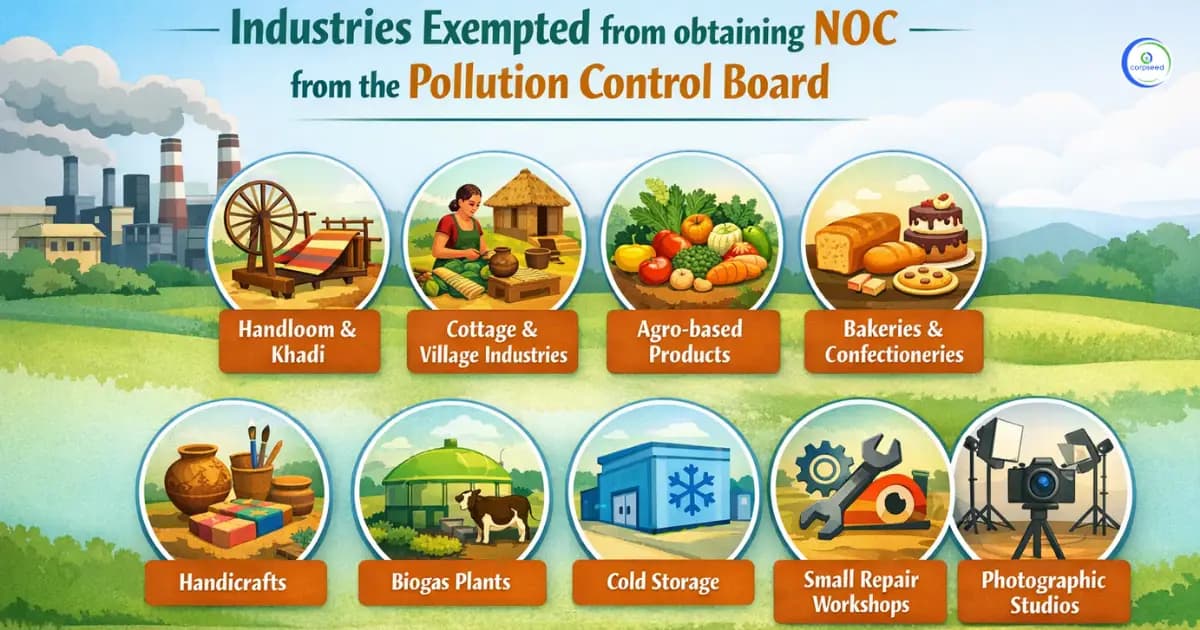
Industries such as the following may be exempt from or have simplified procedures for obtaining NOC from the Pollution Control Board-

  • Small-scale industries: The Pollution Control Board may not issue NOCs to small-scale businesses with low pollution potential or those operating within specific boundaries. 
  • Cottage industries: NOC requirements may not apply to cottage businesses that engage in traditional and non-polluting activities.
  • Certain agricultural activities: Some agricultural activities, such as cultivation and animal husbandry, may not be covered by NOC requirements, depending on the size and kind of operations. 
  • Non-polluting industries: NOC requirements may not apply to companies classified as non-polluting or with minimal environmental impact, such as software development, IT services, and consulting.
  • Renewable energy projects: Businesses engaged in environmentally friendly power projects, such as solar or wind energy, may have developed systems to acquire NOCs because these are harmless to the ecosystem.

Reasons For The Exemption Of Industry From Noc Requirement

The following are some common reasons why an organisation or individual cannot obtain a NOC from the Pollution Control Board: 

  • Statutory Exemptions: Certain regulations or guidelines may explicitly state exclusions from NOC prerequisites for specific actions or substances, these exclusions are typically based on the nature of the action or the situation with the element in question.
  • Governmental or Diplomatic Immunity: Government organisations, strategic missions, and their personnel may be excluded from NOC requirements due to the authority status and the standards of discretionary invulnerability.
  • Emergency or Urgent Situations: To ensure the seamless operation of basic administration some exceptions may be permitted in crises or urgent situations when obtaining an NOC would create significant obstacles or impede basic tasks. 
  • Pre-approved Projects or Activities: Due to predetermined criteria, such as low natural effects or minimal risk to public safety, some jurisdictions may pre-approve projects or activities that are exempt from NOC requirements.
  • Small-scale or Low-risk Operations: Exercises or operations with a narrow scope that pose little harm to the environment, public health, or security may be excluded. It is done to reduce administrative burdens on low-risk enterprises and streamline regulatory processes.
  • Population safety: To ensure the welfare of the general population, public safety services are essential. These services cover a wide range of tasks, including emergency medical care, fire department services, police enforcement, and related services. They are intended to keep people safe and stop potentially dangerous situations.
  • Quick response: During emergencies, exemptions are essential for enabling prompt reactions. They guarantee quick emergency response by enabling emergency responders and other critical personnel to act without delay.
  • Continuity: To ensure essential services continue during emergencies, critical functions must remain operational. Sustaining these services guarantees that people have access to the resources they require and helps avert future crises.

Conditions For Exemptions From Obtaining Noc

  • Industries established in the demarcated Industrial estates.
  • Sectors that do not have more than 1 crore rupees in plant and machinery.
  • Industries that do not have more than Rs 2 Crore in machinery for hosiery units.
  • Industry will not discharge any air pollution, including noise, into the atmosphere.
  • Industry will not discharge any toxic or hazardous waste that could cause water pollution. 

List Of Industries Exempted From Obtaining Noc From The Pollution Control Board

S. No.  
1 Aggarbatti and other cosmetic products are manufactured by blending (Dry Process)
2 Air conditioners, Water Coolers, Room Coolers & heaters without wet process
3 All types of toys and doll-making equipment without the wet process
4 Aluminium utensils from aluminium circles (without any wet process)
5 Aluminium, Stainless Steel, and Brass Vessels are marked with only the processes: spinning without buffing, polishing, pickling, washing, Hot/Cold rolling, annealing furnace, and anodising.
6 Assembling the door closer and the rings
7 Assembly of air coolers and conditioners, repairing and servicing
8 Assembly of the bicycles, baby carriage and other small non-motorised vehicles
9 Assembly of computers, Computer Software, and Computer peripherals.
10 Atta Chakki and Millet grinding.
11 Audio, Video, and consumer electronic equipment assembly only.
12 Automobile Bodybuilding without the wet process.
13 Automobile Repair Workshop. (without any wet process)
14 Ayurvedic and Homoeopathic medicine (without boiler)
15 Baling (hydraulic press) of waste papers (without any wet process)
16 Beauty Parlour
17 Beekeeping
18 Belt Fastener units without a wet process
19 Bindi making units
20 Bio-gas
21 Biscuit trays from a rolled PVC sheet (using an automatic vacuum forming machine)
22 Biscuits, Pastries, Cakes, Confectionery, Bread, Bakery up to 100 kg/day
23 Black Smithy Shop
24 Blending and packaging of Tea
25 Block making for printing without a foundry (excluding the wooden block making)
26 Block making, Printing, Offset Printing
27 Book Binding
28 Brass & Bell metal utensils manufacturing from a circle (without a re-rolling facility)
29 Brush making units with fibre/plastic wire
30 Candle manufacture
31 Carpentry & furniture units without Seasoning
32 Carpentry and wooden furniture manufacturing (excluding sawmills) with the help of electrical (motorised) machines such as electric wood planners, steel saw cutting circular blades, etc.
33 Carpet weaving
34 Cement products (without using Asbestos), such as pipes, pillars, Jafri, well rings, blocks/tiles, etc., should be produced under a covered shed to control fugitive emissions.
35 Ceramic colour manufacturing (not using a boiler and a wastewater recycling process)
36 Chewing Tobacco
37 Coated electrode manufacturing
38 Cotton Belts and Tapes/Cotton Nilwar etc.
39 Cotton cloth Knitting
40 Cotton quilt and mattresses making
41 Cotton socks-knitting
42 Crown cork-making units
43 Dairy farming (Rural Area, points periphery of half KM)
44 Decoration of ceramic cups and plates by the electric furnace
45 Diesel Generator sets up to 15 KVA.
46 Diesel pump repairing & servicing
47 DPC coating of copper and aluminium wire without any wet process.
48 DPC coating of copper and aluminium wire without any wet process.
49 Dry Grinding of spices.
50 Electrical & electronic items assembling
51 Electrical Switches, accessories making, and the Panel Board without the wet process.
52 Electrical/electronic testing and measuring instruments without a wet process.
53 Electronic Components without the use of chemicals
54 Embroidery
55 Engineering good mfg. Units without a wet process
56 Engineering Workshops, Machine Shop, Press Shop, Sheet Metal fabrications, including steel furniture, rolling shutters, grinding, fabrication (without foundry, pickling, electroplating, galvanising, and without any discharge of water/oil)
57 Fabrication units connected with animal-drawn vehicles, trailers without any heat treatment, furnace use, i.e., with no emissions
58 Finished leather goods, conversion of finished goods without the wet process
59 Fish Ponds
60 Flavoured bettle nut production/grinding
61 Floor Polish, Nail Polish, Tooth Powder, Hair Oil, Shampoo, and Tooth Paste with blending only.
62 Fountain pen manufacturing
63 Garments manufacturing without the wet process
64 General Wire Industries like wire drawing, barbed wire, Chain links, making units without a wet process
65 Glass ampoules & vials made from glass tubes.
66 Gold/Silversmithy shops with no water or chemical use
67 Gold/Silversmithy shops with no water or chemical use
68 Groundnut decorticating (dry)
69 Hand Tools without casting
70 Handicraft
71 Handlooms without the wet process
72 Household appliances and the kitchen equipment, without the wet process
73 Insulation and coated papers manufacturing (excluding paper or pulp manufacturing)
74 Jobbing and machining
75 Knitting cloth/Fabrics (Small Scale) Dry process.
76 Lathe and Welding sets (only electrical) without casting.
77 Leather cutting and stitching (more than ten machines, using a motor)
78 Leather footwear and leather products (excluding tanning and hide processing) (except cottage scale)
79 Manufacture of Cement Blocks/Jallies etc.
80 Manufacture of Cement Blocks/Jallies etc.
81 Manufacturing of optical lenses (using an electrical furnace)
82 Manufacturing of a shoe brush & a wire brush
83 Marketing/Industrial Consultancy/Advertising Agencies.
84 Mechanical clocks/watches, etc.
85 Medical & Surgical Instruments and equipment without a wet process.
86 of Transformers without polychlorinated Hydrocarbon
87 Mosaic tiles, cement pipes. Spun pipes manufacturing units
88 Motor and Pump Making without a foundry and wet process
89 Mushroom cultivation under controlled conditions/temperature
90 Musical instrument with no wet process
91 Non-conventional Energy items
92 Nut cracking & roasting
93 Oil extraction by kohlus or expellers without a boiler
94 Oil mill ghani & extraction (no hydrogenation/refining)
95 Optical Frames and glasses without the wet process
96 Organic manure (manual mixing)
97 Orthopaedic equipment without casting/wet process.
98 Packing and Processing of items using the Mechanized Process.
99 Packing materials manufacturing from non-asbestos fibre, vegetable fibre yarn
100 Packing of Agricultural/Forest Products under controlled Temperature (Mechanised Process).
101 Packing of powdered milk
102 Paints and varnishes (mixing and blending) (without ball mill) (without any wet process)
103 Paper Pins, ‘U’ Clips, pen Holders, pen & paper products without wet process
104 Paper Products without the wet process
105 Plastic Niwar from monofilament yarn
106 Polythene Bags from Monofilament Sheets/polythene sheets
107 Power loom Weaving (Small Scale) Dry process
108 Preparation of a photo identification card using a video camera and laser printing.
109 Puffed rice (muri) (using oil, gas, or electrical heating system)
110 RCC Bricks
111 Repairing of electric motor & generator
112 Seed Processing Units/hybrid Seeds- Mechanised process
113 Sericulture units.
114 Small restaurants, coffee/Tea shops, and Snack Bars
115 Solar Energy Panel making.
116 Spinning (Small Scale) Dry process.
117 Sports Goods without leather tanning & other wet processes.
118 STD Booth/cable TV Network/EPBAX.
119 Steel furniture without spray painting
120 Surgical and medical products not involving effluent/emission-generating processes.
121 Tailoring Shop as SSSBI
122 Tea Grading and Packing
123 Tea Grading and Packing
124 Typing Centre/Xeroxing
125 Tire retreading (only cold Processing)
126 Umbrellas, Raincoats, Tarpaulins without wet process
127 Weigh Bridge
128 Weighing machines with no wet process
129 Welding Electrodes
130 Wooden and corrugated Crates and Boxes
131 Zip Fasteners

Conclusion

In conclusion, industries that fall under the White Category or engage in low-risk, non-polluting operations with minimal environmental impact are usually free from getting a No Objection Certificate (NOC) from the Pollution Control Board. These exclusions promote ease of doing business, reduce unnecessary regulatory burdens, and free regulatory bodies to focus on monitoring industries with high pollution levels. To maintain sustainable and lawful operations, these companies must still comply with applicable environmental laws, local regulations, and good environmental practices. Therefore, exemption from NOC does not imply exemption from ecological responsibilities.

This portion of the site is for informational purposes only. The content is not legal advice. The statements and opinions are the expression of author, not corpseed, and have not been evaluated by corpseed for accuracy, completeness, or changes in the law.

BOOK A FREE CONSULTATION

Get help from an experienced legal adviser. Schedule your consultation at a time that works for you and it's absolutely FREE.

Author

Experienced Digital Marketer with a demonstrated history of working in the Internet industry. He likes to write about the latest technology trends, Skilled in Digital Marketing likes. Search Engine Optimization, SMO...

Learn More >>