
CPCB Steel Slag Management Guidelines 2026: Storage, Utilisation and Compliance Requirements
The Central Pollution Control Board (CPCB) released version 2.0 of its Guidelines for Management of Pyro-metallurgical Slags (Iron & Steel Slags) in November 2026. The guidelines outline the process through which iron and steel units can manage, store, treat, and utilise the slag without causing any environmental pollution.
Schedule a Call Back
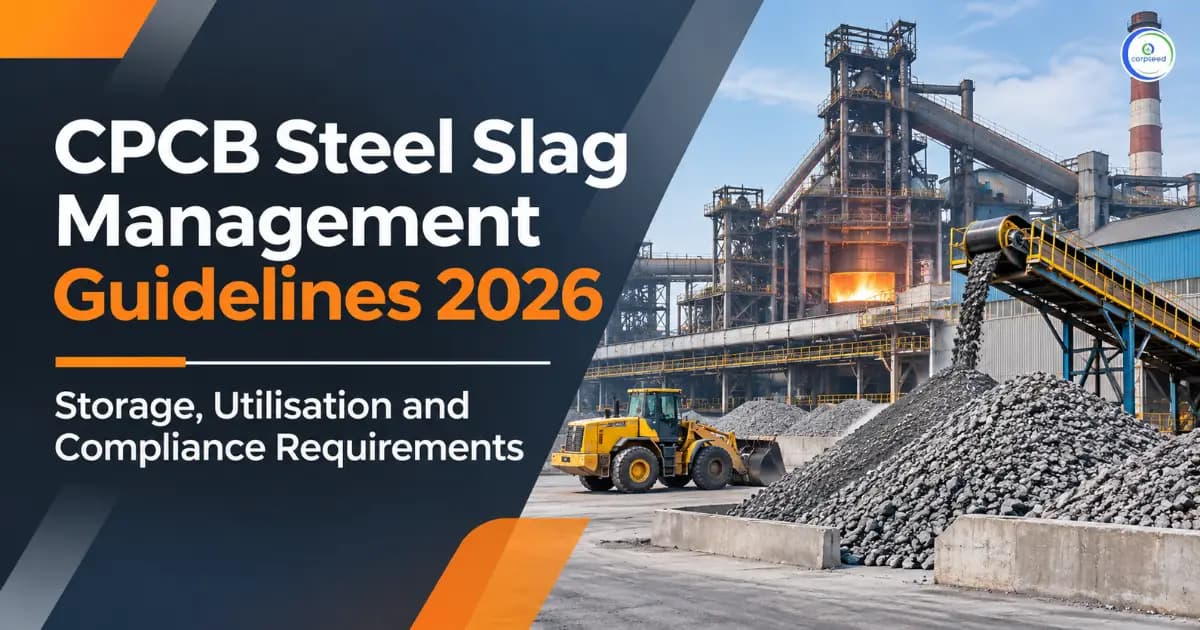
The Central Pollution Control Board (CPCB) released version 2.0 of its Guidelines for Management of Pyro-metallurgical Slags (Iron & Steel Slags) in November 2026. The guidelines outline the process through which iron and steel units can manage, store, treat, and utilise the slag without causing any environmental pollution.
For steel producers, the guidelines focus specifically on storage yard facilities, groundwater monitoring, slag utilisation, and annual reporting. Companies engaged in processing and recycling of slag will have to be aware of the approved uses and any environmental clearances required for such activities.
This blog describes the guidelines for management of steel slags in 2026 by the CPCB and what businesses need to do in this regard.
For anyone researching steel slag management in India or planning a steel slag recycling plant setup in India, the main questions are whether the proposed process is technically suitable and what environmental compliance requirements apply to the site.
Schedule a Call Back
What Are the CPCB Steel Slag Management Guidelines 2026?
The CPCB guidelines for slag management deal with the handling of slag produced during the iron and steel production process. These guidelines deal with the collection, treatment, storage, transportation, recycling and utilization of slag. They include actions for preventing soil, water, and air pollution.
As per the Hazardous and Other Wastes (Management and Transboundary Movement) Rules, 2016, the slags produced through pyro-metallurgical processes are considered HVLE wastes and are exempted from the category of hazardous waste as per the note to Schedule I. This does not imply that slag is exempted from storage or disposal rules without any environmental controls.
The guidelines of November 2026 are concerned with the recovery of materials from slag, reduction of the accumulated slag, and utilization of slag in appropriate industrial processes. These guidelines should be seen in conjunction with the pollution control laws and the conditions set by the SPCB or PCC.
The CPCB iron and steel slag guidelines also provide a useful reference for pyro-metallurgical slag management and industrial slag waste management planning, particularly when businesses review existing facilities or propose changes in production.
Key Highlights of CPCB Iron and Steel Slag Guidelines 2026
Some of the obligations covered in the updated guidelines include those that the iron and steel plants should address in the operation of their facilities.
| Compliance area | Provision described in the CPCB guidelines | Practical check for businesses |
|---|---|---|
| Steel slag storage | Impermeable storage surfaces and suitable run-off control | Review the storage yard, lining and drainage arrangements |
| Slag processing | Safe cooling, granulation, treatment and resource recovery | Check the suitability of the existing handling system |
| Groundwater monitoring | Pre-monsoon and post-monsoon testing through an eligible laboratory | Schedule sampling and retain laboratory reports |
| Steel slag utilisation | Maximise internal recovery and external use in suitable applications | Confirm material quality and possible end users |
| Slag stock management | Legacy utilisation provisions and subsequent storage limits | Maintain a category-wise slag inventory |
| Annual reporting | Submission of generation, utilisation and storage data | Prepare records using Annexure III |
These obligations ensure that managing the slag is an operational obligation and not merely one of looking for space to store it. The plants must know the quantity of slag generated and the recoverable quantities.
Which Industries Are Covered Under the CPCB Steel Slag Guidelines?
The guidelines refer to iron and steel plants producing slag by pyro-metallurgical process. The type and amount of slag will vary depending on the production technology, materials and conditions.
The main processes mentioned in the document are the following:
- Integrated iron and steel plants: plants producing iron and steel by a number of manufacturing processes.
- Blast furnace units: plants producing iron slag while converting iron ore to hot metal.
- Basic Oxygen Furnace (BOF/LD) units: steelmaking plants producing converter slag.
- Electric Arc Furnace (EAF) units: steel plants using electricity for melting and processing metallic feedstock.
- Induction furnace units: secondary steelmaking plants producing slag while melting.
- Ladle furnace and secondary refining units: plants producing slag while refining and adjusting chemistry.
In addition, independent slag processing plants, construction material producers and recycling plants might also need to take into account the guidelines in relation to acquiring and processing the slag. However, the document does not imply that all obligations addressed to iron and steel plants are automatically imposed on each downstream purchaser.
Such plants should separately check their own processing process, consent conditions, product requirements and rules of the proposed site.
A steel plant environmental compliance assessment should therefore distinguish the obligations of the slag-generating plant from those that may apply to a separate steel slag recycling unit or construction material producer.
What Are the Different Types of Iron and Steel Slag?
Iron and steel manufacturing produces different types of slag, depending on the process used. Their physical and chemical properties influence how they should be processed and where they can be utilised.
| Slag type | Source | Processing or utilisation consideration |
|---|---|---|
| Blast furnace (BF) slag | Iron production in a blast furnace | Granulated material is commonly used in cement production; suitable air-cooled material can be processed as aggregate |
| Basic oxygen furnace (BOF/LD) slag | Converter-based steelmaking | Free lime and other properties may require stabilisation or testing before particular uses |
| Electric arc furnace (EAF) slag | Electric arc steelmaking | Material characteristics and metal recovery influence processing and aggregate suitability |
| Ladle furnace slag | Secondary refining | Composition varies with refining inputs and steel grade |
| Desulphurisation slag | Sulphur removal from hot metal | Material separation and metal recovery may be relevant |
| Induction furnace (IF) slag | Induction furnace melting | Testing is needed to assess composition and suitable end use |
The CPCB document explains that granulated blast furnace slag is widely utilised in cement manufacturing. In comparison, the utilisation of steelmaking slag, particularly LD slag, can be more difficult because of its phosphorus content, free lime and specific weight.
In the case of companies that want to recycle steel slag, determining the type of steel slag will be the first step. A technique that works for blast furnace slag may not work for BOF or EAF slag. The quality of the product should be evaluated before purchasing equipment or finding buyers.
What Are the CPCB Requirements for Handling and Storage of Steel Slag?
The CPCB guidelines require iron and steel plants to adopt suitable handling, cooling, treatment and storage practices to control environmental pollution.
Safe Handling and Processing of Slag
Slag is generated at high temperatures and must be handled through appropriate equipment and safety procedures. Depending on its characteristics, it may be cooled through air cooling, water granulation or other suitable treatment methods.
The guidelines focus on safe quenching, granulation, and recovery processes. In addition, it should be ensured that slag is tapped into a pot or pit only after verifying that the pot or pit is dry.
It is recommended that plants audit their handling process to ensure that cooling, handling, and resource recovery processes are done safely. The wastewater that is generated from treatment needs to be recycled or treated before discharge, as applicable.
Slag Storage Yard Requirements
According to Section 6.5, unused slag needs to be stored in a captive slag storage yard with an impermeable base and a garland drain to avoid soil and groundwater pollution.
In the case of new storage yards, Section 6.6 provides information about above-ground construction with an impermeable base such as 600 mm thick compacted clay over a single layer of 1.5 mm geomembrane.
The suitable design of the storage yard also needs to incorporate collection and treatment of run-off before discharge. Companies should consider the engineering design and relevant regulatory requirements instead of believing that any paved surface would meet the requirement.
For businesses checking CPCB steel slag storage guidelines, the main storage yard compliance issues are the impermeable base, drainage arrangements, capacity and treatment of potentially contaminated run-off.
Discontinuation of Unlined Storage Areas
The guidelines state that unlined slag handling areas, storage areas and dumpsites are to be discontinued within two years from issuance.
This requirement is particularly relevant to plants using open ground for accumulated slag. Such businesses should inspect their existing yards, assess the required improvements and plan storage infrastructure according to the quantities handled.
Improvements in the storage yard could consist of civil construction, lining, drainage, runoff collection and treatment facilities. These have to be taken into account while determining the environmental compliance and cost of operation.
What Are the Groundwater Monitoring Requirements for Steel Plants?
Under Section 6.7, iron and steel industries have to test the groundwater quality in the vicinity of slag dumps in both pre-monsoon and post-monsoon seasons.
The testing is to be done using a recognized laboratory under the Environment (Protection) Act, 1986 or a NABL-accredited laboratory, as mentioned in the guidelines. The report is to be submitted annually to the concerned SPCB/PCC.
The parameters identified by CPCB include:
- pH and alkalinity.
- Calcium and magnesium.
- Iron, manganese and aluminium.
- Cadmium and chromium.
- Copper and nickel.
- Mercury and lead.
- Additional parameters prescribed by CPCB or the relevant SPCB/PCC.
A business needs to have a monitoring schedule, find appropriate sites for sampling and keep laboratory results. Records will allow the company to determine whether contamination is caused by slag stockpiling or some other process.
The cost of laboratory testing and any necessary monitoring arrangements should be included in the plant's environmental management budget.
Businesses evaluating groundwater monitoring services for steel plants should confirm the laboratory's eligibility, the required sampling parameters and any additional directions issued by the relevant SPCB/PCC.
How Can Iron and Steel Slag Be Reused and Recycled in India?
The aim of using the guidelines for steel slag utilization by the CPCB is to ensure that there is increased utilization of slag and not that it is stored in large amounts.
The six avenues of utilizing the slag are provided in Section 6.8 and include the following:
- Cement production: Suitable slag, particularly processed blast furnace slag, may be used in cement-related manufacturing.
- Concrete aggregates: Processed slag may be used as aggregate where it satisfies the applicable specifications.
- Bricks, blocks and tiles: Suitable material may be incorporated into cement-concrete products.
- Road and railway construction: Processed slag may be used as aggregate, subject to applicable engineering and project-specific requirements.
- Glass manufacturing: Blast furnace slag may be used as a raw material where technically suitable.
- Paved-road repair products: The guidelines include products for repair of bituminous or asphalt paved roads having a subgrade layer.
Just because slag is allowed for a particular use does not necessarily mean all grades of slag are suitable for that use.
For instance, untreated BOF slag could have free lime, which might cause expansion problems. Some processing, aging, and proper testing might be required before it is suitable for construction purposes.
Technical guidelines for the use of processed steel slag aggregates have been independently provided by the Ministry of Steel and CSIR-Central Road Research Institute. The construction material suppliers must evaluate both these guidelines along with the guidelines of the CPCB.
Commercial Opportunities in Steel Slag Recycling
Recycling of steel slag offers opportunities for material recovery, processing of aggregates and supplying them to appropriate industries.
But commercial viability will be determined by the composition of the slag, processing needs, quality of the products, distance to transport and availability of the customers. The processing company needs to determine the suitability of its products before engaging in large-scale production.
In the case of existing steel companies, a partnership with a suitable processor or consumer may assist in lowering the stock that is held.
A potential buyer of steel slag recycling services should also check whether the processed material meets the intended product standard, while suppliers should assess reliable demand before investing in a steel slag processing facility.
What Are the Steel Slag Utilisation Targets and Deadlines Under CPCB Guidelines?
Section 6.10 calls for iron and steel plants to take steps towards achieving 100% regular utilisation of slag from current generation within one year. It also addresses the full utilisation of legacy slag and limits the quantity that may subsequently remain in storage.
| Slag utilisation or storage provision | Date or limit stated in Version 2.0 |
|---|---|
| Regular utilisation of current iron and steel slag generation | Steps to achieve 100% utilisation within one year |
| Legacy iron slag utilisation | September 2025, as written in the November 2026 document; clarification needed |
| Legacy steel slag utilisation | September 2027 |
| Maximum subsequent storage of steel slag | Not more than one year's generation |
| Maximum subsequent storage of iron slag | Not more than six months' generation |
Important clarification: The guidelines are dated November 2026, but still have September 2025 as the legacy iron slag utilisation date. Companies need to clarify the matter with the appropriate regulatory body before considering it as an updated deadline or an extension.
For operational purposes, factories need to figure out how much slag they generate under different categories, how much slag has been utilised and how much slag is left to be processed or transported.
Such storage limits are not meant to be seen as a green light to continue with inappropriate storage facilities and other environmental requirements.
What Are the Annual Reporting Requirements for Iron and Steel Slag?
Under Section 6.11, industries should submit their annual report on slag generation, quantities stored, quantities utilised, uses and disposal by 30 June of the following year to CPCB and the respective SPCB/PCC.
Annexure III provides the reporting format. Businesses should maintain information relating to:
- Name and address of the plant.
- Contact details of the person responsible for slag management.
- Types of ironmaking and steelmaking slag.
- Opening stock and relevant financial-year quantities.
- Utilisation within the plant.
- Utilisation by external parties.
- Closing stock of slag.
- Method of utilisation.
- Storage methods, including lining and embankment arrangements.
These guidelines also allow for reporting via the waste reporting portal, which could be set up by CPCB.
In reality, to follow these guidelines, the steel plant is supposed to maintain records of slag generation and dispatch instead of preparing the entire report at the end of the fiscal year.
Such records, such as utilization and storage, may assist in reconciling the quantities reported
Businesses preparing a steel slag annual compliance report can use a year-round generation and utilisation register to support the CPCB slag reporting requirements and the annual submission to the relevant authorities.
What Environmental Approvals May Be Required for a Steel Slag Processing or Recycling Plant?
Businesses planning a steel slag recycling plant in India must distinguish between complying with the CPCB slag management guidelines and obtaining environmental approvals under other applicable laws.
The slag guidelines issued in November 2026 do not provide a uniform separate registration for all businesses that recycle steel slag.
However, a proposed process can necessitate Consent to Establish (CTE), Consent to Operate (CTO) or others depending on the process, location, industry and exemptions applicable.
Businesses seeking SPCB consent for a slag processing plant should confirm whether their activity requires a Consent to Establish for a slag processing plant, a Consent to Operate for a slag recycling plant, or any other activity-specific approval. The answer depends on the actual operation and applicable state-level provisions.
Consent to Establish and Consent to Operate
CTE and CTO will be needed under the relevant pollution control regime, which includes the Water (Prevention and Control of Pollution) Act, 1974, and the Air (Prevention and Control of Pollution) Act, 1981.
In processes that require consent, CTE will be considered prior to establishment, while CTO will be considered prior to operation. The last one needs to be determined based on the relevant category and current regulations.
The government updated the Uniform Consent Guidelines in January 2026, which included revisions to consent procedures, exemptions and validity conditions. Thus, it is necessary to check current requirements rather than relying on old assumptions regarding consent renewals or their universality.
Other Regulatory and Technical Considerations
Environmental clearance could also be required in cases where the project as a whole or the expansion thereof is covered under the notification category. This does not mean that it is automatically compulsory simply because the process involves steel slag.
Before buying any property or equipment, the company needs to know the exact process involved, emissions, water treatment, quantity of materials, and the product that would come out of the process.
| Proposed activity | Compliance or technical point to verify |
|---|---|
| New steel slag crushing, screening or recovery unit | Applicable SPCB/PCC consent classification, pollution-control systems and site conditions |
| Adding processing machinery at an existing steel plant | Existing consent conditions and whether a modification or further approval is necessary |
| Supplying steel slag aggregates for roads or concrete | Relevant material specifications, processing requirements and buyer acceptance |
| Proposing an end use not listed in CPCB Section 6.8 | Proposal route to CPCB through the respective SPCB/PCC under Section 6.9 |
| Managing additional waste from the processing activity | Whether other waste-specific requirements apply to the separate waste stream |
What Should Businesses Consider Before Setting Up a Steel Slag Recycling or Processing Unit?
Planning of a steel slag processing plant will have to be done on the basis of the characteristics of the material to be used and the products that can be produced from the material.
First, there has to be assured availability of the slag. The supplier of the material to be processed needs to be identified, along with the quantity, material composition, and whether the material contains any metallic parts.
The rest of the investment will depend upon the process used and the final product that is to be produced.
A realistic assessment of steel slag recycling plant setup cost in India should separately consider equipment, land, storage infrastructure, pollution-control measures, testing and transport. The steel slag processing plant cost cannot be responsibly expressed as a single fixed amount without a project-specific assessment.
Some of the important considerations that will influence the planning and costing of the project are:
- Material sourcing: Quantity, composition and availability of the suitable slag.
- Site and location: Area for processing, storage, vehicular movements and pollution controls.
- Machinery for processing: Crushing, screening, magnetic separation, ageing, etc.
- Environmental facilities: Impermeable surface, dust control, run-off management and wastewater treatment.
- Testing and quality control: Lab testing and technical evaluation in relation to customer specifications.
- Operating costs: Electricity, water, labor, maintenance, wear and tear, and transport.
The commercial value of any slag product relies on whether the product satisfies any market demand. Just because a material is cheap does not mean that the recycling process will be commercially viable if costs of transport and processing are high.
For instance, think of a company that is intending to use BOF slag as road construction aggregates. It must determine whether the slag needs to be stabilized first, the type of tests required, the environmental permits that apply, and whether the potential customers will accept the product.
These checks are useful both for new processing units and existing steel plants considering additional slag utilisation facilities.
How Can Iron and Steel Plants Comply with CPCB Slag Management Guidelines?
A practical compliance program should start with the actual generation, storage and utilization process of the plant.
The following checklist may be useful in identifying gaps in the compliance process:
- Slag classification: Identify the type and quantity of slag generated from various manufacturing processes.
- Storage facilities: Evaluate impermeable surface, drainage system and storage area not lined.
- Processing methods: Assess whether the existing system of cooling, processing and recovery is suitable for the slag produced.
- Groundwater monitoring: Ensure that pre-monsoon and post-monsoon test reports are kept by a qualified lab.
- Usage: Align the processed slag with the uses in industries and applicable standards of products.
- Quantity: Ensure that generation, opening stock, internal use, quantity sent out and closing stock are recorded.
- Regulatory approvals: Ensure the SPCB/PCC consent conditions, amendments and other relevant requirements.
- Annual reports: Ensure the information as per Annexure III is submitted within the stipulated time.
Further, businesses should ensure that there is assigned responsibility for inventory, storage conditions, monitoring and reporting of slag.
Some of the common problems are maintaining stock without utilization records, run-off from open yards, failure to evaluate material properties before utilization and failure to consider changes in the pollution control process.
How Can Corpseed Help with Steel Slag Management and Environmental Compliance?
Steel plants and slag processing companies might require help in understanding the environmental approvals necessary for their projects, especially when there is a proposal to set up a new plant or modify an existing one.
Corpseed offers environmental consultancy and Pollution Control Board consent-related services. According to the needs of the project and the regulations, firms may obtain help with:
- Reviewing environmental approval requirements for proposed industrial projects.
- Understanding CTE, CTO, and SPCB/PCC consent processes.
- Document preparation and submission.
- Environmental compliance requirements for plant operations assessment.
- Consent-related requirements for setting up and modifying processing plants.
Businesses looking for an environmental compliance consultant for steel plants or industrial waste management consultancy can first identify their proposed activity, existing environmental approvals and intended slag utilisation route. This helps define the scope of any steel slag management consultancy or regulatory support.
Firms that intend to establish a steel slag processing plant can contact Corpseed with their proposed location, processing process, material quantity, and existing consents, if any, to understand the environmental compliance requirements.
Conclusion
CPCB Steel Slag Management Guidelines 2026 focus on proper storage, safe processing, material recovery, and improved use of iron and steel slag. The first step for manufacturers is to assess their storage facilities, check their utilization records, and comply with the monitoring and reporting requirements.
For those companies planning slag recycling and processing, an assessment of the technical feasibility and relevant environmental clearances is required before investing in any project. A proper knowledge of these requirements may assist businesses in planning their operations efficiently.
About the Author

Mahek Sancheti
Content WriterMahek Sancheti, BAJMC graduate with a deep passion for writing. As a content writer, video content creator, creative content creator, and scriptwriter, I bring stories to life through words and visuals. I honed my skills by working with a prominent news agency, where I excelled in crafting compelling narratives and engaging content. Coming from a journalism and mass communication background I have skills to craft engaging narratives that captivate audiences. With a keen interest in writing and creativity, I aim to deliver impactful and meaningful content that resonates with diverse audiences.
https://www.linkedin.com/in/mahek-sancheti-837196212
Related articles
CTO vs CTE: Key Differences Explained (Complete 2026 Guide)
2026-07-31
How to Obtain NOC from the Pollution Control Board in India 2026?
2026-05-29

DPCC Issues SOP for Noise Pollution Enforcement and Compensation in Delhi
2026-05-14

How to Apply for a State Pollution NOC Online in 2026?
2026-04-07
Industries Exempted From Obtaining Noc From The Pollution Control Board
2026-02-18
MOEFCC Water Pollution Consent Guidelines 2026: CTE, CTO, Fees, Validity & Approvals
2026-02-11