9311255283
×

Welcome to Corpseed. Please type your query, and we shall provide immediate assistance.

×

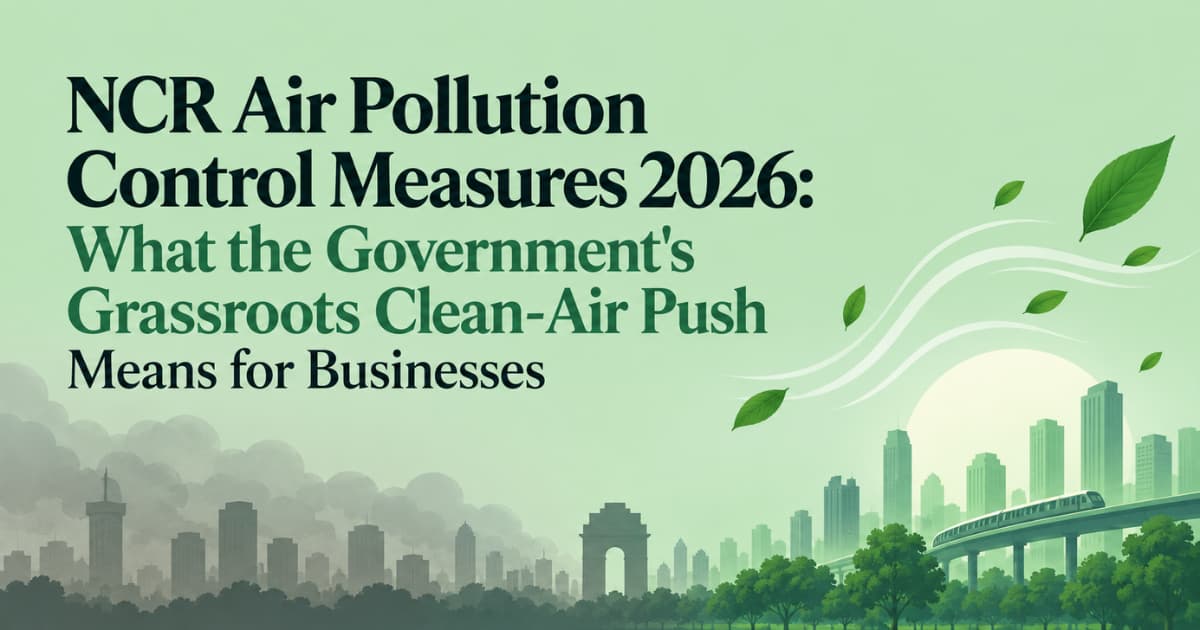
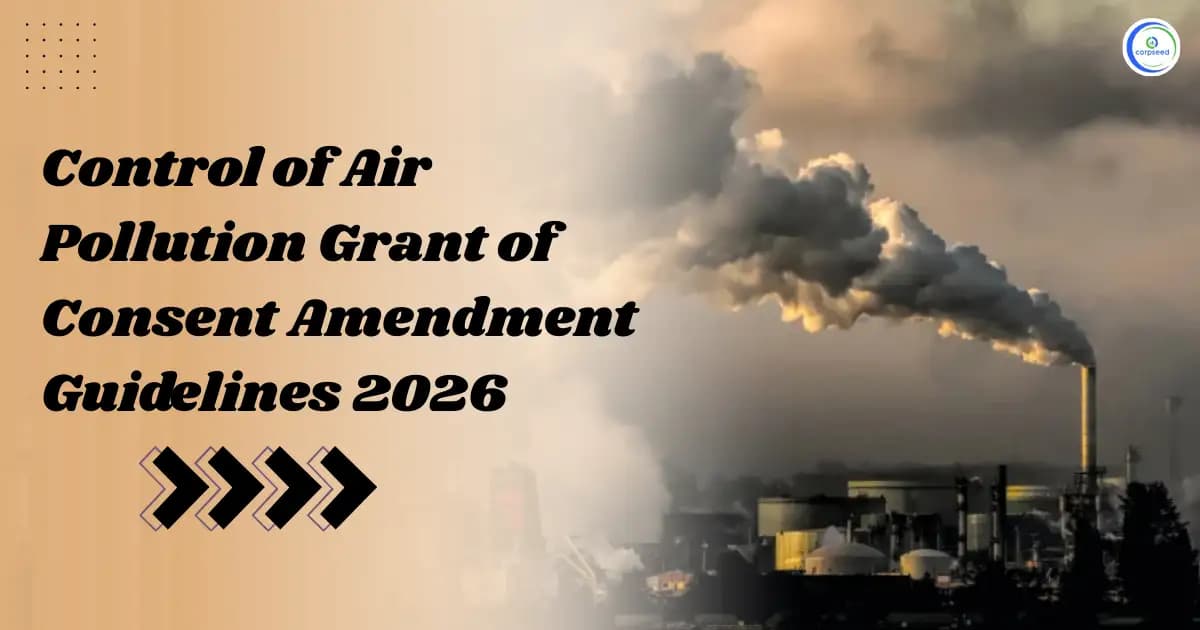
Control of Air Pollution Grant of Consent Amendment Guidelines 2026

Control_of_Air_Pollution_Grant_of_Consent_Amendment_Guidelines_2026_Corpseed.webp
Last updated : 2026-02-05

The Central Government has notified the Control of Air Pollution (Grant, Refusal or Cancellation of Consent) Amendment Guidelines, 2026 under Section 21A of the Air (Prevention and Control of Pollution) Act, 1981, after consulting the Central Pollution Control Board (CPCB). These amendments amend the guidelines which were initially announced on 29 January 2025.
The amended provisions are applicable to all industrial plants that need Consent to Establish (CTE) or Consent to Operate (CTO) under Section 21 of the Air Act, in all the States and Union Territories. The guidelines take effect on the date of their publication in the Official Gazette and are enforceable on State Pollution Control Boards, Union Territory Pollution Control Committees, and Project Proponents.

Revised Procedure for Inquiry on Consent Applications under the 2026 Amendments

The amendments of 2026 redefine the air consent process by substituting the repetitive approvals with a long-term framework that is stable. The revisions focus on the continuity of compliance, professional verification, and digital transparency, and minimise the delays in procedures of regulated industrial activities.

  • Continuous Validity of Consent to Operate: Consent to Operate does not automatically expire after it is granted. It continues unless cancelled due to violations specified, enabling industries to function without recurring renewal-related administrative interruptions.
  • One-Time Fee for Extended Consent Periods: State Governments can prescribe a single consent fee on operating periods of between five and twenty-five years, which will allow them to plan their finances better and avoid recurrent fee reviews.
  • Recognition of Registered Environment Auditors: Registered Environment Auditors are formally empowered to check applications and to carry out site assessments, supporting expediting processing, without compromising technical scrutiny and regulatory integrity.
  • Deemed Consent Mechanism for MSME Units: Micro and Small units situated within the notified industrial areas are given automatic Consent to establish (CTE) when they submit a self-certified application, minimizing the approval timelines during the first stage of the project.
  • Integrated Approval for Waste and Air Consents: The amendments allow joint processing of air consent and waste authorisations, which will enable the coordinated regulatory decisions and prevent duplication of the environmental compliance requirements.
  • Unified Digital Platform for Consent Management: All applications, inspections, approvals and cancellations will be handled through a central online portal to establish a single and transparent system of tracking compliance with all States and Union Territories.

--------------Blog Contact Form-------------

Revised Consent Application and Fee Structure

All applications for consent should be made in the prescribed forms in the First Schedule of the guidelines. The applications should contain full technical specifications, pollution control plans, and supporting documents.

One of the major changes is the adoption of a single fee system of consent. State Governments and Union Territory Administrations can fix a single fee on Consent to operate (CTO) of a term of between 5 years to 25 years, depending on the capital investment and type of project.

After the expiry of the chosen period, the Project Proponent can seek another extension of 5 to 25 years by making the required fee once again.

Validity of Consent to Operate and Removal of Renewal Requirement

The amendments eliminate the idea of periodic CTO renewal. After the Consent to Operate is granted, it stay effective for the extent of the approved period, and thereafter unless cancelled in accordance with paragraph 13 of the guidelines.

The cancellation can be done in instances like failure to adhere with the conditions of consent or failure to pay the prescribed fees. The transformation gives industries a certainty in the long-term operations and removes the recurring renewal filings.

Inspection, Verification, and Role of Registered Environment Auditors

The inspection mechanism has been extended to cover Registered Environment Auditors as stipulated in the Environment Audit Rules, 2025. Confirmation of consent applications can be done by:

Such audits can cover sources of emission, pollution control systems, technical records, and site conditions. Registered Environment Auditors can also be involved by State Boards to assist in their statutory operations to enhance the coverage of inspections and minimize delays in processing.

Deemed Consent to Establish for Micro and Small Units

In the case of Micro and Small enterprises in notified Industrial Estates or Industrial Areas, the guidelines provide a deemed approval process.

Consent to Establish is considered to be given as soon as a self-certified application is submitted in Form-I. The provision eliminates the waiting time at the project start-up phase and maintains the need to ensure compliance verification in operation.

Consolidated Consent, Waste Authorization, and Expansion Approvals

The amendments require one step process for granting:

  • Consent under the Air Act, and
  • Authorisations in accordance with Waste Management Rules.

To expand or amend existing units, the guidelines provide specific decision timelines:

  • 90 days, 60 days, or 30 days, depending on the category and nature of expansion.

This integration prevents overlapping approvals and provides coordinated environmental decision-making.

Unified Online Portal for Consent Implementation

The Central Pollution Control Board in consultation with the State Boards must design a single online consent and authorisation portal. Key timelines include:

  • Portal to be created within a period of 6 months, and not exceeding 1 year upon notification.
  • Mandatory use of the portal once operational

All applications, inspection, approval, refusal, and cancellations will be done solely via this platform. CPCB can impose a 5% service fee on the consent application fees on portal operations.

Impact of the Amendments on Industrial Compliance

The 2026 amendments have a significant restructuring effect on the industry air compliance management by eliminating the repetitive processes and bringing some sense of certainty in approvals. The updated framework promotes long-term planning, timely disclosures, and enhanced accountability without adding more regulation burden.

  • Industries no longer require to frequently monitor consent renewals, and enabling compliance teams to concentrate on operational compliance instead of submitting the same administrative submissions.
  • The long-duration consents allow better financial and capacity planning, since the regulatory timelines are aligned with the real project lifecycle and capital investment horizons.
  • Professional audit support and defined processing timelines minimize approval uncertainty and enhancing predictability in project expansion and modification decisions.
  • The digital consent processing improves transparency, traceability of compliance action, and less manual intervention across the State and Union Territory authorities.

Conclusion

The Control of Air Pollution (Grant, Refusal or Cancellation of Consent) Amendment Guidelines, 2026 is a step in the right direction of simplified, transparent, and technology-based air consent management in India. The amendments strike a balance between compliance and control through the introduction of long-term consent validity, one-time fee structure, recognised environmental auditors, facilitation of MSMEs and a single digital portal. To ensure that operations continue without interruption and that they remain compliant with the amended framework, industrial units should take the initiative to align their consent strategy with the amended framework under the Air (Prevention and Control of Pollution) Act, 1981.

This portion of the site is for informational purposes only. The content is not legal advice. The statements and opinions are the expression of author, not corpseed, and have not been evaluated by corpseed for accuracy, completeness, or changes in the law.

BOOK A FREE CONSULTATION

Get help from an experienced legal adviser. Schedule your consultation at a time that works for you and it's absolutely FREE.

Author

Parul Bohral, a BALLB graduate and experienced legal researcher and content writer with expertise in various legal areas, including corporate law and intellectual property. I have gained valuable experience in esteemed legal environments, where...

Learn More >>