
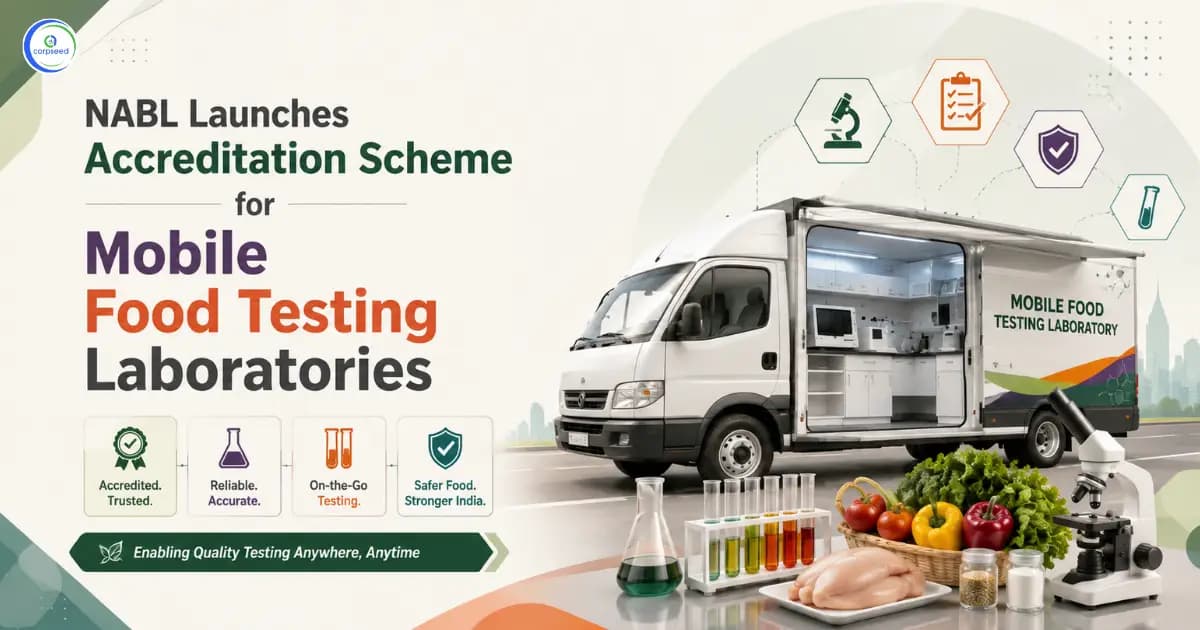
NABL Launches Accreditation Scheme for Mobile Food Testing Laboratories
NABL launches India’s first accreditation scheme for mobile food testing laboratories. Understand the framework, compliance impact and accreditation requirements.
Schedule a Call Back
400+ product testing assignments since 2018
Clients include Emerson Automation Solutions Intelligent Platforms, Intangles Lab, Martelx Electronics, Fleetx Technologies, Waites Sensor Technologies, FluxGen Sustainable Technologies, Hitsavi Electronics, Nibav Lifts, Normet India, N Steels, Magnum Aluminium, JK Cement (12 of 150+ served since 2018).
A few more clients we've served in this industryHide the list
- Electronics and technology
- Emerson Automation Solutions Intelligent Platforms · Intangles Lab · Martelx Electronics · Fleetx Technologies · Waites Sensor Technologies · FluxGen Sustainable Technologies · Hitsavi Electronics
- Engineering and manufacturing
- Nibav Lifts · Normet India · N Steels · Magnum Aluminium · JK Cement · Technotorc Tools
- Pharma and healthcare
- Medtherapy Biotechnology (India) · Sonova Hearing India · Ossur India
- Energy and power
- Sodion Energy · Amperehour Solar Technology
- More clients
- Sreechem Resins · Nilkamal · GHV Medical Anchor · Geepas India · Ample Digital · Lumiere Technologies · Patel Agrotech · AS Building Solutions · Techno Sales Corporation · Aqua Water Systems (India) · Viion Systems · BDS Services · Pentair Water Treatment · Champion EL COM · Jumpking International · WIN the BUY BOX · Brun Health · Knotty Ventures · Nirvana India · Adit Buildwell · OTT Scientific India · Ample Technologies · Maestrotek Innovations · Agricapita Innotech
Introduction
The National Accreditation Board for Testing and Calibration Laboratories (NABL) has launched India’s first accreditation scheme for Mobile Food Testing Laboratories under its Integrated Assessment Programme. The scheme was announced on 10 August 2026 during the Gunvatta Samanvaya- A Multilateral MoU Exchange Ceremony in New Delhi.
The new Mobile Food Testing Laboratory accreditation scheme aims to bring reliable and quality-assured food testing closer to communities while maintaining recognised testing standards. It is expected to support food safety surveillance, faster regulatory action and greater confidence in test results. For laboratories planning to seek NABL accreditation for mobile food testing laboratories, the development also brings attention to testing methods, equipment, technical competence, quality systems and documentation.
Accreditation Scheme at a Glance
| Particular | Details |
| Accreditation body | National Accreditation Board for Testing and Calibration Laboratories (NABL) |
| Parent organisation | Quality Council of India (QCI) |
| New initiative | Accreditation Scheme for Mobile Food Testing Laboratories |
| Programme | Integrated Assessment Programme |
| Announcement date | 10 August 2026 |
| Event | Gunvatta Samanvaya- A Multilateral MoU Exchange Ceremony |
| Location | Hotel Ashoka, New Delhi |
| Laboratory type covered | Mobile Food Testing Laboratories |
| Main purpose | Provide a framework for reliable and quality-assured mobile food testing |
| Broader objective | Strengthen food safety surveillance and access to quality testing |
| Related framework | Integrated Assessment Framework |
| Key areas highlighted | Regulatory convergence, coordinated assessments, mutual recognition and quality infrastructure |
| Relevant stakeholders | NABL, QCI, food regulators, commodity boards and participating organisations |
| Important compliance consideration | Accreditation is linked to demonstrating competence and meeting applicable assessment requirements |
NABL's existing Integrated Assessment framework includes procedures and application documentation for testing laboratories, including NABL 154 for Integrated Assessment of Testing Laboratories and NABL 127 for Integrated Assessment and additional requirements of regulatory bodies. NABL lists both among its current documents.
What Has NABL Announced?
The main development is the introduction of an accreditation scheme designed specifically around Mobile Food Testing Laboratories.
The idea is straightforward. Mobile food testing can make testing more accessible, but the results still need to be dependable when they are used for food safety and quality purposes.
The new framework is intended to help address that need.
The accreditation scheme is expected to support:
- Reliable food testing: Mobile laboratories can work within an accreditation framework that focuses on the reliability and competence of testing activities.
- Quality assurance: Laboratories will need appropriate systems and controls to support consistent testing.
- Better access to testing: Mobile units can take testing capabilities closer to communities and locations that may not have easy access to fixed laboratories.
- Food safety surveillance: Wider access to credible testing can support field-level food safety monitoring.
- Faster regulatory action: When dependable test results are available closer to the point of need, regulators may be able to respond more quickly where testing identifies a concern.
- Greater consumer confidence: Reliable test results can help strengthen confidence in food safety and quality controls.
The scheme is therefore not simply about putting laboratory equipment inside a vehicle. The focus is on whether the mobile food testing lab can produce technically reliable results under an appropriate quality system.
Why Is Mobile Food Testing Important?
Mobile testing has a practical advantage that fixed laboratories cannot always provide: the testing facility can move closer to where samples, businesses or communities are located.
India already has a sizeable mobile food testing network. FSSAI has stated that Mobile Food Testing Laboratories, also known as Food Safety on Wheels, are used to address gaps in food testing infrastructure and improve access to testing services. These units can perform basic tests for common adulterants and also support food safety awareness activities.
This matters particularly in locations where sending samples to a conventional laboratory could take additional time or where laboratory infrastructure is limited.
The new NABL accreditation framework can add another layer of confidence to this model.
For example, mobile food testing can support:
- Food safety surveillance in areas with limited laboratory access.
- Field-level screening and testing activities.
- Testing closer to food markets and communities.
- Faster access to testing facilities.
- Better coverage during targeted food safety drives.
- More consistent testing practices across mobile units.
The scheme does not mean that every test performed by every mobile laboratory will automatically have regulatory acceptance. The actual scope of accreditation, applicable regulatory requirements and the purpose for which a result is being used still matter.
What Does NABL Accreditation Mean for a Mobile Food Testing Laboratory?
NABL accreditation shows that a mobile food testing laboratory has the technical competence and quality systems needed to produce reliable results within its accredited scope. It goes beyond having testing equipment and looks at how the laboratory manages its complete testing process.
Key areas include:
- Testing methods: Suitable methods for the tests covered under the scope.
- Personnel: Qualified and competent staff to carry out testing.
- Equipment: Suitable, maintained and calibrated instruments.
- Sample handling: Proper identification, storage and traceability.
- Quality controls: Checks to support consistent and reliable results.
- Records: Complete testing, equipment and quality records.
- Reporting: Controlled preparation and issue of test reports.
For a mobile laboratory, practical factors such as power supply, temperature, humidity, equipment stability and working space may also need attention where they can affect testing.
How Does the Integrated Assessment Programme Fit In?
The new scheme has been launched under NABL's Integrated Assessment Programme. This programme is relevant where laboratory accreditation is assessed along with additional requirements arising from the concerned regulatory body.
This matters for food testing because accreditation and regulatory recognition are related but are not necessarily the same thing.
NABL's published information shows that its Integrated Assessment framework includes specific procedures and additional requirements from regulatory bodies. NABL also clarified in June 2026 that, where the concerned regulatory body's requirements apply, in-house testing laboratories of food business operators such as manufacturers, processors and exporters are not eligible for recognition or approval by the regulatory body under the Integrated Assessment Programme.
For a laboratory planning its application, this means the scope and intended regulatory use of the testing service should be understood before the application is prepared.
The laboratory should be clear about:
- What food products it intends to test.
- Which parameters it intends to test.
- Which testing methods it plans to use.
- Whether the results are intended for regulatory use.
- Which regulatory body requirements apply.
- Whether any additional assessment requirements are relevant.
- Whether the laboratory's operating model fits the applicable eligibility conditions.
What Should Laboratories Prepare for NABL Accreditation?
The NABL accreditation process requires more preparation than simply submitting an application. A mobile laboratory should first understand its proposed scope and then build its quality and technical systems around that scope.
1. Define the testing scope
The laboratory should identify the exact food categories and parameters it intends to include.
A smaller, clearly defined scope can be easier to manage than applying for a broad range of tests without having the necessary technical capacity.
2. Review testing methods
The laboratory should identify appropriate methods for each test and maintain the necessary technical references, method validation or verification records as applicable.
3. Check equipment and calibration
Equipment needs to be suitable for the intended testing activity. The laboratory should also maintain calibration and equipment records as required.
4. Establish a quality management system
The laboratory needs documented processes covering testing, records, quality control, handling of non-conforming work and other relevant activities.
5. Train and assess personnel
The people conducting testing should have appropriate education, training, technical knowledge and demonstrated competence for their assigned responsibilities.
6. Maintain sample controls
Mobile testing can involve additional challenges around sample collection, transport, storage and environmental conditions. These controls should be built into the laboratory's procedures.
7. Conduct internal checks
Before the formal assessment, the laboratory should review its systems and identify gaps.
This is where NABL documentation support can be useful because many accreditation delays are linked to incomplete records, unclear procedures or gaps between documented processes and actual laboratory practices.
Not sure whether your mobile food testing laboratory is ready for NABL accreditation? Our experts can help you review your testing scope, documentation and compliance gaps before you begin the assessment process.
NABL Accreditation Requirements for Mobile Food Testing Laboratories
The precise requirements will depend on the final applicable NABL criteria and the laboratory's proposed scope. However, laboratories should prepare across several common compliance areas.
| Area | What the laboratory should review |
| Management system | Policies, procedures and controlled documents |
| Personnel | Qualification, training, authorisation and competency records |
| Testing methods | Method selection, verification or validation as applicable |
| Equipment | Availability, suitability, maintenance and calibration |
| Measurement traceability | Relevant calibration and reference arrangements |
| Sample handling | Identification, storage, transport and testing controls |
| Quality control | Controls used to monitor testing reliability |
| Records | Complete and traceable testing and quality records |
| Reporting | Controlled test report preparation and issue |
| Non-conforming work | Process for identifying and handling testing issues |
| Internal audit | Review of the laboratory's own systems before assessment |
| Corrective action | Process for addressing identified gaps |
| Mobile operation | Controls needed to maintain reliable testing in a mobile setting |
The table should be treated as a preparation guide rather than a substitute for the applicable NABL documents and assessment criteria.
NABL currently provides accreditation routes for testing laboratories under ISO/IEC 17025, and its site directs testing laboratories towards the relevant accreditation process and documentation.
How Is a Mobile Lab Different From a Conventional Food Testing Laboratory?
A mobile laboratory has many of the same technical expectations as a fixed laboratory, but its operating environment creates additional practical issues.
The laboratory needs to consider how movement, space, power supply, temperature, equipment stability and sample handling can affect testing.
Some areas deserve particular attention:
- Equipment stability: Instruments must remain suitable for use despite the mobile operating environment.
- Environmental conditions: Temperature, humidity and other relevant conditions should be monitored where they can affect testing.
- Power supply: The laboratory should have suitable arrangements to maintain equipment operation and protect sensitive instruments.
- Sample handling: Samples should remain identifiable and protected from contamination or deterioration.
- Space management: The mobile layout should allow testing activities to be carried out without compromising safety or quality.
- Equipment maintenance: Maintenance and calibration should not be overlooked simply because the laboratory is mobile.
- Records: The laboratory should maintain traceable records for testing performed at different locations.
These issues are important when preparing for mobile food testing laboratory accreditation under the Integrated Assessment Programme.
What Does the Scheme Mean for Food Businesses?
The immediate responsibility for obtaining accreditation lies with the laboratory, not automatically with every food business using mobile testing services.
However, food businesses may still be affected because reliable testing is an important part of food quality and safety management.
A food business may use testing results for purposes such as:
- Checking product quality.
- Supporting food safety monitoring.
- Investigating suspected adulteration or contamination.
- Verifying raw materials.
- Supporting internal quality checks.
- Monitoring production-related parameters.
- Meeting customer or supply-chain requirements.
Businesses should distinguish between using a mobile testing service and relying on a result for a specific regulatory purpose.
Before relying on a report, the business should check:
- Whether the laboratory is accredited.
- Whether the relevant test appears within its accreditation scope.
- Whether the testing method is covered.
- Whether the report is issued within the applicable accreditation conditions.
- Whether the relevant regulator accepts that form of testing for the intended purpose.
Accreditation does not automatically mean that every test result can be used for every regulatory purpose.
Role of FSSAI in the Mobile Food Testing Ecosystem
The new NABL initiative should also be viewed alongside the existing role of the Food Safety and Standards Authority of India (FSSAI).
FSSAI is responsible for laying down science-based food standards and coordinating food safety regulation, while enforcement is shared with State and Union Territory authorities. FSSAI has also supported States and UTs in strengthening food testing infrastructure through its food testing laboratory programmes.
FSSAI's Food Safety on Wheels programme provides an existing example of how mobile testing can help extend food safety services beyond fixed laboratory locations. Its current resources include operational guidance and technical material for Mobile Food Testing Laboratories.
The NABL accreditation scheme adds an important quality and competence dimension to this broader ecosystem.
It can help move mobile testing from simply being an accessible testing arrangement towards a more structured model where the laboratory's competence and testing controls can be assessed against recognised accreditation requirements.
What Is the Significance of Gunvatta Samanvaya?
The accreditation scheme was launched at the Gunvatta Samanvaya- A Multilateral MoU Exchange Ceremony, which also focused on regulatory convergence, coordinated assessments and stronger quality infrastructure. The initiative aims to improve cooperation between quality and regulatory bodies, reduce duplication in assessments and support a more consistent approach to accreditation and compliance.
The initiative is expected to support:
- Regulatory convergence: Greater alignment between assessment and regulatory systems.
- Regulatory harmonisation: More consistent approaches across participating institutions.
- Mutual recognition: Greater scope for assessment outcomes to be recognised across relevant systems.
- Coordinated assessments: Reduced duplication where assessment processes can be better coordinated.
- Ease of Doing Business: Less repetitive compliance work for businesses and laboratories where systems can be aligned.
- Integrated quality infrastructure: Stronger cooperation between accreditation, regulatory and quality institutions.
The Multilateral MoU Exchange therefore provides a broader context for the new scheme. The focus is not only on accrediting one category of laboratory but also on improving how different quality and regulatory systems work together.
Why Regulatory Convergence Matters for Laboratories
A laboratory may have to work with different authorities depending on the tests it carries out and how the results are used. If each authority asks for similar documents or conducts separate assessments, the process can take more time and effort. Better coordination between these systems can make compliance easier without lowering the required quality standards.
For laboratories, this could mean:
- The same information may not have to be prepared repeatedly where assessment arrangements allow it.
- Laboratories can have a better idea of what each authority expects from them.
- Accreditation and regulatory requirements can be managed more closely instead of being treated as completely separate processes.
- More consistent documentation.
- Easier communication between participating institutions.
- Greater confidence in the reliability of assessment outcomes.
What Businesses and Laboratories Should Do Now
The announcement is a good reason for mobile food testing laboratories to review their current systems, even if they are not immediately applying for accreditation.
For mobile food testing laboratories
- Review the proposed testing scope and identify the parameters that the laboratory can genuinely support.
- Check whether the available equipment is appropriate for the intended testing.
- Review calibration and maintenance records.
- Document testing procedures and quality controls.
- Check personnel qualifications and competency records.
- Review sample handling and identification procedures.
- Establish a system for managing testing records.
- Conduct an internal gap assessment against the applicable NABL requirements.
- Identify additional requirements that may apply under the Integrated Assessment Programme.
- Keep regulatory recognition requirements separate from accreditation requirements when planning compliance.
For food businesses using mobile testing
- Check whether the laboratory’s accreditation covers the test you need before relying on its report.
- Confirm that the particular food parameter and testing method are included in its accredited scope.
- Keep the test reports and related records safely for future reference or compliance checks.
- Remember that accreditation may cover only specific tests, so do not assume every service offered by the mobile laboratory is accredited.
Common Mistakes to Avoid During NABL Accreditation
Laboratories often focus heavily on documents and overlook how those documents work in day-to-day operations. For a mobile food testing laboratory, that can create avoidable problems.
Some areas to watch include:
- Applying for an unnecessarily broad scope: The laboratory should apply for tests it can properly support rather than listing every possible food parameter.
- Using outdated procedures: Testing methods and quality documents should be kept current.
- Poor equipment records: Calibration, maintenance and equipment status should be traceable.
- Weak competency records: Training attendance alone may not demonstrate technical competence.
- Mismatch between documents and practice: What staff actually do should match the documented procedure.
- Incomplete sample records: Mobile operations can make sample traceability harder, so identification and handling need particular attention.
- Ignoring regulatory requirements: Accreditation requirements and regulatory recognition requirements should be reviewed together where the Integrated Assessment Programme applies.
- Treating accreditation as a one-time exercise: Accreditation requires continued compliance, not just preparation for the initial assessment.
How Corpseed Can Help?
For laboratories preparing for NABL accreditation for mobile food testing laboratories in India, the main challenge is often putting the technical, documentation and quality requirements together in a workable system.
Corpseed can support laboratories through NABL accreditation consultancy and related compliance assistance.
Support can include:
- Scope review: Help identify the testing activities and parameters that fit the laboratory’s capabilities.
- Gap assessment: Review existing processes and identify gaps against applicable NABL requirements.
- Documentation support: Help prepare and organise quality management and technical documents.
- Procedure review: Check whether laboratory procedures are properly documented and aligned with actual practices.
- Personnel records: Support the organisation of training, qualification and competency records.
- Equipment documentation: Review calibration, maintenance and equipment-related records.
- Assessment preparation: Help laboratories prepare their documentation and processes before the NABL assessment.
- Corrective action support: Assist with addressing gaps identified during the assessment process.
- ISO/IEC 17025 support: Provide guidance where ISO/IEC 17025 requirements apply to the proposed accreditation scope.
- Regulatory guidance: Help laboratories understand the difference between NABL accreditation and regulatory recognition for specific testing purposes.
Key Takeaways
NABL has launched an accreditation scheme for Mobile Food Testing Laboratories under its Integrated Assessment Programme, marking a new step in India's approach to quality-assured mobile food testing.
The initiative is significant because mobile laboratories are already being used to extend food testing to areas where conventional laboratory infrastructure is less accessible. FSSAI's existing Food Safety on Wheels programme has supported the deployment of mobile testing facilities across States and Union Territories.
The key points for laboratories and businesses are:
- NABL mobile food testing laboratory accreditation provides a structured accreditation framework for this type of testing facility.
- The scheme was launched on 10 August 2026 at the Gunvatta Samanvaya- A Multilateral MoU Exchange Ceremony.
- NABL is a constituent board of the Quality Council of India (QCI).
- The initiative focuses on reliable, quality-assured and internationally benchmarked food testing.
- The framework is intended to improve access to food testing and support food safety surveillance.
- Laboratories should review their testing scope, methods, equipment, personnel competence and quality systems before applying.
- ISO/IEC 17025 remains an important reference point for testing laboratory accreditation, subject to the applicable NABL framework.
- Laboratories operating under the Integrated Assessment Programme should also review relevant requirements of the concerned regulatory body.
- Accreditation should not be confused with automatic regulatory recognition for every purpose.
- Food businesses should check a laboratory's accreditation scope before relying on a particular test report.
- The Multilateral MoU Exchange supports broader goals such as regulatory convergence, coordinated assessment, mutual recognition and a stronger quality infrastructure.
- The initiative also fits into the wider Ease of Doing Business objective by seeking to reduce unnecessary duplication while maintaining quality and compliance standards.
For laboratories considering accreditation, the immediate priority should be to understand the applicable NABL framework and assess whether their mobile testing setup, personnel, equipment and documentation are ready for the requirements that apply to their proposed scope.
Need help understanding the NABL accreditation process for your mobile food testing laboratory? Book a free consultation with our NABL accreditation experts for guidance on documentation, scope and compliance preparation.
About the Author

Parul Bohral
Legal Content WriterParul Bohral, a BALLB graduate and experienced legal researcher and content writer with expertise in various legal areas, including corporate law and intellectual property. I have gained valuable experience in esteemed legal environments, where I have strengthened my research skills, allowing me to approach legal writing with precision and depth.
As a legal content writer, I am committed to delivering work that not only informs but also engages readers. By staying informed about the latest trends in content marketing and regulatory developments, I ensure that my writing remains sophisticated and meets industry standards. My dedication to thorough research enables me to craft content that is both insightful and impactful.