
The MSME Amendment Bill 2026: What Every Business Owner Needs to Know
The MSME Amendment Bill 2026 is a proposed amendment to the MSMED Act, 2006. Parliament has passed the Bill, but its legal effect depends on the remaining enactment and commencement steps applicable to its provisions.
Schedule a Call Back
150+ MSME and Udyam assignments since 2018
Clients include Geepas India, Cure and Care Wellness, Netgroove Distribution, MOL Logistics (India), Rathi Group Industries, S S Engineering Corporation, Anagh Traders, Proximise, Touchpoint Commercial, Ornabiz India, Quantara Battery Recycling, Winbioz Pharma (12 of 150+ served since 2018).
A few more clients we've served in this industryHide the list
- Clients include
- Geepas India · Cure and Care Wellness · Netgroove Distribution · MOL Logistics (India) · Rathi Group Industries · S S Engineering Corporation · Anagh Traders · Proximise · Touchpoint Commercial · Ornabiz India · Quantara Battery Recycling · Winbioz Pharma · Milton Elevator · Sheikh Curesphere · ISA Impex Private · Mahalaxmi Ethanol Industries · Mahalaxmi Power Corporation · Rahatein Tradition ( OPC ) · Tesca Technologies · Unisun Housing Company · Viralan Organics
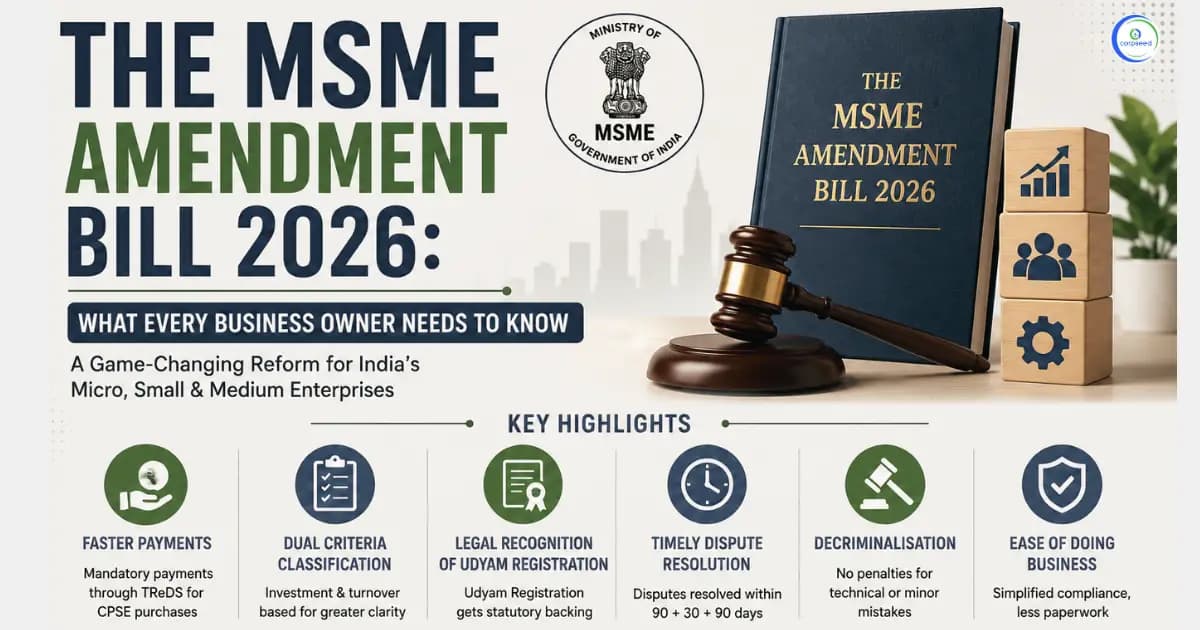
The Micro, Small and Medium Enterprises Development (Amendment) Bill, 2026 was passed by the Rajya Sabha on 3 August 2026 and by the Lok Sabha on 7 August 2026. Parliamentary passage is an important legislative step, but it should not be confused with the Bill already being an enforceable Act. As of this article's publication, businesses should verify Presidential assent and the commencement notifications before treating any proposed provision as legally operative.
The Bill seeks to update the Micro, Small and Medium Enterprises Development Act, 2006 (MSMED Act) in areas including enterprise classification, Udyam registration, delayed-payment mechanisms, dispute resolution, TReDS-related settlement and penalties. Several details also depend on subsequent rules, notifications or commencement dates.
This distinction matters for business owners. A provision described in the Bill may not apply on a particular date merely because Parliament has passed the Bill. The Bill itself provides for commencement through dates notified in the Gazette, and different provisions may therefore become effective at different times.
This article explains the proposed changes, what businesses should prepare for, and what should not yet be treated as a current compliance requirement. For implementation-sensitive matters, businesses should check the latest Gazette and Ministry of MSME notifications before acting.
Schedule a Call Back
What Is the MSME Amendment Bill 2026?
The MSME Amendment Bill 2026 is a proposed amendment to the MSMED Act, 2006. Parliament has passed the Bill, but its legal effect depends on the remaining enactment and commencement steps applicable to its provisions.
In simple terms, the Bill proposes to:
- Use investment and turnover as the twin criteria for MSME classification, with the relevant limits to be governed as provided in the amended framework.
- Provide a statutory basis for the Udyam Registration Portal as a digital registration mechanism.
- Strengthen the use of TReDS for settlement of MSME invoices by Central Public Sector Enterprises (CPSEs), subject to the applicable provisions and implementation framework.
- Empower the Central Government to establish an online mechanism for dispute resolution, with implementation dependent on subsequent rules or notifications.
- Replace certain conviction-based fines with a graded warning/penalty framework rather than describing the change as a blanket replacement of imprisonment.
- Give State Governments greater flexibility regarding the number and functioning of Micro and Small Enterprises Facilitation Councils (MSEFCs).
The existing MSMED Act, 2006 remains the governing statute unless and until the Bill becomes law and its relevant provisions commence. Readers should therefore distinguish between the existing law, the Bill as passed by Parliament, and provisions that have actually been brought into force.
Why Is the MSME Amendment Bill 2026 Important?
The proposed amendments respond to long-standing concerns around MSME classification, delayed payments, digital registration and dispute resolution. They are particularly relevant for businesses that supply goods or services to larger buyers and for organisations that need to track MSME status.
The scale of formalisation has also changed significantly. The registrations increased from 1.65 crore as on 1 April 2023 to 9.16 crore as stated in the relevant government release. The earlier article incorrectly described these figures as rising from 1.65 crore in 2006 to 9.16 crore in April 2023.
The registration figures therefore show growth over the stated period, they should not be used to imply that 1.65 crore registrations existed in 2006 or that 9.16 crore was the April 2023 figure.
Why Does This Matter to Businesses?
- Cash-flow planning: Stronger delayed-payment and TReDS-related mechanisms are intended to improve payment discipline and working-capital access.
- Classification clarity: The investment-plus-turnover approach is intended to provide a clearer basis for determining enterprise category.
- Regulatory certainty: The Bill proposes a graded response to certain defaults instead of relying on conviction-based fines.
- Digital dispute resolution: An online mechanism is proposed, but businesses should wait for the enabling rules and notifications before treating ODR as an operational route.
- Implementation awareness: Businesses need to track commencement notifications because not every provision necessarily becomes effective on the same date.
Applicability of the MSME Amendment Bill 2026
| Category | What the Bill / Existing Framework Means |
| Manufacturing enterprises | Classification is linked to investment and turnover under the proposed framework, applicable thresholds must be checked against the latest notification. |
| Service enterprises | Classification is linked to investment in equipment and turnover under the proposed framework, applicable thresholds must be checked against the latest notification. |
| Central Public Sector Enterprises (CPSEs) | TReDS settlement requirements for MSME procurement should be read with the applicable notification and implementation framework. A separate release confirms the 30 June 2026 TReDS notification for CPSEs. |
| State PSEs and authorities | Any TReDS-related direction should be checked against the relevant Central or State notification rather than assumed to apply automatically. |
| Buyers dealing with micro and small enterprise suppliers | Delayed-payment and dispute-resolution obligations should be assessed under the MSMED Act and the applicable amended provisions. Do not extend MSE-specific remedies automatically to medium enterprises. |
| Businesses not yet registered on Udyam | Udyam registration is a digital, paperless process. Businesses should check whether registration is necessary to establish eligibility for a particular benefit or statutory protection. |
Businesses not yet registered on Udyam Udyam registration is a digital, paperless process. Businesses should check whether registration is necessary to establish eligibility for a particular benefit or statutory protection.
Legal Status: Has the MSME Amendment Bill 2026 Already Become Law?
This is one of the most important corrections to the article. Parliament passing a Bill does not, by itself, establish that every provision is already in force.
The Bill has passed both Houses of Parliament. However, the article should not state that the amendments already govern businesses unless Presidential assent and the relevant commencement notification(s) have been verified. The Bill provides for commencement on dates notified in the Gazette, and different provisions may have different commencement dates.
Accordingly, expressions such as 'under the amended Act', 'mandatory under the new law' or 'businesses must now comply' should be used only where the relevant provision has actually commenced. Until then, use 'the Bill proposes', 'the Bill provides for' or 'once the provision comes into force', as appropriate.
Legal Framework of the MSME Amendment Bill 2026
The Bill proposes amendments to the existing MSMED Act, 2006 in several areas.
- Classification: Investment and turnover are used as the twin criteria, with the applicable thresholds to be read with the relevant government notification.
- Delayed-payment disputes: Provisions relating to references to MSEFCs are proposed to be supplemented by an online dispute-resolution framework.
- Recovery: The Bill provides for recovery mechanisms relating to settlement agreements and arbitral awards in the manner specified by the amended law.
- Penalties: Certain conviction-based fines are proposed to move to a graded warning-and-penalty model.
The detailed operation of these provisions depends on the final enacted law, commencement notifications and any rules or notifications issued under it. Businesses should therefore avoid treating every proposed mechanism as immediately operational.
Governing Authorities and Their Roles
| Authority | Relevant Role |
| Ministry of Micro, Small & Medium Enterprises (MoMSME) | Nodal ministry for MSME policy and administration, including the Udyam framework. |
| Micro and Small Enterprises Facilitation Councils (MSEFCs) | Existing statutory forum for eligible delayed-payment disputes involving micro and small enterprise suppliers, proposed changes may modify the dispute-resolution framework. |
| District Collector / Deputy Commissioner | May have a role in recovery mechanisms provided under the applicable law. |
| Reserve Bank of India (RBI) | Regulates the TReDS ecosystem and authorised platforms. |
| State Governments | May have powers under the amended framework concerning MSEFCs and related state-level administration. |
Eligibility and MSME Classification Under the Proposed Framework
The Bill uses a twin-criterion approach based on:
Investment in plant and machinery for manufacturing enterprises or equipment for service enterprises, and
Turnover of the enterprise.
The applicable thresholds should be taken from the latest government notification. Businesses should not assume that a category mentioned in an older article, certificate or internal record will remain unchanged after the new framework is implemented.
Before relying on MSME status for a contract, benefit or delayed-payment remedy, verify the enterprise's classification and the specific statutory provision that applies to that category.
Benefits and Practical Impact of the MSME Amendment Bill 2026
- Potentially faster payment settlement through TReDS-related mechanisms, particularly for procurement by CPSEs covered by the applicable framework.
- Greater clarity from a twin investment-and-turnover classification system.
- Paperless digital registration through the Udyam system.
- Potentially faster dispute resolution once the proposed online mechanism is established and operational.
- A graded response to certain defaults, reducing reliance on conviction-based fines.
- Greater administrative flexibility for MSEFCs at the State level.
These should be presented as intended or potential benefits of the Bill unless the relevant provision is already in force. In particular, ODR should not be described as an already available mandatory route merely because the Bill empowers the Central Government to establish such a mechanism.
Udyam Registration 2026: Documents or Information Required?
The earlier 'Documents Required' table was misleading. Udyam Registration is a paperless digital process, and applicants do not upload a bundle of documents or proofs such as bank statements, address proofs or financial statements merely to complete registration.
The registration process uses information such as Aadhaar, PAN and GST-related details where applicable, subject to the portal's current requirements and verification process. These should be described as information/details used for registration or verification, not as a list of documents that must be uploaded.
| Information / Detail | How It Is Used |
| Aadhaar details | Used for identity/authentication in the Udyam registration process, as applicable. |
| PAN details | Used for enterprise identification and linkage with relevant government data. |
| GSTIN, where applicable | Used for verification/linkage of GST-related information. |
| Enterprise and classification information | Provided through the digital self-declaration process in accordance with the portal requirements. |
Bank account details, business address proofs and financial statements should not be presented as mandatory Udyam-registration document uploads. They may be relevant to other business, tax, banking, procurement or compliance processes, but that is different from saying they are Udyam registration documents.
How to Prepare for Udyam Registration and the Proposed MSME Framework?
Businesses can prepare without assuming that every proposed amendment is already in force.
- Check your present MSME classification against the latest applicable investment and turnover criteria.
- Complete or update Udyam registration through the official digital portal where appropriate.
- Keep core business and tax information accurate so government records can be cross-checked.
- Review customer contracts and outstanding invoices, especially where the supplier may qualify as a micro or small enterprise.
- Check whether CPSE procurement is covered by the applicable TReDS settlement requirements.
- Monitor Gazette notifications, Ministry of MSME notifications and rules for commencement and implementation of the Bill.
- Use the appropriate MSEFC or other statutory dispute mechanism only after confirming that the relevant provision and eligibility requirements apply.
Timeline for MSME Delayed-Payment Dispute Resolution
The Bill proposes time-bound stages for mediation, arbitration and related proceedings. These timelines should not be presented as universal current obligations until the amended provisions have commenced and the applicable rules or notifications are in place.
| Stage | Position to Be Checked |
| Mediation | The Bill proposes a defined time limit, verify the commencement notification and applicable rules. |
| Referral to arbitration | The Bill provides for a specified period following termination/failure of mediation, verify the final operative text. |
| Arbitral proceedings | The Bill proposes a defined timeline for the award after pleadings, verify the final operative framework. |
| Interim payment in set-aside proceedings | Any percentage or time-based requirement should be applied only after confirming that the relevant provision has commenced. |
Online Dispute Resolution (ODR): What Businesses Should Know
ODR needs a specific qualification. The Bill empowers the Central Government to establish an online mechanism for resolving relevant disputes. That is not the same as saying that a fully operational ODR system is already available or that every delayed-payment dispute must already be filed through it.
Implementation will depend on the rules, notifications, designated mechanism and commencement of the relevant provision. Until those details are officially notified, businesses should continue to follow the dispute-resolution routes that are legally available under the existing framework.
Fees Under the MSME Amendment Bill 2026
Udyam Registration is a free government registration process. Businesses should be cautious of claims that the registration itself carries a government fee.
- Udyam registration fee: no government registration fee.
- Professional or advisory costs: may arise where a business voluntarily engages a consultant.
- Dispute-resolution costs: may arise depending on the forum, process and applicable rules.
Common Mistakes to Avoid
- Treating the Bill as an already commenced Act without checking assent and Gazette notifications.
- Using outdated classification thresholds without checking the latest notification.
- Describing Udyam registration as a document-upload process.
- Listing bank details, address proofs or financial statements as mandatory Udyam registration documents.
- Assuming ODR is already operational merely because the Bill empowers the Central Government to establish it.
- Extending MSE-specific delayed-payment remedies automatically to medium enterprises.
- Describing decriminalisation as the removal of all penalties.
- Calling the change, a replacement of jail terms when the official release refers to conviction-based fines.
- Using registration statistics with the wrong dates or time period.
Penalties Under the MSME Amendment Bill 2026
The Bill proposes changes to certain penalty provisions. The safer description is that some conviction-based fines are proposed to be replaced by a graded warning-and-penalty structure. This should not be rewritten as a blanket statement that 'jail terms are being replaced' unless the exact provision supports that wording.
| Issue | How It Should Be Described |
| Non-filing / non-supply of information | The Bill proposes a graded response involving a warning and subsequent penalty, subject to the final operative provision. |
| Furnishing incorrect information | The Bill proposes a warning for an initial instance followed by penalties for subsequent instances, subject to the final operative provision. |
| Non-disclosure of unpaid dues in annual accounts | The Bill provides for a graded penalty framework, the exact consequences should be checked against the enacted and commenced provision. |
Decriminalisation does not mean penalty-free compliance. Where a provision has commenced, businesses can still face financial or other consequences for non-compliance. The exact consequence should always be linked to the relevant statutory provision.
Latest Updates on the MSME Amendment Bill 2026
- 28 July 2026 - The MSME Amendment Bill, 2026 was introduced in the Rajya Sabha.
- 3 August 2026 - The Rajya Sabha passed the Bill.
- 7 August 2026 - The Lok Sabha passed the Bill, completing parliamentary passage.
- Udyam registration growth - An increase from 1.65 crore as on 1 April 2023 to 9.16 crore in the relevant current reporting period. These figures must not be reversed or assigned to 2006/April 2023.
- TReDS - The invoice discounting on TReDS increased from ₹40,000 crore in FY 2021-22 to ₹3.47 lakh crore in FY 2025-26.
The TReDS figure also records the 30 June 2026 notification requiring operating CPSEs to route settlement of MSME procurement invoices through RBI-authorised TReDS platforms.
For the Bill itself, readers should rely on the final enacted text and Gazette commencement notifications before treating a proposed provision as effective.
What Businesses Should Do Now?
- Do not change statutory compliance processes solely on the basis that Parliament has passed the Bill.
- Check the current legal status, Presidential assent and commencement notification before relying on a new provision.
- Review MSME classification using the latest notified criteria.
- Keep Udyam information accurate and use the paperless portal process.
- Review outstanding invoices from micro and small enterprise suppliers and buyers' payment controls.
- Check TReDS obligations where CPSE procurement is involved.
- Monitor ODR rules and other implementation notifications before changing dispute-resolution procedures.
- Take professional advice where a contract, classification or delayed-payment claim depends on the transition from the existing Act to the amended framework.
Conclusion
The MSME Amendment Bill 2026 is a significant proposed update to India's MSME framework, covering classification, digital registration, payment systems, dispute resolution and penalties. However, Parliament's passage of the Bill should not be presented as proof that every amendment is already enforceable.
The most important compliance point is to separate three things: what the existing MSMED Act currently provides, what Parliament has passed in the Bill, and what has actually commenced through Presidential assent and Gazette notification. The same caution applies to ODR, revised classification thresholds and other implementation-dependent provisions.
Businesses should also avoid inaccurate registration guidance. Udyam is a paperless registration process, and bank details, address proofs and financial statements should not be presented as mandatory registration-document uploads. Similarly, the Bill's penalty changes should be described as changes to conviction-based fines and graded penalties, rather than as a blanket replacement of jail terms.
Corpseed's MSME compliance team can help businesses review their MSME classification, Udyam registration information, TReDS-related processes and delayed-payment compliance while tracking the notifications that bring the proposed amendments into effect. Contact Corpseed for assistance in assessing what applies to your business and what action is required after the relevant provisions commence.
About the Author

Anshika Jindal
Content WriterAnshika Jindal, a Legal Content Writer with strong expertise in legal research and a solid academic background in BA LLB and LLM (Criminal Law). I specialize in researching statutes, case laws, and legal developments and presenting them in clear, accurate, and engaging written content. With strong analytical skills and attention to detail, I create reliable, well-structured legal content while maintaining professional and ethical standards.
I specialize in conducting in-depth legal research using credible sources and presenting legal information in a structured, reader-friendly manner while maintaining precision and authenticity. My work focuses on simplifying legal language without compromising its meaning, making legal content accessible to a wider audience.
Related articles

SVEP: Building a Grassroots Start-up Ecosystem Across Rural India
2026-07-29
Corporate Mitra Scheme 2026: Complete Guidelines
2026-07-29

How To Register A Startup Under Startup India?
2026-12-31

How to Register on the GeM Portal?
2025-12-26

How to Find the Right NIC Code for Udyam Registration (Step-by-Step Guide)
2025-12-16

How SARAL SIMS Changes Import Clearances for MSMEs
2025-12-03