
APEDA Facilitates First Sea Export of GI-Tagged Mithila Makhana to Australia
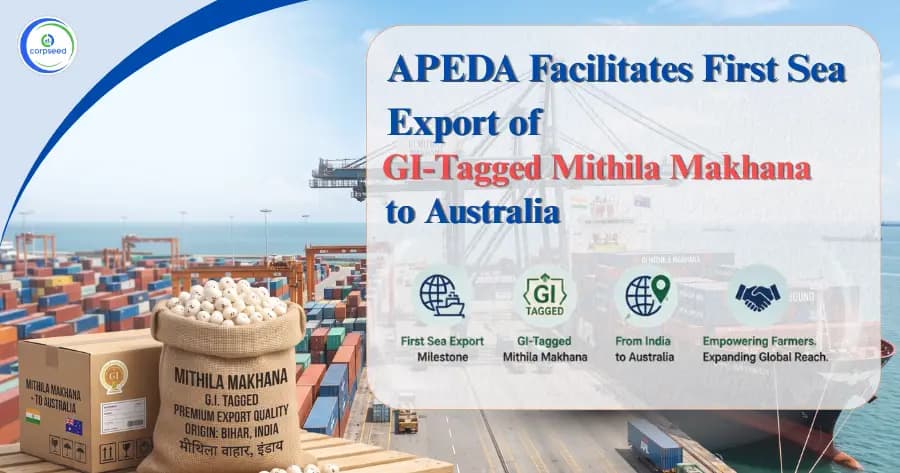
APEDA facilitates the first commercial sea export of 18 MT GI-tagged Mithila Makhana from Bihar to Australia, helping farmers earn 18% more.
Schedule a Call Back
Introduction
The Agricultural and Processed Food Products Export Development Authority (APEDA) has facilitated the first commercial sea shipment of GI-tagged Mithila Makhana from Bihar to Australia. The Ministry of Commerce and Industry announced the development through a Press Information Bureau (PIB) release dated 8 August 2026.
The shipment contained 18 metric tonnes (MT) of premium-quality raw Makhana. It was sourced directly from growers in Darbhanga district, packed at the Bihar Industrial Area Development Authority (BIADA) Industrial Area in Bihta and exported by NIAD Green. The PIB release states that the initiative helped participating farmers realise nearly 18 per cent higher returns than prevailing market rates.
This is an export development notice. It neither proposes any new regulation nor any new licensing requirement, certificate, compliance period, or penalty. What makes it significant is that it outlines a sea freight channel for exporting a GI-labelled agricultural commodity, linking Bihar farmers to an international market.
Export Announcement at a Glance
| Particular | Verified detail |
| Announcing ministry | Ministry of Commerce and Industry, Government of India |
| Facilitating authority | Agricultural and Processed Food Products Export Development Authority (APEDA) |
| Document type | PIB export-development press release |
| Release ID | 2296498 |
| Publication date | 8 August 2026 |
| Main development | First commercial sea shipment of GI-tagged Mithila Makhana from Bihar to Australia |
| Shipment size | 18 MT |
| Product | Premium-quality raw GI-tagged Mithila Makhana |
| Source | Makhana growers in Darbhanga district, Bihar |
| Packing location | BIADA Industrial Area, Bihta, Bihar |
| Exporter | NIAD Green |
| Logistics partner | Jitban Supply Chain Private Limited |
| Destination | Australia |
| Reported farmer benefit | Nearly 18% higher returns than prevailing market rates |
| Direct legal requirement created | None stated in the PIB release |
| Compliance deadline | Not applicable no new compliance duty is announced |
The release records a completed shipment and its expected economic impact. Businesses should not treat 8 August 2026 as an effective date for a new legal requirement.
Why the First Commercial Sea Shipment Matters?
There are commercial differences in shipping 18 MT of Makhana by sea compared to shipping a promotional package or an air freight package. Shipping via sea allows for greater volume, but it requires strict packaging and moisture control, as well as longer-term shelf-life considerations. Sea freight involves longer transit times and requires proper documentation and organization.
There are four reasons why the shipment is important to the Makhana supply chain:
- A greater volume shipment has been demonstrated. This shipment demonstrates that raw GI Mithila Makhana can be collected, packaged, and transported from Bihar to the overseas customer via sea freight.
- Farmers were directly linked to an export consignment. The product was sourced from Darbhanga growers rather than being described only as trader-held stock.
- The release reports better price realisation. Participating farmers reportedly earned nearly 18 per cent more than prevailing market rates. This figure pertains to the described initiative and should not be presented as a guaranteed return for every future shipment.
- The GI identity went along with the product. The association of GI with origin will enable customers to identify Mithila Makhana from unbranded fox nuts, but this depends on proper use of the GI.
The consignment by itself will not ensure repeat orders, premium stability, or reduced freight charges. That will depend on customer demand and consistent quality among other factors.
How the Bihar-to-Australia Export Was Executed?
The PIB release identifies a multi-party model rather than a single exporter acting alone.
| Stage | Organisation or stakeholder | Role stated in the release |
| Farm sourcing | Makhana growers of Darbhanga district | Supplied the raw GI-tagged Mithila Makhana |
| Packing | Facility in BIADA Industrial Area, Bihta | Location where the consignment was packed |
| Export | NIAD Green | Exported the 18 MT consignment |
| Logistics | Jitban Supply Chain Private Limited | Provided logistics support |
| Market access and coordination | APEDA | Facilitated market access and coordinated movement |
| State support | Department of Agriculture, Government of Bihar | Associated with APEDA in facilitating the export |
| Public flag-off | Agriculture Minister, Government of Bihar | Flagged off the consignment |
Jitban Supply Chain is described as a startup supported under APEDA's BHARATI programme, Bharat's Hub for Agritech, Resilience, Advancement and Incubation for Export Innovation. Its participation illustrates how agritech and logistics startups can connect farm-origin products with export infrastructure.
Bihar Agriculture Minister Shri Vijay Kumar Sinha led the flag-off ceremony. It was attended by the Director of Horticulture, Government of Bihar, APEDA officers, exporters, logistics representatives, and progressive Makhana growers.
Farmer Returns and the Makhana Value Chain
However, the greatest immediate impact noted by PIB is an 18 percent higher yield for the farmers under discussion compared with current market rates. This figure needs to be interpreted with caution as the PIB release does not provide any of the following:
- Base market rate
- Farm gate price paid
- Duration of the comparison period and
- Number of farmers who participated in the program.
Therefore, this PIB release only validates the percentage increase achieved and cannot be used to make revenue forecasts for future exporters.
The commercial model may strengthen the value chain by encouraging:
- aggregation of exportable quantities from multiple growers
- clearer quality specifications at the farm and processing stages
- better coordination among growers, processors, packers, exporters and logistics providers
- direct feedback from international buyers and
- stronger incentives to preserve product origin and quality.
The Bihar Agriculture Minister also referred to the Phori community, whose traditional skills are integral to Makhana processing. Continued inclusion of skilled processors is important because export growth should strengthen, rather than displace, the knowledge and livelihoods embedded in the traditional value chain.
GI Status and Product Identity
Mithila Makhana is a registered agricultural Geographical Indication (GI) of Bihar. According to the official GI register, the application number is 696, and the registration date is 14 August 2020. GI denotes a product whose quality, reputation, or other characteristics are connected with its geographical origin.
GI certification is commercially valuable however, it is not only a marketing term. Business organizations using the trademarked name should determine whether their supply chain, authorization, descriptions of goods, packaging, and claims about the products align with the registered GI and intellectual property rights. The PIB press release shows that the exported goods were GI-certified. However, it does not provide information on the authorized user documentation, the GI labelling approach, or the validation documents for this particular shipment.
GI identification may be helpful for foreign clients in providing:
- Proof of recognized regional origin
- Distinguishing from general Makhana or fox nuts
- Additional farm and cultural information
- Premium positioning based on product quality and client demands
- Higher expectations regarding sourcing and packaging traceability.
GI certification does not cover food safety, export, customs, packaging, or destination-country regulations. Each regulatory aspect covers another type of business or legal risks.
APEDA's Role in the Shipment
APEDA is a Statutory Body in the Ministry of Commerce & Industry. It is constituted by the Agricultural and Processed Food Products Export Development Authority Act, 1985, effective from 13th February 1986.
In respect of this consignment, PIB mentions that APEDA has been working with the Bihar Department of Agriculture to facilitate the exporter with market access. The broader activities of APEDA concerning Makhana are described as capacity building, market development, export facilitation, and stakeholder engagement.
APEDA is also working with state governments, exporters, startups, Farmer Producer Organisations (FPOs), Farmer Producer Companies (FPCs) and other stakeholders to improve the global competitiveness of Indian agricultural products. This network approach is particularly relevant to crops in which production is spread among numerous growers and export orders require consistent aggregation.
Bihar's Production Base and India's Makhana Export Position
According to the PIB release, Bihar accounts for nearly 85 per cent of India's Makhana production. This concentration gives the state a natural advantage in grower networks, traditional processing skills and product identity. It also means that weaknesses in Bihar's aggregation, quality infrastructure or logistics can affect a large share of India's export potential.
PIB notes that India exported more than 7,000 MT of Makhana and Makhana products in FY 2025-26. More than 20 countries worldwide are recipients of Makhana exports, including the US, the Middle East, and Africa.
However, the Australian shipment differs in that it provides additional information about destinations beyond those mentioned earlier. But it should be noted that this is just one example of a transaction and does not indicate that all exporters can automatically access these markets.
Makhana HS Classification: What the Release Says
The PIB release states that a separate Harmonised System (HS) code for Makhana came into effect from July 2025 under the Finance Bill, 2025. An HS code is a customs classification used to identify traded goods for tariff, policy and statistical purposes.
The official Finance Bill schedule gives more detail. It defines Makhana for the relevant tariff items as the seed of Euryale ferox Salisb., also commonly known as gorgon nut or fox nut, and identifies three prepared or preserved product categories:
| Tariff item in the Finance Bill schedule | Product description |
| 2008 19 21 | Popped Makhana |
| 2008 19 22 | Popped Makhana |
| 2008 19 29 | Other Makhana within the specified heading |
This classification can improve trade data visibility and distinguish among product forms. It should not be applied mechanically to every consignment. Raw, processed, flavoured or otherwise prepared goods may require classification based on their actual composition and form. Exporters should verify the current ITC (HS) entry, export policy and customs treatment for the product being shipped.
Impact on Makhana Businesses and Stakeholders
Below is the impact on makhana business that are as follows:
| Stakeholder | Immediate relevance | Likely commercial or operational effect | |
| Darbhanga and other eligible growers | Demonstrated access to an export-linked procurement channel | Potential for better price realisation where quality and buyer terms support it | |
| Processors and the Phori community | Traditional processing remains part of the value chain | Higher volumes may create more work and demand for process consistency | |
| Exporters | A sea route to Australia has been demonstrated | Higher volumes may create more work and demand for process consistency | |
| FPOs and FPCs | APEDA identifies them as value-chain partners | Opportunity to aggregate supply and organise growers | |
| Packers and food businesses | Export-quality packing was completed in Bihta | Demand may rise for suitable packing and shelf-life control | |
| Logistics and agritech startups | BHARATI-supported logistics participated | Potential demand for farm-to-port coordination and shipment visibility | |
| Bihar-based MSMEs | A GI product has gained another overseas route | Scope for raw and value-added product development |
The possibility may inspire more firms to venture into Makhana exports however, commercial feasibility is transaction- and product-specific. The buyer's enquiry has to be evaluated based on purchase costs, processing costs, packing costs, transportation within the country, port charges, shipping costs, insurance, payment, and the risk of rejection.
Business Opportunities Created by the Shipment
The release points to genuine opportunities across the Makhana ecosystem without establishing a guaranteed market.
- Organised farm aggregation: FPOs, FPCs and procurement businesses can build verified farmer networks capable of supplying consistent grades in commercial quantities.
- Export-quality processing and packing: Larger sea consignments can create demand for cleaning, grading, moisture control, hygienic processing, suitable packaging and batch-level records.
- Value-added products: India's reported export volume includes Makhana and value-added Makhana products. Businesses may assess popped, powdered or other prepared formats against buyer demand and the applicable classification.
- GI-led brand development: Correct use of the Mithila Makhana identity can help eligible businesses communicate origin and authenticity.
- Specialised logistics: Bihar-to-port planning, container conditions, freight coordination and shipment tracking can become a focused service segment.
- Market-access support: Exporters may need buyer discovery, regulatory research, product adaptation and contract review before attempting repeat shipments.
- Startup participation: Jitban Supply Chain's role shows how APEDA-supported startups can participate in a traditional agricultural value chain.
The most durable opportunities will come from repeatable quality and reliable delivery, not from the publicity value of a first shipment alone.
Export-Readiness Checks for Makhana Businesses
The PIB release does not prescribe a compliance process. The following are practical assessment areas for businesses considering a similar export and must be checked against the actual product, exporter status, destination, and contract:
- Confirm product and GI eligibility. Verify the origin of the Makhana, the right to use the protected GI name, and the records needed to support origin claims.
- Classify the exact product. Determine whether the consignment is raw, popped, powdered, flavoured or otherwise prepared, and verify the current ITC (HS) classification and export policy.
- Review exporter registrations. Assess the applicability and status of the Importer Exporter Code, APEDA Registration-Cum-Membership Certificate and other registrations relevant to the exporter and food business.
- Map Indian and Australian requirements. Check the food safety, phytosanitary or biosecurity, residue, contaminant, packaging, labelling, and import conditions that apply to the exact product. The PIB release does not list these requirements.
- Accept quantified buyer specifications. Document grading, sizing, moisture content, defects, microbiological or chemical characteristics, packaging, shelf life, and inspection conditions.
- Develop traceability. Link producer or supplier information to processing batches, packing lots, and export documentation to verify source and quality claims.
- Confirm seaworthy condition. Evaluate risk factors such as moisture content, temperature, pests, odours, contamination, and shelf life along the planned route of transit.
- Harmonize commercial documents. Ensure that the sales agreement, commercial invoice, packing list, shipping documentation, insurance arrangements, and payment terms are consistent in their descriptions of the goods.
- Assess economics of deal. Determine whether the anticipated sales price will cover the cost of acquisition, processing, packing, testing, inland transportation, shipping, insurance, and working capital.
- Plan contingency arrangements. Develop a contingency plan for transit delays, broken packages, failed tests, buyer complaints, or customs questions.
These measures are not requirements as set out in Release ID 2296498. Further analysis specific to each deal must be conducted before shipment.
Risks and Challenges to Manage
- Quality maintenance during sea transport
Sea transit usually takes longer than air transit. Makhana Enterprises must pay special attention to aspects such as water entry, packaging, container condition, shelf life, and protection from contamination. In the release, there is information about quality requirements, but no details on testing and packaging were specified.
- Maintaining authenticity of GI
Increasing demands may lead to poor origin documentation or inappropriate use of the name of a GI product. This situation is likely to be harmful for legal protection and consumers’ trust. GI must be proven throughout the purchasing, processing, packing, and promotion of goods.
- Making a good beginning to regular business
Successful delivery of one consignment is a starting point. Regular orders require acceptance of cargo at the destination, consistent batches, reliable delivery, relationship-building with buyers, and reasonable pricing. There is no mention of final results of the delivery in the press release.
- Including smaller value-chain participants
Growers, traditional processors and small enterprises may need aggregation, training, working capital and shared infrastructure to participate in export orders. Commercial expansion should maintain transparent procurement terms and recognise the Phori community's contribution to processing.
What Businesses Should Do Next
- Growers and growers’ organisations: maintain records from the origin of farms, determine quality grades, and evaluate group aggregation into exportable batches.
- Processors and packers: check hygiene, batch control, packaging, storage, and shelf-life information for the proposed transit.
- Current exporters: ascertain demand from Australian buyers and verify the import conditions in place before pledging prices and shipping dates.
- New exporters: conduct an applicability assessment related to exporter registration, food business needs, GI application, classification, and destination country requirements.
- Logistics providers: create controls tailored to the particular transit of Makhana, namely inland transport, containerisation, documentation transfers, and delay prevention.
- Startups: study APEDA initiatives and relationships pertinent to agritech, traceability, market access, and export logistics.
- State and industry bodies: use the shipment as a reference model, while collecting transaction data needed to judge repeatability and farmer benefit.
How Can Corpseed Help?
Businesses planning to export Makhana or other agricultural products may need coordinated legal, registration, product and shipment support. Corpseed's agricultural export consultancy services can help identify the requirements applicable to the proposed product and destination, without treating this PIB announcement as a substitute for a transaction-specific review.
Relevant support may include:
- exporter and product applicability assessment
- Importer Exporter Code application support
- APEDA registration and RCMC support, where applicable
- GI registration or authorised-user advisory and application assistance
- food-business registration and compliance support
- ITC (HS) classification and export-policy research
- product labelling and packaging compliance review
- export-documentation and pre-shipment checklist support and
- regulatory research for the intended destination market.
Approvals, shipment acceptance and commercial outcomes remain subject to the competent authorities, documentary evidence, product conformity, buyer requirements and applicable law. Corpseed supports businesses in preparing a clearer, better-coordinated compliance path it does not guarantee approval or export results.
Makhana growers, FPOs, processors, startups and exporters evaluating Australia or another overseas market can seek agricultural export consultancy services from Corpseed for a product- and destination-specific readiness assessment.
Key Takeaways
- APEDA facilitated the first commercial sea shipment of GI-tagged Mithila Makhana from Bihar to Australia.
- The 18 MT consignment was sourced from farmers in Darbhanga and packed at the BIADA Industrial Area in Bihta.
- PIB reports that participating farmers realised nearly 18 per cent higher returns than prevailing market rates.
- NIAD Green exported the shipment, while BHARATI-supported Jitban Supply Chain provided logistics support.
- Bihar accounts for nearly 85 per cent of India's Makhana production, according to the release.
- India exported more than 7,000 MT of Makhana and value-added products to more than 20 destinations in FY 2025–26.
- The announcement creates no new compliance deadline or legal duty, but it highlights market-access possibilities and the need for quality, traceability, GI integrity and export readiness.
The export of Mithila Makhana to Australia is best understood as a successful market-access and value-chain development event. Its long-term value will depend on whether businesses can convert the route into consistent, compliant and commercially sustainable trade.
About the Author

Anshika Jindal
Content WriterAnshika Jindal, a Legal Content Writer with strong expertise in legal research and a solid academic background in BA LLB and LLM (Criminal Law). I specialize in researching statutes, case laws, and legal developments and presenting them in clear, accurate, and engaging written content. With strong analytical skills and attention to detail, I create reliable, well-structured legal content while maintaining professional and ethical standards.
I specialize in conducting in-depth legal research using credible sources and presenting legal information in a structured, reader-friendly manner while maintaining precision and authenticity. My work focuses on simplifying legal language without compromising its meaning, making legal content accessible to a wider audience.