
National Green Hydrogen Mission in India
India's National Green Hydrogen Mission is now progressing into manufacturing, production agreements, and industry applications. The latest update from the Indian government in October 2026 showed that there has been significant progress on the manufacturing of electrolyzers, incentive schemes, certification, and pilot projects. Supply agreements show that there are buyers for green hydrogen in India.
Schedule a Call Back
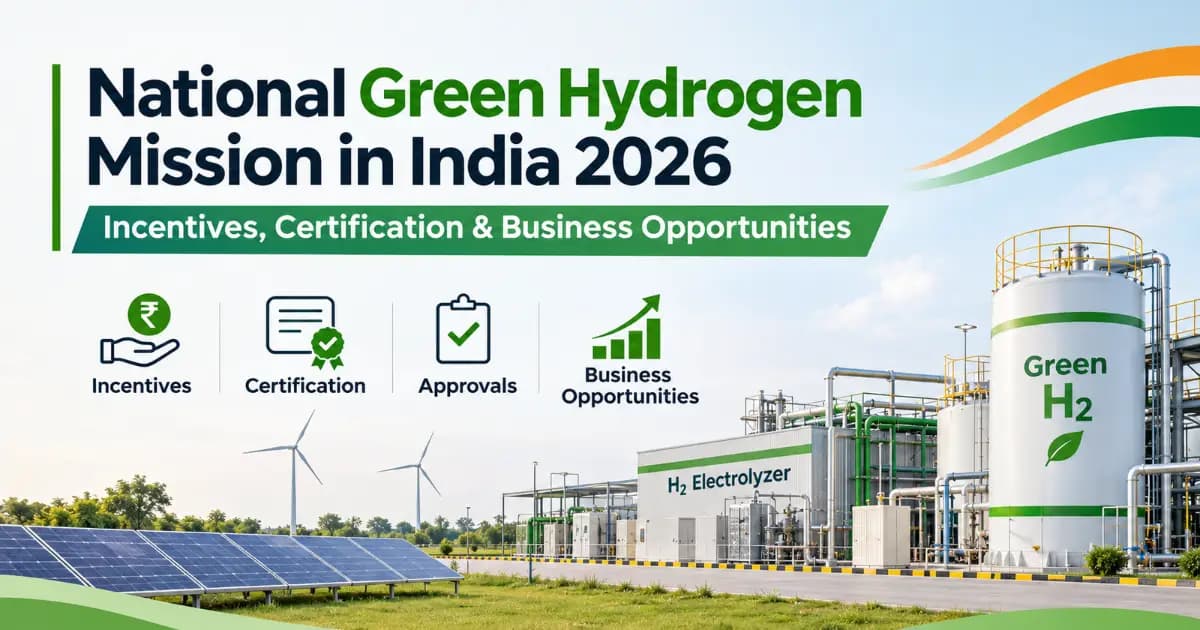
India's National Green Hydrogen Mission is now progressing into manufacturing, production agreements, and industry applications. The latest update from the Indian government in October 2026 showed that there has been significant progress on the manufacturing of electrolyzers, incentive schemes, certification, and pilot projects. Supply agreements show that there are buyers for green hydrogen in India.
This article outlines how far the green hydrogen mission has progressed and why the choice of electrolyzer is not the only consideration for setting up plants in India.
Schedule a Call Back
What Is Green Hydrogen and How Is It Produced?
Green hydrogen is generated via renewable energy sources, specifically by water electrolysis. The electrolyser consumes electricity generated from sources like solar or wind energy to separate water into hydrogen and oxygen. The hydrogen is purified and, according to the purpose, compressed and stored.
Unlike conventional hydrogen made from fossil fuels, renewable-powered hydrogen production can have substantially lower greenhouse gas emissions. Hydrogen can serve as an industrial feedstock or generate electricity through fuel cells.
India's Green Hydrogen Standard also recognises qualifying biomass-based production routes. Meeting the standard depends on measured emissions, including electricity sourcing, water treatment and processing.
National Green Hydrogen Mission: Targets and Progress in 2026
In January 2023, the Union Cabinet sanctioned the National Green Hydrogen Mission. The Ministry of New and Renewable Energy (MNRE) will implement it, and it is designed to increase the production, consumption, and export of hydrogen and its derivatives.
The mission has an approved outlay of 19,744 crore rupees up to 2029–30. Its central ambition is to establish at least five million metric tonnes (MMT) of annual green hydrogen production capacity by 2030.
Incentive awards do not mean plants are operating; commissioned capacity also differs from actual output.
On 29 October 2026, the government also reported signed green hydrogen offtake commitments equivalent to around 5.56 lakh tonnes per year. These are agreements to buy future supplies, not evidence that the same volume is currently being manufactured.
| National Green Hydrogen Mission 2026 indicator | Reported figure | What it means |
| Approved mission outlay | 19,744 crore rupees | Government allocation up to 2029-30 |
| Green hydrogen production capacity target | At least 5 MMT per year | Target for 2030, not current production |
| Green hydrogen offtake commitments | Around 5.56 lakh tonnes per year | Signed future purchase commitments reported on 29 October 2026 |
Government Incentives and Benefits for Green Hydrogen Projects in India
The main financial support comes through the Strategic Interventions for Green Hydrogen Transition (SIGHT) programme, with an allocation of 17,490 crore rupees. Of this, 4,440 crore rupees supports domestic electrolyser manufacturing and 13,050 crore rupees supports green hydrogen production.
Support depends on competitive selection, eligibility and project milestones. Not every proposed plant qualifies for a fixed subsidy.
The availability of a green hydrogen subsidy in India depends on the scheme, project category and selection conditions.
Other policy measures may lower project costs:
- Inter-state transmission charges: Eligible green hydrogen and green ammonia plants commissioned by 31 December 2030 can receive a full waiver of Inter-State Transmission System (ISTS) charges for 25 years, subject to prescribed renewable-energy conditions.
- Renewable electricity access: The Green Hydrogen and Green Ammonia Policy provides for time-bound open access and banking of surplus renewable electricity for up to 30 days, subject to applicable rules and charges.
- SEZ benefits: Eligible Special Economic Zone units may receive specified duty benefits for renewable-energy equipment used exclusively for captive consumption.
- State support: State green hydrogen policies may offer additional facilitation or incentives, but their scope and eligibility vary.
Before estimating a green hydrogen project's returns, businesses should separate confirmed financial support from possible benefits and examine the tender or policy conditions that apply to their location.
Green Hydrogen Certification Rules and GHCI Portal in India
India's Green Hydrogen Standard, which came into effect in August 2023, sets an upper limit of 2 kg of carbon dioxide equivalent emissions per kg of hydrogen produced, calculated as a 12-month average based on a well-to-gate approach. This calculation takes into account various stages such as energy generation, water processing, purification, and compression.
The Green Hydrogen Certification Scheme of India (GHCI) was launched in April 2025, while the online certification portal was launched on 17th June 2026. The online portal helps in the registration of producers, emissions accounting, and verification. The Bureau of Energy Efficiency (BEE) recognizes the organizations responsible for monitoring, verification, and certification.
Under the scheme, a Final Certificate is mandatory for green hydrogen producers that receive central or state government incentives or intend to sell or use green hydrogen in India. Producers must follow the applicable monitoring and verification requirements rather than relying solely on a self-declaration that their electricity is renewable.
In February 2026, India also notified separate standards for green ammonia and green methanol. These define emissions-related conditions for hydrogen-derived products.
GHCI certification establishes whether hydrogen satisfies the relevant green hydrogen standard. It does not replace approvals needed to establish or operate an industrial plant.
Green hydrogen certification in India also requires attention to production records, electricity sourcing and emissions verification.
Green Hydrogen Plant Setup in India: Approvals, Costs and Compliance
Before committing capital to a green hydrogen manufacturing plant, an investor needs a realistic assessment of where the hydrogen will be made, how it will be powered and who will purchase it. Electricity is a major operating input, while hydrogen storage and delivery can add substantial infrastructure costs.
A green hydrogen project feasibility study should examine five areas:
1. Site and customers: Land availability, access roads, industrial zoning, nearby demand and the distance to potential hydrogen or green ammonia buyers.
2. Renewable power: Solar or wind supply agreements, grid connectivity, electricity tariffs, banking arrangements and the need for storage or backup power.
3. Water and technology: Water availability, treatment requirements, electrolyser efficiency, compression, storage and safe handling systems.
4. Project costs: Land, equipment, civil works, renewable-power infrastructure, operating expenses, financing and maintenance. There is no single reliable green hydrogen plant cost in India for every project.
5. Regulatory requirements: Consents from the appropriate State Pollution Control Board, Industrial safety requirements, Water consents, Fire consents and petroleum /compressed gas consents where applicable to the proposed facilities.
| Green hydrogen plant planning area | Key requirement or cost factor |
| Site and project feasibility | Location, industrial zoning, buyers and transport distance |
| Renewable electricity and water | Power supply agreements, tariffs, treatment and water availability |
| Electrolyser and storage infrastructure | Equipment efficiency, hydrogen compression and safe handling |
| Green hydrogen plant setup cost | Land, machinery, civil works, operating expenses and financing |
| Green hydrogen plant approvals | Applicable pollution-control, industrial safety, water, fire and gas permissions |
A detailed project report (DPR) for green hydrogen plant setup can bring production planning, estimated costs and approval requirements into one proposal.
An important environmental exemption applies to qualifying standalone facilities. Green hydrogen or green ammonia plants using renewable-powered water electrolysis do not require prior Environmental Clearance under the EIA Notification, 2006. However, a hydrogen project added to an existing facility covered by an Environmental Clearance may require an amendment. Other statutory consents and safety approvals must still be assessed separately.
This is why a project-specific compliance review is preferable to applying for every approval listed on a generic website. A green hydrogen plant setup consultant can help identify which requirements apply to the planned technology, storage arrangements and location.
Planning a production facility? Explore Corpseed's green hydrogen plant setup services before finalising your project documentation.
Green Hydrogen Applications, Hubs and Business Opportunities in India
Green hydrogen has immediate relevance in industries that already consume hydrogen. Fertiliser plants use it to make ammonia, while petroleum refineries use hydrogen for processing and fuel treatment. Replacing fossil-based supply with qualifying green hydrogen can reduce emissions from these activities.
Other potential markets include direct-reduced iron and steelmaking, selected heavy-duty vehicles, shipping fuels and energy storage. Green ammonia and green methanol may also serve export customers, although commercial viability depends on pricing, long-term purchase agreements, safety standards and logistics.
India is supporting clustered development to bring producers, buyers and infrastructure closer together. MNRE has recognised three port-based green hydrogen hubs: Deendayal Port at Kandla in Gujarat, V.O. Chidambaranar Port at Tuticorin in Tamil Nadu and Paradip Port in Odisha.
According to reports from October 2026, the states of Gujarat, Andhra Pradesh, Maharashtra, Uttar Pradesh, Rajasthan, and West Bengal have notified specific green hydrogen policies. The benefits available in these states are not the same.
For manufacturers, developers and investors, business opportunities extend beyond hydrogen production itself. Electrolyser manufacturing, renewable-energy supply, water-treatment equipment, compression, storage, engineering and logistics may all form part of the developing supply chain. Nevertheless, securing a dependable buyer and competitively priced renewable power is usually more valuable than relying on ambitious market projections alone.
How Can Corpseed Help with Green Hydrogen Projects?
Setting up a green hydrogen production facility involves technical planning alongside different regulatory requirements. Corpseed's green hydrogen project consultancy supports businesses seeking guidance on project documentation, relevant permissions and the steps involved in establishing a facility.
Depending on the proposed activity, assistance can include reviewing approval requirements, preparing applications and coordinating documentation for applicable pollution-control and other regulatory processes. The precise permissions should be determined only after understanding the site, plant design, production capacity and storage arrangements.
Businesses evaluating a new green hydrogen plant setup in India can contact Corpseed to discuss their project scope and compliance requirements before proceeding with applications.
Conclusion
The National Green Hydrogen Mission has created a clearer policy framework for hydrogen producers, manufacturers and industrial buyers. Incentives, certification and emerging supply contracts are encouraging investment, but successful projects still depend on practical economics and the correct approvals. Businesses planning to enter this market should evaluate their power supply, customers, technology and compliance obligations together.
About the Author

Mahek Sancheti
Content WriterMahek Sancheti, BAJMC graduate with a deep passion for writing. As a content writer, video content creator, creative content creator, and scriptwriter, I bring stories to life through words and visuals. I honed my skills by working with a prominent news agency, where I excelled in crafting compelling narratives and engaging content. Coming from a journalism and mass communication background I have skills to craft engaging narratives that captivate audiences. With a keen interest in writing and creativity, I aim to deliver impactful and meaningful content that resonates with diverse audiences.
https://www.linkedin.com/in/mahek-sancheti-837196212
Related articles
CBG Plant Compliance Under GOBARdhan Scheme: Online GC Rules Relaxed Until March 2027
2026-10-28
PNGRB Hydrogen Blending Guidelines 2026: 5% PNG Rules, Safety and Approvals
2026-10-15
India-Japan CBG Initiative Targets 1,000 Biogas Plants and 2.5 Million CNG Vehicles by 2030
2026-07-07
How to Start an E-waste Recycling Business in India?
2026-04-28
Government Initiatives of Compressed Biogas (CBG) Subsidy
2026-04-02
Cleaner Engines, Greener Future: What India’s New Emission Rules Mean for Agriculture and Construction
2026-03-26