
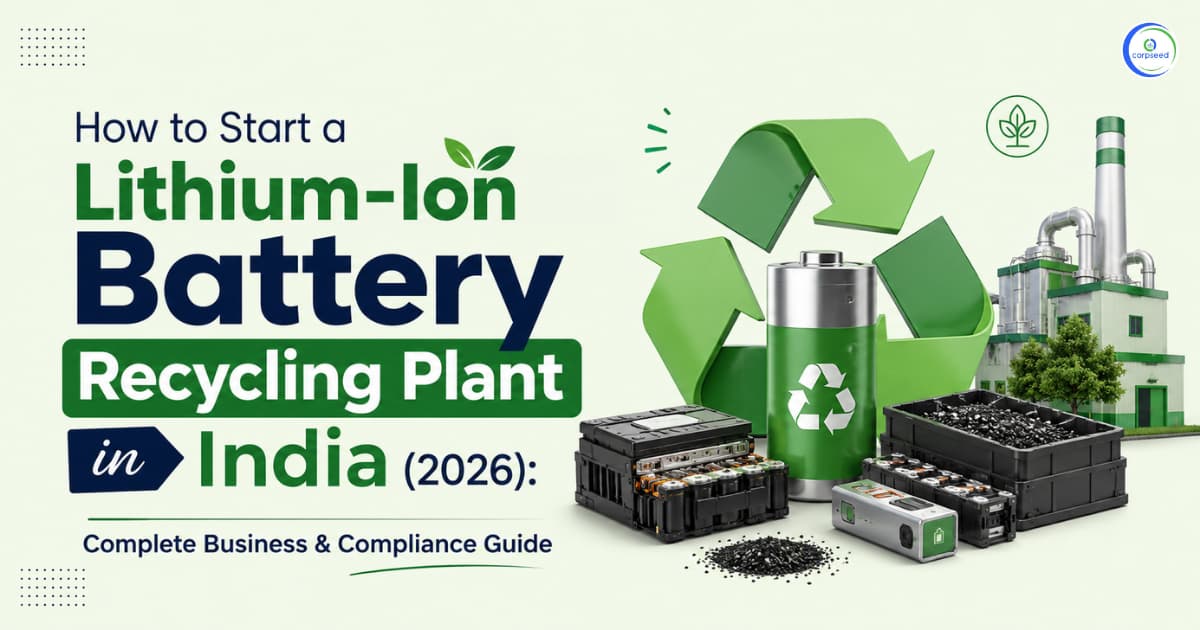
How to Start a Lithium-Ion Battery Recycling Plant in India (2026): Complete Business & Compliance Guide
The rapid adoption of electric vehicles (EVs), consumer electronics, and energy storage systems has significantly increased the demand for Lithium-Ion Battery Recycling in India. Establishing a recycling plant requires compliance with the Battery Waste Management Rules, 2022, CPCB registration, State Pollution Control Board (SPCB) approvals, environmental clearances, factory licenses, hazardous waste management requirements, and other applicable regulations.
Schedule a Call Back
1,800+ plant setup, DPR and CTE/CTO assignments since 2018
Clients include Quantara Battery Recycling, Servotech Renewable Power System, Intangles Lab, Alten India, Saurya Urja Company of Rajasthan, 20Cube Logistics Solutions, Adit Buildwell, Bake Wish, Ecowise Trading, Magnum Aluminium, PMS Waste Management, GS E-Commerce.
A few more clients we've served in this industryHide the list
- Battery recyclers
- Quantara Battery Recycling
- Plant setup clients (DPR, CTE, CTO)
- Servotech Renewable Power System · Intangles Lab · Alten India · Saurya Urja Company of Rajasthan · 20Cube Logistics Solutions · Adit Buildwell · Bake Wish · Ecowise Trading · Magnum Aluminium · PMS Waste Management · GS E-Commerce · Beaucience India · Jiva Ayurveda Pharmacy · Radical Aftermarket Services · SNS Metpro Industries · Enershell Alloys and Steel · Gorevive · Innovation Elephants · P P Bafna Ventures · Sun Mobility · Daebak India Recycler · Ganesh Foundry & Cast · Ganix Rubber Recycling · Pashidaa E Waste Copper Battery Recycling PLT Company · RSV Seeds & Agro Chemicals Products · Boulevard Hotel and Resorts · Dev Plast Privat E · Flexfit Activewear · Resurge Green Tech · SAM Constructions · Abhinandan Jan Kalyan Society · GCM Carbon · Infrathon Projects · Inland Speciality Metals · Moore Pipe India · R K Laxmi General Sales · S G Overseas · Shreeji Anand Resort · SR Polygrain · Switch 2 Nature · Blubble · M-Swasth Solutions · Krisba Healthcare · Meritech India · Proximise · Enzolt Energy · Rays Global Energypower
Introduction
India's electric mobility boom has triggered an unprecedented battery waste crisis, and enterprise investors evaluating how to start a lithium-ion battery recycling plant in India are entering the country's fastest-growing circular economy sector. Industrial investors, e-waste executives, and corporate ESG leads are converging on an efficiently designed battery recycling plant setup that offers three converging revenue lines: black mass sales, refined critical-mineral output, and tradable EPR credits. NITI Aayog projects that India's recyclable lithium-ion battery recycling volume will far outpace current processing capacity by 2030, positioning battery recycling plant investment as one of the most under-capitalised industrial opportunities in the country today. Yet this is not a market for unlicensed entrants. Under the Battery Waste Management Rules, having a valid battery recycling license, CPCB battery recycling registration, and full statutory clearance are mandatory before ground is broken, making advance EPR compliance for battery recycling the single greatest determinant of commercial viability.
What Are Lithium-Ion Batteries?
Lithium-ion batteries are a type of rechargeable battery that works by moving lithium ions from one electrode (cathode) to another (anode) using an electrolyte; the materials used in Li-ion batteries include cobalt, nickel, lithium, and copper, meaning that these batteries cannot be disposed of in landfills and need a recycling facility for this purpose.
Each cell is built from four core components: a metal-oxide cathode, a graphite anode, a liquid or polymer electrolyte, and a polymer separator, all sealed inside a metal or pouch casing.
Because these cells remain electrically charged and chemically reactive at end-of-life, improper handling can trigger thermal runaway, fire, or toxic leaching, which is precisely why the Government of India classifies them as hazardous waste requiring authorized processing.
This hazard profile is exactly what makes a compliant lithium-ion battery recycling plant a unique industrial segment rather than an offshoot of the scrap recycling industry. A compliant lithium-ion battery recycling facility requires the presence of a sophisticated system of discharging procedures, inert atmosphere shredding operations, and licensed hazardous waste handling facilities - something that normal metal recyclers lack.
This technical entry barrier to the industry for business investors is, at the same time, a business opportunity since only certified battery recycling facilities have the right to recycle these batteries, provide EPR certification, and extract valuable metals from them. Such a plant must combine specialized discharging protocols, inert-atmosphere shredding, and licensed hazardous-waste handling - infrastructure that ordinary metal recyclers do not possess.
Schedule a Call Back
Why Invest in a Lithium-Ion Battery Recycling Plant?
A compliant lithium-ion battery recycling plant earns B2B income from three convergent sources - sales of black mass, production of refined metals, and trading of EPR certificates, with the latter source being the fastest-growing and obligatory revenue stream under EPR certification.
According to the Battery Waste Management Rules, all PIBOs have an obligatory EPR responsibility to develop recycling facilities or buy EPR certificates from certified recyclers.
In other words, this purchase of EPR credits an obligatory business for manufacturers due to the possibility of paying for not meeting collection and recovery requirements through environmental compensation.
For investors, this converts battery recycling from a pure commodity-metals business into a hybrid model, commodity revenue plus a regulator-created compliance marketplace.
Market Potential of Lithium-Ion Battery Recycling in India
NITI Aayog projects that India will generate close to 128 GWh of recyclable lithium-ion batteries by 2030, and the domestic battery recycling market is growing at nearly 18% CAGR, making this one of the fastest-expanding industrial sectors in the country today.
Here is what makes the market so promising:
- By 2030, India is expected to have around 128 GWh worth of used lithium-ion batteries that need recycling. That is a massive number, and it keeps growing every year as more electric vehicles hit the road.
- Right now, India can only process a tiny fraction of this volume. This gap between what is available and what can actually be recycled is the biggest reason why new battery recycling plants are in such high demand.
- Industry estimates put the battery recycling business in India growing at close to 18% every year. Few industrial sectors in the country are expanding this quickly.
- Nearly half of all recyclable battery volume by 2030 is expected to come from electric vehicles alone, as early EV batteries from two-wheelers and three-wheelers start reaching the end of their life.
- The country imports almost all of its lithium, cobalt, and nickel from other nations. Every battery recycled at home means less money spent on imports and more mineral security for the future.
- Because so few licensed recycling plants exist today compared to the coming wave of battery waste, businesses that set up now are positioned to capture demand before the market gets crowded.
Business Opportunities in Battery Recycling
A lithium-ion battery recycling business in India is not just one revenue stream. Smart enterprises build income across four layers, and each one needs a different level of investment and technology.
- Black Mass Sales: This is the easiest way to start. You shred old batteries into a concentrated powder called black mass and sell it to bigger refiners. It needs the lowest investment, but you also earn the least profit per tonne.
- Hydro-metallurgical: With hydro-metallurgical technology, you can extract pure lithium, cobalt, and nickel yourself instead of selling raw black mass. This needs much higher investment, but the profit margins are far better too.
- EPR Certificate Trading: Once you are a registered recycler, you can issue Battery EPR certificates on the CPCB portal and sell them to battery producers and importers who need to meet their recycling targets. This is steady, ongoing income that does not depend much on metal prices going up or down.
- Second-Life Repurposing: A battery that no longer works in an EV doesn't necessarily mean that its usefulness has ended completely, there may be plenty of life left to do other tasks, such as storing solar energy or backing up electricity. This relatively new venture has tremendous earning potential.
Read Our Blog: How to Start a Battery Waste Dealing Business in India
Why Is Recycling Lithium-Ion Batteries Important?
Here is why recycling lithium-ion batteries is important:
- India imports almost all of its lithium, cobalt, and nickel from other countries. Hence, recycling old batteries at home is a smart way to reduce this dependence and protect national mineral security.
- Every kilogram of lithium, cobalt, or nickel that India can recover from used batteries means one less kilogram for India to import from other countries. This means saving money and insulating the industry from any unexpected price hikes or shortages abroad.
- Old lithium-ion batteries are hazardous waste. If they end up in landfills, they can leak toxic chemicals into the soil and groundwater, causing serious environmental damage.
- Informal and unlicensed dismantling of batteries is also a major fire risk, since damaged cells can catch fire or explode if handled without proper safety equipment.
- Proper recycling through licensed plants avoids all these dangers while also supporting India's Net Zero 2070 climate goals.
In simple words, battery recycling is not just good business, it is also a matter of national resource security and environmental safety.
Step-by-Step Process to Start a Lithium-Ion Battery Recycling Plant in India
Setting up a lithium-ion battery recycling plant in India works best when you follow a fixed order. Skipping steps or doing them out of sequence usually leads to costly compliance fixes later.
- Site Scouting: The land must be located in an SPCB-approved industrial or hazardous-waste zone. Proper setback distance and fire-safety clearance are essential before any construction begins.
- Feedstock Aggregation Strategy: Sourcing agreements with OEMs, dealers, e-waste aggregators, or Producer Responsibility Organisations should be locked in early. A steady battery supply must be secured before construction starts.
- Engineering and Layout Design: A technical report for the project needs to be prepared, which includes process engineering flows, effluent treatment plants, and fire suppression systems based on the hazard categories of lithium-ion batteries.
- Licensing in Advance: SPCB consent for establishment, CPCB registration, and hazardous waste authorization should all be obtained prior to breaking ground. It is an important compliance risk to start construction without proper licenses.
- Structural Scaling: Expansion in capacity needs to be done in phases, depending on the increase in feedstock between 2026 and 2030.
How Does the Lithium-Ion Battery Recycling Process Work?
The technical recycling process moves through five sequential stages, sorting, safe discharging, mechanical shredding, black mass recovery, and hydro-metallurgical or pyro-metallurgical refining, each with distinct safety and equipment requirements.
- Sorting: Batteries are separated according to their chemistry and state of health due to contamination of downstream material by mixed chemistries.
- Safe Discharging: The remaining charge is discharged under controlled conditions to prevent thermal runaway before mechanical processing.
- Mechanical Shredding: Discharged cells are shredded inside inert-atmosphere or wet shredding systems to prevent ignition.
- Black Mass Recovery: Shredded material is screened and separated into black mass (cathode/anode powder), plastics, and metal casings.
- Hydro-metallurgical: Black mass is leached or smelted to recover battery-grade lithium, cobalt, nickel, and manganese compounds.
Machinery Required for a Lithium-Ion Battery Recycling Plant
Plant machinery falls into two broad categories. Mechanical & chemical equipment. The combination chosen decides whether the plant sells raw black mass or finished battery-grade metals.
Mechanical Processing Machinery:
- Industrial inert air shredding machines
- Magnetic separators (separation of ferrous metals)
- Eddy current separators (separation of non-ferrous metals)
- Air classifier machines and vibratory screening machines (for black mass separation)
- Dust and vapor scrubbers
Chemical / Refining Machinery:
- Hydro metallurgical process tanks (leaching process)
- Solvent extraction and precipitation machines
- Evaporators and crystallization units (battery-grade salt extraction)
- ETP and hazardous waste handling system
Licenses and Approvals Required for a Lithium-Ion Battery Recycling Plant in India
A compliant lithium-ion battery recycling plant in India needs four separate approvals, and all four must be active at the same time before operations can legally begin.
| Licenses/Approval |
| Consent to Establish (CTE) |
| Consent to Operate (CTO) |
| CPCB Battery Recycling Registration |
| Hazardous Waste Authorization (Form 1) |
No operations will be legally permitted unless all four clearances are in effect. Any activity involving shredding, discharging, or managing hazardous waste will not be done before getting the Consent to Operate and Hazardous Waste Authorization. Doing so will put one in danger of getting a closure order and being fined with Environmental Compensation based on the Battery Waste Management Regulations.
Government Rules for Lithium-Ion Battery Recycling Plants in India (2026)
Material recovery targets under the Battery Waste Management Rules, 2022, are well defined and escalating in nature. For EV batteries, the recovery target is 90 percent, whereas the recovery target for automotive batteries and industrial batteries is set at 60 percent up to financial year 2026-27.
Furthermore, the rules introduce an EPR regime that is completely monitored through a portal. Registration of producers will be made with CPCB, recyclers will provide EPR certificates after material recovery, and non-compliance with targets will result in Environmental Compensation under the rules.
From FY 2027-28 onward, producers will also need to use a minimum share of domestically recycled material in every new battery they manufacture. This share starts small and rises progressively to 20 percent by FY 2030-31, a shift that will push growing demand toward certified domestic recyclers.
The 90% EV material recovery goal comes into force completely from FY 2026-27. Recyclers failing to establish verified recovery rates at this percentage stand the risk of revocation of CPCB registration. That would mean that such recyclers could not generate tradable EPR certificates.
Government Support for Battery Recycling Businesses in India
The Indian government has been supporting the recycling of batteries through the Incentive Scheme for Promotion of Critical Mineral Recycling under the National Critical Mineral Mission, which will facilitate the development of production-linked recycling infrastructure within the country through a fund of 1500 crore rupees.
The National Critical Mineral Mission treats recycling as just as important as domestic mining for securing India's critical minerals. This shows that the government sees import substitution through recycling as a matter of national security, not just an environmental cause.
Additional financial support comes in the form of customs duty relief on select recycling feedstock and critical minerals. These measures lower the cost of entry for new businesses looking to set up formal, licensed recycling capacity.
Together, these steps make it clear that the government wants to encourage more players into the formal battery recycling space, rather than leaving the sector dependent on informal, unregulated operations.
How Much Investment Is Required to Start a Lithium-Ion Battery Recycling Plant?
Capital requirements are driven primarily by the choice of the level of automation in dismantling, land zoning classification, and the sophistication of the air and water pollution control systems installed.
Rather than a single headline budget figure, enterprise investors should model cost across these core drivers:
- Technology Choice: Hydro-metallurgical lines typically carry higher upfront capex but yield higher-purity, higher-value battery-grade output than pyro-metallurgical routes.
- Automation Level: Automated dismantling and sorting systems raise capex but materially reduce labour risk exposure in hazardous handling zones.
- Land & Zoning Costs: Sites within SPCB-conforming hazardous-waste industrial zones carry a cost premium over general industrial land, offset by faster CTE approval.
- Pollution Control Infrastructure: Air scrubbers, effluent treatment plants, and hazardous waste storage represent a fixed, non-negotiable cost floor regardless of processing scale.
Enterprise investors should commission a formal Detailed Project Report (DPR) to size these cost drivers against their specific chemistry mix, throughput target, and state-level land costs before finalizing budgets.
Challenges of Starting a Lithium-Ion Battery Recycling Business
Operators face three main challenges while running a battery recycling plant. These are logistics friction, fire risk, and metal price swings. Each one needs its own operational and financial risk controls
Logistics Friction
- Collection of hazardous scrap materials is expensive and inefficient
- Dealers are scattered, and there are also informal sources of collection
- The issue becomes even more complicated away from industrial centers
Fire and Thermal Runaway Risk
- Diseased or inadequately discharged cells pose considerable fire risks
- Fire potential is present at the transportation, storage, and battery shred phases
- Sound safety measures and sound insurance management are critical
Metal Price Volatility
- Global cobalt, lithium, and nickel prices swing sharply
- This directly squeezes black mass and refined-metal margins
- Margins get hit regardless of how well the plant operates
Common Mistakes to Avoid When Setting Up a Lithium-Ion Battery Recycling Plant
The main mistakes are:
- EPR should never be considered an annual ritual
- It requires ongoing and portal-tracked engagement, not just annual submissions.
- Not updating EPR regularly means no regular income from certificates
- It also risks Environmental Compensation penalties
- Mixing battery chemistries during crushing is a major error
- NMC, LFP, and LCO cells must be sorted before shredding
- Crushing them together contaminates the black mass
- Black mass contamination leads to reduced purity levels and reduced profitability
- Undertaking construction prior to the Consent to Establish approval is a gamble
- Prior approval of an SPCB Consent to Establish is necessary
- Failure to do so can result in stop-work orders
- It can also cause financial loss on completed construction
- Delayed commissioning is another common result of this mistake
Conclusion
By 2030, India's lithium-ion battery recycling industry is poised to operate within a tight regulatory window, a national mineral-security policy, and a growing feedstock-to-capacity deficit. The concept of early movers and incorporating compliance into the project from the start, coupled with black mass sales, refined metal production, and EPR certificate trading, can provide a long-term, multi-stream commercial structure for investors.
There is very little room for mistakes, since advanced licensing, chemistry-separated processing, and constant communication through the EPR portal are not luxuries, but the backbone of a successful plant.
Work with a professional corporate compliance and licensing company. From start to finish, Corpseed engineers the Detailed/Technical Project Report, end-to-end submission to the CPCB and SPCB portals, and structures your CTE/CTO, Hazardous Waste Authorization, and EPR registration for error-free, first-pass approval. Connect and coordinate your plant's licensing journey before investing capital.
About the Author

Mahek Sancheti
Content WriterMahek Sancheti, BAJMC graduate with a deep passion for writing. As a content writer, video content creator, creative content creator, and scriptwriter, I bring stories to life through words and visuals. I honed my skills by working with a prominent news agency, where I excelled in crafting compelling narratives and engaging content. Coming from a journalism and mass communication background I have skills to craft engaging narratives that captivate audiences. With a keen interest in writing and creativity, I aim to deliver impactful and meaningful content that resonates with diverse audiences.
https://www.linkedin.com/in/mahek-sancheti-837196212
Related articles
India Bans Lithium-Ion Battery Black Mass Exports in 2026: What It Means for Businesses
2026-11-12
Fertilizer Testing in India: FCO 1985 Mandatory Quality Compliance Guide 2026
2026-09-02
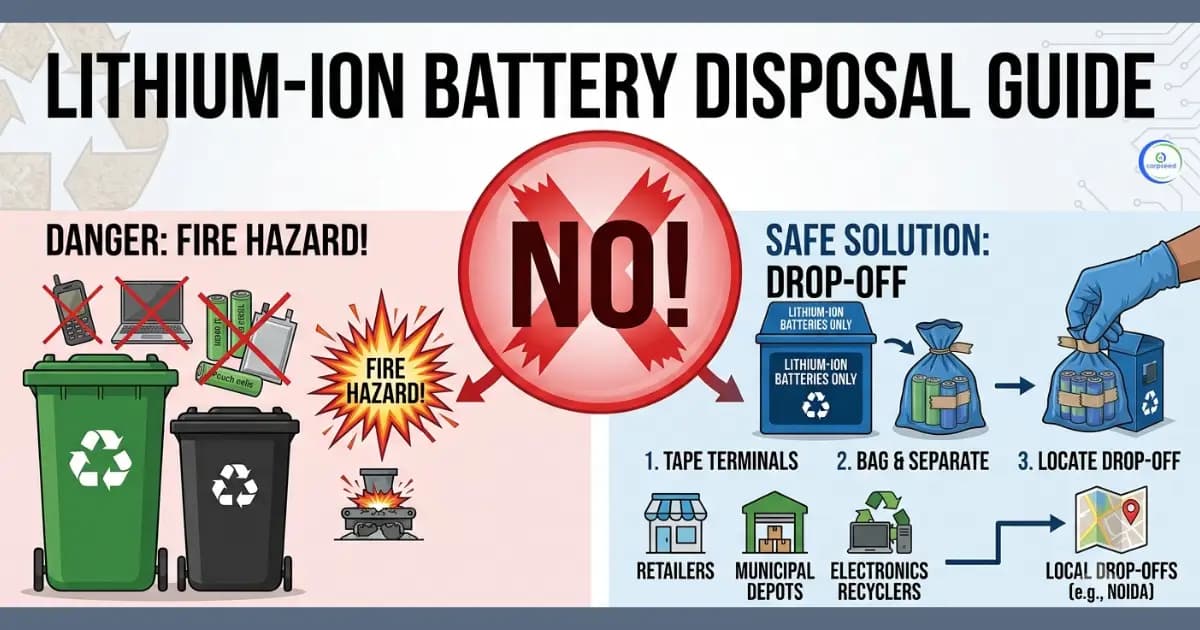
Can Lithium-Ion Batteries Go in the Recycling Bin?
2026-08-27
Can a Dead Electric Vehicle Battery Ever Be Used Again Without Melting It?
2026-08-18
India’s Tyre Recycling Opportunity: What HSN, GST and EPR Changes Could Mean
2026-08-13
CPCB Guidelines for Recycling of Waste Batteries (Lead Acid & Lithium-ion): Complete Compliance Guide 2026
2026-07-24