
How to Apply for FSSAI License for Exporters?
FSSAI license is a certification granted to businesses associated with the FSSAI food industry. Whether it is running a restaurant, a food manufacturing unit, or even a food delivery service, this license is mandatory to operate legally in India.
Schedule a Call Back
500+ FSSAI licence assignments since 2018
Clients include Bidada Foods, Silvertip Foods, Good Food Innovations, Minimal Food, Alluring India Foods and Beverages, Auroras TEA Company, Ania Consumer Products, Ginger Foods Company, Magnalis Foods, ND Spices, Antara Assisted Care Services, Aggriveda Pharmaceutical (12 of 350+ served since 2018).
A few more clients we've served in this industryHide the list
- Food and consumer goods
- Bidada Foods · Silvertip Foods · Good Food Innovations · Minimal Food · Alluring India Foods and Beverages · Auroras TEA Company · Ania Consumer Products · Ginger Foods Company · Magnalis Foods · ND Spices
- Pharma and healthcare
- Antara Assisted Care Services · Aggriveda Pharmaceutical
- Logistics and trade
- Solankili Logistics Management · 23North Logistics Solutions
- Non-profits and education
- All India Hindu Mahajot Foundation · Manovikas Charitable Society
- More clients
- Cure and Care Wellness · Seven Turns · Akshamaala Solutions · Krisba Healthcare · Matha Exports International · Indo Gulf Company · Crescent Biologicals · Cura Consumer Health · Biolush · Cura Consumer · Ethics Prosperity · Rocking Deals · Subohi Agriparks · Aurous International Merchants · Anagh Traders · Shin Traders · Zexcorp Services · Aprodite Infotech · Grandmaz Organics · Instruments and Chemicals · Aaravbabbar Enterprises · DUA OLD Age Caring Institution · Goenka Scrapco · Prime Health
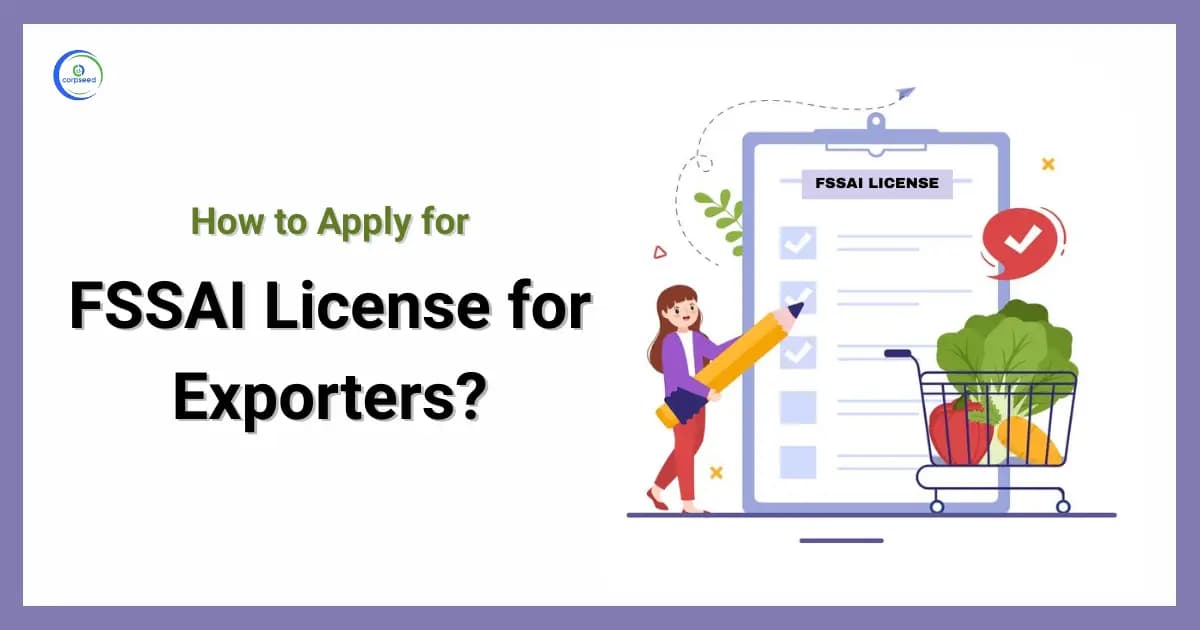
Food safety is one of the most important aspects when it comes to food products that are distributed or exported to other countries. The Food Safety and Standards Authority of India (FSSAI) plays an important role in ensuring that food products meet the required safety standards. FSSAI is the regulatory body that issues licenses to the food industry, including exporters, ensuring that food products meet international quality standards. Exporters who want to ship food products from India to international markets need an FSSAI license. By ensuring compliance with food safety standards, exporters can gain the trust of their customers and expand their reach in global markets.
Schedule a Call Back
Understanding FSSAI
FSSAI stands for Food Safety and Standards Authority of India. It is a government body responsible for regulating and overseeing food safety in India. Established under the Food Safety and Standards Act of 2006, its main goal is to ensure that food products available in the market are safe for consumption and meet quality standards. It plays a key role in formulating and enforcing regulations related to food safety, hygiene and quality control.
What is an FSSAI License?
The FSSAI license is a certification granted to businesses associated with the FSSAI food industry. Whether it is running a restaurant, a food manufacturing unit, or even a food delivery service, this license is mandatory to operate legally in India. The FSSAI license ensures that the food offered meets all the necessary health and safety regulations. It ensures that food products adhere to the safety, hygiene, and quality standards established by the Government of India.
Types of FSSAI License
There are different types of FSSAI licenses depending on the size and nature of the business. FSSAI issues three different types of licenses:
1. FSSAI basic registration: FSSAI basic registration is the most basic form of approval, granted to small food businesses with an annual turnover of up to Rs 1.5 crore (the limit from 1 April 2026; earlier it was Rs 12 lakh). This license is for businesses that are relatively small and in the early stages of growth. It is not the route for exporters: a food business that exports, however small, needs a Central license, because FoSCoS lists exporters as a kind of business licensed by the Central authority whatever their turnover. The process is simple, with minimal documentation and quick turnaround.
2. FSSAI state license: FSSAI state license is required for food businesses whose turnover is above INR 1.5 crore and up to INR 50 crore per annum. This license is applicable for medium-sized food businesses that need to expand their reach within the state; an exporter needs a Central license instead.
3. FSSAI central license: The FSSAI central license is for large food businesses with an annual turnover above Rs 50 crore. This license is also mandatory, whatever the turnover, for exporters who plan to export their food products to international markets (and for importers and e-commerce food businesses). The process of obtaining an FSSAI central license is more elaborate and requires adherence to stringent food safety regulations. Exporters must apply for this license in order to legally export food products to countries around the world. (Source: FSSAI Order dated 13 March 2026, in force 1 April 2026)
Importance of FSSAI License for Exporters
For exporters, having an FSSAI license is essential for several reasons:
- International trade compliance: Most countries require food exports to have a recognized food safety certificate. The FSSAI license is recognized worldwide and ensures that the exporter’s food products meet international safety standards.
- Consumer confidence: FSSAI logo on food products assures consumers that the product is safe and of high quality.
- Regulatory requirement: FSSAI license is legally required to export food products. Without it, exporters cannot legally ship their food products to international markets.
- Global market access: FSSAI license helps exporters to access a wide range of international markets by complying with the food safety norms of different countries.
Also Read: Why do FSSAI Licenses Matter for Every Food Business?
Key Points about FSSAI License for Exporters
- Issued by central authority: FSSAI Central License for Exporters is granted by the Central Authority to food businesses operating in the export sector.
- Subtypes of FSSAI license: There are two subtypes of FSSAI export license: one for manufacturers of food products for export, and the other for traders or merchants who export.
- Declaration of export activity: Applicants should declare whether they are involved in exports exclusively or in both domestic and export markets.
- 100% export units: Businesses certified as 100% Export Units by Ministry of Commerce are eligible to apply for FSSAI Exporter Licence.
- Import Export Code (IEC): IEC certificate is a prerequisite for obtaining FSSAI exporter license.
- Separate license for each premises: FBOs should obtain a separate FSSAI license for each premises involved in the export of food products.
- Premises mentioned in IEC certificate: All premises involved in food exports should be mentioned on the IEC certificate.
- Annual return: Licensed manufacturers, including those that export, file an annual return in Form D-1 on FoSCoS by 31 May each year for the previous financial year (licensed milk and milk-product manufacturers also file a half-yearly return in Form D-2). A return not filed by the due date leads to deemed suspension of the license until it is filed with the penalty.
- Compliance with safety and labelling: Exported food must meet safety, quality and labelling standards as per the regulations of the destination country.
Steps to Apply for FSSAI License for Exporters
Obtaining an FSSAI license is a systematic process. The application procedure varies depending on the type of license. Below is a step-by-step guide on how exporters can apply for an FSSAI license.
1. Visit the FSSAI website and refer to the "How to apply for license/registration" manual at FSSAI FOSCOS.
2. Click on the "License/Registration" tab and then select "Apply for License/Registration" from the yellow menu box.
3. In the next step, click on "Apply for License/Registration" in the red box.
4. Select the state and read the provided note before proceeding further.
5. Under "Kind of Business," select "Exporters" under the "Manufacturer" category.
6. Choose the appropriate type of business under exporters:
- 100% Export Oriented Units (Central License)
- Exporter - Manufacturer (Only Exports)
7. Complete all mandatory fields as shown in Form B. Pay careful attention when filling in communication details, as all correspondence will be directed to the provided contact information.
- Include details such as the GST/PAN/CIN as applicable to the firm.
- Provide accurate address information for both registered and correspondence addresses.
8. Upload the required documents as per FSSAI guidelines.
9. Pay the application fee through the available modes.
10. After payment, a receipt with a 17-digit reference number will be generated, which can be used for future reference.
11. Track the status of the application through the FSSAI homepage.
Also Read: How Can an FSSAI License Improve Your Food Safety Standards?
Validity of the FSSAI License
Since 1 April 2026, an FSSAI license does not need renewal. Under the FSS (Licensing and Registration of Food Businesses) Amendment Regulations, 2026, it stays valid unless suspended, cancelled or surrendered, provided the annual license fee is paid every year (FoSCoS shows Rs 7,500 a year for a Central license; several years can be paid at once) and any required annual return is filed on time. If your license was issued before 1 April 2026 and shows an expiry date, check its status on FoSCoS before that date; Corpseed can check it for you.
Conclusion
Applying for an FSSAI license is a necessary step for exporters who wish to export food products from India to international markets. By ensuring compliance with food safety standards, exporters can gain the trust of their customers and expand their reach in global markets. FSSAI license not only ensures compliance with Indian government food safety regulations but also helps exporters meet international standards required for safe and healthy food exports. With the appropriate FSSAI license, exporters can contribute to the global food supply chain while maintaining the highest quality and safety standards.
About the Author

Mahek Sancheti
Content WriterMahek Sancheti, BAJMC graduate with a deep passion for writing. As a content writer, video content creator, creative content creator, and scriptwriter, I bring stories to life through words and visuals. I honed my skills by working with a prominent news agency, where I excelled in crafting compelling narratives and engaging content. Coming from a journalism and mass communication background I have skills to craft engaging narratives that captivate audiences. With a keen interest in writing and creativity, I aim to deliver impactful and meaningful content that resonates with diverse audiences.
https://www.linkedin.com/in/mahek-sancheti-837196212
Related articles
FSSAI State License Renewal in India 2026: Process, Fees & New Rules
2026-11-12
FSSAI Central License Renewal in 2026: Rules, Fees, Documents & Process
2026-11-12
FSSAI Draft Packaging Rules 2026: New Standards for Recycled Plastic in Food Packaging
2026-11-04

Selling Food Online? FSSAI Rules for Amazon, Flipkart, Swiggy, Zomato & Marketplace Sellers (2026)
2026-10-15
FSSAI Diwali Drive 2026: Food Safety Inspection Checklist for Food Businesses
2026-10-14
FSSAI Licence vs Registration for Sweet Shops, Bakeries & Home Bakers
2026-10-13