
Cleaner Engines, Greener Future: What India’s New Emission Rules Mean for Agriculture and Construction
Rule 115A governs the emission of smoke and vapour from agricultural tractors, power tillers, construction equipment vehicles, and combine harvesters powered by internal combustion engines.
Schedule a Call Back
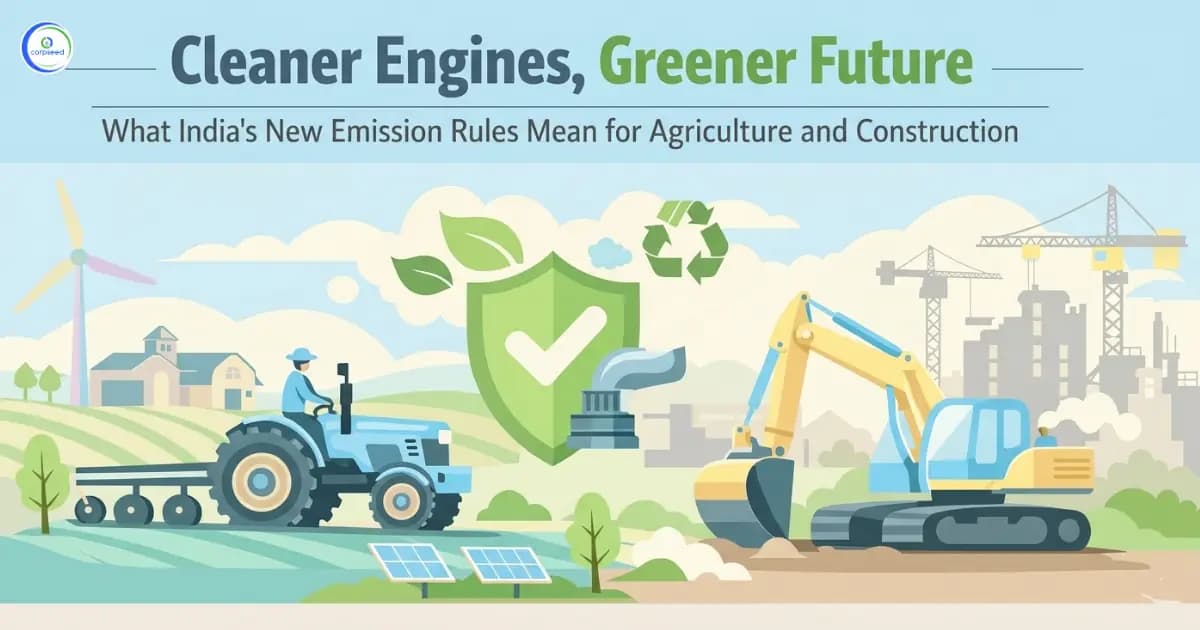
The Ministry of Road Transport and Highways published a draft notification on February 27, 2026, proposing significant amendments to Rule 115A of the Central Motor Vehicles Rules, 1989. The proposal, open for public feedback for 30 days from its publication in the Official Gazette, focuses on strengthening emission standards for non-road engines with greater clarity and technical depth.
This is not merely a routine regulatory update. It represents a structured shift toward tighter emission control in sectors that have historically operated under less stringent norms.
What Is Rule 115A and Why Does It Matter Now?
Rule 115A governs the emission of smoke and vapour from agricultural tractors, power tillers, construction equipment vehicles, and combine harvesters powered by internal combustion engines.
Until now, emission standards for these categories have been less rigorous than those for on-road vehicles. The draft proposes a comprehensive revision, introducing TREM (Tractor Emission) Stage norms for agricultural equipment and CEV (Construction Equipment Vehicle) Stage norms for construction machinery.
The timing is significant. As India advances its environmental commitments, emissions from agriculture and construction equipment, especially particulate matter and nitrogen oxides, are receiving increased regulatory attention. Strengthening standards in these sectors is a necessary step toward improving overall air quality.
TREM Stage IV and Stage V: What Changes for Agricultural Equipment
For agricultural tractors, power tillers, and combine harvesters, the draft lays out a phased transition to stricter emission limits.
- TREM Stage IV, applicable to engines in the 37 to less than 56 kW range, has been in force since January 1, 2023. These engines must comply with limits of 5.0 g/kWh for carbon monoxide (CO), a combined HC+ NOx limit of 4.7 g/kWh, and a particulate matter (PM) limit of 0.025 g/kWh.
- TREM Stage V represents the next level of control. From October 1, 2026, stricter limits will apply across multiple power categories, including engines below 8 kW, 8-19 kW, 56-130 kW, 130-560 kW, and above 560 kW. For example, in the 56 -130 kW category, the PM limit reduces to 0.015 g/kWh, along with the introduction of a Particle Number (PN) limit of 1×10¹² per kWh.
- For engines in the 19-37 kW range, TREM IIIA/IIIAA norms apply from April 1, 2028, with tighter Stage V requirements extending in later phases.
This phased structure ensures a gradual but clear transition toward cleaner engine technologies across agricultural equipment.
Schedule a Call Back
CEV Stage V: Raising Standards for Construction Equipment
Construction equipment vehicles follow a similar regulatory path.
- CEV Stage IV has been applicable since October 1, 2021, covering engines from 37 kW up to 560 kW with defined emission limits.
- CEV Stage V introduces stricter norms across power categories. For engines between 56 and 130 kW, the particulate matter limit is reduced to 0.015 g/kWh, along with the introduction of a PN limit of 1×10¹² per kWh.
For higher power categories, emission limits are restructured based on engine characteristics, with continued focus on NOx and particulate control rather than a uniform increase or decrease across all segments.
Additionally, construction equipment manufactured after April 1, 2026, will be subject to in-service emission monitoring. This ensures that compliance is maintained beyond initial certification and reflects actual operating conditions.
Testing Cycles That Reflect Real-World Conditions
A technically important aspect of the draft is the adoption of advanced emission testing cycles:
- Non-Road Steady Cycle (NRSC)
- Non-Road Transient Cycle (NRTC)
These cycles evaluate engine performance under both stable and dynamic conditions. The NRTC, in particular, simulates real-world operation and calculates emissions using a weighted approach, 10% cold start and 90% hot start.
Compression ignition (CI) engines are tested under both NRSC and NRTC cycles, while positive ignition (PI) engines are primarily tested under NRTC, as per AIS-137 standards.
This approach improves the accuracy of emission measurement and ensures that performance is consistent under actual usage conditions.
Multi-Fuel Compatibility: Expanding the Regulatory Scope
The draft rules apply emission limits across a wide range of fuels, reflecting a transition toward cleaner and alternative energy options. These include:
- CNG and Bio-CNG
- LNG and LPG
- Ethanol blends and ED95
- Biodiesel blends
- Hydrogen and dual-fuel systems
- Hydrogen Enriched Compressed Natural Gas (HCNG)
In addition to fuel coverage, the draft also specifies reference and commercial fuel standards for testing and compliance. In cases where reference fuels are not available, commercially supplied CNG must comply with BIS 15958: 2012, and LPG must meet BIS 14861: 2000 specifications. Similarly, biogas (bio-methane) is required to conform to IS 16087 standards, ensuring uniformity in fuel quality during type approval and conformity of production testing.
The inclusion of HCNG specifications under Annexure IV-ZE further defines parameters such as hydrogen content and impurity limits, supporting the gradual integration of alternative fuels into non-road applications.
Conformity of Production: Strengthening Enforcement
The draft introduces detailed Conformity of Production (COP) requirements to ensure consistency between certified and mass-produced engines.
For agricultural and construction equipment:
- Production up to 200 units per engine family: testing once every two years
- Production exceeding 200 units: annual testing
Sampling is based on one day’s average production, with defined minimum and maximum limits. Engines must also carry a conformance label as per AIS: 137, enabling traceability and verification.
For engines equipped with Selective Catalytic Reduction (SCR), ammonia emission limits are prescribed, and the use of AUS 32 (urea solution) must comply with ISO standards.
In-Service Monitoring: Extending Compliance to Real Use
A notable addition is the requirement for in-service emission monitoring, which extends compliance beyond initial certification. For agricultural equipment, the applicability is phased based on engine power categories:
- Engines below 19 kW and above 37 kW: applicable from October 1, 2026
- Engines between 19 -37 kW: applicable from April 1, 2028
In the case of construction equipment, the in-service monitoring will apply to all vehicles manufactured after April 1, 2026. In this structure, the emissions during operation should not be more than the prescribed limits, and the set allowance should not be more than twice the certified values under controlled conditions. This ensures that the emission level is maintained even during the engine’s operational life.
Durability and Emission Stability over Time
The draft also addresses emission durability. Manufacturers may determine deterioration factors through testing or apply predefined values. Standard factors include:
- CO: 1.3
- HC: 1.3
- NOx: 1.15
- PM: 1.05
Durability periods are defined as:
- 5,000 hours for smaller engines
- 8,000 hours for larger engines
These provisions ensure that emission compliance is maintained over time, not just at the point of approval.
What This Means for Industry Stakeholders
The proposed amendments have direct implications for manufacturers, importers, and equipment users, making compliance a core operational priority rather than a procedural requirement.
The manufacturer will have to align the engine design, testing procedures, and production systems with the rigorous emission standards and evolving certification requirements. At the same time, buyers and fleet operators will need to factor compliance timelines into procurement strategies, as equipment selection will increasingly depend on long-term efficiency, regulatory validity, and lifecycle performance.
Registration of pre-compliance equipment will be permitted only within limited transition timelines after implementation. Once these windows close, only equipment meeting the revised emission standards will be eligible for sale and registration.
A Measured but Necessary Transition
India’s Bharat Stage norms significantly improved emissions from on-road vehicles. Extending structured emission control to non-road equipment addresses a critical gap in the regulatory framework.
The combination of phased implementation, real-world testing, multi-fuel compatibility, and lifecycle monitoring reflects a system designed for practical enforcement.
Conclusion
The proposed amendments to the Central Motor Vehicles Rules, 1989, reflect a clear shift toward stronger and more practical emission control in agriculture and construction. By introducing tighter standards and extending compliance across the entire engine lifecycle, the framework moves beyond basic regulation and focuses on real-world performance.
As these rules progress toward finalization, they are expected to influence how equipment is designed, selected, and operated. For manufacturers, fleet operators, and policymakers alike, this is a step toward cleaner technologies and more responsible industry practices.
About the Author

Parul Bohral
Legal Content WriterParul Bohral, a BALLB graduate and experienced legal researcher and content writer with expertise in various legal areas, including corporate law and intellectual property. I have gained valuable experience in esteemed legal environments, where I have strengthened my research skills, allowing me to approach legal writing with precision and depth.
As a legal content writer, I am committed to delivering work that not only informs but also engages readers. By staying informed about the latest trends in content marketing and regulatory developments, I ensure that my writing remains sophisticated and meets industry standards. My dedication to thorough research enables me to craft content that is both insightful and impactful.
Related articles
National Green Hydrogen Mission in India
2026-11-02
CBG Plant Compliance Under GOBARdhan Scheme: Online GC Rules Relaxed Until March 2027
2026-10-28
PNGRB Hydrogen Blending Guidelines 2026: 5% PNG Rules, Safety and Approvals
2026-10-15
India-Japan CBG Initiative Targets 1,000 Biogas Plants and 2.5 Million CNG Vehicles by 2030
2026-07-07

How to Start an E-waste Recycling Business in India?
2026-04-28
Government Initiatives of Compressed Biogas (CBG) Subsidy
2026-04-02