
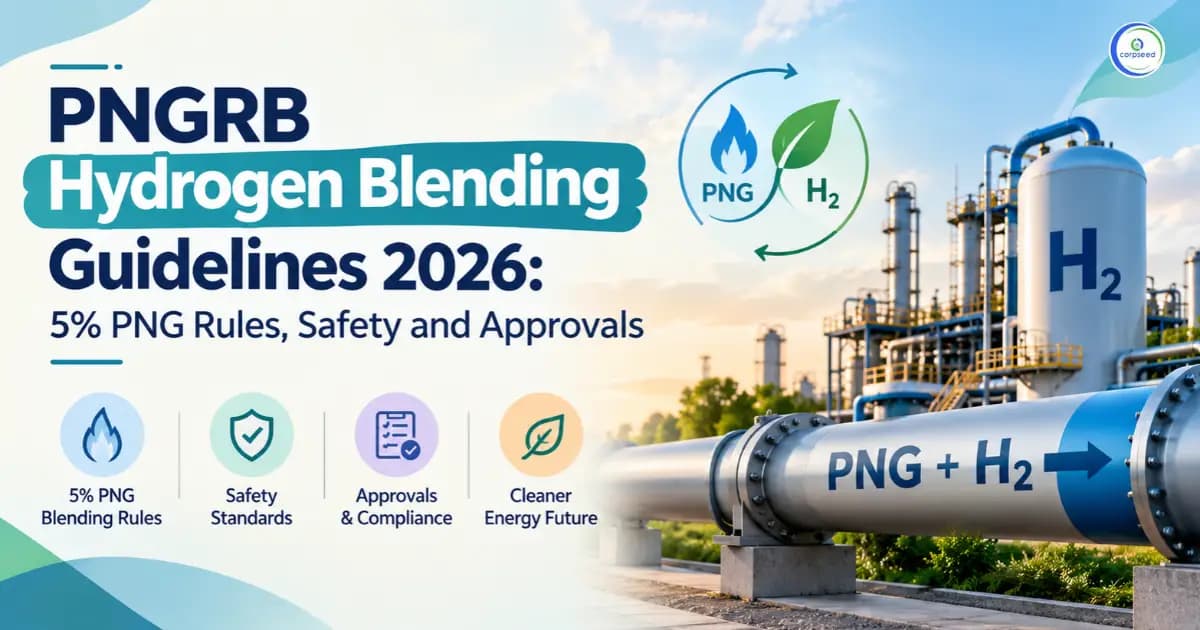
PNGRB Hydrogen Blending Guidelines 2026: 5% PNG Rules, Safety and Approvals
The Petroleum and Natural Gas Regulatory Board (PNGRB) has released its draft guidelines for blending hydrogen with natural gas that is transported to consumers through the Piped Natural Gas (PNG) distribution network.
Schedule a Call Back
Introduction
According to the draft guidelines, up to 5% volume of hydrogen may be blended with natural gas with the approval of the concerned regulator, and subject to compliance with safety requirements.
For city gas distribution (CGD) companies, hydrogen suppliers and infrastructure developers, the proposed PNGRB hydrogen blending guidelines 2026 introduce requirements covering pipeline safety, equipment compatibility, gas quality, consumer billing and monitoring.
However, these directives are still in draft form, and will not, on their own, enable commercial hydrogen blending. Until such time that the necessary legal frameworks and approvals are in place, companies will not be able to commence operations based on these directives.
What Are the PNGRB Hydrogen Blending Guidelines 2026?
The PNGRB Hydrogen Blending Guidelines 2026 were released in October 2026 and establish a proposed regulatory framework for the supply of hydrogen blended natural gas (HNG) to domestic PNG consumers.
Hydrogen blending involves adding a controlled quantity of hydrogen to natural gas before it enters the distribution network.
Under the proposal, authorized CGD companies may undertake commercial blending within approved domestic distribution areas, provided the network, equipment and household appliances are suitable.
Why Is Hydrogen Being Blended with Natural Gas?
India is exploring hydrogen blending as part of its efforts to develop cleaner energy alternatives and make use of existing gas infrastructure.
Hydrogen can be introduced into suitably qualified natural gas networks, potentially reducing dependence on conventional fuels.
Some possible benefits include:
- Existing Infrastructure: Suitable CGD pipelines may be used without constructing a completely separate hydrogen distribution network.
- Green Hydrogen Demand: Blending could create additional opportunities for green hydrogen producers.
- Energy Transition: Low-emission hydrogen may help reduce the carbon intensity of supplied gas.
- Industrial Opportunities: Equipment manufacturers, testing agencies and engineering companies may benefit from new projects.
However, hydrogen has different physical and combustion properties from natural gas. Existing pipelines cannot be considered hydrogen-compatible without proper assessment.
Who Will Be Affected by the Hydrogen Blending Guidelines?
The proposed guidelines primarily apply to PNGRB-authorized CGD companies intending to supply hydrogen-blended natural gas to domestic consumers.
Other businesses may also be affected through their involvement in the hydrogen supply chain.
| Business Category | Potential Compliance Requirements |
| CGD companies | PNGRB approval, network integrity and monitoring |
| Hydrogen suppliers | Hydrogen quality verification |
| Pipeline operators | Material compatibility and safety assessment |
| Equipment manufacturers | Meter, regulator and component testing |
| Engineering companies | Blending facility design and technical assessment |
| Testing agencies | Independent inspection and verification |
The proposed commercial framework does not generally cover CNG, automotive HCNG, transmission pipelines, pure hydrogen supply or non-domestic PNG consumers.
Such activities may require separate regulatory arrangements.
What Is the Maximum Hydrogen Blending Limit in India?
The draft proposes a maximum commercial blending limit of 5% hydrogen by volume in approved domestic PNG networks.
This does not mean every network can automatically operate at 5%.
The actual operating concentration must remain within the approved safety and technical limits. A lower concentration may be necessary where equipment or appliance conditions require it.
Can Hydrogen Blending Exceed 5%?
Yes, but only through individual, approved pilot projects in Annexure P of the draft.
The framework for the pilot projects allows testing of blending of H2 above 5% in a controlled environment. Any operations above 10% require a full technical assessment by PNGRB and specific approval.
Higher pilot concentrations don’t mean higher concentrations for commercial supply.
What Approvals Are Required for Hydrogen Blending Projects?
Under the proposed rules, companies planning commercial hydrogen blending must secure specific approval from PNGRB and obtain the other statutory permissions that apply to their projects.
- PNGRB Approval: The authorized CGD company will have to provide project specific details of injection points, distribution network, hydrogen concentration, monitoring systems and arrangements for emergencies.
- Safety and Technical Assessment: An Integrated Safety and Readiness Dossier will have to be prepared by the concerned business to demonstrate safety of the proposed infrastructure.
- Independent Verification: An independent competent agency will have to examine the technical documents, compatibility of equipment and safety and operating readiness of the system.
- Other Relevant Approvals: Other relevant approvals may be needed based on the mode of transport of hydrogen, storage of hydrogen, hydrogen cylinders and associated facilities.
For example, certain project arrangements may require permissions under applicable PESO-administered laws.
Businesses should determine their specific requirements through a hydrogen project regulatory compliance assessment rather than assuming that every project needs identical licences.
What Are the Technical and Safety Requirements for Hydrogen Blending?
The draft places considerable importance on pipeline integrity, gas quality and emergency preparedness.
Pipeline and Equipment Compatibility
Before hydrogen introduction, operators must assess:
- Pipelines, joints, valves and fittings.
- Gas meters and pressure regulators.
- Seals, gaskets and diaphragms.
- Hydrogen detection and monitoring equipment.
- Domestic gas appliances and service connections.
Operators must establish whether the existing materials are suitable for the proposed hydrogen concentration.
Testing and inspection should reflect actual risks rather than requiring unnecessary replacement of every component.
Hydrogen Quality Requirements
Hydrogen received at the blending facility must meet Type I, Grade A requirements under IS 16061, as specified in the draft.
Quality verification must consider moisture, oxygen and relevant impurities.
Non-conforming hydrogen must not be injected.
Fire Safety and Emergency Systems
The proposed safety arrangements include hydrogen-suitable gas detection, ventilation, emergency shutdown systems and suitable isolation facilities.
Operators must also undertake appropriate studies such as Hazard and Operability Study (HAZOP), Quantitative Risk Assessment (QRA) and Hazardous Area Classification (HAC).
Gas Monitoring
Hydrogen concentration must be continuously monitored at the blending facility outlet.
Automatic protective arrangements must stop hydrogen injection when unsafe conditions develop, including insufficient natural gas flow or invalid safety-critical concentration measurements.
These requirements create a need for suitable CGD safety compliance services, technical verification and ongoing operational monitoring.
How Can Businesses Obtain PNGRB Approval for Hydrogen Blending?
The proposed commercial approval process involves several stages.
Step 1: Identify the Distribution Area: Select a domestic PNG network that can be monitored, controlled and isolated during emergencies.
Step 2: Check Existing Infrastructure: Inspect pipelines, verify equipment compatibility, and check whether domestic appliances can operate safely with the proposed system.
Step 3: Compile Technical Documents: Prepare the Integrated Safety and Readiness Dossier with engineering assessments, safety measures and monitoring plans.
Step 4: Obtain Independent Verification: Appoint a competent agency to review the relevant technical, and safety evidence.
Step 5: Submit the Application: Provide PNGRB with the required project information and supporting documentation.
Step 6: Complete the Pre-Startup Safety Review: Verify that equipment, emergency systems, operating procedures and required safety measures are ready.
Step 7: Obtain written go-live Permission: Hydrogen introduction can begin only after the necessary written permission and statutory approvals.
Step 8: Conduct Trial Operations: Operate within the approved limits and submit the required monitoring reports.
Step 9: Obtain Confirmation: Routine commercial operation requires PNGRB's written confirmation following review of trial performance.
What are the Monitoring and Reporting Requirements?
The draft proposes continuous monitoring and periodic technical verification after hydrogen introduction.
| Activity | Proposed Frequency |
| Hydrogen concentration | Continuous |
| Initial attended operation | At least 24 hours |
| Downstream concentration checks | Weekly initially, followed by monthly checks during trial |
| Odorization testing | Fortnightly during the first six months |
| Independent audit | At least annually |
| Trial reporting | Monthly |
| Record retention | At least five years |
The proposed commercial trial must continue for at least six months. PNGRB may require additional evidence or extend the trial before allowing routine operation.
Will Hydrogen Blending Affect Domestic PNG Bills?
Hydrogen contains less energy per unit volume than natural gas. Therefore, blending hydrogen may reduce the heat content of the gas supplied.
To protect consumers, the draft requires appropriate heat-content billing adjustments.
Operators must use suitable calorific-value information, explain the adjustment to consumers and correct billing errors where necessary.
Consumers should not be charged for energy that has not been delivered.
The draft also proposes advance consumer communication, emergency contact arrangements and complaint-handling procedures.
What Should Businesses Do Before Starting Hydrogen Blending Projects?
Businesses considering hydrogen blending should begin preparing their technical and compliance documentation.
Important actions include:
- Verify the current regulatory status.
- Identify applicable PNGRB and statutory approvals.
- Review pipeline and equipment compatibility.
- Examine hydrogen supply and quality arrangements.
- Plan necessary risk and safety assessments.
- Prepare monitoring and emergency procedures.
- Estimate testing, engineering and ongoing compliance costs.
These preparations can help identify potential difficulties before making major infrastructure investments.
How Can Corpseed Help with Hydrogen Blending Compliance?
Hydrogen blending projects may involve regulatory approvals, technical documentation, safety compliance and environmental requirements.
Corpseed can assist businesses in understanding applicable regulatory requirements and identifying relevant compliance services.
Support may include:
- Regulatory compliance assessment for proposed hydrogen projects.
- Guidance on applicable PNGRB and statutory approval requirements.
- Assistance with relevant PESO licence applications, where required.
- Environmental and industrial safety compliance support.
- Coordination of applicable documentation and compliance processes.
Specialist engineering studies and independent technical verification must be performed by appropriately qualified agencies.
Planning a hydrogen blending or CGD infrastructure project?
Contact Corpseed to discuss the applicable regulatory compliance requirements and documentation for your business.
Conclusion
The PNGRB draft guidelines for 2026 propose blending up to 5% hydrogen into domestic PNG networks approved for this purpose. CGD companies will need to look at their existing pipelines, equipment and household connections before introducing hydrogen into the gas supply.
The guidelines are still in draft form. The final requirements will depend on PNGRB's decision, so companies should wait for the final notification before treating the proposed conditions as mandatory.
About the Author

Parul Bohral
Legal Content WriterParul Bohral, a BALLB graduate and experienced legal researcher and content writer with expertise in various legal areas, including corporate law and intellectual property. I have gained valuable experience in esteemed legal environments, where I have strengthened my research skills, allowing me to approach legal writing with precision and depth.
As a legal content writer, I am committed to delivering work that not only informs but also engages readers. By staying informed about the latest trends in content marketing and regulatory developments, I ensure that my writing remains sophisticated and meets industry standards. My dedication to thorough research enables me to craft content that is both insightful and impactful.
Related articles
National Green Hydrogen Mission in India
2026-11-02
CBG Plant Compliance Under GOBARdhan Scheme: Online GC Rules Relaxed Until March 2027
2026-10-28
India-Japan CBG Initiative Targets 1,000 Biogas Plants and 2.5 Million CNG Vehicles by 2030
2026-07-07
How to Start an E-waste Recycling Business in India?
2026-04-28
Government Initiatives of Compressed Biogas (CBG) Subsidy
2026-04-02
Cleaner Engines, Greener Future: What India’s New Emission Rules Mean for Agriculture and Construction
2026-03-26