
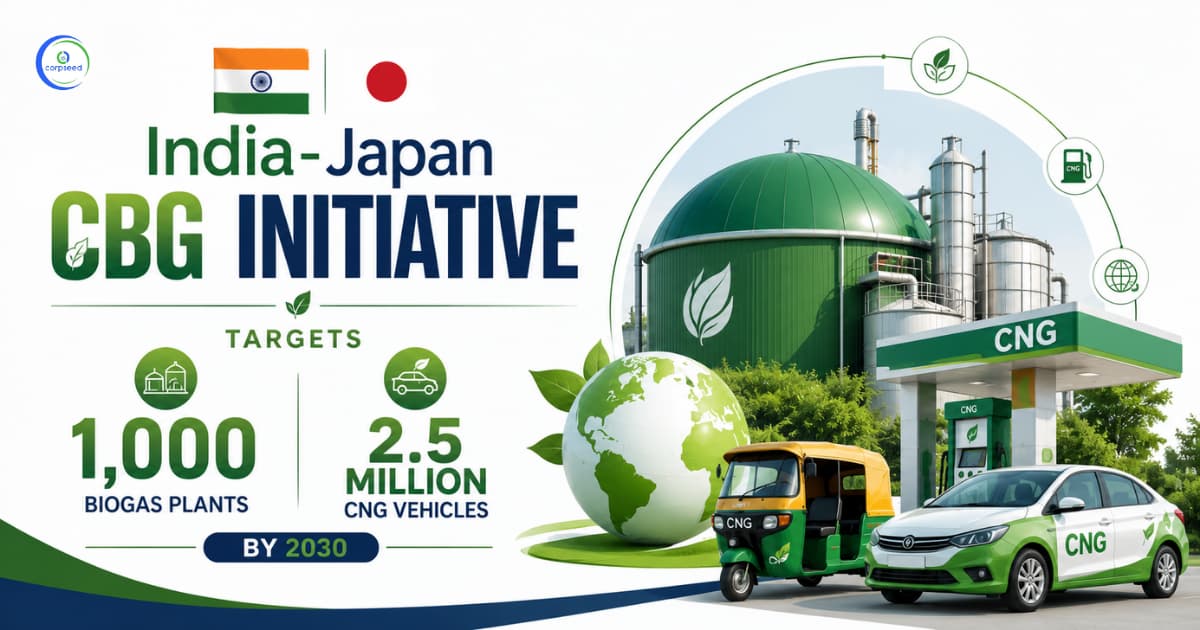
India-Japan CBG Initiative Targets 1,000 Biogas Plants and 2.5 Million CNG Vehicles by 2030
India and Japan have announced a strategic collaboration to accelerate the adoption of Compressed Biogas (CBG) in India, with the ambitious goal of establishing 1,000 biogas plants and supporting 2.5 million CNG vehicles by 2030. The initiative aims to strengthen clean energy infrastructure, reduce dependence on fossil fuels, improve waste management, and promote sustainable transportation.
Schedule a Call Back
Introduction
India and Japan just took a major step in clean energy together. Japanese Prime Minister Sanae Takaichi visited India for three days, from July 1 to 3, 2026, at the invitation of Prime Minister Narendra Modi. During this visit, she launched the Japan-India Compressed Biogas (CBG) Initiative.
The concept is simple. Rural India produces plenty of biomass, which usually goes to waste. This concept takes all the wasted biomass and converts it into useful energy, increasing energy security as well as earning money for the rural population. Furthermore, this project represents the move from large centralized energy systems to small decentralized ones based on farms.
For developers, automakers, and ESG teams, this is a space worth watching closely, right from the start.
Schedule a Call Back
What is the Japan-India Compressed Biogas (CBG) Initiative?
The Japan-India CBG Initiative is a strategic bilateral clean energy project launched under the 16th India-Japan Annual Summit in New Delhi. It was formalized at the India-Japan Joint Economic Forum, where both governments committed to joint energy and automotive market development.
A formal Letter of Intent (LoI) was signed between India and Japan, committing both nations to build compressed biogas production capacity and a matching automotive consumption market, using cooperative institutions as the delivery mechanism.
Key Targets by 2030
Two measurable pillars define the roadmap, and businesses should treat these figures as the baseline for investment planning.
- 1,000 biogas plants to be established across India by 2030.
- 2.5 million CNG vehicles will be running on compressed biogas produced under the initiative by the same year.
Objectives of the Japan-India CBG Initiative
The initiative rests on four pillars, each targeting a distinct economic and diplomatic outcome.
- Expanding Clean Energy Production: Scale compressed biogas into a mainstream fuel category, not a niche pilot.
- Strengthening Rural Economies: Route new farmer income through biomass sales and cooperative dividends.
- Enhancing Energy Security: Cut India's reliance on imported CNG and LNG via domestic feedstock.
- Deepening Bilateral Ties: Extend Clean Energy Bilateral Cooperation into agri-energy.
Biomass Resources Targeted Under the Initiative
Rural India holds vast, largely idle biomass reserves. The initiative identifies four primary feedstock categories for Compressed Biogas Production in India.
- Cattle Dung: India's dairy and livestock base offers a continuous, low-cost feedstock stream.
- Rice Straw (Parali): Redirecting straw into CBG plants cuts stubble-burning emissions across northern states.
- Sugarcane Residue (Bagasse): Sugar mill belts gain a secondary revenue channel by feeding bagasse into biogas units.
- Other Agricultural Biomass: Crop husks, vegetable waste, and food-processing residue widen plant siting options nationwide.
The Role of Cooperative Institutions in CBG Production
Cooperatives sit at the center of this rollout. Both leaders pointed to them as the backbone that will run things on the ground. That makes sense, India's dairy and sugar cooperatives already handle large-scale collection and supply chains, so they have the infrastructure for biomass aggregation needs.
This matters for two reasons. Firstly, the farmers trust these cooperatives, hence the steady supply of the raw materials without relying on new and unproven channels. Secondly, prices offered by these cooperatives tend to be transparent, meaning that farmers get reasonable deals rather than being exploited by intermediaries.
For investors, this is good news too. Setting up a plant usually means solving two hard problems: getting land and winning farmer trust. Cooperatives already have both. That lowers the risk of entering this space and makes decentralized CBG plants a more practical investment than starting from scratch.
Market Expansion for CNG Vehicles Powered by Biogas
The Letter of Intent sets a clear number: 2.5 million CNG vehicles running on biogas by 2030. That's not just a production target, it directly ties fuel supply to vehicle demand, so both sides of the market grow together instead of one outpacing the other.
This puts pressure on automakers to shift gears. CNG platforms, retrofit kits, and engines tuned to run on biogas all need to scale up fast. Companies that already build CNG vehicles have a head start, but everyone in this space will need to ramp up production capacity soon.
There's a compliance angle here too. As this market grows, fuel-grade certification rules will likely get updated or tightened. Legal and regulatory teams at auto companies should keep a close eye on these changes, since falling behind on certification could slow down vehicle rollouts.
Conventional Fuel Framework vs. Japan-India CBG Ecosystem
The structural gap between legacy fuel systems and the emerging CBG ecosystem is stark.
| Parameter | Conventional Fossil Fuel & CNG Infrastructure | Proposed Japan-India CBG Ecosystem (2030) |
| Feedstock Source | Imported crude oil and natural gas | Domestic cattle dung, straw, bagasse |
| Forex Exposure | High import dependency | Reduced forex outflow |
| Carbon Footprint | High lifecycle emissions | Lower, circular-economy emissions |
| Rural Wealth Impact | Minimal direct farmer benefit | Direct cooperative-driven income |
| Vehicle Market Scale | Fragmented CNG adoption | 2.5 million vehicles by 2030 |
| Production Model | Centralized refineries | 1,000 decentralized plants |
Business Opportunities in India's Compressed Biogas Sector
Multiple enterprise verticals open up as this ecosystem scales.
- Setting up Commercial CBG Production Plants: Build and operate anaerobic digestion units near dairy or sugar cooperative belts.
- Supply Chain and Biomass Logistics Management: Aggregation, storage, and transport of biomass become standalone logistics businesses.
- Manufacturing and Retrofitting CNG Automotive Fleets: OEMs and fleet operators gain a growing retrofit and new-vehicle market.
- Technology Transfer and Joint Ventures with Japanese Firms: Japanese digestion and gas-purification technology enter India through structured JVs.
Benefits of the Japan-India Compressed Biogas Initiative
Benefits for the Indian Economy and Rural Infrastructure
This initiative creates jobs right where they're needed most. Cooperatives will need people for collection, digestion, and plant operations, so rural employment gets a real boost. It also solves a long-standing problem: stubble burning. If straw can be sold instead of burned, farmers have a reason to stop setting fields on fire. And because this money flows straight into rural areas, it reaches deeper into the agricultural economy than most infrastructure projects do.
Benefits for Corporate and Industrial Entities
There are even more gains for firms. Offtake arrangements in biogas could yield verified carbon credits, something every company monitoring its emission reduction objectives would benefit from. A reliable flow of clean energy would reduce risks related to volatility in the prices of crude oil. Finally, there is a new investment channel for private equity and infrastructure investors in the field of the Indian bioenergy industry, an emerging one.
Key Takeaways for Corporate Investors and Project Developers
The following points summarize the strategic shifts stakeholders should track closely.
- The installation of 1,000 biogas units serves as the key point in the roadmap of decentralized energy generation up to 2030.
- The 2.5 million CNG vehicle mandate guarantees built-in demand for produced biogas.
- Agricultural waste is now a formal national energy input, not just farm residue.
- Japanese technical cooperation brings proven digestion and gas-purification expertise into India.
Conclusion
The Japan-India Compressed Biogas Initiative is a game-changing strategy to expand green energy markets through international collaboration. The project will turn farm-based agricultural waste into an energy commodity supported by a Letter of Intent, partnerships, and 2030 goals.
For companies operating in energy, automotive, and agriculture, the time for a definitive entry point has arrived. Companies that align themselves statutorily before the expansion of 1,000 plants and 2.5 million vehicles will have a significant advantage over others.
About the Author

Mahek Sancheti
Content WriterMahek Sancheti, BAJMC graduate with a deep passion for writing. As a content writer, video content creator, creative content creator, and scriptwriter, I bring stories to life through words and visuals. I honed my skills by working with a prominent news agency, where I excelled in crafting compelling narratives and engaging content. Coming from a journalism and mass communication background I have skills to craft engaging narratives that captivate audiences. With a keen interest in writing and creativity, I aim to deliver impactful and meaningful content that resonates with diverse audiences.
https://www.linkedin.com/in/mahek-sancheti-837196212
Related articles

National Green Hydrogen Mission in India
2026-11-02

CBG Plant Compliance Under GOBARdhan Scheme: Online GC Rules Relaxed Until March 2027
2026-10-28
PNGRB Hydrogen Blending Guidelines 2026: 5% PNG Rules, Safety and Approvals
2026-10-15
How to Start an E-waste Recycling Business in India?
2026-04-28
Government Initiatives of Compressed Biogas (CBG) Subsidy
2026-04-02

Cleaner Engines, Greener Future: What India’s New Emission Rules Mean for Agriculture and Construction
2026-03-26