
Step‑by‑Step Checklist for Auditing Recycled‑Granule Suppliers Before Signing a Long‑Term Contract
Choosing the right recycled plastic granule supplier is essential for ensuring product quality, regulatory compliance, and a reliable supply chain. Before entering into a long-term agreement, buyers should conduct a comprehensive supplier audit covering legal registrations, CPCB and SPCB authorisations, EPR compliance, manufacturing capacity, quality control systems, laboratory testing, raw material traceability, production consistency, environmental practices, and financial stability.
Schedule a Call Back
4,500+ plastic EPR assignments since 2018
Clients include Brenntag Ingredients India, Reliant Packaging Films, Taurus Packaging, Axel Polymers, Lintec India, Kumar Organic Products, HP Adhesives, DDP Speciality Products India, Colt Technology Services India, Emerson Automation Solutions Intelligent Platforms, Intangles Lab, Shindengen India (12 of 1,700+ served since 2018).
A few more clients we've served in this industryHide the list
- Chemicals and materials
- Brenntag Ingredients India · Reliant Packaging Films · Taurus Packaging · Axel Polymers · Lintec India · Kumar Organic Products · HP Adhesives · DDP Speciality Products India
- Electronics and technology
- Colt Technology Services India · Emerson Automation Solutions Intelligent Platforms · Intangles Lab · Shindengen India · Emerson Process Management (India) · Lianchuang Electronic India · Emerson Process Management Chennai · Hayakawa Electronics India
- Pharma and healthcare
- Beryl Drugs · Ascent Meditech · Eli Lilly and Company (India) · Q-Line Biotech · Rajasthan Antibiotics · G D Pharmaceuticals · Micro Labs · ADK Health Care
- Engineering and manufacturing
- Essel Mining & Industries · Juki India · Hilti India · Bundy India · Hilti Manufacturing India · KJS Cement (I) · Mangalam Cement · Birla Precision Technologies
- Food and consumer goods
- Onest · AVT McCormick Ingredients · Akay Natural Ingredients · Ugraya Foods and Feeds · AVT Natural Products · Jalpaiguri Food Industries · Param Dairy · Esther Parfumerie
- Logistics and trade
- Siddhartha Logistics · Siddhartha Logistics Ftwz · Honda Trading Corporation India · Dksh India · MOL Logistics (India) · Fibs Logistics India · Zenexpress Logistics
- More clients
- Nilkamal
Introduction
The recycled plastics industry in India is booming, powered by increasing EPR objectives, adoption of the circular economy philosophy, and the growing requirement for PCR plastic and PIR plastic resins in packaging and automotive applications. At the same time, there has been an increased disparity between recycled plastic granule suppliers capable of supplying consistent, tested material versus those that do not.
In terms of procurement and quality control challenges, the dangers are numerous: inconsistent batches, lack of documentation on the source, CPCB approval not obtained, and production stoppages due to contaminated granules.
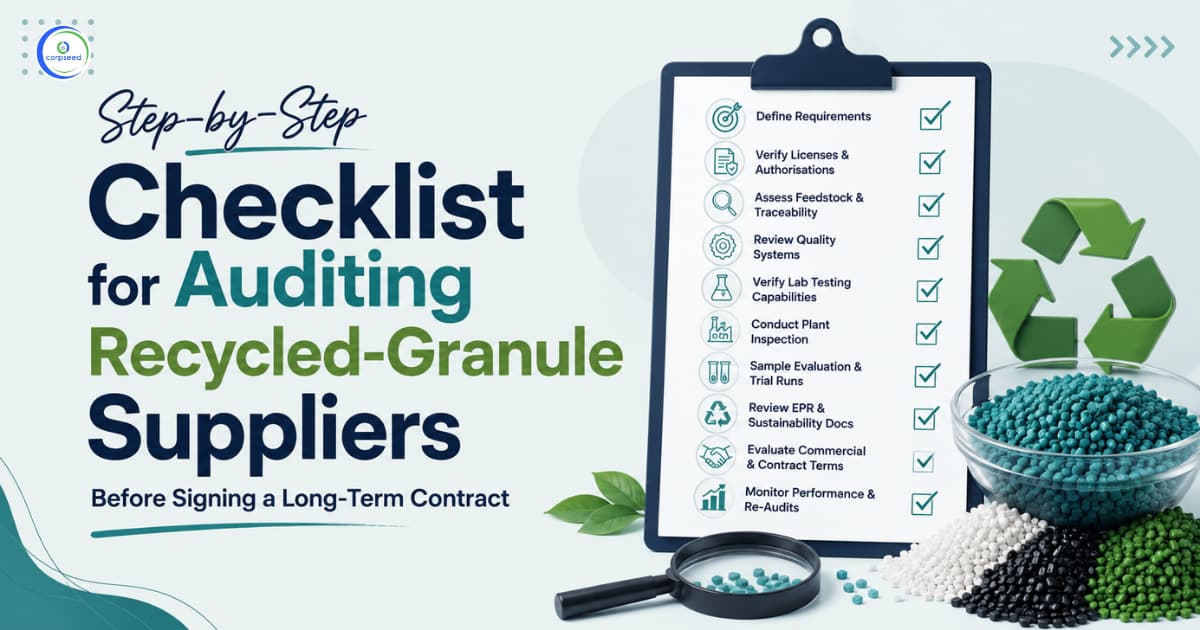
This guide lays out a practical, ten-step supplier audit checklist used by experienced procurement teams to qualify recycled plastic granule suppliers before committing to a long-term contract.
Why Auditing Recycled Plastic Granule Suppliers Is Important
Recycled pellets have higher natural variability than virgin polymers. The quality of feedstock varies due to changes in the source, seasons, and level of sorting practices; hence, melt flow index, color, and moisture content vary from batch to batch from the same plastic granule supplier.
This variability is directly related to costs. Every nonconforming batch results in production downtime, idle machines, and usually expedited shipping to make up for the difference, making plastic granule quality testing a critical checkpoint.
There are additional compliance risks involved too. Procuring from a plastic waste processor without a valid CPCB or SPCB license may result in problems with the buyer's own EPR reporting and overall plastic recycling compliance.
Why Does It Matter?
An unregistered vendor poses risks not only of nonconformity but also of frequent machine downtimes, rejections, and possible future compliance gaps, underscoring why working only with a CPCB-registered plastic recycler matters for anyone active in the plastic recycling industry.
Schedule a Call Back
Step-by-Step Checklist for Auditing Recycled Plastic Granule Suppliers
Step 1: Define Your Requirements Clearly
Prior to approaching any plastic granule supplier, finalize your technical specification. It will be used as a measuring stick for all future audit steps and will make sure that the audit does not turn into just another vendor evaluation exercise.
- Type of polymer (PP, HDPE, PET, etc.) and its intended application
- Melting Flow Index (MFI) and testing procedure
- Density and moisture resistance
- Limits for ash content
- Color and appearance specifications
- Regulatory requirements for the final product
Step 2: Verify Facility Licenses & Legal Authorisations
Documentation serves as the initial filtering mechanism. A recycled polymer supplier that does not have proper documentation will not move to the next step of inspection of the facility, irrespective of the attractive price quoted by the supplier.
- CPCB/SPCB Registration for Plastic Waste Processing
- CTE and CTO
- GST and PAN
- Factory Licence
- MSME Registration (if applicable)
Pro Tip:
Verify the registration number from the SPCB website itself, rather than taking the route of verification through the scanned copy of the certificate, which might be expired or suspended. This step alone helps confirm whether a plastic recycler in India is a genuine CPCB-registered plastic recycler.
Step 3 - Assess Feedstock Sourcing & Traceability
Ask how the supplier distinguishes Post-Consumer Recycled (PCR) plastic from Post-Industrial Recycled (PIR) plastic, since the two carry different quality and compliance profiles, and many sustainability claims depend on this distinction being accurate.
- Source validation documents for incoming waste
- Incoming inspection and segregation procedures
- Moisture test at reception
- Material traceability on a batch basis
- Proof of reliable monthly volume
Suppliers that do not have an explanation for the source of PCR plastic or PIR plastic, or suppliers that combine the two without declaring the same, are risky for buyers sourcing recycled plastic granules and can undermine overall plastic waste management standards.
Step 4: Review Quality Management Systems
A well-developed quality management system distinguishes an efficient plastic recycling firm from one that operates using guesswork and gut feeling.
- ISO 9001 Certification or similar internal Quality Management System
- Standard operating procedures for each step in production
- Maintenance plans for equipment
- Controls for polymer separation
- Cross-contamination precautions
Step 5: Verify Laboratory Testing Capabilities
The existence of an in-house laboratory or accredited lab is the clearest sign that a recycled plastic granule supplier takes its business seriously, and this has an immediate impact on the ability to catch quality problems before shipping.
- MFI testing on every batch
- Testing of density and moisture
- Ash content testing
- Certificate of Analysis (COA) issued on every shipment
- NABL-accredited third-party testing in critical applications
- Traceability of batch with COA issued on it
For critical tolerance requirements, such as for automotive parts, third-party NABL accreditation testing should be insisted upon as part of thorough plastic granule quality testing.
Step 6: Conduct an On-Site Plant Inspection
Nothing can replace an actual visit to a facility. Visit the entire manufacturing process from start to finish, and document how the plastic recycler in India actually functions, rather than the ideal presentation on a planned tour.
- Water usage and recycling in wash lines
- Consistency in extrusion and pelletizing operations
- Maintenance routine for screen changers (level of contamination is reflected here)
- Material storage and segregation
- Cleaning procedures and worker safety
Frequent changeovers of screens during extrusion clearly indicate contaminated feedstock, and inquire about the screen changing routine in a normal working day, an important part of any supplier audit checklist.
Red Flags to Look Out For at the Facilities:
Polymer stockpiles mixed, opened bags of granules exposed to dust and moisture, unmarked storage bins, and equipment maintenance overdue, all warning signs that a plastic waste processor may not meet plastic recycling compliance standards.
Step 7 - Perform Sample Evaluation & Factory Trial Runs
Laboratory data is not enough for a recycled plastic granule supplier; get the material tested in your own process first before putting in volumes.
- Take samples throughout several batches, and not just one
- Independently test against your specification
- Machine trials to see extrusion behaviour and melt strength
- Look at surface quality and effect on cycle time
- Filter blinding will show contamination
- Specify acceptable limits before conducting the trial
The result of this trial should be documented, together with any process changes necessary. This forms part of a reliable supplier audit checklist and will prove useful if plastic granule quality testing later shows deviation from the accepted limit.
Step 8: Review EPR & Sustainability Documentation
When dealing with a plastic waste processor whose goods may fall under your EPR compliance obligations, the compliance documents from the supplier are directly linked to downstream reporting, making plastic recycling compliance difficult to demonstrate without them.
- EPR compliance certificates
- CPCB recycling documentation
- Global Recycled Standard (GRS) certification, where claimed
- Ocean-Bound Plastic certification, if any claims have been made
- Ocean Bound Plastic certification if the material falls under that category
Treat sustainability claims with the same scrutiny as technical specs; ask for the underlying certification report from the plastic recycling company, not just a logo on a brochure.
Step 9: Evaluate Commercial & Contract Terms
Technical qualification means nothing without commercially sound terms that guarantee continuity and quality from your recycled polymer supplier. It is in this respect that audit results ought to be converted into contract wording.
- Pricing mechanism and revision criteria
- Minimum Order Quantity (MOQ) and delivery periods
- Supply assurance during sudden increase in demand
- Quality rejection mechanism and response time
- Retention samples for batch disputes
- Penalties for non-conformance
Whenever possible, pricing revision criteria should be based on an agreed-upon index rather than left open-ended.
Step 10: Monitor Supplier Performance & Conduct Periodic Re-Audits
Supplier qualification isn't a one-time event. Build ongoing monitoring into the relationship with your plastic granule supplier from day one, since performance at onboarding doesn't guarantee consistency a year later.
- Track OTIF (On-Time, In-Full) delivery performance
- Maintain a supplier scorecard covering quality and service
- Monitor MFI trends across batches for drift
- Log and track complaint resolution
- Run annual desktop audits and periodic physical re-audits
A scorecard reviewed quarterly, rather than only at contract renewal, gives you time to address a declining supplier relationship before it disrupts production.
| Metric | What It Measures | Target Benchmark |
| OTIF | On-time, in-full delivery reliability | ≥ 95% |
| Batch Acceptance Rate | Share of batches passing incoming QC | ≥ 98% |
| MFI Deviation | Consistency of melt flow index across batches | Within ±10% of spec |
| Complaint Closure Time | Speed of corrective action on quality issues | ≤ 7 working days |
Common Red Flags to Watch During Supplier Audits
The following warning signs will generally emerge among poor recycled plastic granules suppliers, irrespective of how professional their first impression may seem.
- Late delivery of license or test certificates
- Absence or expiry of SPCB/CPCB clearances, a key marker of a CPCB registered plastic recycler
- Lack of proper traceability of feedstocks, including PCR plastic and PIR plastic sourcing
- Absence of an in-house or third-party testing lab
- High variation in MFI or coloration across various batches
- Unprofessional housekeeping practices with polymers being stored together
- Open granule bags prone to contamination
Each red flag can potentially be explained on valid grounds. A number of red flags appearing together would point towards a weakness in the overall approach to plastic waste management on the part of the supplier.
Conclusion
Structured auditing not only ensures product quality but also ensures production continuity, regulatory compliance, and supply sustainability in the long run. Buyers who systematically qualify their recycled plastic granule suppliers, not just on the basis of cost, consistently report fewer rejections and compliance issues.
The ten steps outlined here, forming a complete supplier audit checklist, are not hurdles to clear once and forget. Even after onboarding a plastic recycler in India, the same discipline applied during the audit should carry into ongoing monitoring of your plastic recycling supplier.
Before finalizing your next recycled plastic granule supplier, run this checklist end to end. Given how fast the plastic recycling industry is evolving, it's a small investment of time against the cost of a disrupted production line or a compliance failure discovered too late.
About the Author

Mahek Sancheti
Content WriterMahek Sancheti, BAJMC graduate with a deep passion for writing. As a content writer, video content creator, creative content creator, and scriptwriter, I bring stories to life through words and visuals. I honed my skills by working with a prominent news agency, where I excelled in crafting compelling narratives and engaging content. Coming from a journalism and mass communication background I have skills to craft engaging narratives that captivate audiences. With a keen interest in writing and creativity, I aim to deliver impactful and meaningful content that resonates with diverse audiences.
https://www.linkedin.com/in/mahek-sancheti-837196212
Related articles
C&D Waste EPR Registration in India: CPCB Process, Documents, Fees & Compliance
2026-11-12
From 62% to Zero: The Complete Guide to Zero Waste to Landfill Certification
2026-08-11
Top 10 Category 2 Plastic Recycled Granules Manufacturers in India
2026-07-23
Plastic Waste Management Amendment Rules 2026: A Complete Guide
2026-04-02
What are the Solid Waste Management Rules, 2026?
2026-02-05
BMW Certificate Renewal Process For Clinics And Hospitals
2026-01-05