
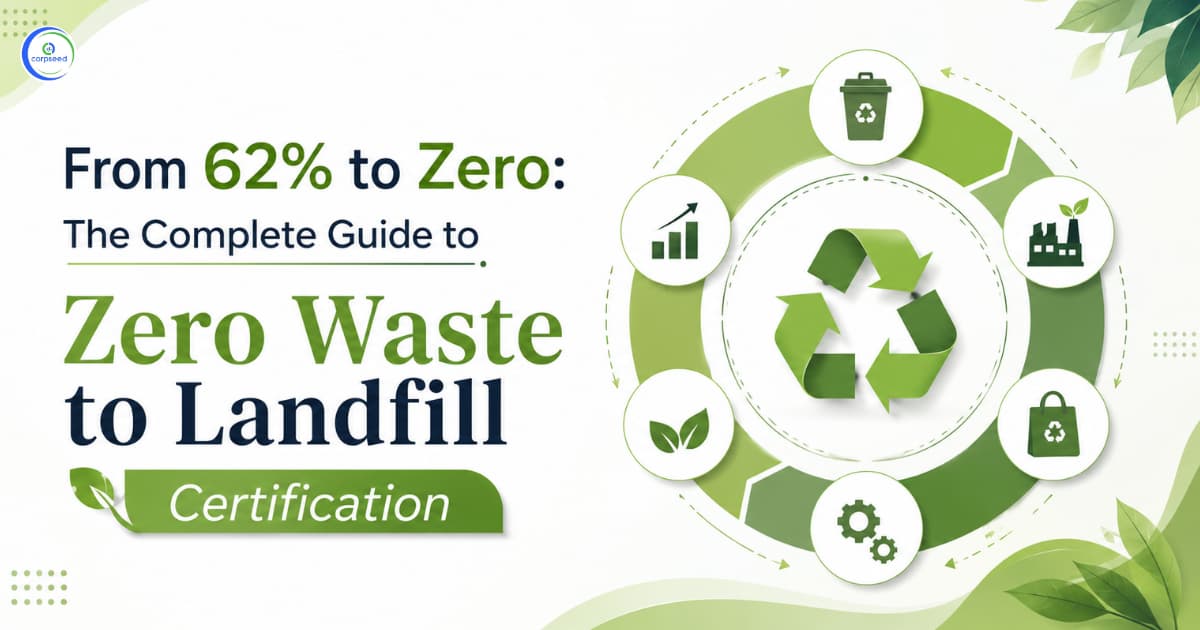
From 62% to Zero: The Complete Guide to Zero Waste to Landfill Certification
Zero Waste to Landfill (ZWTL) is a facility-level approach to keeping discarded materials out of landfills through prevention, reduction, reuse, recycling, composting, and other recognized recovery routes. The precise boundary, calculation method and treatment of waste-to-energy depend on the selected certification or validation programme.
Schedule a Call Back
A significant purchaser poses a straightforward question: Can you verify where each waste stream goes after leaving your premises?
There is a waste log at the facility, a list of approved vendors, and an EMS. Still, there are some important waste streams for which there isn’t sufficient traceability to prove the final destination. It is believed that most of the waste is recycled, but this can’t be verified through an customer or third-party waste audit.
In this fictional scenario, a professional waste gap assessment reveals a 62% landfill diversion rate to work from. It is not about making a marketing claim out of the 62% diversion rate. It is about improving waste prevention and segregation practices, material recovery, and tracing until this can be certified for Zero Waste to Landfill designation.
That is the purpose of zero-waste-to-landfill certification - converting day-to-day waste practices into measured, independently reviewed performance.
Schedule a Call Back
What Does Zero Waste to Landfill Actually Mean?
Zero Waste to Landfill (ZWTL) is a facility-level approach to keeping discarded materials out of landfills through prevention, reduction, reuse, recycling, composting, and other recognized recovery routes. The precise boundary, calculation method and treatment of waste-to-energy depend on the selected certification or validation programme.
Three distinctions are essential:
- Diversion is measured, not assumed. A credible claim is based on stream-level weights, a defined facility boundary, and a repeatable calculation method.
- Waste-to-energy is not the same as material recovery. Some programmes exclude it from qualifying for diversion or limit its contribution to a designation.
- Traceability doesn’t stop at the gate. Collection manifests don’t prove recycling; the evidence must establish downstream processing and end-point treatment.
The practical takeaway: Many locations divert more waste than they can prove. The immediate problem is evidence, ownership, and process control – not just infrastructure.
How is the Landfill Diversion Rate Calculated?
The simple diversion rate divides the material that is kept out of landfills by the total amount of material produced in the set scope:
Diversion rate (%) = diverted waste / total waste generated x 100
However, the above calculation is complicated by various judgments regarding the included streams, whether liquids and hazardous waste streams are treated separately, how residues after downstream sorting will be allocated, and whether thermal treatment will be included. Always use the formula given by the selected program and keep records of all inputs.
Choosing a ZWTL Certification or Validation Route
There is no single global ZWTL law. Facilities select one of the accepted programs, taking into account customers' expectations, location, facility maturity, and necessity.
Criteria can change. Confirm the current program documents and scope with the issuing body before making a public claim.
Why Indian Manufacturers are Prioritising ZWTL
Zero-waste-to-landfill certification is gaining attention because several business pressures now converge on the same point: traceable data.
- Customer qualification: Consumers need to verify environmental performance metrics and evidence from suppliers, particularly in export-focused supply chain operations.
- Disclosure requirements: Waste information is available in BRSR, but consumers and investors may request controls and evidence.
- Regulatory discipline: India's waste rules create stream-specific obligations. A structured evidence system can support, but does not replace, the registrations, authorizations, records, and filings applicable to the facility.
- Operating economics: segregation could help reduce disposal costs and add value to recoverable material, while source reduction could minimize material loss.
- Credibility: third-party verification is more defensible than a broad self-declared 'zero waste' statement.
Are you ready to compare with other sites? Download the Zero Waste to Landfill Readiness Checklist or set up a gap analysis session. Add links before publishing.
The ZWTL Certification Process: Three Connected Stages
Such a program manages the process of assessment, improvement, and certification-readiness preparation in an integrated manner, with each step feeding into the next.
Stage 1 - Gap identification
The goal is to establish a reliable baseline and a prioritized plan. A waste gap assessment should include:
- Waste characterization: sample and classify actual material streams across relevant shifts, operating modes, and seasonal conditions.
- Mass-balance review: compare material inputs with product, by-product, effluent, emissions, and waste outputs to identify missing or poorly measured streams.
- Downstream traceability: verify transporters, aggregators, and processors, including authorizations, capacity, treatment routes, and residual disposal.
- Contamination analysis: measure when mixed or contaminated loads reduce recyclability and identify where contamination occurs.
- Evidence audit: review weighbridge records, manifests, vendor certificates, contracts, training records, and applicable filings.
- Clause-by-clause gap scoring: map findings to the chosen program, then rank actions by compliance risk, diversion impact, cost, and effort.
The output should be a verified baseline, a stream-level gap register, a route-selection recommendation, and a practical implementation roadmap.
Stage 2 - Rectification and operational control
This is where the diversion rate improves, and the evidence system becomes routine.
- Redesign segregation based on how people and materials actually move, with clear labels, suitable containers, and convenient capture points.
- Prioritize prevention and source reduction through yield improvement, packaging redesign, reusable transit systems, and supplier engagement.
- Vet vendors and put documentation duties into contracts, including treatment evidence and timely records.
- Develop appropriate outlets for difficult streams without using thermal recovery as a blanket substitute for material recovery.
- Maintain ownership, train staff, and conduct monthly governance for contamination, vendor performance, and corrective action.
- Develop a digital or controlled chain of evidence to reconcile weights and identify missing documents before the audit period expires.
Stage 3 - Certification preparation and maintenance
Certification preparation converts operating performance into an auditable submission.
Define the facility boundary and claim precisely: plant, campus, line, or group of sites.
Maintain the evidence period required by the selected programme and review results monthly for drift.
Assemble procedures, calculations, stream records, downstream evidence, training records, and corrective-action logs.
Run an internal pre-assessment, close findings, and coordinate the independent audit or validation.
Plan ongoing monitoring, surveillance, and revalidation so performance continues after the certificate is issued.
What Can a Credible ZWTL Program Unlock?
Benefits vary by facility and should be quantified during the assessment. The strongest value typically appears in five areas:
Commercial access: Stronger supplier scorecards and evidence for tenders that include environmental qualification criteria.
Cost control: Lower disposal volumes, better recovery value, and reduced material loss where source-reduction projects succeed.
Risk management: Clearer vendor oversight, better audit readiness, and a more defensible environmental claim.
Reporting: Consistent waste data for BRSR, customer questionnaires, ESG reporting, and internal performance reviews.
Workplace discipline: Clearer ownership, cleaner operating areas, and better material-handling habits.
Promises of cost neutrality, reduced financing costs, and certification guarantees must be avoided unless Corpseed can back them up with approved client data.
The next step is to use a readiness checklist to check for any evidence gaps and determine whether a site visit or a waste gap assessment is necessary.
Six Reasons ZWTL Programmes Fail
- Starting with the certificate. A facility applies before its boundary, data, and baseline are stable. Begin with measurement and programme selection.
- Treating waste as an EHS-only issue. Production, procurement, facilities, finance, and vendors influence material flows. Give them defined roles.
- Stopping at collection records. A pickup receipt does not prove that final treatment was provided. Verify the downstream chain and residuals.
- Relying too heavily on waste-to-energy. Program rules may restrict its treatment, prioritizing prevention, reuse, and material recovery.
- Failure to invest in behaviour. Misconceptions about segregation can arise if labelling, location, training, and supervisor behaviors do not align with business operations.
- Allowing poor performance to slide. Certification is a process cycle. Review your weight issues, contamination, and lack of evidence monthly.
How can Corpseed Support the Journey?
Corpseed's proposed model is a single program that covers gap identification, implementation support, and certification readiness, so that findings are linked to owners, actions, and evidence.
Baseline evaluation and gap assessment, including stream mapping and review of evidence.
Aid in standard selection based on the needs of the facility’s customers/reporting.
Plan for rectification regarding segregation, vendors, training, documentation, and governance.
Pre-assessment and audit-readiness support, including evidence-pack review and corrective-action tracking.
Ongoing monitoring and multi-site rollout design where the engagement scope includes those services.
Before publication, Corpseed needs to determine which services it provides on its own and which it provides through partnerships.
Conclusion
Zero Waste to Landfill certification is not just a label for environmental compliance. It is a process that makes good business sense and ensures accurate data and growth. Measuring all waste streams, ensuring end-of-life treatment, improving segregation, and promoting prevention and recycling will help you make waste management a performance metric.
The process starts with establishing a baseline, followed by rectifying areas of deficiency, and ultimately succeeds when evidence becomes part of business operations. With the right standards, proper ownership and accountability, and continual monitoring, organizations will be able to reduce risk, increase customer confidence, provide sustainability reporting, and identify opportunities for savings. Corpseed can assist organizations throughout the entire process from assessing gaps until certification.
About the Author

Mahek Sancheti
Content WriterMahek Sancheti, BAJMC graduate with a deep passion for writing. As a content writer, video content creator, creative content creator, and scriptwriter, I bring stories to life through words and visuals. I honed my skills by working with a prominent news agency, where I excelled in crafting compelling narratives and engaging content. Coming from a journalism and mass communication background I have skills to craft engaging narratives that captivate audiences. With a keen interest in writing and creativity, I aim to deliver impactful and meaningful content that resonates with diverse audiences.
https://www.linkedin.com/in/mahek-sancheti-837196212
Related articles
Top 10 Category 2 Plastic Recycled Granules Manufacturers in India
2026-07-23
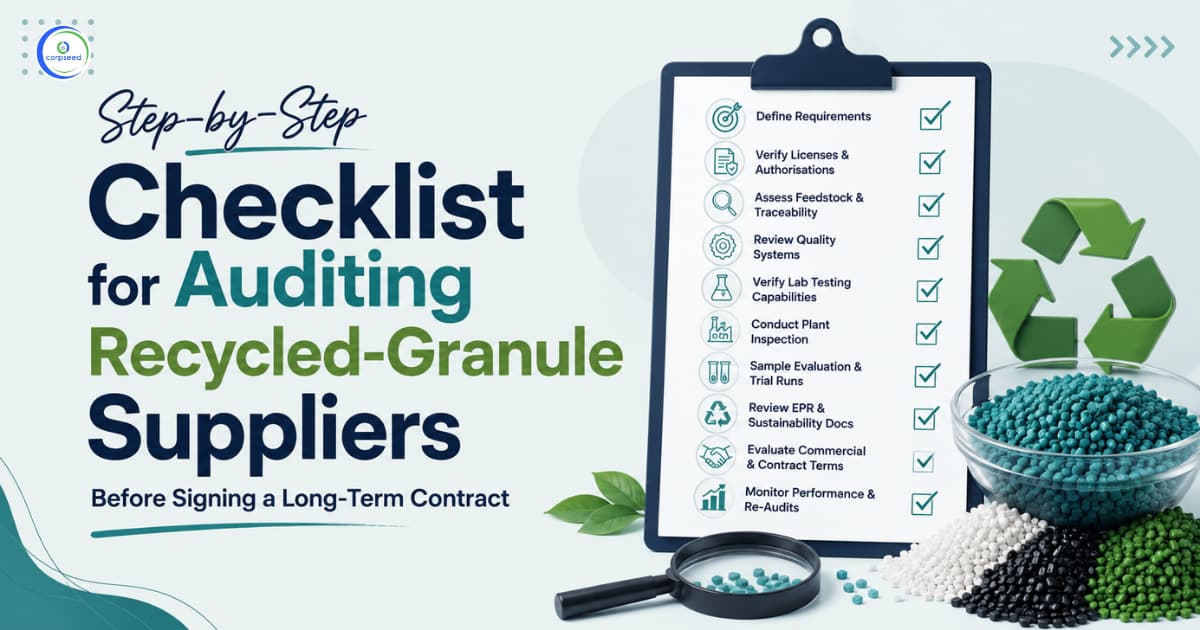
Step‑by‑Step Checklist for Auditing Recycled‑Granule Suppliers Before Signing a Long‑Term Contract
2026-07-22
Plastic Waste Management Amendment Rules 2026: A Complete Guide
2026-04-02
What are the Solid Waste Management Rules, 2026?
2026-02-05
BMW Certificate Renewal Process For Clinics And Hospitals
2026-01-05
How to Apply For Bio-Medical Waste Registration Online: Step-By-Step Guide
2025-12-23