
GST on Waste and Scrap 2026: New RCM, TDS & Registration Rules
The changes to GST on waste and scrap in 2026 deal with three different obligations: who pays tax, who may need to register and when a buyer must deduct tax. All three amendments take effect on 1 November 2026.
Schedule a Call Back
200+ GST assignments since 2018
Clients include Cmp Security Services, T&T Security and Management Services, The Meeras Security and Placement Company, R3 Clinic, Pia Lifesciences, Naduvin Dental Care, SNS Metpro Industries, Rathi Group Industries, RGK Crop Science, S S Engineering Corporation, Anagh Traders, Hopeful Hearts Foundation (12 of 200+ served since 2018).
A few more clients we've served in this industryHide the list
- Professional services and finance
- Cmp Security Services · T&T Security and Management Services · The Meeras Security and Placement Company
- Pharma and healthcare
- R3 Clinic · Pia Lifesciences · Naduvin Dental Care
- More clients
- SNS Metpro Industries · Rathi Group Industries · RGK Crop Science · S S Engineering Corporation · Anagh Traders · Hopeful Hearts Foundation · Metanovo Health · Kapemai Lifestyle · Mobi Tech · Nimblegait Healthtech · Arng · NutraX Biotech · Ania Consumer Products · SEI Thai Electric Conductor · Zariwala & Company · Apna Shop · Bay Skin · Hearing Solutions Technologies · Ningi Neyla Exim Trade India · Shandong Donghao Autoglass
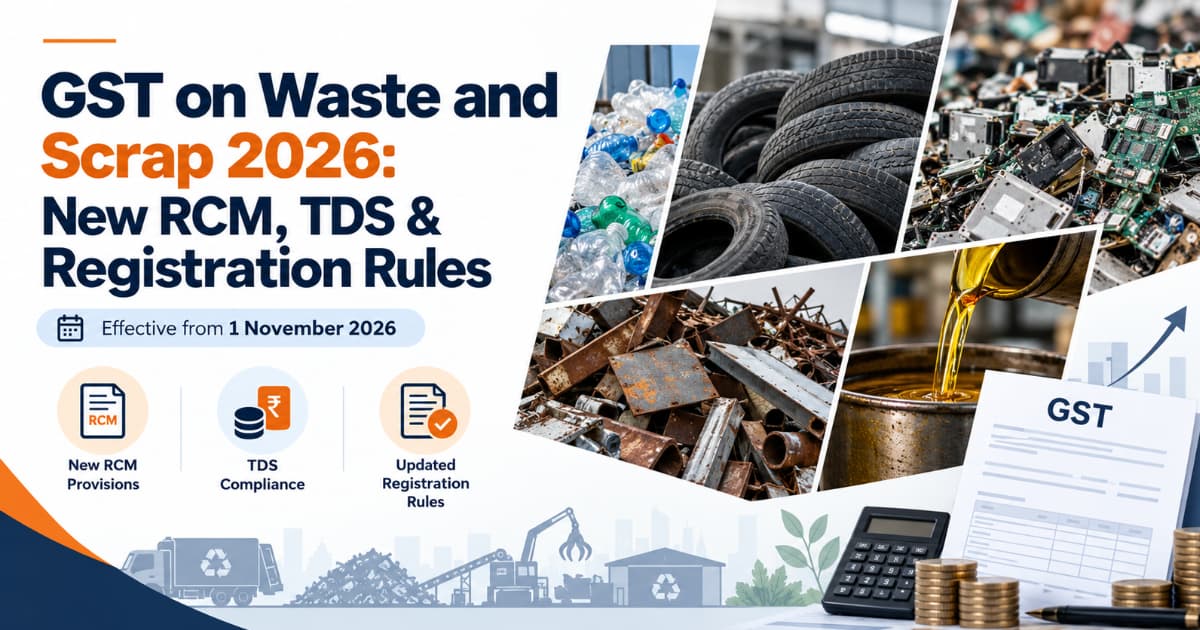
From 1st November 2026, organizations purchasing certain waste and scrap materials will be required to identify who bears the liability to pay GST. Where there is a registered buyer buying the specified scrap from an unregistered seller, reverse charge will apply. Purchase of such materials from a registered seller will be liable to 2% GST TDS.
The Ministry of Finance notified these changes on 27 October 2026. They concern plastic waste, tyre scrap, electronic waste and used cooking oil, with separate provisions also covering metal scrap. For dealers, recyclers and manufacturers, the new rules make the supplier's GST status and the correct classification of goods particularly important.
The new GST rules for scrap dealers also affect how businesses review their purchases and decide whether a GST registration check is needed.
Schedule a Call Back
What Are the New GST Rules for Waste and Scrap in 2026?
The changes to GST on waste and scrap in 2026 deal with three different obligations: who pays tax, who may need to register and when a buyer must deduct tax. All three amendments take effect on 1 November 2026.
GST changes for waste and scrap from 1 November 2026
| Notification | Amendment | Effective date |
| 04/2026-Central Tax (Rate) | New RCM entries for four specified goods categories supplied by unregistered persons to registered recipients | 1 November 2026 |
| 06/2026-Central Tax | Revised exclusion from the registration exemption for suppliers of five specified goods categories | 1 November 2026 |
| 07/2026-Central Tax | Revised GST TDS coverage for specified registered-to-registered supplies | 1 November 2026 |
Related notifications also cover IGST and UTGST. The amendments do not set one new GST rate for all scrap.
Which Waste and Scrap Categories Are Covered Under the New GST Rules?
The notifications identify goods by their tariff headings or chapters. A business must check the actual material being traded, not just describe it as "scrap" on an invoice.
Waste and scrap categories covered under the GST amendments
| Waste or scrap category | HSN heading / chapters | New RCM entry | Registration and TDS amendments |
| Used cooking oil | 1518 | Yes | Included |
| Plastic waste and scrap | 3915 | Yes | Included |
| Tyre waste and scrap | 4004 | Yes | Included |
| Electrical and electronic waste and scrap | 8549 | Yes | Included |
| Metal scrap | Chapters 72–81 | No new entry, existing framework | Included |
Four categories are newly included in RCM, while five, including metal scrap, feature in the registration and TDS changes. Tyre scrap under heading 4004 differs from retreaded tyres under 4012. A used electronic device is not automatically e-waste scrap under 8549.
When Does GST Reverse Charge Apply to Scrap Purchases?
Normally, a registered seller charges and pays GST. Under the Reverse Charge Mechanism (RCM), the buyer pays instead.
From 1 November, GST reverse charge on scrap applies to the newly notified categories when an unregistered person supplies the covered goods to a registered recipient. Buyers should check:
- Whether the goods fall under headings 1518, 3915, 4004 or 8549.
- Whether the supplier is unregistered under GST.
- Whether the recipient holds GST registration.
- Whether the transaction meets the applicable GST provisions.
For GST RCM on plastic scrap, the buyer should confirm both the material's heading 3915 classification and the seller's unregistered status.
The registered buyer liable under RCM needs to pay and report the tax. Recipient-generated invoices and payment receipts may be necessary. Input tax credit is still governed by eligibility requirements.
If both parties are registered, these new entries under unregistered suppliers' RCM will not be applicable. The seller will charge GST normally, whereas the buyer needs to verify the GST TDS requirement.
Does RCM Apply When the Scrap Supplier Is Below the GST Registration Threshold?
Yes. A registered buyer can still be liable under reverse charge when the unregistered seller's turnover is below the GST registration threshold. The government's clarification expressly addresses this situation. The seller's ability to remain unregistered does not cancel the buyer's RCM obligation on a notified supply.
Is GST Registration Mandatory for Scrap Dealers in 2026?
Not for every scrap dealer. Notification No. 06/2026-Central Tax changes a specific exemption provided under Notification No. 5/2017-Central Tax. From 1 November, that exemption will not be available to suppliers of the five specified goods categories.
That does not remove all turnover thresholds. Actual GST registration requirements for scrap businesses still depend on Sections 22 and 24 of the CGST Act, the type of supply, the state concerned and other applicable conditions.
For GST registration for recycling businesses, the actual supply activity and registration conditions matter more than whether a firm calls itself a recycler or scrap dealer.
Before applying for GST registration for scrap dealers, an unregistered business should establish:
- Its aggregate turnover and the applicable registration threshold.
- Whether it supplies goods covered by the revised exemption.
- Whether such a mandatory registration clause applies.
- Whether it has already got a valid registration for its activities.
GST Council is clear that suppliers will have to register once they exceed the specified limit. The subsequent supplies of goods/services to registered persons would normally be on the basis of forward charge, with TDS being treated separately.
The fact that such notifications have been made does not mean that an existing registered entity needs to go for GST registration again. In case of change in the particulars of registration, it may check for GST registration amendment.
When Does 2% GST TDS Apply to Waste and Scrap?
GST TDS on scrap applies to covered purchases by registered persons from other registered persons when the conditions under Section 51 of the CGST Act are met. Notification No. 07/2026-Central Tax extends the notified buyers to the five goods categories listed above.
The total deduction is 2%: generally 1% CGST plus 1% SGST or UTGST on relevant intra-state supplies, or 2% IGST on applicable inter-state supplies. This deduction is not an additional GST rate on the goods.
Under Section 51, the taxable supply value under a contract must exceed ₹2.5 lakh for the general TDS requirement to apply. The value used for deduction excludes GST and cess shown on the invoice. The section also contains a place-of-supply exception, so registration of both parties alone is not enough to decide whether deduction is required.
For GST TDS compliance on scrap purchases, buyers should review the contract amount, supplier GSTIN and place-of-supply conditions before making a deduction.
Where TDS applies, the buyer must deduct and deposit the tax, report it in Form GSTR-7 and provide the prescribed certificate. The deducted amount, once properly reported, is credited to the supplier's electronic cash ledger under the GST mechanism. Businesses acting as GST TDS deductors should also check their deductor-registration obligations.
The CGST Act, Section 51, sets out the governing conditions. A purchase from an unregistered seller should instead be checked against the relevant reverse-charge entry.
GST RCM vs GST TDS vs GST Registration
The three rules answer different queries. RCM deals with who should pay GST for a notified supply. TDS deals with the deduction of tax from the supplier's payment. Registration deals with whether the entity is required to have GST registration.
Difference between GST RCM, TDS and registration
| Point | GST RCM | GST TDS | GST registration |
| Main purpose | Registered recipient pays tax on notified supplies | Notified buyer deducts tax on eligible purchases | Determines registration liability |
| Typical relevant transaction | Notified goods: unregistered seller to registered buyer | Covered goods: registered seller to registered buyer, subject to Section 51 | Determined by turnover and other applicable conditions |
| Main compliance action | Pay and report applicable GST | Deduct, deposit and report TDS | Obtain or amend registration when required |
A business should assess each purchase rather than apply one rule to its entire scrap operation.
How Will the New GST Rules Affect Scrap Dealers and Recyclers?
The effect depends on what a business buys or sells and who its suppliers are.
- Plastic recyclers: Purchases of plastic waste under heading 3915 may require RCM or TDS checks. Finished recycled plastic products may have different classifications.
- Tyre scrap dealers: Transactions involving waste and scrap under heading 4004 need correct classification and supplier-status checks.
- E-waste recyclers: Registered buyers of material falling under heading 8549 should review the relevant tax mechanism. Environmental authorisations remain separate requirements.
- Used cooking oil businesses: Purchasers should distinguish supplies from registered and unregistered sellers before deciding the GST treatment.
- Metal scrap dealers: Existing RCM provisions and the revised registration and TDS notifications must be read together.
For mixed scrap businesses, product-wise purchase records and accurate supplier GSTINs help with reconciliation.
What Should Scrap Businesses Do Before 1 November 2026?
Businesses covered by these notifications should check their transactions before the rules take effect. This is especially useful for buyers dealing with both registered and unregistered suppliers.
1. See HSN Classification. Check whether the purchase/supply comes under any of the notified heads or chapters.
2. Check supplier registration status. Note down the registration status of the suppliers and GSTIN number.
3. Review RCM purchases. Identify covered purchases from unregistered suppliers and determine the applicable tax treatment.
4. Assess registration liability. Check turnover, the revised exemption and any compulsory-registration conditions.
5. Analyse GST TDS. For registered to registered transactions, look into the contract value and Section 51 exclusions.
6. Check accounts and returns. Verify that purchases, tax payments, and deductions can be accounted for.
7. Check existing registration details. Apply for a modification only where the registered particulars actually need updating.
Not every step applies to every business.
How Can Corpseed Help with GST Registration?
Scrap dealers and recycling businesses sometimes need support establishing their registration position or preparing an application. Corpseed offers online GST registration services, including assistance with the relevant application information and documents.
The GST amendment service that it offers can assist businesses to amend their registration details where necessary. The transaction-specific RCM/TDS queries should be analyzed based on the relevant tax provisions.
For businesses comparing GST compliance services, GST modification services may be more relevant than a fresh registration application when existing registration particulars need updating.
Need GST registration assistance for your scrap or recycling business? Contact Corpseed to discuss the applicable registration process and available support.
Conclusion
The new GST on waste and scrap 2026 provisions take effect on 1 November. They expand reverse charge to four additional goods categories, revise a registration exemption and extend GST TDS coverage to specified purchases. The right treatment depends on the goods, supplier status and legal conditions. Checking those details before recording a transaction is more useful than assuming one rule applies to every scrap purchase.
About the Author

Mahek Sancheti
Content WriterMahek Sancheti, BAJMC graduate with a deep passion for writing. As a content writer, video content creator, creative content creator, and scriptwriter, I bring stories to life through words and visuals. I honed my skills by working with a prominent news agency, where I excelled in crafting compelling narratives and engaging content. Coming from a journalism and mass communication background I have skills to craft engaging narratives that captivate audiences. With a keen interest in writing and creativity, I aim to deliver impactful and meaningful content that resonates with diverse audiences.
https://www.linkedin.com/in/mahek-sancheti-837196212
Related articles
How RBI’s FEMA 2026 Regulations Impact Money Changers and Forex Businesses in India
2026-05-12

RBI Prudential Norms on Specified Non-financial Assets (SNFA) Directions 2026
2026-05-12

RBI Strengthens Digital Payment Protection for Bank Customers
2026-03-09
FEMA Registration Process, Compliance, and Requirements
2025-09-10

Understanding the Regulatory Landscape for Foreign Investments in India
2025-04-23

How to Start a Factoring Business in India?
2025-01-23