
UDI for Medical Devices in India: Complete CDSCO Compliance Guide
Unique Device Identification (UDI) is a globally recognized system that assigns a unique identification code to every medical device, improving product traceability, patient safety, post-market surveillance, and recall management. In India, medical devices are regulated by the Central Drugs Standard Control Organisation (CDSCO) under the Medical Devices Rules, 2017.
Schedule a Call Back
2,100+ CDSCO medical device assignments since 2018
Clients include Endolite India, Mankind Pharma, Ossur India, ADK Health Care, Credence Prosthetic India, V2U Physio Asia, International Electro Medical Company, Radimage Healthcare India, Istok New Hearing AID, Simpladent Implant Solutions, Starkey Laboratories India, Gentec Medical (12 of 1,100+ served since 2018).
A few more clients we've served in this industryHide the list
- Pharma and healthcare
- Endolite India · Mankind Pharma · Ossur India · ADK Health Care · Credence Prosthetic India · V2U Physio Asia · International Electro Medical Company · Radimage Healthcare India · Istok New Hearing AID · Simpladent Implant Solutions · Starkey Laboratories India · Gentec Medical · Cureesse Pharma · Hygiene Medicus · Nexus Surgical and Medicare
- More clients
- Meditronix Corporation · Nilkamal · Haesi GHL · GHL · Servotech Power Systems · Elektrocraft India · Happy Medicare · Anantaa Gsk Innovations · Cogmac Technologies · Aficionados Tech · Superceuticals · Truevis Technologies · 1008 Digital Health · BDS Services · Evoq Imaging Technologies · Premier Medical Systems and Devices · Riransa · Vitrag Infra Projects · Insta Biotech · Digital Acoustics · Artificial Learning Systems India · Nfilade Security Solutions · Humors Tech · K2O Consulting
Introduction
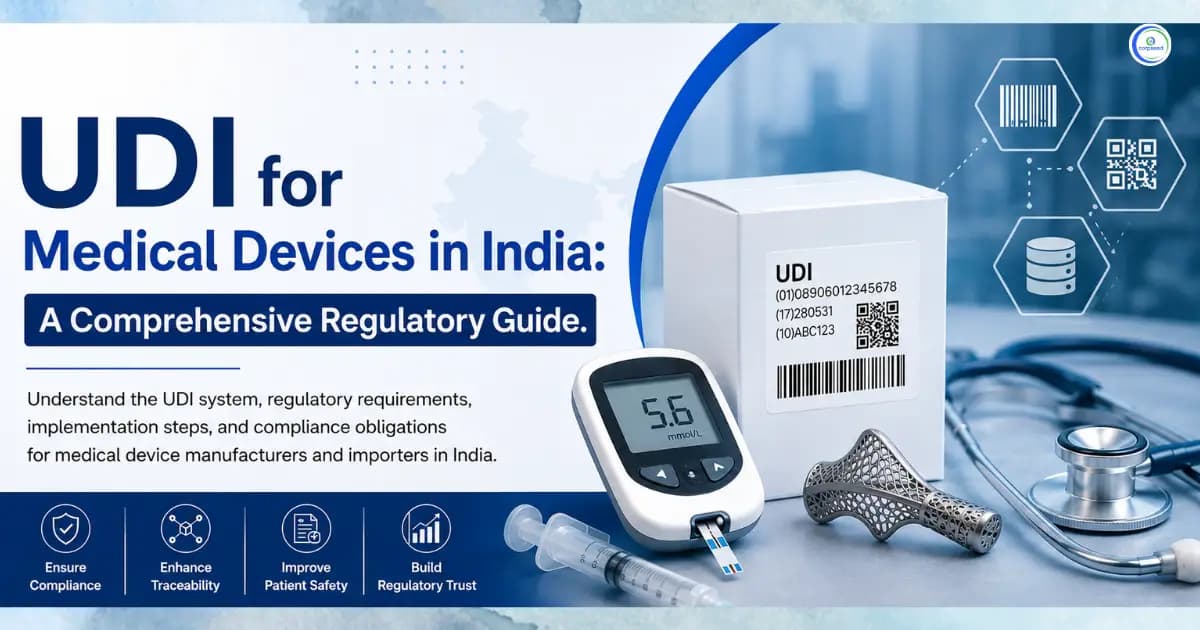
India's healthcare industry is still growing quickly, and as a result, stronger regulatory frameworks are required to protect patient safety and guarantee product quality. The Central Drugs Standard Control Organization's (CDSCO) Unique Device Identification (UDI) system for medical equipment is one of the most important of these systems.
This guide provides a structured overview of the UDI system for medical devices in India, covering its purpose, implementation process, benefits, and the challenges organizations commonly encounter.
Schedule a Call Back
What Is the UDI System for Medical Devices in India?
Additionally, the UDI system creates a standardized method for giving each medical device a unique identification code, allowing traceability throughout the device's lifecycle, from production to distribution to final usage.
There are two main parts to every UDI code:
- Device Identifier (DI): A fixed number that identifies the specific model and manufacturer of the device.
- Production Identifier (PI): A variable identifier that records information unique to manufacturing, including batch number, serial number, manufacturing date, and expiration date.
Medical device producers and importers must also assign and maintain UDI codes for their products in accordance with CDSCO requirements. These codes, like barcodes or QR codes, must be shown in both machine-readable and human-readable versions.
Why the UDI System matter?
Implementing UDI is more than a compliance obligation it also represents a meaningful advance in the quality and safety of India's healthcare ecosystem. Key benefits include:
- Enhanced Patient Safety facilitates rapid identification of defective or unsafe devices.
- More Efficient Recalls enable regulators and manufacturers to execute product recalls with greater speed and accuracy.
- Stronger Supply Chain Oversight improves tracking and monitoring across distribution networks.
- Reduced Counterfeiting helps verify product authenticity and limits the circulation of counterfeit devices.
- Global Regulatory Alignment brings India's medical device framework in line with international standards and practices.
Benefits of the UDI System for Medical Devices in India
| Regulatory Objective | Resulting Benefit |
| Accurate device identification | Greater transparency across the healthcare system |
| Regulatory compliance | Reduced legal exposure for manufacturers |
| Full lifecycle traceability | Faster recalls and corrective actions |
| Post-market surveillance | Improved patient safety and public trust |
| Elimination of duplication and errors | More efficient inventory management |
The UDI Compliance Process Under CDSCO
Achieving UDI compliance involves several defined steps:
- Device Classification: Determine the device's regulatory class (A, B, C, or D) in accordance with the CDSCO rules.
- Selection of an Issuing Agency: Engage an authorized UDI issuing agency, such as GS1, HIBCC, or ICCBBA.
- Assignment of the Device Identifier (DI): Generate a unique DI for each product model.
- Assignment of the Production Identifier (PI): Incorporate manufacturing details, including batch number, serial number, and expiry date.
- Labelling Compliance: Ensure the UDI appears on product labels and packaging in both readable and scannable formats.
Common Challenges in Achieving UDI Compliance Without Expert Support
Although the process is clearly defined, many organizations encounter difficulties when managing UDI compliance independently, including:
- Limited Regulatory Familiarity: CDSCO guidelines can also be difficult for newer entrants to navigate.
- Misclassification Risk: Incorrect device classification can create downstream compliance issues.
- Technical Errors in UDI Generation: Mistakes in DI or PI assignment may result in rejection or penalties.
- Labelling Non-Compliance: Improperly formatted labels can delay regulatory approval.
- Resource-Intensive Documentation: Managing the process internally often requires significant time and administrative effort.
- Compliance Risk: Errors in the process can expose businesses to legal and operational consequences.
Conclusion
An essential part of India's efforts to improve healthcare safety, transparency, and operational efficiency is the UDI system for medical devices under the CDSCO. It guarantees that patients obtain safe, traceable, and dependable items in addition to helping regulators monitor devices more efficiently.
UDI compliance used to be an optional best practice for producers and importers, but it is now a legal necessity. Even though there are numerous technical and administrative processes involved in the process, thorough preparation backed by knowledgeable regulatory assistance may make complete compliance simple and effective while enhancing an organization's reputation in India's healthcare industry.
About the Author

Anshika Jindal
Content WriterAnshika Jindal, a Legal Content Writer with strong expertise in legal research and a solid academic background in BA LLB and LLM (Criminal Law). I specialize in researching statutes, case laws, and legal developments and presenting them in clear, accurate, and engaging written content. With strong analytical skills and attention to detail, I create reliable, well-structured legal content while maintaining professional and ethical standards.
I specialize in conducting in-depth legal research using credible sources and presenting legal information in a structured, reader-friendly manner while maintaining precision and authenticity. My work focuses on simplifying legal language without compromising its meaning, making legal content accessible to a wider audience.
Related articles
CDSCO MD-7 Endorsement for Medical Devices: A Practical Guide for Manufacturers
2026-10-23

CDSCO Export NOC for r-DNA Products: Who Needs It?
2026-10-21
CDSCO Registration: A Simple Guide to Getting Your License in India 2026
2026-10-21

Importing Cosmetic Gift Sets into India? CDSCO, LMPC & Labelling Checklist
2026-10-14

CDSCO Medical Device Registration Consultant
2026-09-23
CDSCO Registration for Lab Equipment and Diagnostic Devices
2026-09-22