
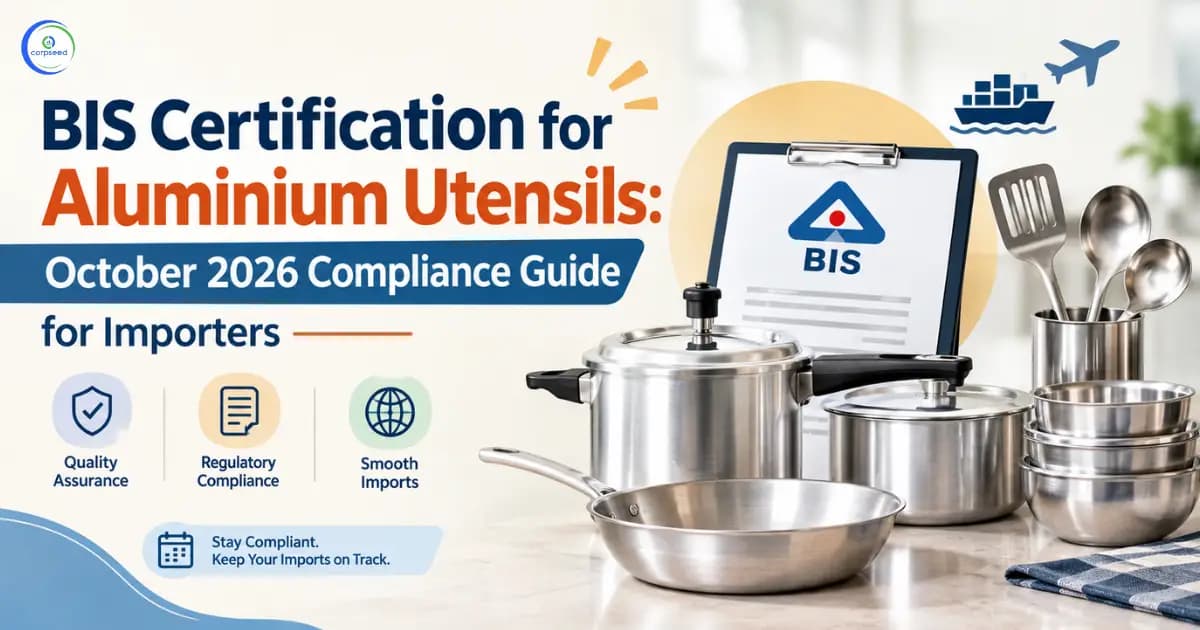
BIS Certification for Aluminium Utensils: October 2026 Compliance Guide for Importers
Importers dealing in aluminium cookware and utensils need to check the BIS certification requirement before placing orders or shipping products to India.
Schedule a Call Back
750+ BIS certification assignments since 2018
Clients include Juki India, Nibav Lifts, Normet India, Hirotec India, Kito India, Technotorc Tools, N Steels, Agromach Engineering, Emerson Automation Solutions Intelligent Platforms, Intangles Lab, Deki Electronics, Emerson Process Management (India) (12 of 450+ served since 2018).
A few more clients we've served in this industryHide the list
- Engineering and manufacturing
- Juki India · Nibav Lifts · Normet India · Hirotec India · Kito India · Technotorc Tools · N Steels · Agromach Engineering
- Electronics and technology
- Emerson Automation Solutions Intelligent Platforms · Intangles Lab · Deki Electronics · Emerson Process Management (India) · Martelx Electronics · Waites Sensor Technologies · Fleetx Technologies · Comap India
- Jewellery
- Swarnmala Jewellers · Muktavali Jewellers · Omana Jewels · Escarl Jewels · Aahaana Mooguthi · Aparna Jewels · Arraa Gold · DV Jewellery
- Pharma and healthcare
- Radimage Healthcare India · Sonova Hearing India · Agfa Healthcare India
- Energy and power
- Bitek Solar · Sodion Energy · Essar Oil and Gas Exploration and Production
- Chemicals and materials
- Sreechem Resins · Appl GOR Plastics India · Global Colours and Chemicals
- More clients
- Nilkamal · Siddhartha Logistics · GHV Medical Anchor · Geepas India · Smarthome Solutions India · Lumiere Technologies · Tegamen Safety Products · Patel Agrotech · Abbie IT Mart · Aqua Water Systems (India) · Pentair Water Treatment · WIN the BUY BOX · TNY Services (India) · Silcom (PTY) · Zeal Medical
Introduction
Under the Cookware, Utensils and Cans for Foods and Beverages (Quality Control) Order, 2026, wrought aluminium utensils must conform to IS 1660:2024, and carry the (Bureau of Indian Standards) BIS Standard Mark under a valid licence. The general implementation date is 1 October 2026, while small, and micro enterprises have later dates under the order.
For importers, the key steps are to confirm product coverage, verify the manufacturer's BIS licence and check whether any specific exemption applies. A product's material or customs classification alone is not enough to establish its position under the order.
What Changes for Aluminium Utensil Imports in October 2026?
The Government of India issued the Cookware, Utensils and Cans for Foods and Beverages (Quality Control) Order, 2026, through notification S.O. 219(E), dated 15 January 2026. The order sets out the applicable Indian Standards and implementation dates for the products listed in its table. It also requires covered goods to bear the Standard Mark under a BIS licence issued under Scheme-I of the BIS Conformity Assessment Regulations, 2018.
For importers of aluminium utensils, the important aspects are as under:
- Applicable Standard: IS 1660:2024 for wrought aluminium utensils.
- General Implementation Date: 1 October 2026.
- Small Enterprises: 1 January 2027.
- Micro Enterprises: 1 April 2027.
- Certification: Covered products shall conform to the relevant Indian Standards and bear the BIS Standard Mark under a valid licence, subject to applicable provisions and exemptions.
The later dates apply to qualifying small and micro enterprises as defined under the MSMED Act, 2006. Importers should not assume that these dates automatically extend to every business importing aluminium utensils. The relevant category and circumstances must be checked against the QCO.
Which BIS Standard Applies to Aluminium Utensils?
The QCO lists IS 1660:2024, Wrought Aluminium Utensils, for the relevant cookware and utensil category. BIS's product manual for this standard is titled Wrought and Cast Aluminium Utensils and describes the product scope used for certification.
Products Covered Under IS 1660:2024
The BIS product manual identifies product types as well as classifications relevant to licensing under IS 1660:2024. These include:
- Wrought aluminium utensils
- Cast aluminium utensils
- Compartmental trays
- Lunch boxes
- Thick-bottom utensils
- Certain utensils with shapes and dimensions not covered by the standard's listed figures and dimensions.
The scope also distinguishes products by coating type, such as plain, anodic, hard anodic and non-stick, and by classification as light, medium or heavy.
This list is a guide to the product scope, not a substitute for checking the standard and the manufacturer's actual licence. The product type, manufacturing process, dimensions and coating may affect the scope of certification.
How to Check Whether Your Product Is Covered
Before importing, compare the product with the scope described in IS 1660:2024 and the QCO. Review the product's construction, manufacturing process, intended use, dimensions and coating, where applicable.
Do not decide coverage from the word “aluminium” alone. An aluminium product may fall under a different standard or a separate regulatory requirement. Aluminium beverage cans, for example, are listed under IS 14407:2023 rather than IS 1660:2024 in the 2026 order.
What Are the BIS Certification Requirements for Aluminium Utensils?
The BIS certification requirement depends on whether the product falls within the scope of the QCO and whether a valid licence covers it. For products covered by the order, the requirements include the following:
- Conformity with the Applicable Indian Standard: The product must meet the requirements of IS 1660:2024, including relevant material, construction, performance and testing requirements.
- A valid BIS Licence: The manufacturer must hold a licence covering the relevant product under the applicable certification scheme.
- Standard Mark: Covered products must bear the BIS Standard Mark as required by the order and the applicable licensing conditions.
- Correct Product Coverage: The licence scope should match the product being supplied, including the relevant utensil type and other declared varieties.
- Supporting Technical Information: Importers should obtain product details and certification information from the manufacturer before confirming the shipment.
BIS certification is granted through an assessment of the manufacturer's facilities, process controls, quality-control arrangements and product conformity. Testing forms part of the certification process. A supplier's general claim that its factory is certified does not, by itself, establish that the specific utensil is covered by the licence.
BIS Certification Deadlines for Aluminium Utensils
The aluminium QCO 2026 sets different implementation dates for general businesses and qualifying small and micro enterprises.
| Business Category | Implementation Date for IS 1660:2024 |
| General category, excluding micro and small enterprises | 1 October 2026 |
| Small enterprises | 1 January 2027 |
| Micro enterprises | 1 April 2027 |
The dates are specified in the official order.
Importers should plan around the date that applies to their situation rather than relying on the later dates without checking eligibility. They should also verify whether any subsequent official amendment has changed the applicable requirements before arranging a shipment.
Is BIS Certification Mandatory for Importing Aluminium Utensils?
BIS certification is mandatory for aluminium utensils covered by the applicable Quality Control Order from the relevant implementation date, subject to the order's provisions. The QCO requires covered products to conform to the specified Indian Standard, and bear the Standard Mark under a BIS licence.
This does not mean that every item made from aluminium automatically requires certification under IS 1660:2024. Importers must first establish whether the particular product is covered by the order.
Before importing, check:
- Whether the product falls within the scope of IS 1660:2024.
- Whether the applicable implementation date has arrived.
- Whether the overseas manufacturer has a valid BIS licence covering that product.
- Whether the product is covered by a specific exemption or stock-related provision in the QCO.
Where coverage is unclear, obtain advice based on the product's specifications and the current notification before placing the order.
How Can Importers Check BIS Compliance Before Shipment?
Importers can reduce avoidable shipment problems by checking certification before goods leave the manufacturing country. The following steps provide a practical starting point.
Step 1: Check the Product Against IS 1660:2024
Before placing an order, check whether the utensil falls under IS 1660:2024. A pressure cooker, frying pan and lunch box may differ in design, construction and coating, so don't assume that the same standard applies to every item in your catalogue.
Step 2: Check the BIS Licence Number
Get the manufacturer's BIS licence number, and look it up on the BIS website. Check the product names and varieties covered by the licence. If your supplier sends a licence for a different product, ask for proof that your utensil is covered before making the payment.
Step 3: Match the Test Report to Your Product
Request the test report for the utensil you are purchasing from the manufacturer. Make sure that the model and specifications match your order. If the report is for another product, make sure to confirm with the supplier that the product being shipped is the correct one.
Step 4: Check the BIS Mark on the Utensil
Ask the supplier for clear photographs of the product marking, and packaging. Check these against the applicable BIS marking requirements and licence details. Don't treat a logo printed on a catalogue or carton as proof that the product has a valid BIS licence.
Step 5: Check the QCO Exemptions Before Shipping
There may be cases where goods may be exempt from the QCO. If you are importing old stock, you need to confirm its manufacturing/import date and whether it can be sold after the deadline. You can not always take the supplier’s word on this. You must check the applicable QCO clause and review the documents for your shipment.
Can Existing Aluminium Utensil Stock Be Sold After the QCO Deadline?
The QCO contains a specific provision for certain goods manufactured domestically or imported before the relevant implementation date. Subject to the stated conditions, qualifying declared stock may be sold, displayed or offered for sale for up to six months from the applicable implementation date.
The provision requires a declaration to BIS certified by a Chartered Accountant. It is not a blanket permission for all old stock or all products ordered before the deadline. The order also refers to the manufacturer's certification status or application for certification and the importer in relation to the relevant goods.
Importers considering this provision should check the exact wording of the order and confirm that their stock, dates and supporting documents meet the conditions. They should not assume that a purchase order or payment made before the deadline is sufficient on its own.
The QCO also contains specific provisions for goods imported into India already filled with solid, liquid or gaseous material, and for up to 200 goods or articles imported annually by manufacturers for research and development, subject to conditions. The R&D provision includes restrictions on commercial sale and requirements for records and disposal. These exemptions should be assessed against the actual transaction.
Also Read: BIS Certification for Imported Products in India: Complete Guide for Importers
Common BIS Compliance Mistakes Importers Should Avoid
Importers should watch for these common errors when sourcing aluminium utensils:
- Checking only the Material: Not every aluminium product necessarily falls under IS 1660:2024.
- Accepting an Unverified Certificate: Check the manufacturer's licence status, and product scope.
- Ignoring Implementation Dates: Apply the date relevant to the business category and product.
- Assuming all Stock is Exempt: The stock provision has specific conditions and a declaration requirement.
- Going by the HS Code Alone: Check the product description in the QCO too. The HS code by itself may not tell you whether the utensil is covered.
- Leaving BIS Checks until the Last Minute: Check the licence and product requirements before the supplier ships the goods to India.
How Can a BIS Certification Consultant Help Importers?
A BIS certification consultant can help importers assess product coverage, review manufacturer licence details and identify documentation gaps before shipment. This support can be useful when a business is importing multiple utensil models, dealing with an overseas manufacturer or checking how a QCO applies to existing stock.
Corpseed can assist with BIS certification requirements, product-standard checks, documentation review and coordination for certification-related matters. The exact support needed will depend on the product, manufacturer and status of the application.
Before proceeding with an order, importers can contact Corpseed's BIS compliance experts for guidance on the applicable standard, licence scope and relevant QCO provisions.
Conclusion: What Should Importers Do Before Importing Aluminium Utensils?
From October 1, 2026, any business in the 'general category' covered by the Quality Control Order (QCO) will have to obtain a BIS licence for the import of aluminium utensils. Current practices should help you identify whether you are in the general category. IS 1660:2024 should also be compared with your product. If your supplier says that certification is not required, ask your supplier to give you the clause of the standard which allows them to take that decision.
Need Help with BIS Certification for Aluminium Utensils?
Not sure whether your aluminium utensils need BIS certification or how to proceed under the 2026 QCO? Contact Corpseed's BIS experts for guidance on product requirements, manufacturer licensing and certification procedures. Get a free consultation today.
Frequently Asked Questions
Quick answers to common questions on this topic.
Is BIS certification required for aluminium utensils imported into India?
Yes, if the utensils are under the purview of a Quality Control Order. Importers should check if their products are covered by IS 1660:2024, and if a BIS license is in place.
What is the BIS standard for wrought aluminium utensils?
The applicable standard listed in the 2026 QCO is IS 1660:2024, titled Wrought Aluminium Utensils. Check the product's specifications to confirm whether this standard applies to the utensil you plan to import.
What is the last date for BIS certification of aluminium utensils in 2026?
The QCO's implementation date for the general category is 1 October 2026. Small enterprises have until 1 January 2027 and micro enterprises until 1 April 2027, subject to the eligibility conditions in the order.
Can I import aluminium utensils without a BIS licence?
If the product is covered by the QCO and its applicable deadline has passed, the required BIS certification must be in place unless a specific exemption applies. Check the aluminium QCO 2026 before arranging the shipment.
Does the aluminium QCO 2026 apply to all aluminium cookware?
No. The requirement depends on the product covered by the order and the relevant Indian Standard. Check the product description and specifications rather than deciding from the material or HS code alone.
How can I check BIS certification for aluminium utensils made outside India?
Ask the manufacturer for its BIS licence number and check the licence details on the BIS website. Make sure the licence covers the particular utensil you intend to import. If you need help with the BIS certification requirement, consult a BIS certification expert before placing the order.
About the Author

Parul Bohral
Legal Content WriterParul Bohral, a BALLB graduate and experienced legal researcher and content writer with expertise in various legal areas, including corporate law and intellectual property. I have gained valuable experience in esteemed legal environments, where I have strengthened my research skills, allowing me to approach legal writing with precision and depth.
As a legal content writer, I am committed to delivering work that not only informs but also engages readers. By staying informed about the latest trends in content marketing and regulatory developments, I ensure that my writing remains sophisticated and meets industry standards. My dedication to thorough research enables me to craft content that is both insightful and impactful.
Related articles
BIS Hallmarking Centre Setup Scheme 2026-31
2026-11-02
BIS Establishes Three New Indian Standards for Electric Cycles, Therapeutic Footwear and EV Charging Cables
2026-10-19
Importing Toys into India: BIS Toy Certification & Battery EPR Requirements
2026-10-19
BIS Notifies 33 New and Revised Indian Standards in October 2026: Compliance Guide
2026-10-16
BIS Certification for Electrical Appliances: 2026 Guide for Manufacturers & Importers
2026-10-14

BIS Solar PV Module Model Number Update: New MNRE SOP and Registration Requirements
2026-10-09