The Indian manufacturing landscape just witnessed a significant shift that brings relief to millions of small-scale entrepreneurs. On February 12, 2026, the Ministry of Commerce and Industry, through the Department for Promotion of Industry and Internal Trade (DPIIT), issued a landmark notification.
This order exercises powers under Section 16 of the Bureau of Indian Standards Act, 2016. It introduces vital amendments to several existing Quality Control Orders (QCOs). The primary goal is to balance the need for high-quality products with the practical survival of Micro, Small, and Medium Enterprises (MSMEs). By providing specific exemptions for micro-units, the government is ensuring that the "Make in India" dream remains accessible to the smallest of workshops.
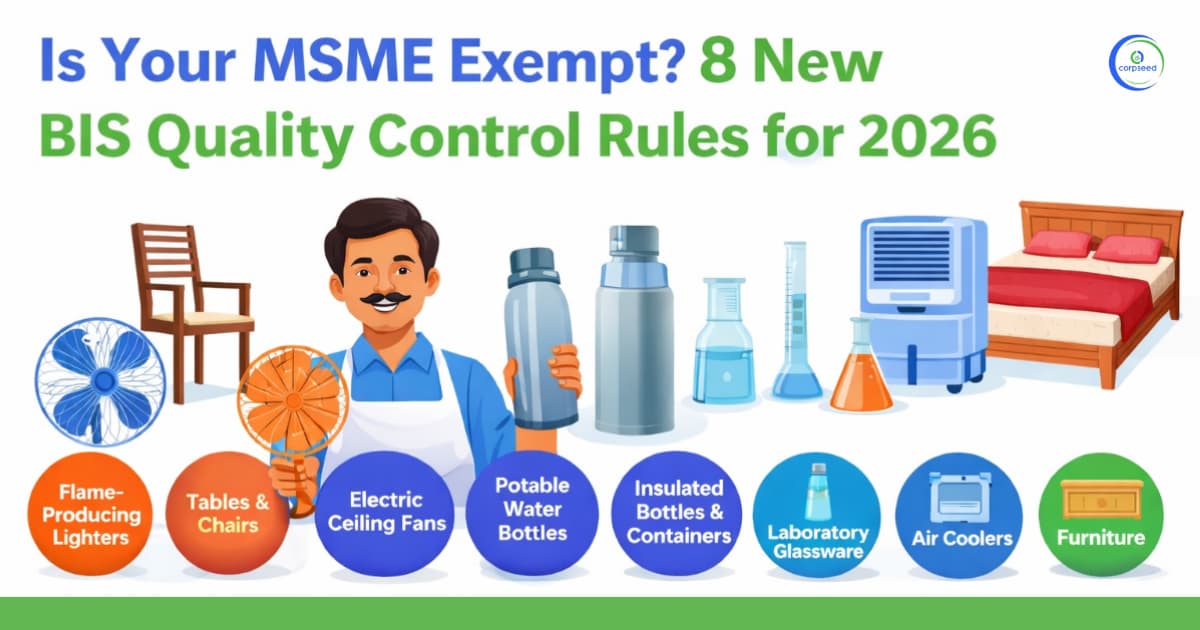
Table of Contents
- Understanding the Core Change: The "Micro-Enterprise" Exemption
- Breakdown of the 8 Amended Quality Control Orders
- Flame-Producing Lighters (Quality Control) Order, 2023
- Potable Water Bottles (Quality Control) Order, 2024
- Welding Rods and Electrodes (Quality Control) Order, 2023
- Insulated Flask, Bottles and Containers (Quality Control) Order, 2024
- Electric Ceiling Type Fans (Quality Control) Order, 2023
- Laboratory Glassware (Quality Control) Order, 2023
- Air Cooler and Air Filters (Quality Control) Order, 2025
- Furniture (Quality Control) Order, 2025
- Why the Bureau of Indian Standards Act, 2016 Matters?
- Essential Compliance Checklist for Small Businesses
- How does this Impact the Indian Market and Consumers?
- Conclusion
--------------Blog Contact Form-------------
Understanding the Core Change: The "Micro-Enterprise" Exemption
The heart of this 2026 notification is a standardised exemption clause added to eight product categories. Previously, many small businesses struggled with the high costs of BIS certification and laboratory testing. Now, the government has set a clear boundary. An enterprise is exempt from these strict quality orders if it satisfies three main conditions:
- Udyam Registration: The business must be officially registered on the Udyam Portal.
- Investment Limit: The investment in plant and machinery (at original cost) must not exceed 1 crore rupees.
- Turnover Limit: The total turnover for the previous financial year must not exceed 5 crore rupees.
- Pro Tip: To claim this benefit, a business must obtain a certificate from a Chartered Accountant (CA) verifying these financial figures.
Breakdown of the 8 Amended Quality Control Orders
The 2026 amendment targets a wide variety of household and industrial goods. Below is a detailed look at each category and what the new rules mean for manufacturers.
1. Flame-Producing Lighters (Quality Control) Order, 2023
Originally dated July 5, 2023, this order made BIS certification mandatory for lighters. The new amendment changes Paragraph 2, sub-paragraph (2).
- The Change: Micro-enterprises making lighters no longer need to comply with the mandatory standards if they meet the 1-crore investment and 5-crore turnover rule.
- Impact: Small-scale, lighter manufacturers can now operate without the heavy burden of certification fees, provided they remain in the micro-category.
2. Potable Water Bottles (Quality Control) Order, 2024
This order, which covers plastic, glass, and metal drinking bottles, was a major concern for small manufacturers.
- The Change: The second proviso of Paragraph 2 has been replaced by the new MSME exemption clause.
- Impact: If a shop manufactures water bottles and remains under the 5-crore turnover limit, it can continue production without the mandatory "ISI" mark.
3. Welding Rods and Electrodes (Quality Control) Order, 2023
Crucial to the construction and repair industry, welding rods are subject to strict safety standards.
- The Change: Similar to the others, the second proviso is replaced to protect micro-enterprises.
- Impact: This helps local hardware manufacturers who supply welding materials to nearby markets, keeping local prices competitive.
4. Insulated Flask, Bottles and Containers (Quality Control) Order, 2024
This covers high-demand items like thermos flasks and insulated tiffins used for domestic purposes.
- The Change: Substitutes the second proviso in Paragraph 2.
- Impact: Small businesses that create innovative insulated products can grow their brand before moving into the expensive certification phase.
5. Electric Ceiling Type Fans (Quality Control) Order, 2023
Ceiling fans are essential in every Indian household. This QCO was one of the most talked-about updates in 2023.
- The Change: The 2026 amendment replaces the second proviso to include the micro-enterprise relief.
- Impact: Local fan assemblers using small setups can now compete more fairly with large corporations by reducing compliance costs.
6. Laboratory Glassware (Quality Control) Order, 2023
This order ensures that beakers, test tubes, and flasks used in science labs are safe and accurate.
- The Change: A brand-new proviso is inserted after the third proviso in Paragraph 2.
- Impact: Scientific instrument makers in hubs like Ambala now have significant relief if they qualify as micro-enterprises.
7. Air Cooler and Air Filters (Quality Control) Order, 2025
Air coolers are the lifeline of the Indian middle class during summer. This recent order from January 30, 2025, has already been updated.
- The Change: The third proviso has been replaced with the standard MSME exemption.
- Impact: Since local MSMEs make many air coolers, this move prevents a sudden price hike for consumers and protects local jobs.
8. Furniture (Quality Control) Order, 2025
One of the most recent and impactful orders covers beds, chairs, tables, and storage units.
- The Change: The third proviso is substituted to give micro-manufacturers an "out" based on their size and turnover.
- Impact: This is a huge win for the thousands of small furniture workshops across India that were worried about the February 2026 deadline for mandatory certification.
Why the Bureau of Indian Standards Act, 2016 Matters?
The government uses the BIS Act, 2016, to promote "Brand India." By setting high standards, they make sure Indian products can be sold globally. However, the DPIIT recognises that quality cannot come at the expense of small businesses.
By amending these orders, the government is following a "Staggered Approach." They allow big companies to lead with high quality while giving micro-enterprises time and space to reach those same standards as they grow.
Essential Compliance Checklist for Small Businesses
If a business wants to take advantage of these new exemptions, it must have its paperwork in order. Here is what is needed:
- Udyam Certificate: Ensure the NIC codes on the certificate match the products being manufactured (e.g., furniture, fans, etc.).
- Original Cost Audit: Keep records of the original cost of plant and machinery. Remember, this must be under 1 crore rupees.
- Turnover Proof: Have a clear profit and loss statement showing the turnover is under 5 crore rupees.
- CA Certification: Hire a qualified Chartered Accountant to provide the specific certification required by the February 2026 order.
How does this Impact the Indian Market and Consumers?
For the average person, this news is a mixed bag. On the one hand, it keeps the prices of fans, coolers, and furniture low because small makers don't have to pass on the "certification cost" to customers.
On the other hand, the government is still encouraging quality. Most of these small makers still try to follow good practices to stay competitive. The DPIIT is essentially saying that while quality is the goal, the "Ease of Doing Business" for the smallest player is equally important for the economy.
Conclusion
The updates issued on February 12, 2026, mark a turning point for the "Make in India" initiative. By amending these eight Quality Control Orders, the Ministry of Commerce and Industry has proven that quality and growth can coexist. This relief for micro-enterprises, those with a turnover under 5 crore rupees, is not just a legal change; it is a lifeline for local craftsmanship. It allows small-scale innovators to focus on production and local employment without the immediate pressure of expensive certifications. As these businesses grow, they will eventually meet global standards, but for now, the government has ensured that the smallest players have a fair seat at the table.
Are you a small business owner looking to claim this exemption? Ensure your paperwork is ready by verifying your Udyam Registration and getting your turnover certified by a Chartered Accountant.
This portion of the site is for informational purposes only. The content is not legal advice. The statements and opinions are the expression of author, not corpseed, and have not been evaluated by corpseed for accuracy, completeness, or changes in the law.
BOOK A FREE CONSULTATION
Get help from an experienced legal adviser. Schedule your consultation at a time that works for you and it's absolutely FREE.