
Is India Ready for Safe LNG Fueling? IS 19584:2026 Has the Answer
IS 19584:2026, by the Bureau of Indian Standards (BIS), now sets the rules for LNG fueling stations across the country. Built on the international framework of ISO 16924:2016 and adapted for Indian conditions, this standard gives engineers, station owners, safety officers, and regulators a clear playbook to follow.
Schedule a Call Back
200+ BIS ISI certification assignments since 2018
Clients include Kito India, Hirotec India, N Steels, Agromach Engineering, Annapurna Agronics Machinery, Rajco Metal Industries, Vedas Cement, Sreechem Resins, Appl GOR Plastics India, Global Colours and Chemicals, Deki Electronics, Emerson Process Management (India) (12 of 150+ served since 2018).
A few more clients we've served in this industryHide the list
- Engineering and manufacturing
- Kito India · Hirotec India · N Steels · Agromach Engineering · Annapurna Agronics Machinery · Rajco Metal Industries · Vedas Cement
- Chemicals and materials
- Sreechem Resins · Appl GOR Plastics India · Global Colours and Chemicals
- Electronics and technology
- Deki Electronics · Emerson Process Management (India) · Martelx Electronics
- More clients
- Geepas India · Tegamen Safety Products · TNY Services (India) · Zeal Medical · Trans Health Care India · Agfa Healthcare India · BDS Services · AS Building Solutions · Bhimraj Industries · Indraj Beverages and Distilleries · Knotty Ventures · T Commercialization Global · Bagichi Builder Constructions · Balaji Engineering · Deshi Udyog Corporation · Finnmark India · Nexgen Brands Distributors (I) · Om Construction Company · Provevo Design · SEI Thai Electric Conductor · Amankit Pipes Manufacturing · Essem Srinisons Systems · Ganpat Udyog · IW Software Solutions
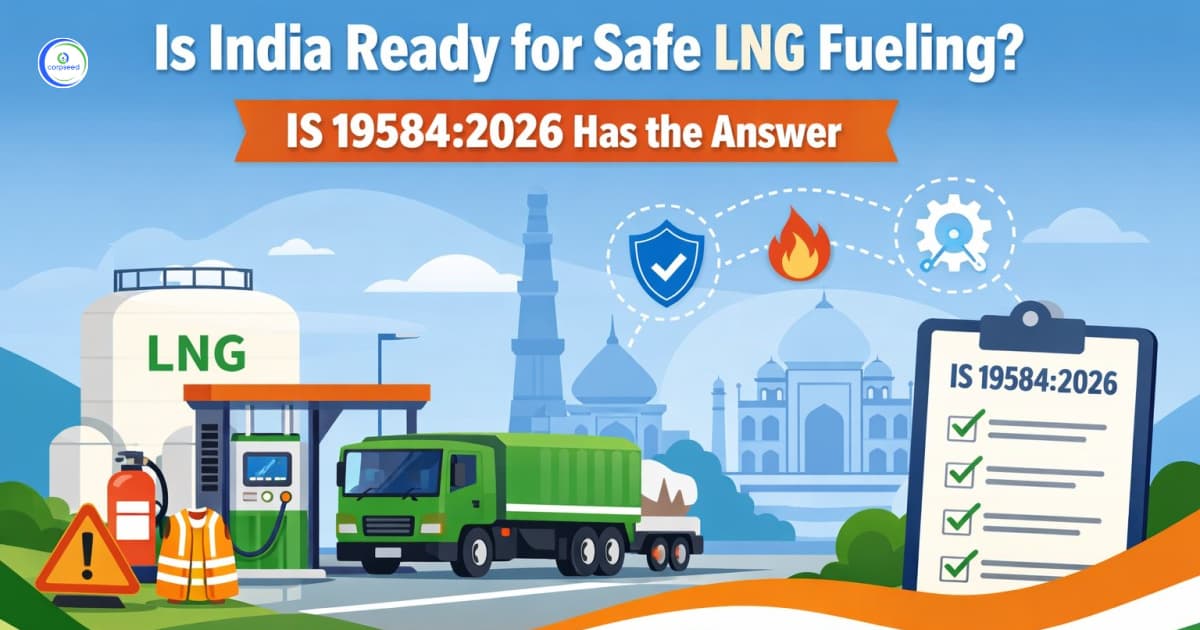
Fuel shapes everything, the air people breathe, the money spent at the pump, and road safety. India is moving away from diesel and petrol, and liquefied natural gas (LNG) is leading the way as a cleaner, smarter choice for heavy-duty transport.
But big questions come with big change. How does a station store fuel that sits at minus 162 degrees Celsius? What rules keep workers and drivers safe? What happens during an emergency? These are not easy questions, and until now, India lacked a single, unified answer.
That answer has arrived. IS 19584:2026, by the Bureau of Indian Standards (BIS), now sets the rules for LNG fueling stations across the country. Built on the international framework of ISO 16924:2016 and adapted for Indian conditions, this standard gives engineers, station owners, safety officers, and regulators a clear playbook to follow.
Schedule a Call Back
What is LNG and Why Does India Need It?
LNG stands for Liquefied Natural Gas. Natural gas becomes LNG when it is cooled to extremely low temperatures, around minus 162 degrees Celsius. At that temperature, gas turns into liquid. Liquid takes up far less space than gas, which makes it much easier to store and transport in large amounts.
Heavy trucks, buses, and long-haul vehicles burn large amounts of fuel every day. LNG fits their needs perfectly because it packs a lot of energy into a compact space. Compared to diesel, LNG burns cleaner. It releases fewer harmful gases into the air, making cities less polluted and roads safer to breathe around.
India has committed to cutting pollution and reducing its dependence on imported oil. LNG offers a practical path toward both goals. As more fleet operators and logistics companies make the switch, the country needs fueling infrastructure that matches international safety levels. IS 19584:2026 builds that foundation.
What Does IS 19584:2026 Cover?
This standard touches every part of an LNG fueling station, from the ground it sits on to the nozzle that delivers fuel to a vehicle. Here is what it addresses:
1. Station Design and Site Layout
A secure LNG facility is not an accident. IS 19584:2026 provides the design requirements of the stations. It defines the distance in which tanks have to be located in relation to roads, buildings, and other dangers. It installs regulations that govern the movement of traffic within the station to ensure that the vehicles flow in a safe manner without causing congestion and risk of collisions. Proper planning makes little issues turn into big tragedies.
2. Storage Tanks
LNG tanks are used to store liquids that are cryogenic and whose temperature is colder than that of the usual materials. The standard provides the requirements for materials, the construction methods, and the insulation needs that tanks should have. It also addresses pressure limits, inspection schedules, and testing procedures. The tanks constructed to such specifications remain safe even in harsh environments.
3. Cryogenic Pumps and Compressors
LNG is transported to the storage tank by pumps to the dispenser. LCNG (LNG-to-CNG) stations employ compressors that transform LNG to compressed natural gas (CNG), which powers vehicles that operate on CNG. IS 19584:2026 stipulates how such machines should be installed, maintained, and monitored in a way that they operate reliably and safely even with time.
4. Vaporizers and Dispensers
When required, LNG is once again warmed into gas through vaporizers. Direct to Vehicles Dispensers, the fuel pumps in an LNG station, make vehicles receive fuel. The standard addresses the technical specifications of both to make sure that there is proper measurement, prevention of leakage, and safe transfer of the same each time a vehicle receives fuel.
5. Piping and Electrical Equipment
Pipes carry LNG between different parts of the station. They must handle extreme cold without cracking or leaking. Electrical systems at these stations must meet strict standards, too, because sparks near natural gas can be dangerous. IS 19584:2026 sets the specifications for piping materials, joints, fittings, and electrical equipment to reduce this risk.
Safety at the Core of IS 19584:2026
Safety is not an afterthought in this standard, it is the foundation. IS 19584:2026 takes a structured approach to risk by addressing several key safety concerns head-on:
- Hazard Identification: The standard requires stations to identify every possible risk before construction begins. Engineers must think through what could go wrong and design systems to prevent it.
- Fire and Explosion Protection: Natural gas is flammable. Fire detection systems, explosion-proof equipment, and fire inhibition measures are some of the standard requirements that are required at all stations.
- Emergency Shutdown (ESD) Systems: In a real emergency, every second counts. IS 19584:2026 mandates automatic and manual emergency shutdown systems that stop fuel flow instantly when danger is detected.
- Overpressure Protection: Pressure relief valves and protective devices prevent tanks and pipes from building up dangerous pressure levels. The standard defines exactly what type of protection each part of the station needs.
- Safety Signage and Training: People need to know where the danger zones are and how to act in an emergency. The standard requires clear safety signs and proper training for all station personnel.
LCNG Stations: A Dual-Fuel Solution
The coverage of LCNG stations is one of the most viable features of the IS 19584:2026. LCNG is an abbreviation of Liquefied Compressed Natural Gas. These stations save fuel in the form of LNG and later convert it into CNG within the station to be used by vehicles that utilize compressed gas. This bi-fuel nature renders the LNG infrastructure more flexible. Only a few LCNG stations will be necessary to supply LNG-powered trucks and CNG-powered cars/buses. As India builds out its natural gas vehicle network, LCNG stations offer a cost-effective way to reach more customers with one facility. IS 19584:2026 sets uniform standards for both types of operations, so station designers do not need to guess which rules apply.
Testing, Commissioning, and Maintenance
Building a safe station is only half the job. Keeping it safe over time takes discipline. IS 19584:2026 includes detailed requirements for:
Testing: All the systems should be tested before the opening of the station. Checks are carried out on tanks, pumps, dispensers, and safety systems.
Commissioning: After testing, the station is formally commissioned with the qualified engineers ensuring that all works properly.
Regular Inspection: The standard establishes the time of regular inspection. Machinery becomes old after a certain period. Frequent audits identify issues at a very early stage before they turn into an emergency.
Maintenance Procedures: Proper maintenance keeps equipment performing at its best. The standard defines what maintenance tasks must happen, how often, and by whom.
Why IS 19584:2026 Matters for India's Future?
India is at a crossroads in transportation. EV is trendy, and, in the case of long-haul freight, which is the foundation of the Indian economy, LNG provides a more direct and viable option. Natural gas is cleaner, also cheaper in the long run, and millions of vehicles globally are already using it.
For this transition to succeed, the country needs infrastructure that people trust. A truck driver pulling into an LNG station needs to know that the equipment is safe. A logistics company investing in LNG trucks needs to know that fueling stations meet a defined standard. A government regulator needs a clear legal framework to enforce safety.
IS 19584:2026 provides all three things. It aligns India with the international standard ISO 16924:2016 while adapting requirements to local conditions, regulations, and climate factors. Such alignment also finds it easier to invest in the LNG infrastructure of India by international companies who are assured that the rules are in line with international standards.
Conclusion
IS 19584:2026 is more than a technical document. It is a statement of intent, a signal that India takes the safety, reliability, and standardization of its LNG fueling infrastructure seriously.
From storage tanks and cryogenic pumps to emergency shutdowns and personnel training, this standard covers every aspect of what it takes to run a safe and effective LNG fueling station. It protects workers, drivers, communities, and the environment. It gives developers a clear blueprint and gives customers confidence that the stations serving them meet the highest possible standards.
With the increasing number of natural gas cars on the road and the rise in the number of LNG fueling stations along Indian highways, IS 19584:2026 is the silent watchdog that will see that the expansion occurs safely. The standard can reside on an official paper, but the effects will be observed on all the roads, on each breath of cleaner air, and on all the safe refuelling stations in the country.
India's LNG future is here. And thanks to IS 19584:2026, that future is built on a solid, safe, and standardized foundation.
About the Author

Mahek Sancheti
Content WriterMahek Sancheti, BAJMC graduate with a deep passion for writing. As a content writer, video content creator, creative content creator, and scriptwriter, I bring stories to life through words and visuals. I honed my skills by working with a prominent news agency, where I excelled in crafting compelling narratives and engaging content. Coming from a journalism and mass communication background I have skills to craft engaging narratives that captivate audiences. With a keen interest in writing and creativity, I aim to deliver impactful and meaningful content that resonates with diverse audiences.
https://www.linkedin.com/in/mahek-sancheti-837196212
Related articles

National Green Hydrogen Mission in India
2026-11-02
CBG Plant Compliance Under GOBARdhan Scheme: Online GC Rules Relaxed Until March 2027
2026-10-28
PNGRB Hydrogen Blending Guidelines 2026: 5% PNG Rules, Safety and Approvals
2026-10-15
India-Japan CBG Initiative Targets 1,000 Biogas Plants and 2.5 Million CNG Vehicles by 2030
2026-07-07

How to Start an E-waste Recycling Business in India?
2026-04-28
Government Initiatives of Compressed Biogas (CBG) Subsidy
2026-04-02